

AI search engine optimization is the practice of structuring, formatting, and proving the trustworthiness of your content so that AI-driven systems like Google AI Overviews, ChatGPT, Perplexity, and Copilot can find it, understand it, and quote it directly in their answers. In other words, it is what happens to SEO once search stops being a list of ten blue links and starts being a single, synthesized response. Because these systems read, summarize, and cite content differently than a classic search index, the rules for winning visibility have quietly changed. This guide covers everything the topic touches — how AI search engines actually work, the real differences from traditional SEO, the exact steps to build a strategy, the tools that automate it, and the mistakes that quietly kill visibility.
Quick answer: AI search engine optimization means writing and structuring content — including schema markup, direct answer blocks, and topical depth — so large language models and AI-powered search tools can accurately extract, trust, and cite it. It combines classic SEO fundamentals with generative engine optimization (GEO) and answer engine optimization (AEO), and it is quickly becoming the deciding factor in whether a brand stays visible as search evolves.
What Is AI Search Engine Optimization, Really?
At its core, AI search engine optimization is the discipline of making digital content machine-readable, factually verifiable, and easy to summarize. Unlike older tactics that leaned almost entirely on keyword density and backlink count, this approach also asks a harder question: would a language model trust this content enough to repeat it?
Consequently, AI search engine optimization sits at the intersection of three closely related disciplines: generative engine optimization (GEO), which focuses on how generative AI tools compose written answers; answer engine optimization (AEO), which focuses on earning the single “best answer” slot; and AI search optimization (AISO), an umbrella term some practitioners use to describe the whole category. In practice, most teams use these terms interchangeably, but understanding the nuance helps when building a strategy.
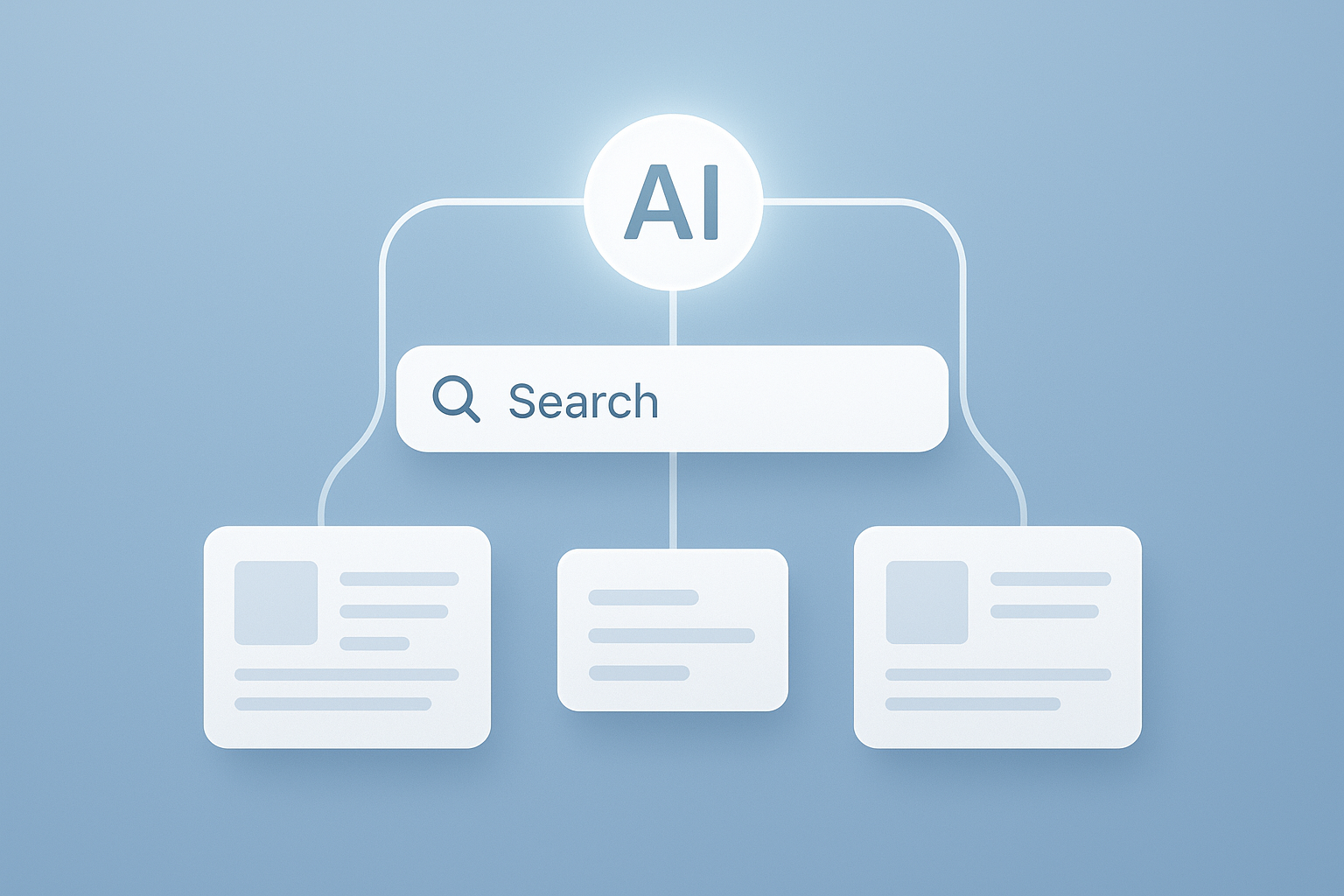
AI search engine optimization connects structured content to the AI systems that generate search answers.
How AI Search Engines Actually Work Under the Hood
Before optimizing for AI search, it helps to understand the mechanics. Most AI-powered search tools rely on a process called retrieval-augmented generation (RAG) — a method where a model retrieves relevant documents from an index, then generates a written answer grounded in that retrieved text. For a deeper technical explanation, the Wikipedia overview of retrieval-augmented generation is a solid starting point.
In practice, this means your page still needs to be crawled and indexed like traditional SEO requires. However, once it is indexed, the AI layer converts your content into numerical representations called embeddings, then compares those embeddings against a user’s query to decide relevance. As a result, content that is clearly labeled, logically organized, and unambiguous in meaning gets retrieved — and cited — far more often than content that buries its point under fluff.
Google itself documents how its systems evaluate and rank content for these AI-driven experiences; reviewing the Google Search Central documentation alongside this guide gives you both the AI-search theory and the platform-specific technical detail.
Meet the Major AI Search Platforms You Need to Optimize For
Each AI search platform sources and formats answers slightly differently. Therefore, a strategy built for one won’t necessarily transfer perfectly to another.
- Google AI Overviews & AI Mode: Pulls heavily from pages that already rank well organically, then layers in structured, extractable summaries above traditional results.
- ChatGPT Search: Blends OpenAI’s model knowledge with live web retrieval, favoring pages with clear, well-labeled facts and recent publish dates.
- Perplexity AI: Builds answers almost entirely from cited sources, making it one of the most citation-friendly platforms for well-structured, authoritative content.
- Microsoft Copilot / Bing Chat: Leans on Bing’s index and rewards schema-rich pages with strong topical authority.
- Gemini: Integrates Google’s knowledge graph and search index, favoring entity-rich, well-linked content clusters.
AI Search Engine Optimization vs. Traditional SEO: What Actually Changes
Traditional SEO centers on ranking a URL within a results page, relying heavily on backlinks, keyword placement, and domain authority. AI search optimization, in contrast, focuses on whether a model chooses to quote or summarize your content at all — regardless of where it technically ranks.
Specifically, generative engine optimization prioritizes clarity, factual accuracy, and structured formatting over keyword density alone. Similarly, answer engine optimization emphasizes providing a direct, extractable answer near the top of a section rather than making the reader scroll to find it.
That said, the two approaches are not mutually exclusive. Above all, strong technical SEO — fast load times, mobile-friendliness, and clean site architecture — remains the foundation that AI search engine optimization builds upon. Skip the foundation, and no amount of schema markup will save the page.
GEO, AEO, and AISO — Untangling the Acronyms
These three terms overlap so much that marketers often use them interchangeably, but each has a slightly different focus:
- Structured data: Schema markup helps AI systems parse facts accurately and reduces the chance of misquotation.
- Direct answers: Concise responses placed early in a section dramatically improve extractability.
- Topical depth: Comprehensive coverage of related subtopics signals authority to both crawlers and language models.
- E-E-A-T signals: Author expertise, first-hand experience, and credible citations build the trust that ranking systems weigh heavily.
For a deeper breakdown of these mechanics, see this guide on answer engine optimization and the future of AI search.
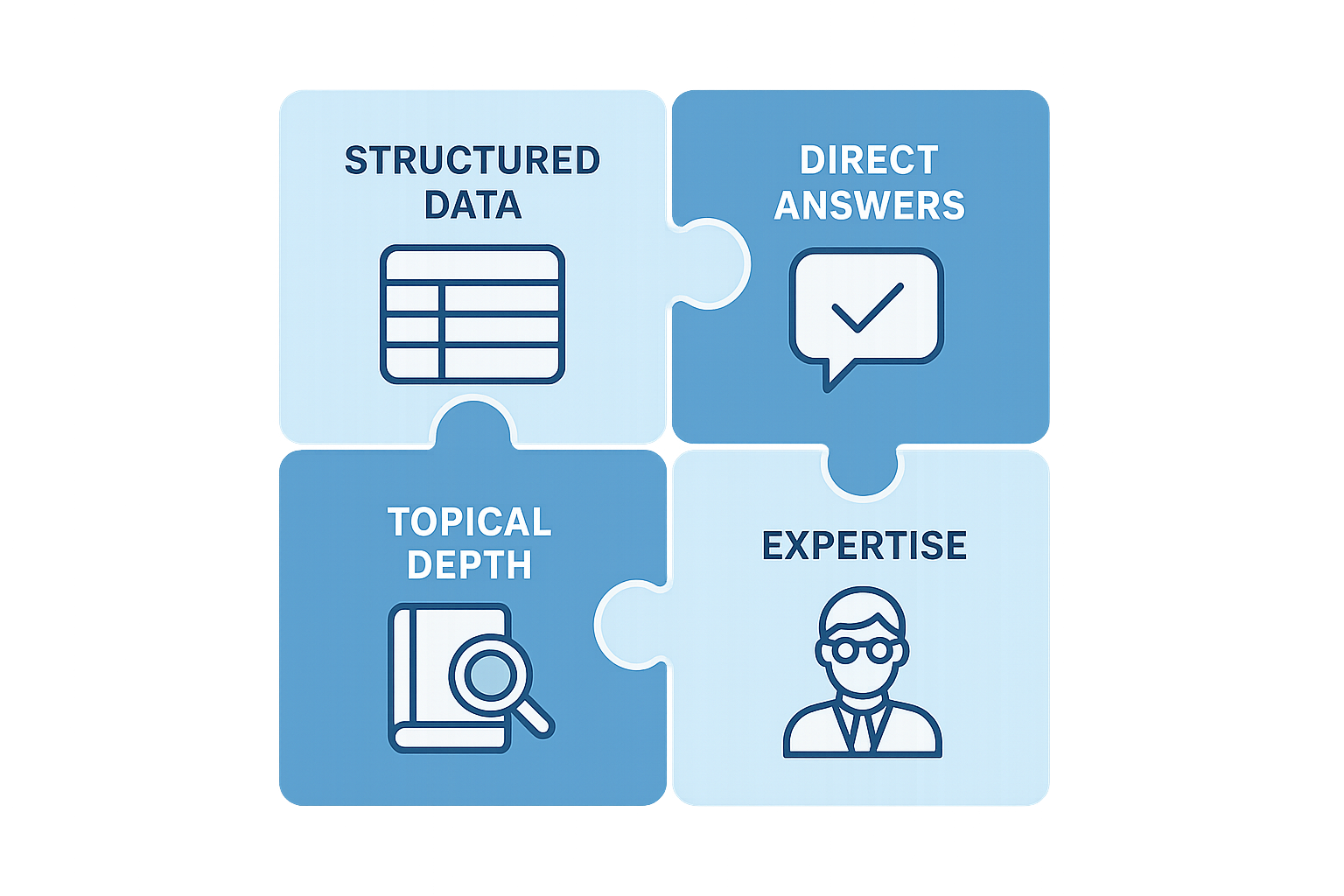
Structured data and direct answers form the foundation of effective AI search optimization.
The Ranking Factors That Matter Most to AI Search Engines
While every platform weighs signals slightly differently, several factors show up consistently across AI-powered search systems.
- Experience: First-hand, demonstrable experience with the topic — not just recycled facts — builds the trust language models look for.
- Expertise: Author credentials, bylines, and topic-specific depth signal that the content came from someone qualified to write it.
- Authoritativeness: Being cited by other credible sources tells AI systems your content is a reliable reference point.
- Trustworthiness: Accurate, up-to-date, and transparent content — including clear sourcing — reduces the risk an AI model takes when quoting you.
- Answer-first structure: Placing the core answer within the first two or three sentences of a section dramatically increases extraction odds.
- Structured data: Schema markup gives AI crawlers explicit context clues instead of forcing them to infer meaning.
- Freshness: Recently updated content is favored, particularly for fast-moving topics like AI itself.
- Entity consistency: Using the same terminology, names, and definitions consistently helps models map your content to known concepts.
Step-by-Step: Building an AI Search Engine Optimization Strategy
Building a working strategy does not require rebuilding your site from scratch. Instead, follow this sequence to layer AI-focused improvements onto your existing SEO foundation.
- Audit existing content. Identify pages that already answer common questions clearly, and flag ones that bury the answer too deep or lack structure entirely.
- Add structured data. Implement FAQPage, HowTo, and Article schema so AI systems can parse your facts correctly and reduce the risk of misquotation.
- Write direct answer blocks. Place a short, two to three sentence answer near the top of each key section so it can be lifted cleanly into an AI-generated summary.
- Build topical authority. Publish interlinked content that covers related subtopics in depth, forming a cluster that signals genuine expertise rather than a single thin page.
- Strengthen E-E-A-T signals. Add visible author bios, credentials, and original data or examples so AI systems have clear evidence of experience and trustworthiness.
- Monitor AI citation performance. Track how often your content shows up in AI Overviews, chatbot answers, and Perplexity citations, then refine underperforming sections.
For more detailed tactics and tool comparisons, this resource on AI search engine optimization strategies, tools, and ROI is worth reviewing.
Structured Data and Schema Markup Essentials
Structured data, defined in detail at Schema.org, gives AI crawlers a labeled map of your content instead of forcing them to guess at meaning. In particular, Article, FAQPage, HowTo, and Organization schema types are the most valuable for AI search engine optimization because they map directly to the question-and-answer format most AI tools generate.
Writing Content AI Models Actually Want to Cite
In practice, the highest-cited pages share a pattern: they open each section with a plain-language answer, follow with supporting evidence or a statistic, and cite where that evidence came from. Short paragraphs, descriptive subheadings, and bulleted summaries all make it easier for a model to lift a clean, accurate excerpt.
Tools and Automation for GEO and AEO
Manually implementing every schema type and answer block across a large site can be time-consuming. Therefore, many businesses now rely on automated platforms to handle the technical heavy lifting.
For example, tools that combine automated schema generation with AI-driven content audits can significantly cut implementation time. Rankauthority.com’s own 1-Click AI AutoPilot technology is built for exactly this use case, streamlining GEO and AEO work for small businesses, agencies, and marketers managing multiple sites. You can explore how it works directly at rankauthority.com.
Additionally, learn more about the broader AI search optimization (AISO) category and how it fits into modern SEO strategy in this overview of AISO.
Choosing the Right Platform for AI Search Optimization
Not every business has the time or expertise to manually manage schema, content audits, and citation tracking. As a result, many turn to automated GEO and AEO platforms that handle this work continuously.
Rankauthority.com, for instance, offers a risk-free seven-day trial for businesses testing automated optimization before committing. This approach suits small business owners, digital marketers, and agencies overseeing multiple client sites who need scalable results without a steep learning curve. If privacy-focused search is also part of your strategy, this comparison of AI-free search engines and how they work offers useful additional context.
How to Measure AI Search Visibility and ROI
Unlike traditional rankings, AI citation performance does not always show up in classic rank trackers. Instead, look for these signals:
- Citation frequency: How often your brand or page appears as a cited source in AI Overviews, Perplexity, or Copilot answers.
- AI referral traffic: Segment analytics by referrer to isolate visits arriving from chatgpt.com, perplexity.ai, and similar domains.
- Share of voice: Run the same query repeatedly across platforms to see how consistently your content appears versus competitors.
- Brand mention volume: Track how often your brand name appears in AI-generated answers, even without a direct link.
Common Mistakes That Hurt AI Search Visibility
Even well-intentioned optimization efforts can fall flat due to a few recurring mistakes. First, vague or unstructured content makes it hard for AI models to extract a clean answer.
Second, skipping schema markup leaves valuable context on the table. Likewise, burying the answer deep within a page rather than stating it upfront reduces the odds of being cited.
Finally, neglecting author expertise signals — such as credentials or citations — weakens the trust scores answer engines use when selecting sources. Other frequent errors include ignoring conversational, long-tail phrasing that mirrors how people actually talk to chatbots, and leaving pages orphaned without internal links that reinforce topical authority. To avoid these pitfalls, review practical fixes in this guide on improving search performance using AI.
Can Small Businesses Really Compete at AI Search Engine Optimization?
Yes — and often more easily than in traditional SEO. Because AI answer engines prioritize clarity and specificity over sheer domain size, a well-structured, niche-focused page can outrank a generic page from a much larger competitor. For example, consider a local service business that publishes a tightly focused, schema-rich FAQ page answering the exact questions its customers ask; that page can outperform a national brand’s thin, generic version of the same topic simply because it is easier for an AI model to extract a confident answer from it.
The Future of AI Search Engine Optimization
Looking ahead, search is moving toward multimodal and agentic experiences, where AI systems don’t just answer questions but complete tasks on a user’s behalf — booking, comparing, and purchasing directly from cited sources. As a result, AI search engine optimization will increasingly reward structured, transactional clarity in addition to informational depth. In particular, brands that treat their content as a machine-readable knowledge base, rather than a marketing brochure, will be best positioned as this shift accelerates.
Frequently Asked Questions About AI Search Engine Optimization
What is AI search engine optimization?
AI search engine optimization is the practice of optimizing content so it gets surfaced, cited, or summarized by AI-powered search tools like Google AI Overviews, ChatGPT, and Perplexity. It combines traditional SEO fundamentals with structured data and clear answer formatting.
How is AI search engine optimization different from traditional SEO?
Traditional SEO focuses on ranking a URL among a list of links, while AI search engine optimization focuses on getting content quoted inside an AI-generated answer. Both rely on relevance and authority, but AI optimization emphasizes structure and directness above all.
Why does AI search engine optimization matter in 2025?
It matters because a growing share of searches now end with an AI-generated summary instead of a list of links. Businesses that skip this optimization risk losing visibility even with strong classic rankings.
What are GEO, AEO, and AISO?
GEO, or generative engine optimization, refers to optimizing content for generative AI tools that produce written answers. AEO, or answer engine optimization, focuses on getting content selected as a direct answer, while AISO is the broader umbrella term covering both.
How do AI search engines like ChatGPT and Perplexity actually find content?
Most rely on retrieval-augmented generation, pulling relevant pages from an index, then generating a summary grounded in that retrieved text. Clear structure and unambiguous language make retrieval far more reliable.
What role does structured data play in AI search engine optimization?
Structured data, such as JSON-LD schema, helps AI systems understand the exact meaning and context of a page’s content. This makes it easier for answer engines to extract accurate facts and steps.
How long does it take to see results?
Most sites see measurable movement in AI citation frequency within four to eight weeks after implementing structured content and schema changes. Full authority-building typically takes three to six months.
Does AI search engine optimization replace traditional SEO?
No, it builds on top of traditional SEO rather than replacing it. Strong technical SEO, quality backlinks, and site speed remain essential foundations.
What common mistakes hurt AI search performance?
Common mistakes include vague, unstructured content, skipping schema markup, and failing to answer questions directly within the first few sentences. Ignoring E-E-A-T signals also weakens AI visibility.
Can small businesses compete with large brands?
Yes, because AI answer engines prioritize clarity and specificity over sheer domain size. A well-structured, niche-focused page can outrank a generic page from a larger competitor.
What tools help automate AI search engine optimization?
Automated platforms can analyze content gaps, generate schema markup, and monitor AI citation performance without requiring deep technical expertise. These tools significantly reduce manual workload.
How do I measure the ROI of AI search engine optimization?
Track how often content is cited or summarized within AI Overviews, chatbot responses, and answer boxes, and segment analytics referrer data for AI platform traffic. Rising brand mention volume is another useful signal.
How much does AI search engine optimization typically cost?
Costs vary widely, ranging from a few hundred dollars a month for automated platforms to several thousand for full-service agency work. Automated tools generally offer the most cost-effective entry point.
Final Thoughts: Winning at AI Search Engine Optimization Starts Today
In summary, AI search engine optimization is no longer optional for businesses that want to stay visible as search evolves. By combining structured data, direct answers, strong E-E-A-T signals, and genuine topical authority, brands of any size can improve their odds of being cited by AI-powered search tools.
Ultimately, the businesses that adapt early — whether through manual effort or automated platforms like rankauthority.com — will be best positioned as AI search continues to reshape how people discover information online. The sooner you treat AI search engine optimization as core strategy rather than an afterthought, the sooner you start showing up in the answers that matter.

