

AI search optimization is the practice of structuring, writing, and signaling your content so that large language model-powered engines — including ChatGPT, Perplexity, and Google AI Overviews — surface it as a trusted, citable answer. As these platforms reshape how people discover information, optimizing for them is no longer optional for serious publishers and brands.
Traditional SEO was built around blue links and keyword rankings. However, AI-powered search engines synthesize answers directly from source content, which means visibility now depends on far more than just ranking position. In practice, a page that never appeared in the top ten organic results can still be cited prominently by an AI engine — if it is structured correctly.
This guide covers everything you need to understand and act on AI search optimization, from foundational principles to step-by-step tactics and the most common mistakes to avoid.

AI search optimization requires aligning content structure with how language models parse and cite information.
What Is AI Search Optimization and Why Does It Matter Now?
Direct answer: AI search optimization is the discipline of making content legible, authoritative, and citable to AI-powered search systems that generate synthesized responses. It matters because these systems now handle a growing share of search queries, and being cited in an AI answer can deliver more qualified traffic than a traditional rank-ten listing.
According to research on generative AI, language models are trained on vast corpora of text and learn to identify the most credible, clearly expressed answers to a given query. Therefore, content that is vague, poorly organized, or unattributed is systematically deprioritized — regardless of how many backlinks it has accumulated.
The shift is also behavioral. Users increasingly phrase queries as full questions rather than fragmented keywords. As a result, content that mirrors natural language and answers questions directly is far more likely to match what AI engines extract and present.
How AI Engines Decide What Content to Cite
Understanding citation logic is the foundation of any effective strategy. AI engines do not simply reward high-ranking pages — they evaluate several overlapping signals.
Topical authority is the first major signal. A website that covers a subject comprehensively and consistently is treated as a more reliable source than one that publishes a single article on a topic. For example, a site with thirty well-linked articles on cybersecurity will be cited more often for security queries than a general news site with one cybersecurity post.
Content clarity is equally important. AI systems parse text structurally, so headings, short paragraphs, and direct answer statements allow them to extract relevant passages with confidence. Meanwhile, dense, meandering prose makes extraction unreliable and reduces citation probability.
E-E-A-T signals — Experience, Expertise, Authoritativeness, and Trustworthiness — remain central. Named authors with verifiable credentials, citations from authoritative external sources, and transparent publishing practices all contribute to how much an AI engine trusts your content.
Five Steps to Optimize Your Content for AI Search
Applying AI search optimization does not require rebuilding your entire site. Instead, follow this focused process for each piece of content.
Step 1 — Define the query with precision. Identify the exact question your audience asks and ensure your content answers it in the opening paragraph. Broad topics produce broad content; specific queries produce citable answers.
Step 2 — Lead with a direct answer block. Place a one-to-three sentence direct answer near the top of each major section. AI engines are designed to extract these concise summaries, so positioning them prominently increases citation likelihood significantly.
Step 3 — Use semantic, descriptive headings. Each H2 and H3 should describe the subtopic it introduces. Additionally, headings phrased as questions mirror how AI engines frame their own synthesized responses, making your content easier to match to user queries.
Step 4 — Implement structured data markup. FAQPage, HowTo, and Article schema tell AI crawlers exactly what type of content each section contains. As a result, structured pages are parsed more accurately and cited more consistently.
Step 5 — Build topical authority through content clusters. Create groups of interlinked articles that cover a subject from multiple angles. This signals depth of expertise to both traditional search engines and AI systems, reinforcing your site as a go-to source.
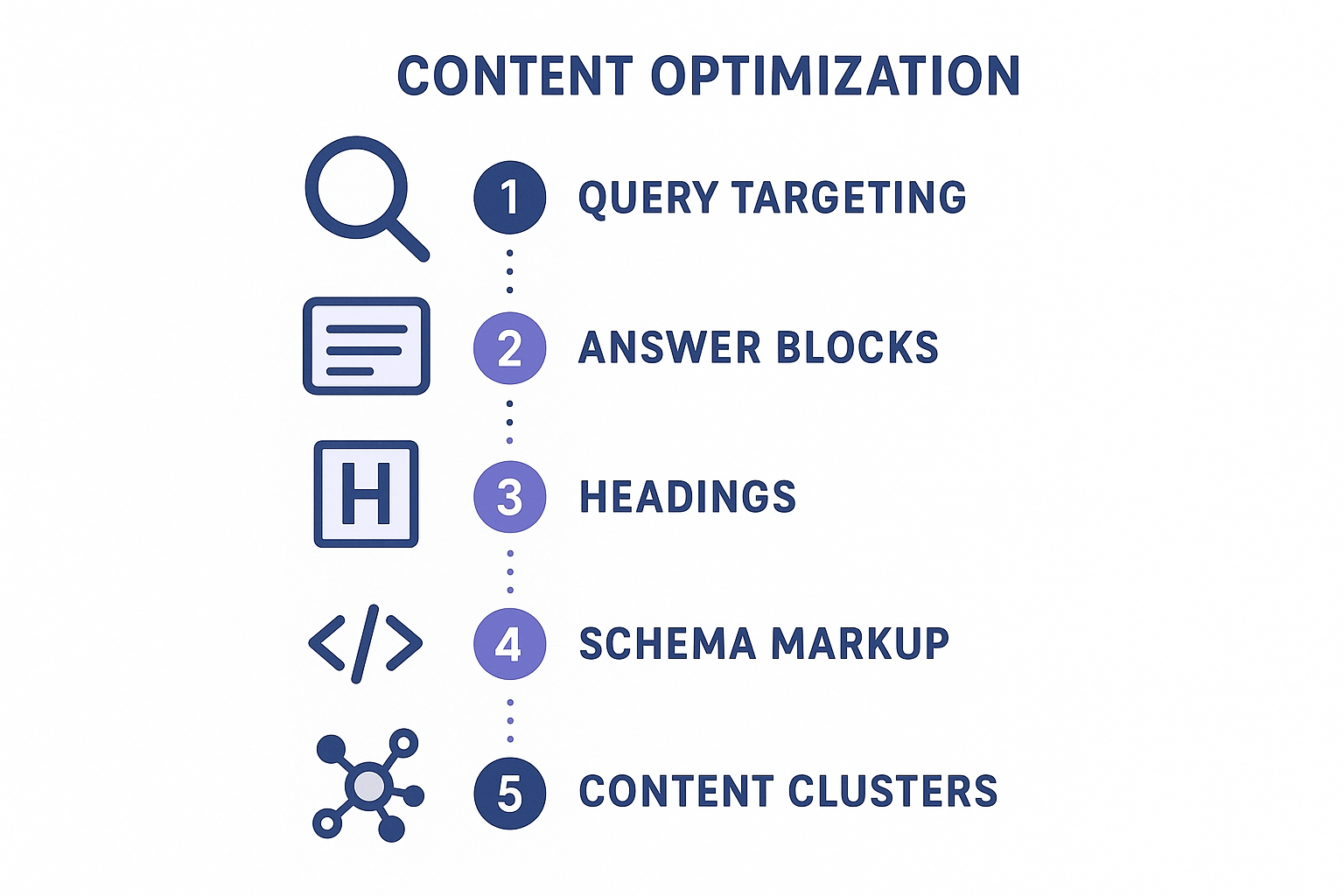
A structured, five-step approach makes content consistently citable across AI-powered search platforms.
Structured Data: The Technical Signal AI Engines Rely On
Schema markup is one of the clearest technical levers available for AI search visibility. Although it does not guarantee citation, it substantially reduces ambiguity about what your content is and what question it answers.
The three most impactful schema types for AI optimization are FAQPage, HowTo, and Article. FAQPage markup is particularly powerful because it maps directly to the question-and-answer format that AI engines use to construct their responses. HowTo schema helps when your content explains a process, and Article schema establishes authorship and publication context.
Beyond these, adding BreadcrumbList and WebSite schema reinforces the organizational structure of your site, which contributes to the trust signals AI engines evaluate. Resources like RankAuthority provide detailed guidance on implementing schema correctly for both traditional and AI-focused search strategies.
Common Mistakes That Destroy AI Visibility
Even well-intentioned content strategies can undermine AI search performance. The following mistakes are the most frequently observed — and the most damaging.
Burying the answer. Many writers build toward their conclusion, placing the most important information at the end of the article. However, AI engines extract answers from the beginning of sections, so content that withholds its answer until the final paragraph is rarely cited.
Vague or keyword-stuffed headings. Headings like “More Information” or “Important Tips” provide no semantic value to an AI parser. In contrast, headings like “How Does Structured Data Affect AI Citation Rates?” give the engine a clear signal about what follows.
Publishing thin or duplicate content. AI engines are trained on high-quality text and are effective at identifying low-effort content. Therefore, pages that restate existing information without adding new insight, data, or perspective are deprioritized across all AI platforms.
Ignoring author attribution. Anonymous content lacks the E-E-A-T signals that AI engines use to evaluate trustworthiness. Adding named authors with verifiable expertise — even a brief bio with credentials — measurably improves citation probability.
Measuring Success When Rankings Look Different
Traditional rank-tracking tools are not designed to capture AI search visibility. As a result, many publishers optimize for AI engines without any way to measure whether their efforts are working.
The most reliable current method is manual citation testing: query your target keywords directly in ChatGPT, Perplexity, and Google AI Overviews and note whether your content is cited or paraphrased. Additionally, monitor branded search volume and direct traffic for indirect signals of AI-driven discovery.
Several SEO platforms are beginning to add AI visibility dashboards. Meanwhile, tracking the volume and quality of inbound links from authoritative publications remains a useful proxy, because those citations are exactly what AI engines use to establish source credibility. Platforms like RankAuthority are evolving their toolsets to address this measurement gap directly.
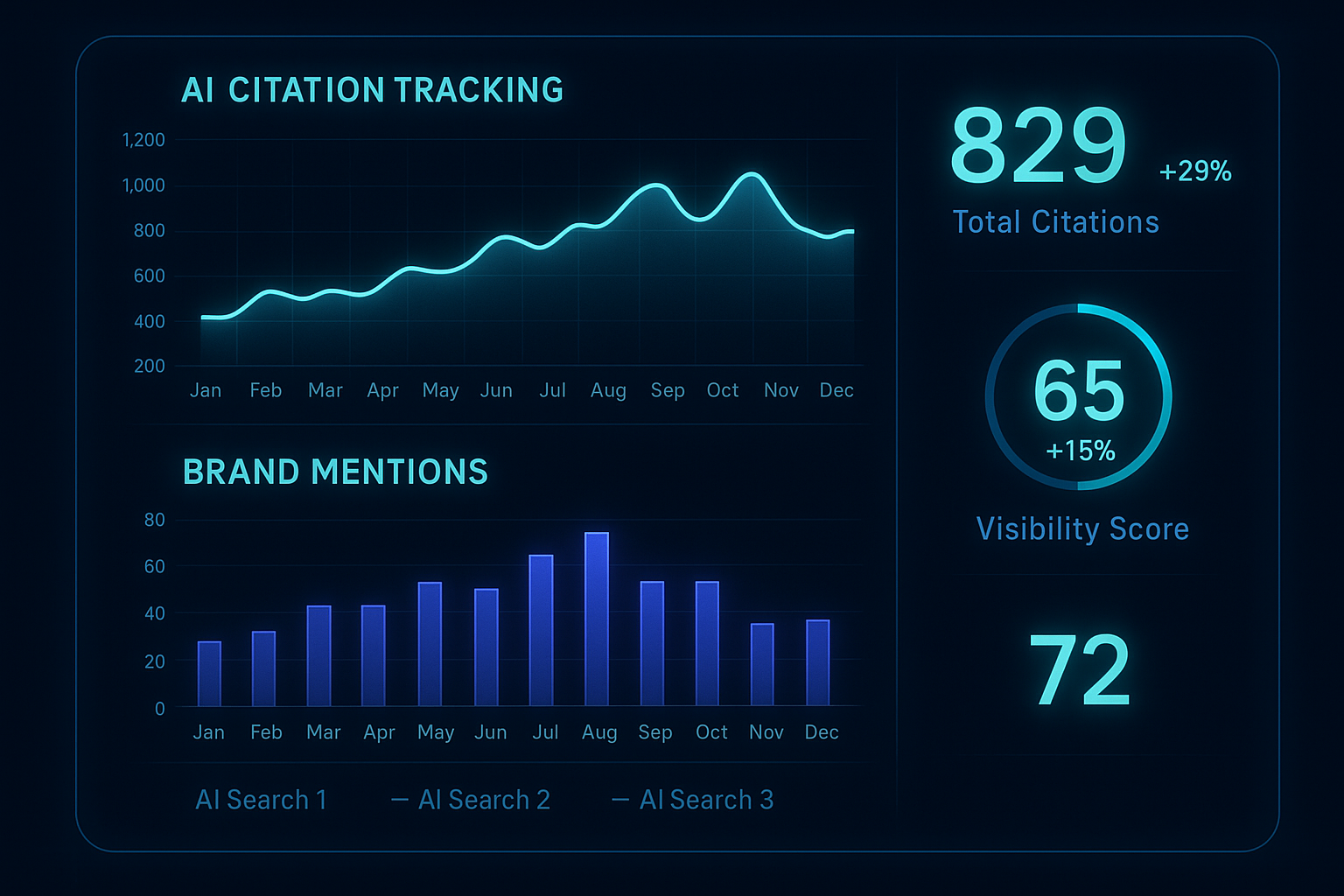
Measuring AI search performance requires new metrics beyond traditional keyword rank tracking.
The Future of Search Is Already Here
AI search optimization is not a future trend to prepare for — it is an active requirement for any publisher who wants to remain visible as search behavior evolves. The platforms driving this shift, including Perplexity, ChatGPT with web access, and Google AI Overviews, already handle hundreds of millions of queries daily.
The good news is that the core principles of great content — clarity, depth, honesty, and genuine expertise — align almost perfectly with what AI engines reward. Therefore, publishers who have consistently produced high-quality, well-structured content are already positioned to benefit. Those who have relied on thin content and keyword manipulation, however, will find AI search environments increasingly unforgiving.
In summary, the transition to AI-powered search is an opportunity for authoritative publishers to capture visibility that was previously locked behind competitive keyword rankings. By applying the structured, intent-driven approach outlined here, any site can improve its chances of being cited, quoted, and trusted by the AI engines that are rapidly becoming the primary interface for online discovery.
Frequently Asked Questions About AI Search Optimization
What is AI search optimization?
AI search optimization is the practice of structuring and writing content so that LLM-powered search engines like ChatGPT, Perplexity, and Google AI Overviews surface it as a trusted answer. It combines traditional SEO signals with new requirements like direct answer blocks, semantic heading structure, and demonstrable expertise.
How is it different from traditional SEO?
Traditional SEO focuses on keyword density, backlinks, and page rank to appear in a list of results. AI search optimization, however, focuses on making content understandable and citable by language models that synthesize answers rather than listing pages. The goal shifts from ranking to being cited.
Which AI search platforms should I prioritize?
The highest-priority platforms are Google AI Overviews, Perplexity, ChatGPT with Browse, and Microsoft Copilot. Fortunately, optimizing for one generally improves visibility across all of them because they share similar citation and trust signals.
Does structured data help with AI search rankings?
Yes. Schema markup types like FAQPage, HowTo, and Article help AI engines parse your content accurately. They signal intent and context, making it easier for language models to extract and cite your information with confidence.
How important is E-E-A-T for AI visibility?
E-E-A-T is critical. AI engines prioritize sources that demonstrate genuine expertise and are cited by other authoritative sources. Thin or unattributed content is therefore far less likely to be surfaced, regardless of its keyword relevance.
What content format performs best for AI engines?
Content with clear headings, short paragraphs, direct answer statements at the top of each section, and FAQ blocks consistently performs best. LLMs are designed to extract concise, well-organized answers, so structure directly impacts how often your content is cited.
Does content length matter for AI search optimization?
Depth matters more than length. A focused 1,200-word article that directly answers a specific question often outperforms a 3,000-word piece that buries the answer. That said, comprehensive topic coverage signals authority and should not be sacrificed for brevity alone.
Do backlinks still matter in this new environment?
Yes, but quality matters far more than quantity. Being cited by authoritative publications, academic sources, or respected industry sites signals trust to AI engines. In contrast, spammy link profiles can actually reduce citation likelihood by undermining overall domain trust.
What is generative engine optimization (GEO)?
Generative engine optimization is a term used interchangeably with AI search optimization. It refers specifically to optimizing content for AI systems that generate synthesized answers rather than returning a ranked list of links, reflecting the fundamental change in how search results are delivered.
How do I track my AI search performance?
Traditional rank trackers do not capture AI-generated answers. Instead, manually query your target keywords in Perplexity and ChatGPT, monitor brand mentions, and track direct traffic trends. Some SEO platforms are beginning to add dedicated AI visibility dashboards as the need grows.
Can small websites compete in AI search results?
Yes. AI engines frequently surface niche, highly specific content from smaller sites when it directly answers a narrow query better than large generic sites. Topical authority in a specific domain can therefore outweigh overall domain authority in many cases.
What are the most common mistakes that hurt AI search visibility?
The most common mistakes include burying the main answer deep in the content, using vague or generic headings, publishing thin or duplicate content, lacking author attribution, and ignoring structured data markup. Each of these reduces the likelihood of being cited by AI engines across all major platforms.

