

Complete Guide · Updated 2025 · By Rank Authority Editorial Team · By Rank Authority (add author bio and credentials below)
App Enabler: What It Is, How It Works, and Why It Matters in 2025
Understanding the role of an app enabler guide is now essential for every developer, startup founder, and enterprise architect navigating the modern software landscape. The infrastructure choices you make at the foundation will define how fast — and how far — your product can grow.
Direct Answer
An app enabler overview is a platform, toolset, or service layer that provides the core building blocks — APIs, SDKs, authentication, data services, and cloud infrastructure — that allow developers and organizations to build, deploy, and scale applications efficiently. Rather than replacing applications, an app enabler powers them from underneath, dramatically accelerating development and reducing infrastructure complexity.
What Is an App Enabler resources?
An app enabler is a platform, tool, or integrated set of services that gives developers and businesses the foundational capabilities they need to build functional, scalable, and secure applications — without engineering every component from scratch. Specifically, it is the scaffolding behind the visible product: invisible to end users, but entirely responsible for the application’s speed, reliability, and reach.
The concept has roots in the broader Platform as a Service (PaaS) model, where third-party providers abstract infrastructure complexity so that development teams can focus on writing business logic. However, app enablement has since expanded well beyond PaaS. Today it encompasses API gateways, identity providers, data streaming services, AI model APIs, communication SDKs, payment processors, and much more.
Crucially, an app enabler is not the application itself — it is the layer that makes the application possible. This distinction matters enormously when evaluating technology strategy, vendor relationships, and long-term scalability. Furthermore, it shapes how engineering teams are structured, how budgets are allocated, and how quickly an organisation can respond to competitive pressure.

A visual representation of how an app enabler acts as the foundational layer beneath modern application stacks.
How Does an App Enabler Work?
At a technical level, an app enabler operates by exposing well-documented interfaces — most commonly REST or GraphQL APIs — through which developers request services, retrieve data, trigger actions, or integrate capabilities into their own products. The enabler handles the complexity of execution behind the scenes: server provisioning, load balancing, data encryption, compliance logging, and uptime guarantees.
For example, consider a fintech startup building a payment application. Instead of obtaining banking licenses, building fraud detection models, and managing card network integrations independently, the team integrates with a payment app enabler. That single integration unlocks card processing, currency conversion, dispute management, and regulatory compliance — capabilities that would otherwise require years and millions of dollars to develop in-house. See our App Enabler guide for implementation notes.
Similarly, a healthcare application can plug into a HIPAA-compliant data storage enabler and immediately satisfy data residency requirements, rather than building compliant infrastructure independently. As a result, the development team can redirect months of engineering effort toward features that directly benefit patients and clinicians.
The App Enabler Integration Lifecycle
Understanding how integration actually works in practice helps teams plan adoption more effectively. Therefore, here is a typical integration lifecycle for integrating an app enabler into a new product:
- Discovery and evaluation — Review API documentation, test sandbox environments, and assess SLA commitments before committing to a provider.
- Authentication setup — Obtain API keys or OAuth credentials and configure secure token storage within your application environment.
- SDK or API integration — Write integration code, typically behind an internal service abstraction layer to preserve flexibility.
- Testing and validation — Run end-to-end tests in staging against the enabler’s sandbox, covering edge cases, rate limits, and failure scenarios.
- Production deployment — Go live with monitoring, alerting, and logging configured to track the enabler’s response times and error rates in real time.
- Ongoing review — Establish a regular cadence for reviewing release notes, deprecation notices, and pricing changes from the provider.
Without an App Enabler
- Build every service from scratch
- Manage own infrastructure
- Handle security and compliance in-house
- Slower time-to-market
- Higher ongoing maintenance cost
- Larger engineering team required
- Greater exposure to unknown security risks
With an App Enabler
- Plug into ready-made, proven services
- Scalable cloud infrastructure included
- Built-in compliance and security certifications
- Rapid deployment cycles
- Predictable, usage-based pricing
- Lean team can ship more, faster
- Access to world-class engineering at API level
Types of App Enabler Services You Should Know
The category of app enablement is broad, covering several distinct service types. Understanding which type fits your project is, therefore, the first step toward making a sound architectural decision. In addition, many modern platforms combine multiple enablement types into a single offering — so it pays to map your requirements before evaluating vendors.
1. Backend-as-a-Service (BaaS) Platforms
BaaS platforms provide pre-built server-side functionality including databases, user authentication, file storage, real-time syncing, and push notifications. Developers connect their front-end applications to these services through simple API calls, eliminating the need to manage backend servers. Examples include Firebase, Supabase, and AWS Amplify. Consequently, mobile and web teams can ship production-grade products with a fraction of the back-end engineering investment traditionally required. For a deeper walkthrough, see our Hidden Content on Mobile Devices.
2. API Gateways and Integration Platforms
These enablers act as a managed entry point for all API traffic, providing routing, rate limiting, authentication enforcement, caching, and analytics. They are especially valuable in microservices architectures where dozens of internal services must communicate reliably. Furthermore, API gateways allow organisations to enforce security policies centrally, rather than duplicating logic across every individual service.
3. Identity and Authentication Providers
Handling user login, multi-factor authentication (MFA — requiring users to verify identity through two or more methods), and access control is a significant engineering challenge. Identity-focused app enablers abstract this complexity, offering standards-compliant OAuth 2.0 and OpenID Connect flows out of the box. Providers such as Auth0, Okta, and Clerk have made enterprise-grade identity accessible to teams of every size. As a result, even early-stage startups can implement security practices that were previously available only to large enterprises.
4. Communication and Messaging APIs
SMS, email, voice, and video capabilities are frequently required across applications. Communication API providers function as app enablers by abstracting telecom infrastructure, allowing developers to add real-time messaging in hours rather than months. Twilio, SendGrid, and Vonage are well-known examples. In contrast to building carrier integrations in-house, these platforms handle global delivery, compliance, and failover automatically.
5. AI and Machine Learning APIs
One of the fastest-growing enablement categories in 2025, AI API providers allow any application to integrate natural language processing (NLP — enabling computers to understand and generate human language), image recognition, recommendation engines, and generative AI without building or training models internally. OpenAI, Google Vertex AI, and Anthropic all offer API-based access to powerful models. Specifically, this has lowered the barrier to AI-powered features so dramatically that even solo developers can ship intelligent applications. See our AI content platform guide for implementation examples and costs.
6. Payment Processing and Fintech APIs
Payment enablers such as Stripe, Adyen, and Braintree provide card processing, subscription billing, fraud detection, and global currency support through clean API interfaces. Moreover, many now offer embedded finance capabilities — allowing non-financial applications to offer banking, lending, or insurance features without obtaining their own licenses.
7. Cloud Infrastructure and DevOps Enablers
Infrastructure platforms such as AWS, Google Cloud, and Azure are arguably the most foundational app enablers in existence. Above them, managed Kubernetes services, serverless platforms (like AWS Lambda and Vercel), and CI/CD pipeline tools act as further enablers, automating deployment, scaling, and monitoring. Together, these platforms allow small teams to operate infrastructure that scales to millions of users.
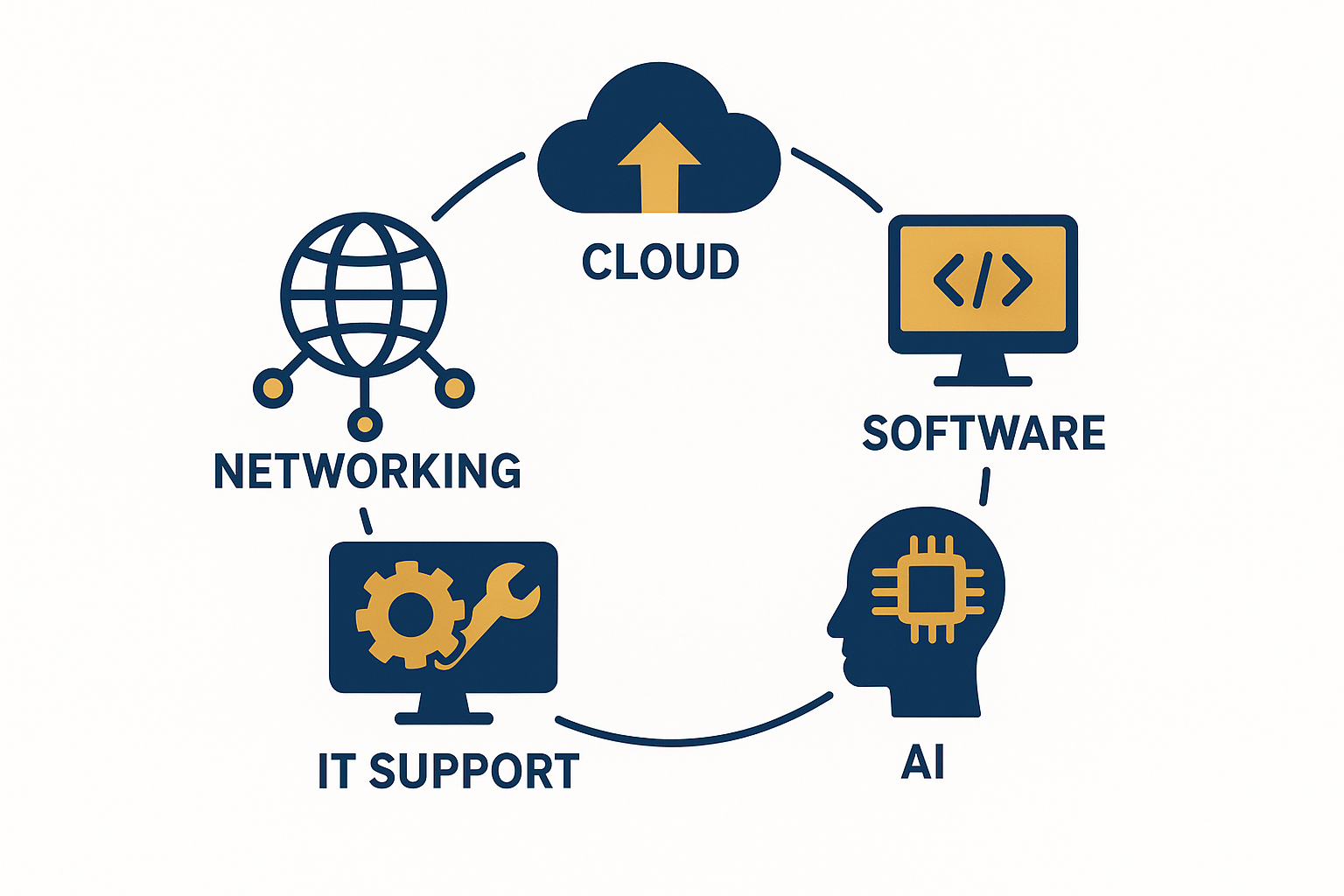
The seven primary categories of app enabler services powering modern application development in 2025.
App Enabler vs. Traditional Software Platforms: Key Differences
A common source of confusion is the difference between an app enabler and a conventional software platform. In short, a regular software platform delivers a finished product directly to end users — for example, a project management tool or a CRM. An app enabler, by contrast, specifically provides the building blocks that power other applications.
However, the boundary is not always sharp. Some platforms serve both roles simultaneously. Salesforce, for instance, delivers a CRM product to end users while also functioning as an app enablement platform through its API ecosystem and AppExchange marketplace. Similarly, Shopify serves merchants directly but also enables an entire ecosystem of app developers through its APIs and Partner Program.
Quick Comparison — see our deeper analysis in the App enablement guide for vendor trade-offs and cost modelling.
| Dimension | App Enabler | Traditional Software Platform |
|---|---|---|
| Primary user | Developers / engineering teams | End users / business users |
| Output | APIs, SDKs, services | Finished product UI |
| Integration depth | Deep — embedded in product stack | Surface — used as standalone tool |
| Value delivery | Delivers value directly |
Why Choosing the Right App Enabler Is a Strategic Business Decision
Selecting the right app enabler is not merely a technical choice — it is a business strategy decision with long-term implications for cost structure, competitive agility, and vendor risk. Organisations that choose enablement platforms thoughtfully can ship products faster, respond to market changes with less friction, and maintain leaner engineering teams.
Conversely, organisations that make poor enablement choices often find themselves locked into expensive contracts, constrained by platform limitations, or exposed to security vulnerabilities they did not anticipate. Therefore, thorough evaluation — including reviewing documentation quality, SLA commitments, compliance certifications, and developer community health — is non-negotiable before committing.
The True Cost of App Enablement
Many teams focus exclusively on the monthly API cost when evaluating an app enabler. However, the total cost of enablement is substantially broader. In addition to direct fees, consider:
- Integration engineering time — The upfront developer hours required to integrate, test, and document the enabler within your stack.
- Dependency maintenance — Ongoing effort to track deprecations, update SDKs, and respond to breaking changes.
- Switching costs — The complexity and time required to migrate away from the enabler if the provider relationship deteriorates.
- Compliance overhead — The work required to validate that the enabler meets your specific regulatory obligations, particularly in healthcare, finance, or government sectors.
- Scaling penalties — Many enablers use usage-based pricing that becomes expensive at scale. Model your costs at 10x current volume before committing.
Strategic Tip:
When evaluating any app enabler, treat the vendor’s API documentation as a proxy for their engineering culture. Thorough, well-maintained documentation signals a team that values developer experience — and is far more likely to deliver reliable, long-term support. Sparse changelogs, unresolved GitHub issues, and slow support response times are all early warning signals worth heeding before you commit to deep integration.
Key Evaluation Criteria for Any App Enabler
Specifically, here is what to assess when comparing app enabler options side by side: For a deeper walkthrough, see our What Strategies Yield the Best Results in SEO Today?.
- API reliability and uptime SLAs — Look for 99.9% or higher, with transparent incident history and status pages.
- Documentation quality — Comprehensive reference docs, quickstart guides, working code samples, and an active changelog.
- Security and compliance certifications — SOC 2 Type II, ISO 27001, GDPR alignment, and sector-specific standards where relevant.
- Pricing transparency — Clear pricing pages, predictable tier structures, and no surprise overage charges.
- Scalability under load — Evidence that the platform has handled traffic spikes comparable to your growth projections.
- Developer community health — Active forums, third-party tutorials, Stack Overflow presence, and responsive support channels.
- Data portability — The ability to export your data in open formats if you choose to migrate away.
- Geographic availability — Data centres in the regions your users are located, particularly important for latency and data sovereignty requirements.
Managing Vendor Lock-In Risk with App Enablers
Vendor lock-in mitigation is one of the most significant risks associated with deep app enabler adoption. When a single provider handles authentication, data storage, messaging, and payments simultaneously, migrating away becomes an enormously complex undertaking. Consequently, teams that build directly against vendor-specific APIs — without abstraction — are most exposed.
The most effective mitigation strategy is to introduce a thin internal service layer — sometimes called an adapter or anti-corruption layer — that translates your internal domain language into the specific API calls your chosen enabler expects. If you later need to swap providers, you only need to rewrite this adapter, rather than touch every part of your codebase that uses the service.
Practical Lock-In Mitigation Steps
- Abstract every enabler integration behind an internal interface rather than calling third-party APIs directly throughout your codebase.
- Prefer open standards — favour enablers that support OAuth 2.0, OpenID Connect, S3-compatible storage, or other portable standards over proprietary formats.
- Audit your dependency footprint quarterly. Identify which enablers are load-bearing and which could be replaced within a sprint.
- Maintain data export processes so you can retrieve all stored data in a vendor-agnostic format at any time.
- Diversify where practical — use different providers for different capability areas to avoid a single point of failure in your enabling stack.
Keeping Your App Enablement Strategy Current
The app enablement landscape evolves rapidly. Providers release new capabilities, deprecate legacy APIs, adjust pricing models, and shift strategic focus — sometimes with little warning. Teams that treat their enablement stack as a set-and-forget decision frequently discover compatibility issues, security vulnerabilities, or cost overruns months or years down the line.
Establishing a quarterly review cadence for your enablement dependencies is a low-effort practice that prevents high-impact problems. Specifically, this review should include:
- Checking every integrated enabler for deprecated endpoints or approaching end-of-life notices.
- Reviewing provider release notes and security advisories since the last review cycle.
- Benchmarking your current providers against emerging alternatives on price, performance, and feature set.
- Re-validating that compliance certifications remain current and applicable to your obligations.
- Modelling cost trajectories for the next 12 months based on current usage growth rates.

Regular strategy reviews ensure your app enabler stack remains secure, cost-effective, and aligned with evolving product requirements.
The Future of App Enablement in 2025 and Beyond
Several forces are reshaping what app enablement means in practice. First, the rise of AI-native development workflows means that AI APIs are rapidly becoming as foundational as authentication or storage services once were. In 2025, it is increasingly common for a startup’s first enabler decision to be which large language model (LLM) API to build on — rather than which database or cloud provider.
Second, edge computing is pushing enablement closer to the end user, reducing latency and enabling new categories of real-time applications. Specifically, edge-native app enablers can execute logic within milliseconds of the user, unlocking use cases in gaming, financial trading, IoT, and AR/VR that were previously impractical with centralised cloud architectures.
Third, the growing emphasis on data sovereignty is driving demand for enablement platforms that can operate within specific geographic or regulatory boundaries. In particular, organisations operating under GDPR, India’s DPDP Act, or China’s PIPL are increasingly prioritising regional cloud providers and sovereign stack alternatives over US-headquartered hyperscalers.
Additionally, the open-source community continues to produce powerful enablement tools that challenge commercial providers on both cost and flexibility. Organisations willing to invest in self-hosted enablement infrastructure — particularly for high-volume, commodity services — can achieve significant cost advantages while retaining full control over their data. Tools such as Supabase, Appwrite, and Keycloak exemplify this trend.
Above all, the most resilient technology organisations in 2025 are those that treat app enablement as a living architecture — one that is continuously evaluated, selectively adopted, and strategically balanced between managed convenience and operational control.
Frequently Asked Questions About App Enablers
What exactly is an app enabler and how does it differ from a regular software platform?
An app enabler is a platform or service that provides the building blocks — APIs, SDKs, and managed services — that power other applications. In contrast, a regular software platform delivers a finished product directly to end users. The app enabler’s purpose is to accelerate third-party or in-house development rather than serve end users directly.
What are the most common real-world examples of app enablers?
Common examples include cloud infrastructure providers (AWS, Google Cloud, Azure), backend-as-a-service platforms (Firebase, Supabase), payment gateway APIs (Stripe, Adyen), identity and authentication services (Auth0, Okta), communication SDKs (Twilio, SendGrid), and AI model APIs (OpenAI, Anthropic). Each addresses a specific layer of the application stack.
What should I prioritise when choosing an app enabler for my project?
Prioritise API reliability and uptime SLAs, documentation quality, security and compliance certifications (SOC 2, ISO 27001, GDPR alignment), pricing transparency, scalability under load, and developer community health. Additionally, assess data portability and geographic availability. Avoid platforms with sparse changelogs, unresolved issues, or unresponsive support channels.
Is vendor lock-in a real risk with app enablers?
Yes — deep integration with a single app enabler creates significant switching costs if that provider changes pricing, deprecates features, or experiences reliability issues. Mitigate this risk by abstracting enabler integrations behind internal service layers, preferring open standards, and conducting regular dependency audits to understand your switching exposure.
How does an app enabler support compliance and security?
Reputable app enablers obtain and maintain compliance certifications on your behalf — for example, SOC 2 Type II, ISO 27001, HIPAA, or PCI DSS. By integrating with a certified enabler, your application inherits these controls, which significantly reduces the scope of your own compliance programme. However, you remain responsible for how you configure and use the enabler within your own environment.
What is the difference between an app enabler and middleware?
Middleware traditionally refers to software that connects different systems or applications within an enterprise environment. An app enabler is a broader and more modern concept — it includes middleware-style integration capabilities, but also encompasses developer-facing APIs, managed cloud services, SDKs, and full platform capabilities. In essence, middleware is one type of app enabler, but not every app enabler is middleware.
Can open-source tools function as app enablers?
Absolutely. Open-source platforms such as Supabase, Appwrite, Keycloak, and Kong serve as fully capable app enablers for organisations that prefer self-hosted infrastructure. The trade-off is that you assume responsibility for deployment, maintenance, and security patching. For high-volume use cases where commercial API pricing becomes prohibitive, self-hosted open-source enablers can deliver substantial cost savings.
Conclusion: Building Smarter with the Right App Enabler
An app enabler is far more than a convenience — it is the infrastructure backbone that determines how quickly your team can innovate, how reliably your product performs, and how confidently you can scale. The organisations that win in competitive software markets are, above all, those that select their enablement stack with the same rigour they apply to hiring, product strategy, and financial planning.
Furthermore, great app enablement strategy is never static. Evaluate your current dependencies honestly, benchmark them against emerging alternatives, and build internal processes that keep your enablement architecture current. The landscape in 2025 offers more capable, more affordable, and more specialised app enabler options than ever before.
The investment in getting your app enabler choices right compounds over every product cycle that follows — in faster delivery, lower costs, and stronger competitive positioning.

