

Automated real-time SEO adjustments are the AI-driven systems that detect a ranking or technical problem on your website and fix it within minutes, not weeks. Traditional audits catch a broken meta tag, a de-indexed page, or a slow-loading image days or even months after the damage started. In contrast, an automated platform notices the same issue almost the moment it appears and applies the correction automatically. This matters more than ever because search itself has fragmented. Google’s classic results page now competes with AI Overviews, chat-based answer engines, and voice assistants that all pull from the same technical foundation underneath a website. As a result, a single unresolved error can quietly remove a page from several search surfaces at once. This guide explains exactly what automated real-time SEO adjustments are, how the underlying process works step by step, how automation compares to both manual audits and content-editor style analysis tools, and what businesses should look for before choosing a platform.

A visual example of how automated real-time SEO adjustments appear on a modern optimization dashboard.
What Are Automated Real-Time SEO Adjustments?
Automated real-time SEO adjustments refer to AI-driven processes that continuously monitor a website’s performance and automatically correct technical, content, or ranking issues as they occur. In short, the system detects a problem — such as a slow-loading page or a de-indexed URL — and fixes it instantly, keeping search visibility stable around the clock.
Unlike traditional search engine optimization, which relies on scheduled audits, this approach uses machine learning to compare live performance data against historical benchmarks. As a result, issues that once took days to notice are caught within minutes. For readers new to the underlying concept, search engine optimization is the broader practice of improving a site’s visibility in organic search results, and automation simply accelerates the response time within that practice.
Real-Time SEO Automation vs. Real-Time Content Analysis Tools
Many SEO plugins ship with a built-in analysis panel that scores a single post while a person writes it. Typically, this panel uses a traffic-light system — red, orange, and green indicators — to flag keyphrase density, sentence length, subheading distribution, and internal or outbound link counts. This kind of real-time content analysis is genuinely useful while drafting one piece of content. However, it stops at the editor window.
Specifically, four limitations show up quickly once a site grows past a handful of pages:
- It only evaluates the single page currently open, not the hundreds of pages already live on a domain.
- It flags problems but leaves every fix to a human, so nothing changes until someone logs in and edits the post.
- It has little to no visibility into technical issues such as crawl errors, broken internal links, slow server response, or duplicate title tags across the site.
- It cannot react after publication; once a post goes live, its score freezes at whatever state it reached during editing.
Automated real-time SEO adjustments close every one of those gaps. Rather than scoring a draft and waiting for a writer to act, the system monitors every published page continuously and applies the correction itself. In other words, real-time content analysis tells you what might be wrong with one page as you type it; automated real-time SEO adjustments find and fix what is already wrong across an entire live site, second by second.
Why Real-Time SEO Automation Matters in 2025
Search is no longer a single environment. In addition to traditional results pages, AI overviews and chat-based answer engines now summarize content directly, meaning a technical error can quietly erase a page from consideration in multiple channels at once. Google alone documents thousands of ranking-related changes each year through its own Search Central documentation, and keeping pace manually is difficult for most teams.
Consequently, automated systems that apply real-time SEO adjustments give smaller teams a way to compete with larger organizations that have dedicated SEO staff. Because the correction happens the moment an issue is detected, sites avoid prolonged visibility loss. You can see a detailed breakdown of this shift in how real-time SEO adjustments help sites win rankings, which explores the mechanics in greater depth.

AI systems apply corrections the moment an issue is identified, without waiting for manual review.
How Automated Real-Time SEO Adjustments Work: The Complete 5-Step Process
Although every platform is built differently, most automated real-time SEO adjustments follow a similar sequence. Understanding the process helps clarify what to expect before adopting a tool.
-
1
Continuous Site Monitoring: The automation platform crawls your site around the clock, tracking rankings, page speed, indexation status, and technical health indicators such as broken links or missing schema markup. -
2
Instant Issue Detection: AI models compare current performance against historical benchmarks and competitor data to flag anomalies, such as a sudden traffic drop or a duplicate title tag, within minutes of occurrence. -
3
Automated Correction: Once an issue is confirmed, the system applies pre-approved fixes automatically, such as updating meta descriptions, compressing images, or restructuring internal links, without manual intervention. -
4
Content & Readability Signal Scoring: The system runs the same kind of checks found in editor-based traffic-light tools — keyphrase placement, readability, and subheading distribution — but applies it across every published page at once instead of one draft at a time. -
5
Reporting and Learning: The platform logs every adjustment, measures its impact on rankings, and refines its decision models so future corrections become progressively more accurate over time.
Key Benefits of Automated SEO Adjustments
Speed is the most obvious advantage, but it is not the only one. For instance, automated SEO adjustments also reduce human error, since repetitive technical checks are handled consistently rather than inconsistently across different team members. Furthermore, automation scales easily across dozens or hundreds of pages, which matters for agencies managing multiple client sites. A full breakdown of these advantages is available in this guide to the benefits of automated SEO tools, and a related resource on instant SEO solutions covers how faster fixes translate into ranking gains.
Automated vs. Manual SEO: What’s the Real Difference?
Manual SEO audits typically involve a specialist reviewing analytics, crawling reports, and search console data on a set schedule, often monthly or quarterly. In contrast, automated systems run continuously, meaning the gap between a problem appearing and being fixed shrinks from weeks to minutes. However, manual review still has value for strategic decisions, such as messaging and brand positioning, that automation is not designed to handle. For a deeper comparison, the complete guide to automated SEO solutions outlines where each approach fits best.
According to a widely cited estimate from Search Engine Land, Google implements thousands of algorithm changes annually, though only a small fraction are ever formally announced. As a result, sites that depend solely on periodic manual reviews risk missing subtle ranking shifts that automated monitoring would catch almost immediately.
Choosing the Right Platform for Real-Time SEO Automation
Not all automation tools operate at the same depth. Some only send alerts for a human to act on, while others, like RankAuthority’s 1-Click AI AutoPilot, apply the fix automatically. Because this platform is designed for small business owners, marketers, and agencies alike, it removes much of the technical learning curve typically associated with SEO management.
In addition, pairing real-time fixes with ongoing performance tracking, such as the insights covered in automated SEO analytics for smarter rankings, helps teams understand not just what changed, but why it mattered. Businesses exploring this approach can review the platform directly at RankAuthority, including its risk-free seven-day trial.
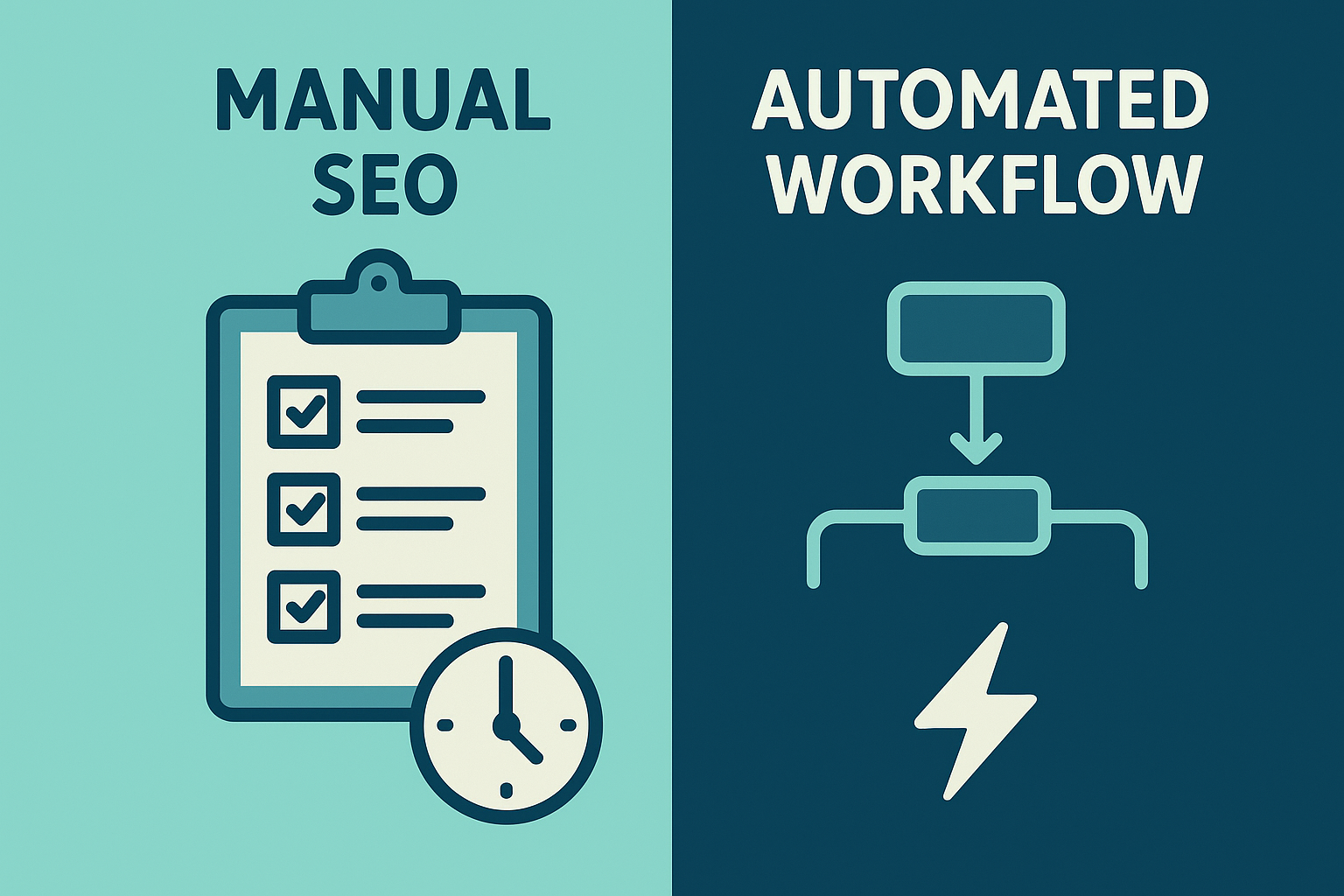
Manual audits versus automated workflows: the core difference is response time.
Real-Time SEO Corrections for AI Search & Answer Engines
AI-driven answer engines, such as Google’s AI Overviews and chat-based search assistants, tend to cite sources that are technically clean, fast-loading, and clearly structured with valid schema markup. Page speed alone influences whether an AI crawler can fully render and understand a page’s content before summarizing it; the MDN Web Performance documentation outlines how load timing and rendering directly affect what a machine can reliably parse.
Consequently, automated real-time SEO adjustments that fix slow assets, broken structured data, or crawl errors the moment they appear give a page a materially better chance of being cited in an AI-generated answer, not just ranked on a traditional results page. In particular, freshness signals matter too: pages that stay technically current tend to be re-crawled and re-summarized more often than pages left untouched for months.
Frequently Asked Questions About Automated Real-Time SEO Adjustments
What are automated real-time SEO adjustments?
Automated real-time SEO adjustments are AI-driven fixes that a platform applies to a website the moment a ranking or technical issue is detected, without waiting for a manual review. This keeps search visibility stable as algorithms and competitor pages change.
How do automated real-time SEO adjustments improve search rankings?
They improve rankings by closing the gap between a problem occurring and it being fixed, often within minutes instead of weeks. Faster corrections mean less lost traffic and steadier positions in both traditional and AI-generated search results.
Why are automated real-time SEO adjustments important for AI search?
AI search engines pull answers from sources that are technically clean, well-structured, and frequently updated. Automated adjustments help ensure a site consistently meets those standards, improving its odds of being cited in AI overviews and answer boxes.
What is the difference between automated real-time SEO adjustments and traditional SEO audits?
Traditional audits are periodic snapshots, often run monthly or quarterly by a human reviewer. Automated adjustments run continuously and apply fixes instantly, removing the delay between diagnosis and action.
How is automated SEO different from real-time content analysis tools?
Real-time content analysis tools score a single post while you write it, using a traffic-light system to flag readability and keyphrase issues that a human must then fix manually. Automated real-time SEO adjustments, by contrast, monitor every already-published page and apply the fix automatically, with no editor session required.
How much do automated real-time SEO tools typically cost?
Pricing varies widely, from free basic monitoring tools to subscription platforms costing $50 to $500 or more per month depending on the number of sites and features. Many providers, including RankAuthority, offer a free trial period before committing.
How long does it take to see results from automated real-time SEO adjustments?
Technical fixes can show measurable impact within days, while ranking improvements from content and authority signals often take several weeks. However, the correction itself happens almost immediately once an issue is flagged.
What common mistakes should businesses avoid with SEO automation?
A common mistake is enabling automation without reviewing which fixes are pre-approved, which can lead to unintended content changes. Another is treating automation as a replacement for strategy rather than a tool that executes it faster.
What best practices ensure automated real-time SEO adjustments work effectively?
Best practices include setting clear rules for what the system can change automatically, reviewing performance reports regularly, and pairing automation with human oversight for major content or structural decisions. Combining both produces the most reliable results.
Can automated real-time SEO adjustments replace an SEO strategist entirely?
Not entirely. Automation handles repetitive technical and monitoring tasks extremely well, but strategic decisions like brand positioning, content direction, and competitive analysis still benefit from human judgment.
Which businesses benefit most from automated real-time SEO adjustments?
Small business owners, agencies managing multiple client sites, and marketers with limited technical resources tend to benefit the most. These groups often lack the time to manually monitor and fix issues across many pages every day.
Conclusion: Why Automated Real-Time SEO Adjustments Are the New Baseline
Ultimately, automated real-time SEO adjustments give businesses a practical way to keep pace with search engines that never stop changing. Instead of reacting weeks after a ranking drop, teams using this approach can catch and correct issues within minutes, whether those issues affect traditional rankings or visibility in AI-generated answers. Unlike editor-only content checkers, this kind of automation watches the whole site, not just the page currently being drafted. As search continues to fragment across new platforms, relying on continuous automation, rather than periodic manual reviews or single-page analysis, is becoming less of a luxury and more of a baseline requirement. For businesses ready to explore this shift, platforms built around real-time automation, such as RankAuthority’s AI AutoPilot, offer a practical starting point.

