

Complete Guide · Updated 2025 · By Rank Authority · By Rank Authority Editorial Team · By Rank Authority editorial team
Best SEO Software for Content Creators in 2025
SEO software for content creators helps you choose, use, and stack the right tools to turn every piece of content into consistent, compounding organic traffic — with zero guesswork.
Quick Answer
SEO software for content creators refers to a category of digital tools that help writers, bloggers, podcasters, and video creators research keywords, optimize content before publishing, analyze competitors, generate data-driven content briefs, and monitor rankings over time. The best platforms in this category combine all of these functions into a single, creator-friendly workflow — replacing guesswork with data at every stage of content production.
What Is SEO Software for Content Creators?
SEO software for content creators is a dedicated category of platforms engineered to help people who produce content — not developers or technical SEO specialists — gain measurable visibility in search engine results pages (SERPs). These tools translate raw search engine data, competitive signals, and algorithmic patterns into clear, actionable guidance that fits directly inside an editorial workflow.
Unlike enterprise-grade technical SEO suites that focus on site architecture, crawl budgets, and server logs, creator-focused SEO software prioritizes keyword discovery, content scoring, SERP analysis, content brief generation, and performance tracking. The goal is simple: give creators the data they need to publish content that ranks, drives organic traffic, and satisfies user intent — without requiring a computer science degree to operate.
According to Wikipedia’s overview of search engine optimization, SEO encompasses both technical and content-driven strategies. Creator-focused software sits firmly in the content strategy lane, providing the intelligence layer that transforms topic ideas into structured, high-ranking articles, videos, and multimedia pieces.

The right SEO software for content creators turns complex search data into a clear, actionable content optimization tools workflow.
Why Content Creators Cannot Afford to Skip SEO Tools
Publishing content without SEO data is the equivalent of writing a book and storing every copy in a basement. The quality of the writing is irrelevant if no one can find it. In a content landscape where millions of articles are published every day, creators who operate without dedicated SEO software are systematically outcompeted by those who do not. Learn practical monitoring and protection tactics in our tool selection and monitoring guide.
Here is what SEO software specifically solves for content creators at each stage of the workflow:
🔍 Keyword Discovery
Find exactly what your target audience is actively searching for — including AI SEO platforms, long-tail variations, question-based queries, and low-competition terms that are realistically rankable for newer sites.
📊 Competitor Analysis
Understand what the current top-ranking pages cover, how comprehensively they cover it, and where content gaps exist that your article can fill more thoroughly.
✅ Real-Time On-Page Scoring
Receive live feedback on title tags, meta descriptions, heading hierarchy, internal link structure, keyword density, and semantic term coverage as you draft — before publishing.
📈 Rank Tracking & Performance
Track how every published piece ranks over time, identify which keywords are gaining or losing ground, and pinpoint exactly which articles need a strategic refresh to recapture or improve positions.
📝 Content Brief Generation
Generate structured outlines that tell you exactly which headings to use, how long the piece should be, which related questions to answer, and which semantic terms to include — before writing a single word. See the best SEO software guide for tool-specific brief examples.
🔔 Technical Issue Alerts
Get immediate notifications about broken links, crawl errors, missing meta data, site speed regressions, and other technical problems that silently kill rankings if left unaddressed.
The Core Features Every Creator Must Demand
Not every SEO platform is designed with content creators in mind. Many are built for technical SEO agencies and enterprise teams, making the interface and feature set feel overwhelming, bloated, and irrelevant to day-to-day content production. When evaluating SEO software for your creator workflow, these are the non-negotiable capabilities that will actually move the needle:
1. Keyword Research, Search Volume, and Difficulty Scoring
The foundation of any content strategy is knowing precisely which keywords to target before writing a single word. The best SEO software for content creators surfaces search volume, keyword difficulty (KD), cost-per-click as a proxy for commercial intent, SERP feature opportunities (featured snippets, People Also Ask boxes, image packs), and related semantic terms all in one place. The ability to filter by difficulty means newer sites can prioritize attainable terms while building domain authority.
2. Keyword Clustering and Topical Authority Mapping
Modern search engines evaluate topical authority — meaning they reward sites that cover an entire subject comprehensively across multiple, interconnected pieces. Keyword clustering tools automatically group semantically related keywords so you can build content clusters: a pillar page supported by several satellite articles that together dominate an entire topic. This is one of the most powerful features in contemporary creator SEO software and one that dramatically accelerates ranking velocity.
3. SERP Analysis and Competitor Content Breakdown
Great content optimization starts with understanding what is already ranking for your target keyword and why. Look for tools that analyze the top 10 or 20 SERP results and extract data on average word count, heading structures, number of images, domain authority ranges, backlink counts, and the specific semantic terms those pages use. This competitive intelligence lets you engineer content that is demonstrably more thorough and more useful than anything currently on the first page.
4. AI-Powered Content Brief Generation
The best SEO software for content creators goes beyond raw data and generates a complete content brief automatically — recommended H2 and H3 headings, target word count ranges, related questions to answer (drawn from People Also Ask and forum data), semantic terms to include, and internal linking opportunities. Learn how to choose the right tool for generating briefs.
5. Real-Time Content Optimization Scoring
As you write, the tool should score your content in real time against the benchmark set by top-ranking competitors. This includes checking for keyword coverage, semantic term inclusion, heading optimization, meta tag quality, readability, and internal link density. A live score that updates as you type turns content optimization from a post-publishing afterthought into an integrated part of the writing process itself.
6. NLP and Semantic Term Analysis
Natural language processing (NLP) analysis identifies the entities, concepts, and related terms that Google’s algorithms associate with a topic. SEO software that incorporates NLP analysis helps creators build content that signals genuine topical expertise rather than simple keyword repetition — a critical factor in post-Helpful Content Update rankings. The tool should tell you not just which keywords to include, but which related concepts demonstrate depth of understanding.
7. Content Usefulness and E-E-A-T Signals
Google’s Helpful Content System and E-E-A-T framework (Experience, Expertise, Authoritativeness, Trustworthiness) have fundamentally changed how content is evaluated. Understanding why content usefulness matters is the starting point — the second step is using software that actively evaluates your content’s depth, specificity, and genuine value relative to what is currently ranking, then provides actionable recommendations to close the gap.
8. Real-Time SEO Issue Alerts and Site Health Monitoring
Publishing great content is only half the equation. If technical issues silently emerge — broken internal links, pages accidentally deindexed, crawl errors, duplicate content flags, or slow load times — your rankings will deteriorate regardless of how well-optimized the content itself is. Platforms that deliver real-time SEO issue alerts are essential for creators who want to protect the rankings they have earned and catch problems before they compound into significant traffic losses.
9. Rank Tracking and Keyword Position Monitoring
Rank tracking is the feedback loop that tells you whether your content strategy is actually working. Look for tools that track daily or weekly keyword positions, segment rankings by country or device type, and provide historical trend data so you can see how your content moves over time. Alerts for significant rank changes — up or down — let you respond quickly, either capitalizing on momentum or diagnosing a drop before it becomes catastrophic.
10. Content Audit and Refresh Identification
Over time, published content loses ranking power as competitors update their pages and search intent evolves. SEO software that performs content audits can identify which of your existing articles are declining in rankings, which have traffic potential that remains untapped, and which are performing so strongly that internal linking from new content would accelerate your overall topical authority. This turns your existing content archive into a continuously optimized asset rather than a static collection of old posts.

Content briefs generated by SEO software give creators a structured roadmap before a single word is written.
Understanding Search Intent: The Most Underrated Feature
One of the most common reasons well-optimized content fails to rank is a mismatch between the content’s purpose and the search intent behind the keyword. Search intent falls into four primary categories, and the best SEO software for content creators surfaces this data automatically:
📚 Informational Intent
The searcher wants to learn something. Blog posts, how-to guides, and explainer articles typically target this intent. Example: “how does keyword clustering work.”
🔎 Navigational Intent
The searcher is looking for a specific website or brand. Unless you are the brand being searched for, targeting navigational keywords rarely produces meaningful organic traffic.
🛒 Commercial Investigation Intent
The searcher is evaluating options before making a decision. Comparison articles, tool roundups, and “best of” lists align with this intent. Example: “best SEO software for content creators.”
💳 Transactional Intent
The searcher is ready to act — sign up, purchase, or download. Landing pages and free trial offers target this intent. Example: “SEO software free trial.”
SEO software that accurately identifies search intent for each keyword in your list — and flags when your planned content format mismatches the dominant intent in the SERP — saves you from investing hours into content that Google will never rank in the expected position, regardless of how well it is written.
Comparing Tool Categories: What to Use and When
The SEO software landscape is broad, and different tools serve genuinely different purposes. Understanding which category solves which problem prevents creators from overspending on overlapping functionality or leaving critical gaps in their stack.
How to Choose SEO Software for Content Creators
There is no single best SEO software for content creators because creators operate in fundamentally different contexts — a solo blogger with 50 published articles has different needs than a team of six writers producing 40 pieces per month. Here is how to match tool selection to your specific situation:
Solo Bloggers and Independent Writers
Budget constraints matter most here. The ideal stack combines Google Search Console (free), cloud-based SEO tools, and a content optimization layer (Frase at entry level or Surfer SEO). This three-tool stack costs under $150/month for most independent creators and covers the full content lifecycle from research to ranking monitoring.
YouTube Creators and Podcasters Repurposing Content
Video and audio creators who repurpose scripts or transcripts into blog content need SEO software that helps them identify which parts of their existing content carry the most search potential. Tools with content audit features and People Also Ask data integration are especially valuable here, helping creators identify which video topics have strong written search volume and prioritize repurposing accordingly.
Content Teams and Editorial Operations
Teams need SEO software with collaboration features — the ability to share content briefs with writers, assign keywords to specific team members, track editorial progress, and ensure consistent optimization standards across all pieces. Enterprise tiers of platforms like Semrush, MarketMuse, and Clearscope are built specifically for this use case. Pair these with a centralized site monitoring solution to maintain technical health as publishing volume scales.
Affiliate and Niche Site Builders
Niche site creators typically need the deepest keyword research and competitor analysis available, because their entire revenue model depends on ranking above established affiliate sites for commercial investigation queries. Tools with strong SERP analysis, backlink gap identification, and keyword difficulty accuracy — like Ahrefs — are the top choice here, supplemented by content optimization tools that score pages against existing SERP leaders before they are published.
Building a Lean Creator SEO Stack
You do not need to subscribe to every tool on the market. A practical, cost-effective SEO software stack for most independent content creators looks like this, organized by priority:
- Google Search ConsoleYour baseline for understanding how Google already sees your site: which queries drive impressions and clicks, where indexing gaps exist, which pages have high impressions but low click-through rates, and where Core Web Vitals are failing. Every creator should have this configured before investing in any paid tool.
- One All-in-One Keyword Research and Audit ToolA platform like Ahrefs or Semrush provides keyword research tool, competitor analysis, backlink data, site audit capabilities, and rank tracking. Most independent creators need only one of these — choose based on which interface resonates with your workflow. Mangools offers a more budget-friendly alternative that covers the core use cases effectively.
- A Dedicated Content Optimization LayerA tool like Surfer SEO, Clearscope, or Frase that scores your writing in real time against the current SERP, generates content briefs, and surfaces NLP terms to include. For a deeper look, see choose the right SEO tool. This is the layer that directly improves the quality of individual pieces before they are published — it is distinct from research tools and provides value that all-in-one suites rarely match in depth.
- A Site Monitoring and Alert Solution
A platform such as Rank Authority that keeps continuous watch over your site’s technical health and delivers real-time alerts the moment issues arise — so your published content is never silently penalized by fixable technical problems. Once content is published and ranking, protecting that investment is just as important as optimizing it.
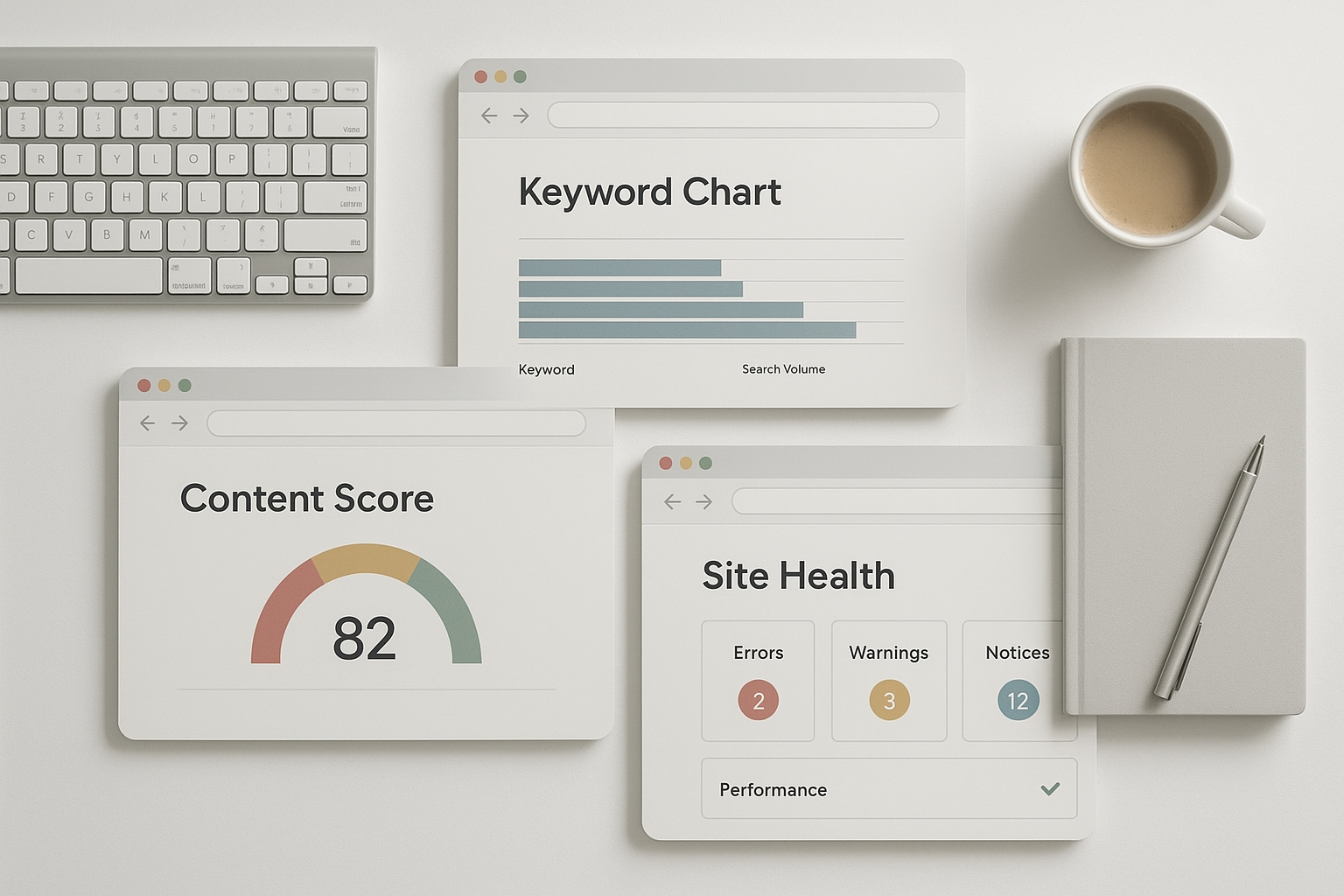
A focused four-tool stack covers the full content lifecycle from research to ongoing monitoring.
The Content Optimization Process: Step by Step
Owning great SEO software and using it effectively are two very different things. Here is the precise workflow that separates creators who see compounding organic growth from those who pay for subscriptions and see minimal results:
Research before you write — not after
Run your topic idea through your keyword research tool before drafting a single sentence. Identify the primary keyword, confirm the search intent, find supporting long-tail variations, and understand the competitive difficulty of each. Adjust your planned content angle based on what the data reveals — informational, commercial, or transactional — before committing to a direction.
Analyze the SERP before building your outline
Use your content optimization tool to pull a full SERP analysis for your target keyword. Review the top 10 results: what headings do they share? What questions do they answer? What word count range are they hitting? What semantic terms appear consistently? Use this data to build a content brief following our SEO strategy guide that covers everything the competition covers — plus the specific angles and depth they are missing.
Write with your optimization score open
Draft your content inside your optimization tool’s editor (or paste regularly to refresh the score) so you can see the real-time content score as you write. Prioritize semantic term coverage and heading optimization without over-stuffing. For approaches to AI-assisted optimization, review AI SEO for creators. Aim for a content score that matches or exceeds the average score of the current top-ranking results.
Publish, submit to indexing, and activate monitoring
After publishing, request indexing in Google Search Console immediately. Ensure your site monitoring platform is tracking the published URL so you will be alerted if any technical issues emerge — deindexation, crawl errors, or internal link breaks — in the critical hours and days after publishing when Google is actively evaluating the page. See our AI content writing guide for repurposing and indexing best practices.
Build internal links from related content
Use your SEO platform’s internal link suggestions or site audit to identify existing pages that should link to your new content. Internal links pass authority between pages and help search engines understand how your content is related. This step is consistently overlooked but delivers measurable ranking improvements, especially for newer pages on established domains.
Schedule monthly content audits
Use your SEO platform’s content audit or rank tracking data to identify published pieces experiencing ranking declines. A strategic refresh — updating statistics, expanding thin sections, adding new semantic terms, improving internal links — is almost always faster and more effective than producing entirely new content for the same topic. The return on effort from content refreshing is consistently undervalued by creators.
Track clusters, not just individual keywords
Modern search rankings reward topical authority — meaning Google evaluates the totality of your coverage on a subject, not just an individual URL. Use your tool’s clustering features to track how your entire topic cluster is performing, identify missing sub-topics, and ensure your pillar and satellite content is properly interlinked to signal comprehensive authority in your niche. See recommendations for AI content writing approaches that support cluster building.
Common Mistakes Content Creators Make with SEO Software
Purchasing SEO software does not automatically translate into ranking improvements. These are the most common mistakes creators make — and how to avoid them:
- Chasing high-volume keywords without assessing difficulty. A keyword with 50,000 monthly searches is useless if every ranking result belongs to a domain with a decade of authority and thousands of backlinks. Creators — especially those on newer domains — should prioritize search volume relative to difficulty and domain strength, building toward harder terms over time. See our AI SEO guide for modern keyword prioritization techniques.
- Optimizing for a keyword without confirming search intent. Writing an informational guide for a keyword where Google’s SERP is dominated by product pages, or vice versa, will reliably fail regardless of content quality. Always verify intent by manually reviewing the current top results before committing to a content format.
- Treating content score as an absolute target rather than a guide. A content score of 80/100 is useful directional feedback — not a guarantee of ranking. Over-stuffing semantic terms to chase a higher score can make content feel unnatural and actually harm user engagement signals. Use the score as a floor check, not a ceiling to obsess over.
- Ignoring published content after it goes live. The majority of SEO value from content is realized over months, not immediately. Creators who publish and then abandon — without monitoring rankings, refreshing declining pieces, or building internal links over time — leave enormous traffic potential on the table.
- Neglecting technical SEO entirely. Even perfectly optimized content will underperform if pages load slowly, canonical tags are misconfigured, or duplicate content flags confuse crawlers. Technical SEO and content SEO are not separate disciplines — they are complementary, and ignoring one undermines the other.
- Subscribing to too many tools with overlapping features. Budget spent on redundant platforms is budget that could go toward producing more content or building links. Audit your stack annually and eliminate tools whose core functionality is already covered by something else in your workflow.
Free vs. Paid SEO Software: A Realistic Assessment
The free-versus-paid debate is one of the most common questions among newer content creators. Here is an honest breakdown of what you can and cannot accomplish with free tools alone:
The bottom line: free tools provide essential baseline data but cannot substitute for paid SEO software if you are operating in any competitive niche. For creators serious about building sustainable organic traffic, the ROI on a well-chosen paid stack is typically realized within the first two to three months through improved rankings and reduced wasted effort on content that would never have ranked.
Frequently Asked Questions About SEO Software for Content Creators
What is the best SEO software for content creators in 2025?
The best SEO software for content creators depends on your specific use case and budget. For independent bloggers, a stack combining Google Search Console, Ahrefs or Semrush at a starter tier, and Surfer SEO or Frase for content optimization covers the full workflow effectively. For teams, enterprise tiers of Clearscope or MarketMuse add collaboration and workflow management. The best platform is the one that integrates into your actual writing process and that you will use consistently — not the one with the most features.
Do content creators really need dedicated SEO software?
Yes — emphatically. Without SEO software, content creators are making decisions based on intuition rather than data: guessing which topics to write about, estimating how competitive keywords are, and publishing without knowing whether the content structure aligns with what Google is rewarding. Dedicated tools replace all of that guesswork with data-driven guidance that directly improves both the quality of each piece and its realistic probability of ranking in competitive SERPs.
What is content optimization scoring and how does it work?
Content optimization scoring is a feature in tools like Surfer SEO and Clearscope that analyzes the current top-ranking pages for your target keyword, extracts the semantic terms, heading patterns, word counts, and structural characteristics they share, and then compares your content draft against that benchmark. The result is a real-time score that updates as you write, showing how comprehensively your content covers the topic relative to what is already winning in the SERP. Higher scores generally correlate with stronger topical coverage, though they are a guide rather than a guaranteed ranking predictor.
Is free SEO software good enough for content creators?
Free tools like Google Search Console and Google Keyword Planner provide a solid foundation for understanding existing performance, but they lack the depth required to compete effectively in most niches. They do not offer accurate keyword difficulty data, competitor content analysis, real-time content scoring, keyword clustering, proactive rank change alerts, or content audit capabilities. For creators building serious organic traffic, investing in a paid platform typically delivers a clear return within the first two to three months through better keyword selection and more effective content structure.
How does SEO software help with content usefulness and E-E-A-T?
Modern SEO software evaluates content against the signals Google uses to assess quality under the Helpful Content System and E-E-A-T framework — including topical depth, breadth of coverage, semantic richness, and structural clarity. Some platforms specifically flag thin sections, missing related concepts, or low-depth coverage that may signal to Google that a page lacks genuine expertise. This helps creators produce content that satisfies both search engines and real readers, which is increasingly critical as Google’s quality evaluation systems grow more sophisticated.
What is keyword clustering and why does it matter for content creators?
Keyword clustering is the process of grouping semantically related keywords together so they can be targeted by a single piece of content or a coordinated set of content pieces (a content cluster). It matters for content creators because modern search engines evaluate topical authority — meaning a site that covers a subject comprehensively across many interconnected articles ranks better than a site with one isolated page on a topic. SEO software with clustering features automates this grouping process, helping creators build content strategies that establish genuine authority in their niche rather than randomly targeting disconnected keywords.
How often should I audit my content using SEO software?
For most independent content creators, a monthly content audit is the right cadence — reviewing rank tracking data to identify pieces that are declining, checking for pages that have high impressions but low CTR (which often indicates a title or meta description needs improvement), and flagging content that has fallen below page one. Sites publishing at higher volumes — 20 or more pieces per month — should consider a weekly audit workflow and use automated alerts to surface the most critical changes between formal review cycles.
Final Thoughts: Choosing the Right SEO Software for Content Creators
The best SEO software for content creators is not necessarily the most expensive or the most feature-rich platform on the market — it is the one that integrates seamlessly into your creative workflow and delivers clear, actionable data at every stage of the content lifecycle.
Start with a solid keyword research and competitive intelligence foundation. Layer in real-time content optimization to ensure every piece is structurally and semantically aligned with what Google is rewarding. Protect your published content investment with reliable monitoring that alerts you the moment anything threatens the rankings you have earned. And continuously audit and refresh your archive so existing content compounds in value rather than decaying.
Whether you are a solo blogger building a niche site, a YouTube creator repurposing content to capture search traffic, a podcaster trying to drive listeners through organic discovery, or a brand managing a full editorial operation — the principles are identical: research with data, write with intent, optimize before publishing, monitor continuously, and refresh strategically. The creators who build that discipline — backed by the right tools — are the ones who build durable, compounding organic traffic that grows with each new piece they publish.
Ready to Protect What You Publish?
Explore how Rank Authority can serve as the monitoring backbone of your SEO software stack — delivering real-time technical alerts and keeping your content rankings stable and protected around the clock. For a deeper walkthrough, see our How Can I Simplify My Digital Marketing Strategy?.

