

Easy SEO for entrepreneurs means using simplified, largely automated strategies to grow organic search visibility without a marketing degree, a coding background, or a full-time SEO specialist on payroll. Founders already juggle sales calls, product decisions, and customer support — search optimization can feel like one more full-time job stacked on top of everything else. The good news is that it doesn’t have to be. This guide covers every stage of the process, from foundational keyword research to local search, link building, AI-driven optimization, and the exact tools that make ranking on Google realistic for a solo founder or a five-person team.
Quick answer: Easy SEO for entrepreneurs relies on automated platforms that handle keyword research, technical audits, on-page fixes, and content structure — plus increasingly, AI answer optimization — so business owners spend minutes, not hours, on the technical side of search visibility.
What Is Easy SEO for Entrepreneurs?
Easy SEO for entrepreneurs is a streamlined version of traditional search engine optimization built specifically for people who don’t have time for a steep learning curve. Instead of manually researching keywords line by line or auditing raw site code, entrepreneurs use guided platforms that automate the repetitive, technical steps. As a result, the process becomes accessible to anyone running a business, regardless of their marketing background.
According to Google’s own SEO Starter Guide, the core principles of good search visibility have stayed fairly consistent for years: clear content, fast pages, and genuinely relevant keywords. What has changed is how much of that work software can now handle instead of a human specialist. In other words, the strategy hasn’t gotten easier — the execution has.
Who Actually Benefits From Simplified SEO?
Solo founders, local service businesses, e-commerce startups, and agencies managing several client sites all benefit differently from easy SEO for entrepreneurs. A freelance consultant, for example, mainly needs local visibility and a handful of well-optimized service pages. Meanwhile, a growing e-commerce brand needs product page optimization, technical crawl efficiency, and content that answers pre-purchase questions. Simplified SEO platforms flex to fit both use cases because the automation adapts to the site type rather than forcing a one-size-fits-all checklist.
Why SEO for Business Owners Feels So Overwhelming
Many small business owners assume SEO requires coding knowledge or a dedicated marketing department. In reality, the difficulty usually comes from too many disconnected tools and conflicting advice, not the underlying concepts themselves. This is one of the common challenges entrepreneurs face in SEO, and it often leads to abandoned efforts after just a few weeks of half-hearted attempts.
Furthermore, time is the scarcest resource for any entrepreneur. Spending hours writing meta tags or manually checking for broken links pulls attention away from sales, customer service, and product development. A closer look at the specific challenges of SEO for entrepreneurs shows that most of the friction is procedural, not strategic — which is exactly why automation solves so much of the problem so quickly.

Simple dashboards make easy SEO for entrepreneurs achievable without technical training.
Core Principles of Simple SEO Strategies for Startups
Every effective simple SEO strategy rests on a few repeatable principles. First, content must answer a specific question a potential customer is actually searching for — not just what the business wants to say about itself. Second, pages need to load quickly, since search engines factor speed directly into ranking decisions. Third, internal structure matters, meaning related pages should link to one another so search engines understand how a site fits together as a whole.
Long-Tail Keyword Research Made Simple
In particular, entrepreneurs benefit from focusing on long-tail keywords — longer, more specific phrases with less competition. For example, targeting “affordable bookkeeping for freelancers” is far more achievable than competing for “bookkeeping.” Consequently, smaller sites can rank sooner and start attracting relevant visitors without waiting years for domain authority to build. A practical way to find these phrases is to type your core service into Google and note the autocomplete suggestions and “People also ask” questions — those are real searches, not guesses.
For a deeper breakdown of these fundamentals, the complete guide to SEO solutions for entrepreneurs walks through each principle with real examples tailored to small business budgets.
On-Page SEO Essentials You Can’t Skip
On-page SEO simply means optimizing the elements on your own pages: title tags, headings, meta descriptions, image alt text, and internal links. Each page should target one primary keyword and a handful of closely related terms. Above all, the title tag and first paragraph should make the topic obvious within seconds, both to readers and to search engine crawlers. For a concise checklist, see best SEO strategies.
Technical SEO Basics (Without the Jargon)
Technical SEO covers the behind-the-scenes health of a website: how fast it loads, whether it works properly on mobile devices, and whether search engines can crawl it without errors. Google has confirmed that mobile-first indexing — the practice of using the mobile version of a site as the primary version for ranking — is now standard practice. In practice, this means a slow or broken mobile experience can quietly cap your rankings no matter how good the content is. Automated audit tools flag these issues instantly, which removes the need to manually inspect site code.
Local SEO and Google Business Profile: The Fastest Win for Entrepreneurs
For any entrepreneur serving customers in a specific city or region, local SEO is often the fastest path to visible results. Claiming and fully completing a Google Business Profile — including accurate categories, business hours, photos, and service descriptions — directly influences whether a business appears in the local map pack for searches like “plumber near me” or “bakery in [city].” Reviews matter too: businesses with consistent, recent, keyword-relevant reviews tend to outrank competitors with stronger domains but weaker local signals.
In addition, local SEO depends on consistent business information (name, address, phone number) across directories. Inconsistent listings confuse search engines and can quietly suppress rankings even when the website itself is well optimized. Therefore, before investing heavily in blog content, entrepreneurs running local or regional businesses should treat their Google Business Profile as priority number one, not an afterthought.
How AI Automation Makes Easy SEO for Entrepreneurs Possible
Artificial intelligence has fundamentally changed how quickly optimization work can happen. Tools like Rank Authority’s 1-Click AI AutoPilot analyze a website, identify weaknesses, and generate prioritized fixes automatically. This removes the need for entrepreneurs to interpret dense technical audit reports themselves — the software translates the problem into a plain-language action item. Read more about AI in SEO for entrepreneurs.
Moreover, this type of automation extends beyond classic search engines into Generative Engine Optimization (GEO), which improves how a brand appears in AI-generated answers from tools like ChatGPT and Google’s AI Overviews, and Answer Engine Optimization (AEO), which prepares content to be cited correctly by voice assistants and AI chat tools. Since AI-driven search is growing rapidly, entrepreneurs who ignore this shift risk losing visibility even if they still rank well on a traditional results page. You can review the rankauthority.com platform to see how automated GEO and AEO optimization works in practice, alongside traditional keyword and technical SEO.
6 Steps to Implement Easy SEO for Entrepreneurs
Getting started doesn’t require a marketing degree. Instead, follow this straightforward sequence to build momentum quickly and avoid wasted effort.
- Audit your current site. Run a technical and content audit to identify slow pages, missing metadata, and broken links across your entire site. Automated audit tools can complete this scan in minutes rather than days.
- Research realistic keywords. Choose long-tail phrases that match your offerings and have achievable competition levels, rather than chasing broad, oversaturated terms that larger competitors already dominate.
- Claim and optimize your Google Business Profile. Fill out every field completely, add real photos, and request reviews consistently to strengthen local search visibility right away.
- Optimize on-page elements. Update titles, headings, and meta descriptions to include target keywords naturally while keeping the content genuinely useful and readable for actual visitors.
- Publish helpful, structured content. Create articles that directly answer customer questions using clear headings and short paragraphs, since structured content also performs better in AI-generated answers.
- Monitor and adjust monthly. Review analytics and search console data every month to spot ranking changes, then refine your approach based on real performance data rather than guesswork.
Notably, a 2023 industry analysis from Moz’s Beginner’s Guide to SEO found that websites publishing consistent, structured content saw organic traffic gains of over 30% within six months. This confirms that a repeatable process, even a simple one, produces measurable results over time.
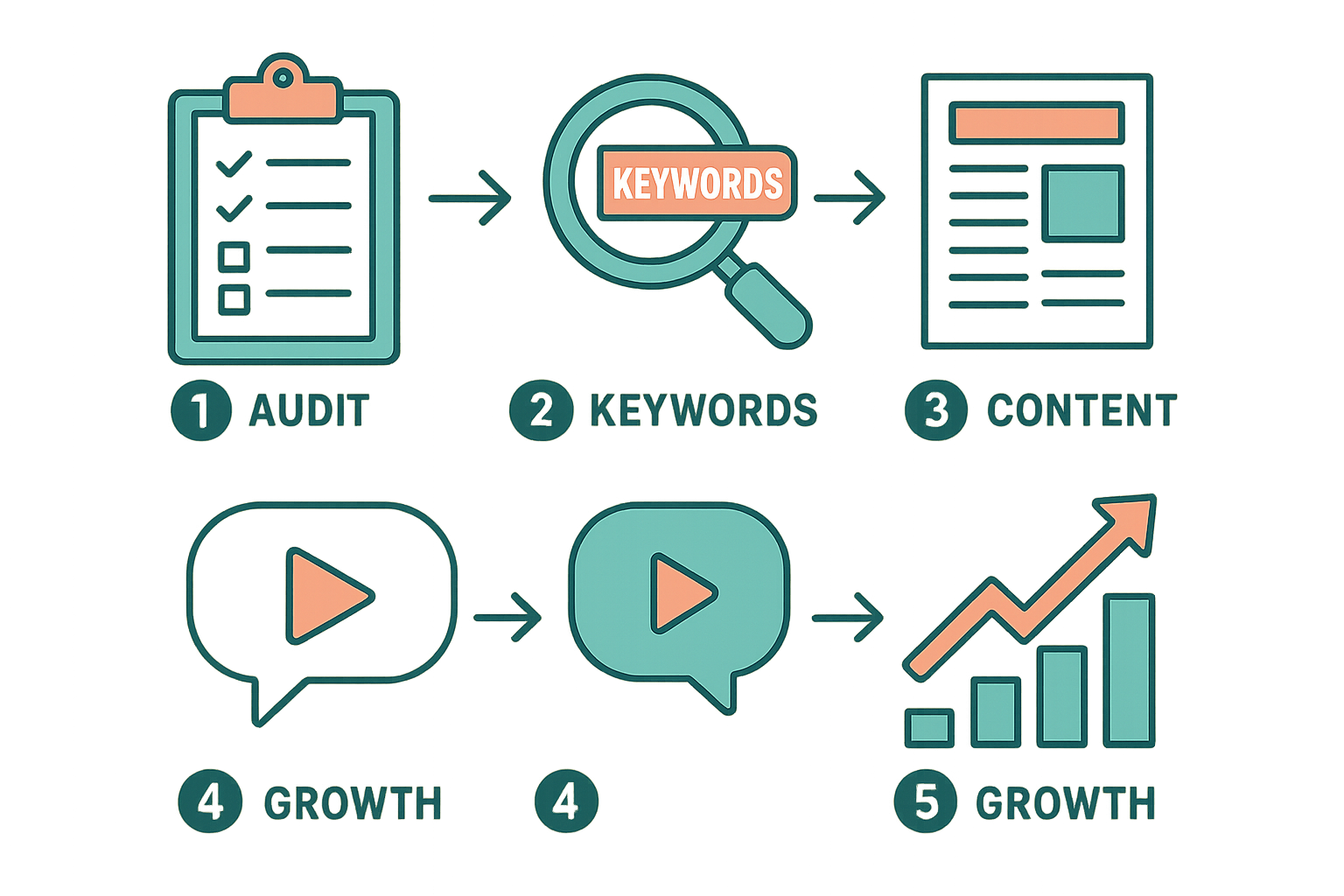
A repeatable, step-by-step process supports easy SEO for entrepreneurs at any stage of growth.
Link Building for Entrepreneurs: Earning Authority Without an Agency
Backlinks — links from other websites pointing to yours — remain one of the strongest ranking signals search engines use. However, entrepreneurs don’t need an expensive outreach agency to earn them. Simple, repeatable tactics work well: getting listed in relevant local or industry directories, guest contributing to niche publications, and creating genuinely useful resources that other site owners want to reference naturally.
Similarly, existing business relationships often translate into easy link opportunities. Suppliers, partners, and satisfied customers with their own websites are frequently willing to add a link with a simple, polite request. In contrast, buying links from low-quality sites violates search engine guidelines and can trigger penalties, so it’s worth avoiding entirely regardless of how tempting the shortcut looks.
Choosing the Right Tools for Stress-Free SEO
Not every SEO platform is built with entrepreneurs in mind. Above all, look for tools that automate technical work while still giving visibility into what’s happening and why. Rank Authority, for example, offers a risk-free seven-day trial and its 1-Click AI AutoPilot technology, specifically designed for small business owners, agencies, and marketers managing multiple sites without dedicated technical staff.
If you’re unsure where to start simplifying your current workflow, the resources on how to simplify SEO for your business, how to simplify SEO for my business step by step, and simplifying SEO tasks for small businesses offer practical, low-effort starting points that don’t require a technical background.
Tracking and Measuring Your SEO Success
SEO without measurement is just guessing. At minimum, entrepreneurs should track three metrics monthly: organic traffic, keyword rankings, and conversion rate from organic visitors. Google Search Console is free and shows exactly which queries bring visitors to your site, along with click-through rates and average ranking position for each one.
Furthermore, small, consistent improvements matter more than one dramatic overhaul. As a result, checking these numbers monthly — rather than daily — reduces stress while still catching meaningful trends early enough to adjust course before a small issue becomes a major traffic drop.
Common Mistakes Entrepreneurs Make With SEO
Even with the right tools, a few recurring mistakes slow progress. Ignoring mobile page speed is one of the most damaging, since search engines prioritize fast, mobile-friendly experiences above almost everything else. Similarly, publishing thin content that doesn’t fully answer a searcher’s question tends to underperform regardless of keyword placement.
In addition, many entrepreneurs skip keyword research entirely and write content based on guesses rather than actual search demand. Consequently, that content may never reach the audience it was meant for. Neglecting the Google Business Profile is another frequent oversight for local businesses, as is treating link building as optional rather than essential. Avoiding these pitfalls is often just as important as adding new optimization tactics.
Frequently Asked Questions
What is easy SEO for entrepreneurs?
Easy SEO for entrepreneurs is a simplified approach to search optimization that removes technical complexity so business owners can improve visibility without needing deep coding or marketing expertise. It typically relies on automation, templates, and guided workflows.
How long does it take to see SEO results?
Most entrepreneurs start seeing measurable ranking improvements within three to six months of consistent effort. Factors like competition, content quality, and site age can speed up or slow down that timeline.
Can I do SEO myself without hiring an agency?
Yes, many entrepreneurs successfully manage their own SEO using automated platforms that handle keyword research, technical audits, and content suggestions. This makes it possible to compete without a full-time specialist on staff.
What is the difference between SEO and GEO?
Traditional SEO focuses on ranking in classic search engine results pages, while GEO (Generative Engine Optimization) focuses on being cited accurately by AI chat and answer tools. Both aim to increase discoverability but target different platforms.
How much does SEO cost for a small business?
Costs vary widely, from free do-it-yourself efforts to several thousand dollars per month for agency retainers. Automated platforms often bridge the gap, offering professional-grade results at a fraction of agency pricing.
What are the biggest SEO mistakes entrepreneurs make?
Common mistakes include ignoring page speed, publishing thin content, neglecting the Google Business Profile, and skipping keyword research before writing content, all of which waste time and effort.
Do I need technical skills to rank on Google?
No, modern SEO tools handle most technical requirements automatically, including site speed checks and structured data. Entrepreneurs can focus on their business while automation manages the backend details.
How often should I update my website content for SEO?
Refreshing key pages every three to six months keeps information current and signals relevance to search engines. Regularly updated content tends to maintain or improve rankings over time.
What is AEO and why does it matter for entrepreneurs?
Answer Engine Optimization (AEO) prepares content to be selected as direct answers by voice assistants and AI search tools. As a result, entrepreneurs who optimize for AEO can capture visibility even when users never click through to a website.
Is local SEO different from general SEO?
Local SEO focuses on ranking for geographically specific searches, such as those including a city or neighborhood name. It relies heavily on the Google Business Profile, reviews, and location-based keywords rather than broad national terms.
Do I need backlinks if I already rank locally?
Yes, backlinks still strengthen local rankings by signaling trust and authority to search engines. Even a handful of relevant links from local directories or partner sites can noticeably improve visibility.
Can automation really replace manual SEO work?
Automation can handle repetitive technical and research tasks extremely well, which covers a large portion of SEO work. However, strategic decisions and brand voice still benefit from some human oversight.
What tools help make SEO simple for entrepreneurs?
Platforms that combine keyword research, technical audits, and AI-generated recommendations in one dashboard significantly reduce complexity. Rank Authority’s automated approach is one example designed specifically for busy business owners.
How do I measure if my SEO efforts are working?
Track organic traffic, keyword rankings, and conversion rates using free tools like Google Search Console. Consistent upward trends over several months indicate that your strategy is effective.

Consistent research and monitoring keep easy SEO for entrepreneurs sustainable long-term.
Final Thoughts on Making SEO Simple
Ultimately, easy SEO for entrepreneurs isn’t about cutting corners; it’s about removing unnecessary complexity so business owners can focus on growth instead of guesswork. By claiming a strong local presence, following a repeatable content process, earning a handful of genuine backlinks, avoiding common mistakes, and leveraging automation for technical work, entrepreneurs can build durable search visibility without becoming full-time marketers. Therefore, whether you’re managing one website or several client accounts, the right combination of strategy and automated tools makes consistent, long-term SEO progress genuinely achievable — starting today, not someday. Last updated: 2026-08-14. Author: Rank Authority team.

