

SEO autopilot is changing how business owners approach search visibility in 2026, automating the technical and strategic work that once required a dedicated specialist on payroll. Instead of manually auditing pages, fixing schema errors, and chasing algorithm updates by hand, teams can now hand repetitive optimization tasks to intelligent software that works continuously in the background. In particular, platforms built around automation, like Rank Authority, combine traditional ranking signals with newer AI search requirements. This guide explains what SEO autopilot actually means, how it works step by step, and what to look for when choosing a platform for your business.
What Is SEO Autopilot?
SEO autopilot is a category of software that automatically audits, fixes, and monitors a website’s search optimization elements — including technical issues, on-page content, and schema markup (structured data that helps search engines read page content) — with minimal manual input from the user. Rather than requiring an in-house specialist to implement every change by hand, the system continuously scans for gaps and applies approved fixes on an ongoing basis.
Consequently, business owners no longer need to choose between hiring expensive consultants and letting their site’s technical health slide. As a result, automation has become especially relevant now that search itself is splitting into two environments: the familiar Google results page, and AI-generated answers from tools like ChatGPT, Perplexity, and Google’s AI Overviews. A platform limited to classic SEO autopilot tasks alone may improve rankings while still missing the structured, citation-ready formatting that AI systems look for. That gap is why newer tools fold Generative Engine Optimization (GEO) — building content formatted for AI citation — and Answer Engine Optimization (AEO) — structuring direct answers for featured snippets and AI responses — directly into the automation layer.
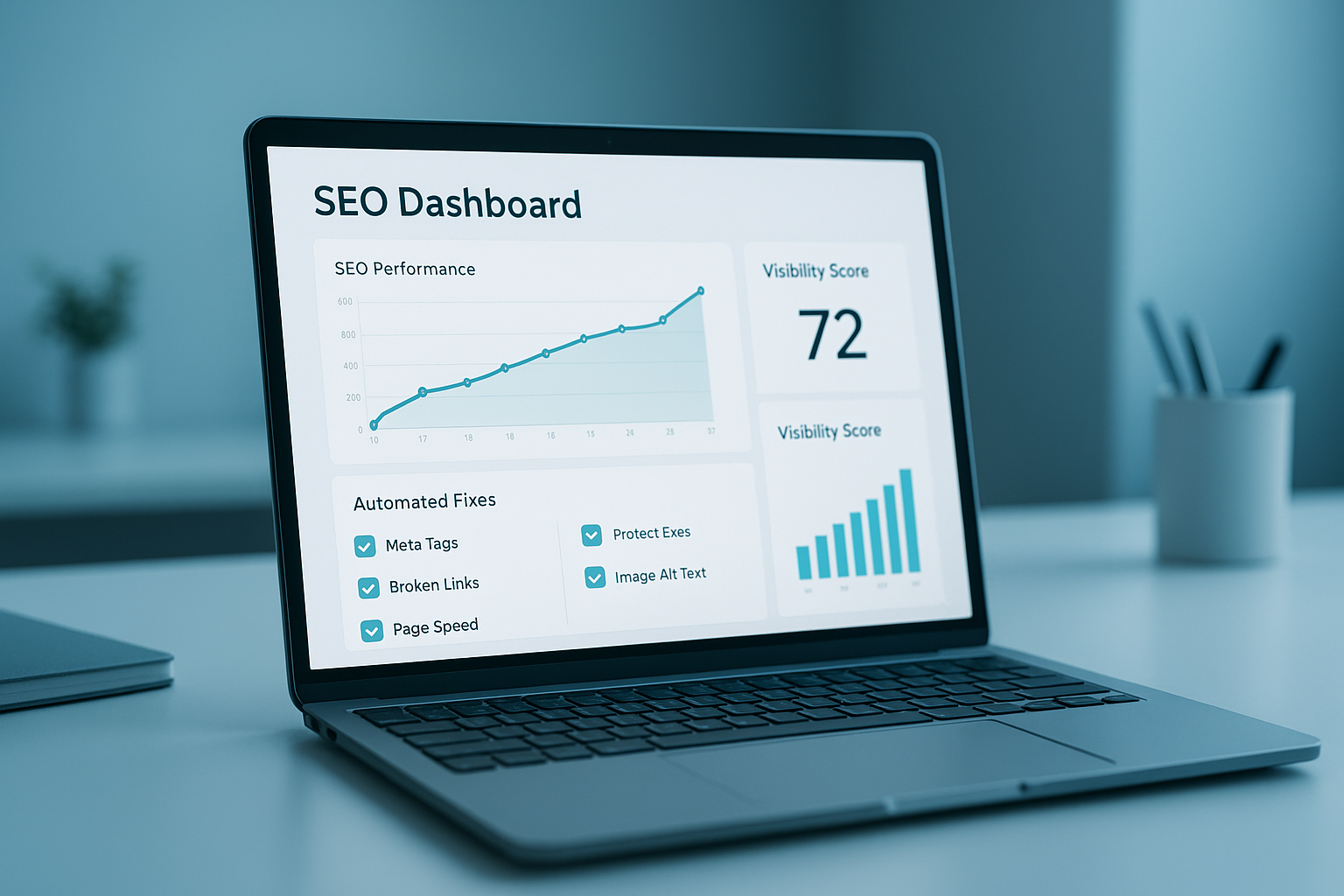
An SEO autopilot dashboard scans a site, flags issues, and tracks visibility score over time.
How Automated SEO Technology Works
In practice, most SEO autopilot systems follow a predictable sequence. Specifically, the process below mirrors how Rank Authority’s 1-Click AI AutoPilot technology operates once it is connected to a website.
- Connect your site. Link your website’s CMS, such as WordPress, Shopify, or Webflow, to the autopilot platform so it can access pages, metadata, and existing schema for analysis.
- Run the automated audit. Allow the platform to scan technical SEO elements, content gaps, schema coverage, and AI visibility signals, generating a Rank Authority Score or similar diagnostic report.
- Review suggested fixes. Examine the prioritized list of recommended changes, including title tags, internal links, schema markup, and content updates, before approving deployment.
- Deploy fixes with one click. Approve the automation action so the platform applies technical and on-page changes directly to the connected CMS without manual coding work.
- Monitor visibility and iterate. Track ranking movement, AI citation activity, and indexing status through the dashboard, then let the system continue applying incremental improvements over time.
Note: automated tools can submit pages for indexing, but Google alone determines whether and when a page is indexed.
SEO Autopilot vs. Traditional Manual SEO
Traditional SEO typically depends on a specialist manually reviewing crawl reports, writing meta tags, and building internal links one page at a time. In contrast, SEO autopilot software performs these same tasks programmatically across an entire site, often in a fraction of the time. However, this does not mean strategy becomes irrelevant. For example, decisions about target topics, brand voice, and which keywords matter most to a business still benefit from human judgment. Therefore, the most effective setups pair automated execution with periodic strategic review, rather than treating automation as a complete replacement for thinking about the business.
Additionally, agencies managing multiple client sites often find automation particularly valuable because it reduces repetitive labor across accounts. According to Google Search Central documentation, technical factors like crawlability, structured data, and page experience remain foundational ranking inputs — exactly the categories automated platforms are built to monitor continuously.
Why AI Search Makes Automated SEO Essential
Search behavior is shifting quickly. Gartner has publicly estimated that traditional search engine volume could fall significantly by 2026 as more users turn to AI chatbots and assistants for answers instead of clicking through search results. As a result, a site that ranks well on Google but is never cited by an AI answer engine may still lose meaningful visibility over time.
For this reason, SEO autopilot platforms increasingly combine three layers: traditional SEO automation for Google rankings, GEO for AI citation readiness, and AEO for structured answer formatting that favors featured snippets and conversational AI responses. Rank Authority’s approach, detailed on its AI autopilot SEO service page, folds all three into one dashboard.

SEO autopilot now spans both traditional search rankings and AI-generated answer visibility.
How Rank Authority’s SEO Autopilot Works in Practice
Rank Authority structures its automation around a measurable diagnostic called the Rank Authority Score, which reflects a site’s overall optimization health across technical SEO, GEO, and AEO factors. Specifically, the platform’s autopilot technology explainer walks through how scanning, fix generation, and deployment connect to this score.
Beyond core automation, the platform includes RankFast, which analyzes competitor pages and rebuilds stronger alternatives, and RankLink, which automates topical siloing and internal linking across a site. Meanwhile, the AI Blog Builder publishes SEO- and AEO-optimized articles on an ongoing schedule, reducing the content workload that often stalls smaller teams. Individual results vary, and outcome-based claims about ranking or traffic improvements should always be read as examples rather than guarantees.
Choosing the Right SEO Autopilot Platform
Not every automated SEO tool covers the same ground, so comparing platforms matters. In particular, business owners should check whether a tool handles technical fixes, schema generation, GEO-formatted content, and AEO structuring together, or whether it only addresses one slice of the problem. Furthermore, CMS compatibility is worth confirming upfront — platforms like Rank Authority integrate with WordPress, GoDaddy, Shopify, Wix, GoHighLevel, and Webflow, which covers most small business and agency setups.
For smaller operations specifically, Rank Authority’s page on whether the platform is effective for small businesses outlines how automation lowers the expertise barrier that traditionally kept smaller teams from competing with larger, better-resourced competitors. Likewise, the breakdown of what makes the platform unique compares its nine integrated AI tools against single-purpose SEO software.
Getting Started With a Free Trial
Above all, testing a platform before committing budget is a reasonable way to evaluate fit. Rank Authority offers a seven-day trial, which allows a business to run a full site audit, review suggested fixes, and see how the Rank Authority Score responds before subscribing to a paid plan. As with any outcome-based marketing, individual results vary and reviews reflect individual user experiences rather than guaranteed outcomes for every site.
Quick Reference: What Automated SEO Covers
- Technical audits and automated fixes (broken links, page speed, crawl errors)
- Schema markup generation and deployment
- GEO-formatted content designed for AI citation
- AEO structuring for featured snippets and AI answers
- Competitor analysis and keyword gap identification
- Indexing submission and ongoing visibility monitoring

Automation reduces the manual workload small businesses face when competing for search visibility.
Frequently Asked Questions
What is SEO autopilot?
SEO autopilot is software that automatically scans a website, identifies technical and content gaps, and applies approved optimization fixes with minimal manual work. It typically covers on-page SEO, schema markup, and ongoing monitoring.
How does SEO autopilot technology work?
It runs a continuous site audit, flags issues like missing schema or thin content, generates fixes, and deploys them to your CMS after approval. Reporting dashboards then track the resulting visibility changes.
Is SEO autopilot different from traditional SEO?
Traditional SEO relies on manual audits and specialist labor, while autopilot tools automate repetitive technical and structural tasks. Strategic decisions still benefit from human oversight, but execution speed increases significantly.
How much does SEO autopilot cost?
Pricing varies by platform and the number of sites or pages managed, often ranging from affordable small-business plans to agency-tier packages. Many providers, including Rank Authority, offer a free trial before committing.
How long does it take to see results from SEO autopilot?
Technical fixes can appear within days, while ranking and visibility improvements typically take several weeks to months as search engines recrawl and reassess the site. Individual results vary by niche and competition.
Can SEO autopilot replace an SEO agency?
It can replace much of the manual execution work an agency performs, but strategic planning and content direction often still benefit from human input. Many agencies use autopilot tools to handle client workloads more efficiently.
What is the difference between SEO autopilot and GEO?
SEO autopilot automates traditional ranking factors, while Generative Engine Optimization (GEO) focuses on structuring content so AI systems can cite it in generated answers. A complete platform automates both simultaneously.
Does SEO autopilot work for small businesses?
Yes, automation is particularly useful for small businesses without in-house SEO staff, since it reduces the expertise and time required to compete. Individual results vary depending on industry and starting site health.
What are common mistakes when using automated SEO tools?
Common mistakes include approving fixes without reviewing them, ignoring content quality, and expecting instant rankings. Automation works best when paired with periodic human review of strategy and messaging.
Can SEO autopilot fix schema markup automatically?
Many platforms generate and deploy structured data automatically, covering formats such as schema.org types like Article, FAQ, and Organization schema. This helps search engines and AI answer systems understand page content more accurately.
Does SEO autopilot guarantee first-page rankings?
No reputable platform can guarantee specific rankings, since search engines control final placement based on many factors. Individual results vary, and outcome-based claims should always be treated as examples rather than promises.
What is the 1-Click AI AutoPilot technology?
1-Click AI AutoPilot is Rank Authority’s automation feature that scans a website and streamlines approved technical and on-page fixes without requiring manual coding. It is designed to reduce the SEO workload for non-technical users.
How does SEO autopilot help with AI search visibility?
By combining traditional optimization with Generative Engine Optimization and Answer Engine Optimization, autopilot platforms structure content so it can be referenced by AI chatbots and answer engines, not just ranked in classic search results.
What should I look for in an SEO autopilot platform?
Look for automated technical audits, schema generation, GEO and AEO support, CMS integrations, and transparent reporting such as a visibility or authority score. Support for multiple sites matters for agencies managing client portfolios.
Is a free trial available for SEO autopilot platforms?
Rank Authority offers a risk-free seven-day trial so businesses can evaluate automated audits and fixes before subscribing. This lowers the barrier to testing automation against a site’s current performance, and it’s covered in more depth on the platform comparison page.
In summary, SEO autopilot removes much of the manual labor from technical optimization, schema deployment, and content publishing, while newer platforms extend that automation into GEO and AEO to keep pace with AI-driven search. As search engines like Google and AI answer tools continue to reshape how people find information, businesses that automate these foundational tasks are better positioned to maintain visibility without hiring a full in-house team. For a closer look at how this works in practice, see the background on search engine optimization or explore Rank Authority’s free diagnostic tools to see where a site currently stands. Individual results vary, and reviews reflect individual user experiences rather than guaranteed outcomes for every business.

