

Generative AI is the branch of artificial intelligence that creates brand-new content — text, images, audio, video, and even software code — by learning statistical patterns from massive datasets and then generating original output in response to a prompt. Unlike earlier AI systems built only to classify, detect, or predict, generative AI actively produces something that did not exist before. That single distinction is why it has become one of the most consequential technologies of this decade.
In just a few years, generative AI has moved out of research labs and into everyday workflows. Tools such as ChatGPT, DALL-E, and Google Gemini now let anyone — not only engineers — direct AI to write, design, and code on command. As a result, understanding how generative AI actually works is no longer optional for business leaders, marketers, developers, and creators who want to stay competitive.
This guide goes further than a typical explainer. Below, you will find a plain-language definition, an honest look at the underlying technology, a full breakdown of model types and tools, real industry use cases, the risks nobody should ignore, a step-by-step adoption plan, and an in-depth FAQ section that answers the questions people actually search for.
What Is Generative AI, Exactly?
At its core, generative AI is defined by its ability to produce outputs that resemble human-created work. Traditional, or “discriminative,” AI models are built to answer yes/no questions, detect objects in a photo, or predict a numerical value. Generative AI, however, generates entirely new artifacts — a poem, a photorealistic portrait, a working software function, or a synthesized voice — from a simple instruction called a prompt.
This distinction matters enormously for industries that depend on creative or knowledge-based output. Because generative AI can produce high-quality drafts in seconds, it fundamentally changes how teams approach content production, design prototyping, customer support, and software development.
According to Wikipedia’s overview of generative artificial intelligence, these systems are trained on datasets so large that they develop statistical representations of language, images, and other data types — enabling remarkably coherent, context-aware generation rather than simple copy-and-paste retrieval.

Generative AI models learn from billions of data points to produce text, images, and code on demand.
A Brief History: How We Got Here
Generative AI did not appear overnight. Early neural networks in the 2010s could recognize images but not create them. Generative Adversarial Networks arrived in 2014 and produced the first convincing synthetic images. Then, in 2017, Google researchers published the transformer architecture, which became the foundation for nearly every large language model that followed. By 2022, tools like ChatGPT and DALL-E 2 brought generative AI to the mainstream, and by 2024–2025, multimodal and agentic systems had pushed the technology even further. Understanding this progression helps explain why today’s models feel so capable compared with the chatbots of even five years ago.
How Does Generative AI Actually Work?
Most modern generative AI systems are built on transformer architectures — a type of neural network (a computing system loosely modeled on how brain cells connect) introduced by Google researchers in a landmark 2017 paper. Transformers process sequences of data using a mechanism called “attention,” which lets the model weigh the importance of each word or pixel relative to every other one in a sequence. You can read the original research directly in “Attention Is All You Need” on arXiv, the paper that started this entire wave of innovation.
During training, the model is exposed to enormous datasets — sometimes hundreds of billions of words or millions of images. Through this process, it learns the statistical likelihood that one token (a small unit of text, such as a word or part of a word) follows another. Therefore, when you ask it a question, it does not retrieve a stored answer; instead, it generates a statistically probable and contextually coherent response, word by word.
Additionally, many systems are fine-tuned using Reinforcement Learning from Human Feedback (RLHF), a training method that rewards the model for producing outputs that human reviewers rate as helpful, accurate, and safe. This step is critical for making AI assistants like ChatGPT practical and reliable for everyday use, rather than just technically impressive.
Key Generative AI Model Types You Should Know
Not all generative AI models work the same way. In particular, four architectures power almost every tool on the market today:
- Large Language Models (LLMs): Trained on text data to generate and understand natural language. Examples include GPT-4 and Google Gemini.
- Diffusion Models: Used for image generation by progressively refining random noise into a coherent image. DALL-E and Stable Diffusion use this approach.
- Generative Adversarial Networks (GANs): Two neural networks compete — one generates content, the other critiques it — until outputs become indistinguishable from real data.
- Variational Autoencoders (VAEs): Compress and reconstruct data, enabling controlled generation of new variations of existing content.
Generative AI vs. Traditional AI: What’s the Real Difference?
Traditional, discriminative AI is trained to sort information into categories — is this email spam, is this transaction fraudulent, is this a photo of a cat. In contrast, generative AI is trained to produce new information that fits a learned pattern. Put simply: discriminative AI answers “what is this?” while generative AI answers “make me something like this.” Both approaches are valuable, but generative AI unlocks an entirely different category of use case — creation rather than classification.
Real-World Applications: How Industries Use Generative AI Today
Generative AI is no longer a novelty — it is actively reshaping how entire industries operate. In marketing, teams use it to draft blog posts, product descriptions, and ad copy in a fraction of the usual time. Specifically, marketers who want a repeatable process should review this generative AI content marketing playbook for a structured approach to scaling output without sacrificing quality.
In software development, tools like GitHub Copilot generate code suggestions that dramatically speed up engineering workflows. Meanwhile, healthcare researchers use generative models to design new drug molecules and analyze medical imaging data, and financial firms use them to summarize regulatory filings and detect anomalies in transaction data. In entertainment, studios use AI-generated concept art and music to accelerate pre-production, and in education, generative AI powers adaptive tutoring systems that adjust explanations to each student’s level.
For SEO professionals specifically, resources like Rank Authority explore how generative AI intersects with content strategy and search visibility — an intersection that is becoming increasingly important as AI-generated answers reshape how people search.
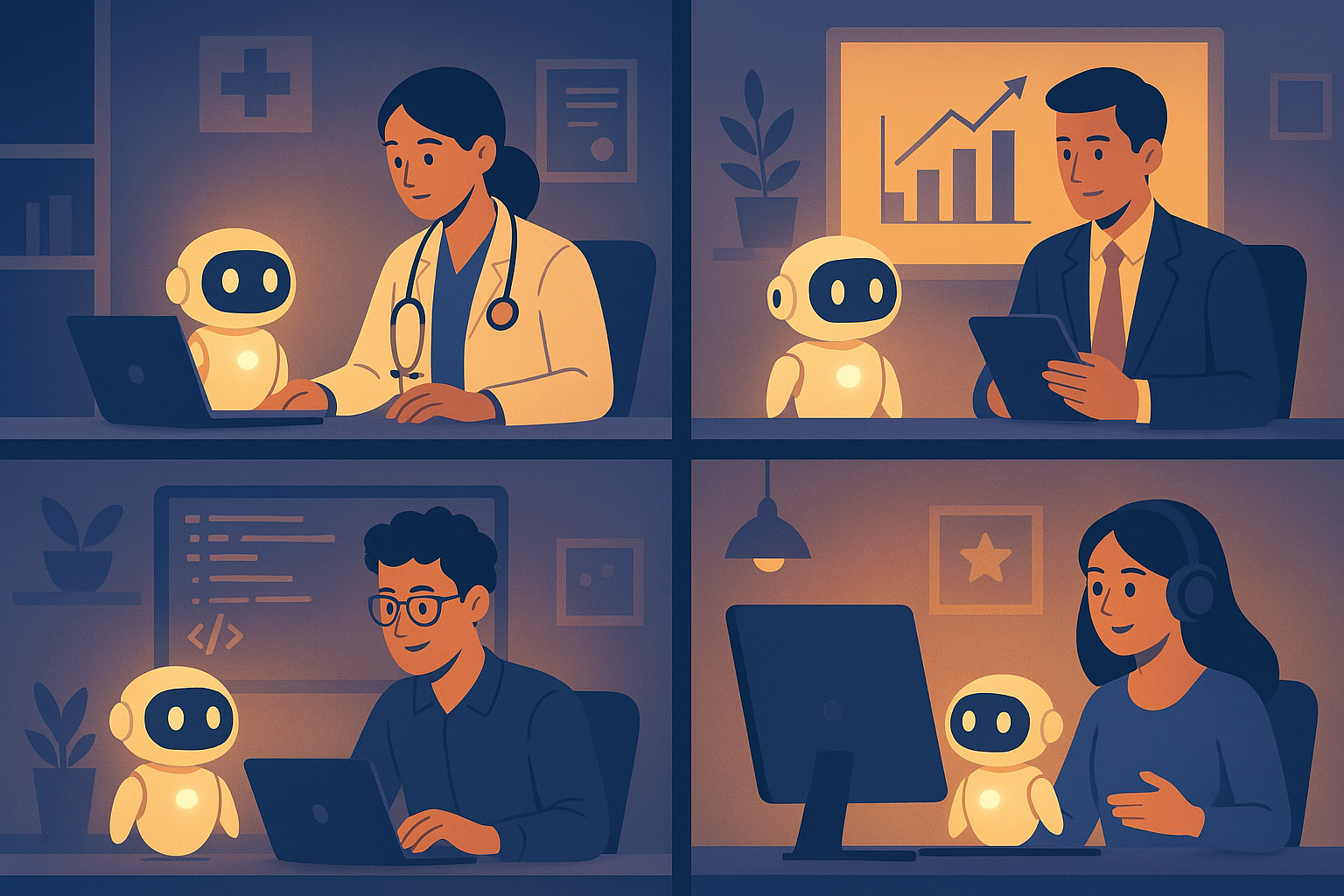
From healthcare to digital marketing, generative AI is accelerating workflows across nearly every industry. For a deeper walkthrough, see our What is Generative Engine Optimization?.
The Core Benefits of Generative AI
- Speed: First drafts of text, images, or code appear in seconds instead of hours.
- Scale: One person can now produce output that previously required a team.
- Accessibility: Non-experts can generate professional-quality design, writing, or code with plain-language prompts.
- Personalization: Content can be tailored instantly to different audiences, languages, or formats.
- Innovation: Rapid prototyping shortens the distance between an idea and a testable product.
Risks and Limitations You Cannot Ignore
Despite its impressive capabilities, generative AI carries significant risks that every user should understand. The most discussed issue is hallucination — the tendency of a model to generate confident-sounding but factually incorrect information. This happens because the model optimizes for plausibility, not truth.
In addition, questions of intellectual property remain unresolved. Because these models are trained on copyrighted text and images, their outputs can sometimes reproduce protected material without attribution. Legal frameworks are still catching up to these challenges in most jurisdictions.
Furthermore, bias is a persistent concern. If training data reflects historical inequalities or stereotypes, the model will reproduce — and sometimes amplify — those biases. Deepfakes and synthetic misinformation are a related risk, since the same technology that writes a helpful email can also fabricate a convincing fake video or voice. Responsible deployment therefore requires ongoing monitoring, diverse training data, and clear governance policies, such as the practices outlined in the NIST AI Risk Management Framework.
Finally, there is an environmental cost that is often overlooked: training and running large models consumes significant electricity and water for data-center cooling. Consequently, organizations that care about sustainability should factor model efficiency into their vendor selection, not just raw capability.
Common Mistakes When Deploying Generative AI Tools
Organizations often stumble when first adopting generative AI. However, the most frequent mistakes are entirely avoidable:
- Publishing AI output without human review — always verify facts and tone before going live.
- Using AI for sensitive decisions — legal, medical, or financial advice requires expert human oversight.
- Ignoring data privacy rules — feeding confidential customer data into third-party AI tools may violate regulations like GDPR.
- Treating AI as infallible — even the best models make errors; calibrate your trust accordingly.
- Skipping prompt engineering — vague prompts produce vague outputs; clear, specific instructions yield far better results.
How to Choose the Right Generative AI Tool
Selecting a generative AI tool depends heavily on your use case. For long-form writing and research, GPT-4 or Google Gemini offer the strongest performance. For image creation, DALL-E 3 and Midjourney produce photorealistic and artistic results respectively. For code generation, GitHub Copilot integrates directly into development environments. Compare platforms in our AI content creation platform guide.
Cost is also a practical consideration. Most platforms offer free tiers, but serious professional use typically requires a paid plan in the $10–$30 per month range for individuals, while enterprise API access scales with usage volume. Additionally, enterprise users should evaluate whether the vendor offers data privacy guarantees, such as ensuring that your inputs are not used to train future models.
Finally, consider integration. The best tool is often the one that fits most naturally into your existing workflow — whether that means a browser extension, an API, or a built-in feature in software you already use. If your priority is search visibility rather than general content creation, it is worth exploring a dedicated generative AI SEO platform built specifically to help pages rank in AI-driven search results. For a broader look at aligning AI tools with content and SEO strategy, Rank Authority offers practical frameworks worth exploring.
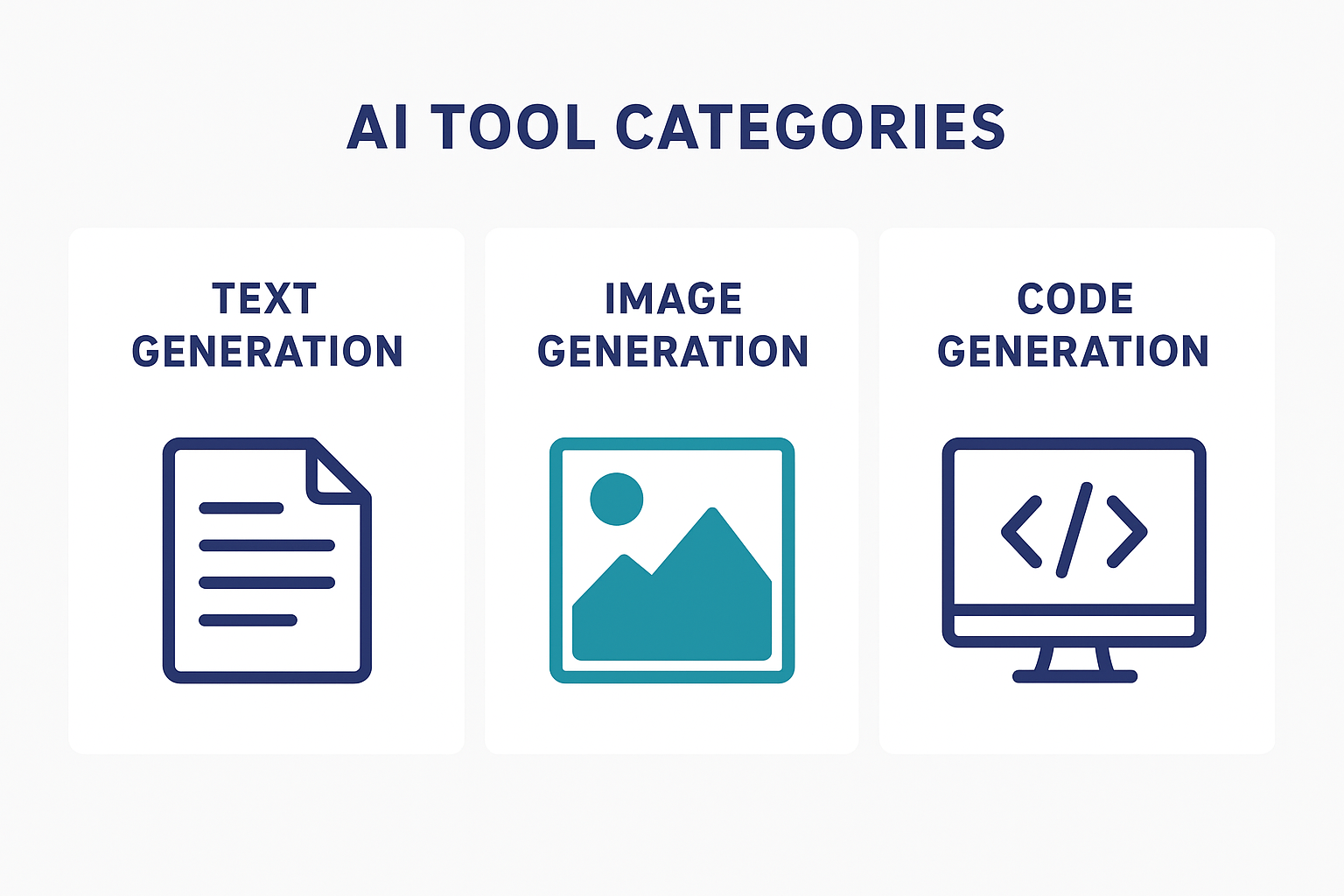
Choosing the right generative AI tool depends on your output type, budget, and integration requirements.
How to Start Using Generative AI in Your Business
Above all, successful adoption follows a repeatable process rather than a one-off experiment. Here is the sequence we recommend for any team getting started:
- Define a specific use case: Pick one narrow, measurable task — such as drafting product descriptions or summarizing support tickets — rather than trying to “adopt AI” broadly all at once.
- Choose the right generative AI tool: Match the model type (text, image, or code) and budget to your defined use case, and confirm the vendor’s data privacy terms before rollout.
- Establish a human review workflow: Require a qualified person to check every AI-generated output for accuracy, tone, and compliance before it reaches customers or the public.
- Set data privacy and governance policies: Document what information employees may and may not input into third-party tools, referencing frameworks like NIST’s AI Risk Management guidance.
- Train your team on prompt engineering: Teach staff to write clear, specific instructions, since vague prompts reliably produce vague, low-quality output.
- Measure results and scale gradually: Track time saved, quality, and error rates for four to six weeks, then expand generative AI to additional workflows once the process proves reliable.
The Future Trajectory of Generative AI
Generative AI is advancing at a pace that continues to surprise even its creators. Multimodal models — systems that simultaneously handle text, images, audio, and video — are becoming the new standard. In practice, this means a single model can accept a photo as input and return a detailed written analysis, or generate a video from a text description.
Agentic AI is another emerging frontier, where generative models are given tools — web browsers, code interpreters, APIs — and allowed to complete multi-step tasks autonomously. Although this unlocks tremendous productivity potential, it also raises new questions about oversight and accountability.
Regulatory frameworks are evolving in parallel. The European Union’s AI Act, for instance, introduces tiered risk classifications that affect how generative AI products can be deployed. Organizations that adopt responsible AI practices today will therefore be better positioned as compliance requirements tighten globally. Similarly, search itself is changing shape — as AI-generated answers appear directly in search results, teams that understand this shift early will have a lasting advantage. Our complete guide to generative engine optimization and our breakdown of generative engine optimization tools both go deeper into that transition.
Conclusion: Embracing Generative AI Thoughtfully
Generative AI represents one of the most significant technological shifts in decades. It offers genuine productivity gains, creative possibilities, and competitive advantages for those who learn to use it well. However, its risks — hallucinations, bias, copyright uncertainty, environmental cost, and misuse — are real and require deliberate management.
The organizations and individuals who benefit most from generative AI are those who treat it as a powerful collaborator rather than an infallible oracle. Start with a clearly defined use case, establish human review processes, and build your understanding incrementally. As a result, you will be equipped not just to use today’s tools, but to adapt confidently as generative AI continues to evolve.
Frequently Asked Questions
What is generative AI in simple terms?
Generative AI is a type of artificial intelligence that creates new content — such as text, images, audio, or code — by learning patterns from large datasets. Unlike traditional AI that classifies or predicts, generative AI produces original outputs based on a prompt or input.
How does generative AI work technically?
Generative AI uses neural network architectures — most commonly transformers — trained on massive datasets to predict and generate new data. During training, the model learns statistical relationships between tokens and uses those patterns to produce coherent outputs at inference time.
What are the most popular generative AI tools today?
The most widely used tools include ChatGPT and GPT-4 for text generation, DALL-E and Midjourney for image creation, Google Gemini for multimodal tasks, and GitHub Copilot for code generation. Each is optimized for a specific type of output.
What is the difference between generative AI and traditional AI?
Traditional AI is primarily designed to classify, detect, or predict outcomes based on existing data. Generative AI, in contrast, creates entirely new content that did not previously exist, making it far more versatile for creative and content-driven tasks.
Is generative AI safe to use for businesses?
Generative AI is generally safe for business use when proper guardrails are in place, including data privacy policies, output review processes, and clear usage guidelines. However, risks such as hallucinations, bias, and intellectual property concerns must be actively managed.
Can generative AI replace human writers or designers?
Generative AI can automate repetitive content tasks and accelerate creative workflows, but it currently lacks the nuanced judgment and strategic thinking that skilled humans bring. Most experts recommend treating it as a powerful assistant rather than a replacement.
What industries benefit most from generative AI?
Industries that benefit most include marketing, software development, healthcare, education, finance, entertainment, and e-commerce. Any sector that produces large volumes of content or requires rapid prototyping stands to gain significantly.
What is a large language model (LLM)?
A large language model is a type of generative AI trained on billions of text tokens to understand and produce human language. LLMs like GPT-4 and Google Gemini power most modern text-based generative AI applications.
How accurate is generative AI output?
Generative AI output can be highly accurate for well-defined tasks but is prone to hallucinations — confidently stated but factually incorrect information. Always verify important facts, statistics, or code before publishing or deploying it.
What does it cost to use generative AI tools?
Many generative AI tools offer free tiers with limited usage, while premium plans range from around $10 to $30 per month for individual users. Enterprise API access can cost significantly more depending on usage volume and the model selected.
What are the biggest risks of generative AI?
The biggest risks include misinformation from AI hallucinations, copyright and intellectual property disputes, data privacy breaches, bias amplification, and potential misuse for deepfakes or spam. Responsible deployment requires clear governance policies.
How is generative AI used in SEO and digital marketing?
In SEO and digital marketing, generative AI is used to produce blog content, meta descriptions, ad copy, social media posts, and keyword research summaries at scale. Tools must be used carefully to ensure content remains original, accurate, and genuinely helpful to users. Learn more about practical SEO uses in How AI enhances SEO.
How is generative AI regulated around the world?
Regulation varies by region. The European Union’s AI Act applies tiered risk classifications to generative AI systems, while the United States relies more on voluntary frameworks such as NIST’s AI Risk Management guidance. Organizations operating globally should track requirements in every market they serve.
Does generative AI have an environmental impact?
Yes. Training and operating large generative AI models requires significant electricity and water for data-center cooling. Consequently, sustainability-conscious organizations increasingly factor model efficiency into their vendor and tool selection.

