
How to analyze keyword gaps using AI tools is one of the fastest ways to uncover ranking opportunities your competitors have already locked down. Instead of combing through spreadsheets by hand, AI-powered platforms compare your content against rival pages in minutes and surface the exact search terms you’re missing. In fact, this process has become essential as AI search features reshape how people discover information online. This guide breaks down the practical steps, the tools involved, and the mistakes worth avoiding so you can close those gaps before competitors pull further ahead.
Quick answer: To analyze keyword gaps using AI tools, connect your site and two or three competitor URLs to an AI-powered SEO platform, then run a gap comparison report. The tool flags keywords competitors rank for that you don’t, scores them by volume and difficulty, and helps you prioritize the highest-impact opportunities first, often in minutes rather than hours of manual spreadsheet work.
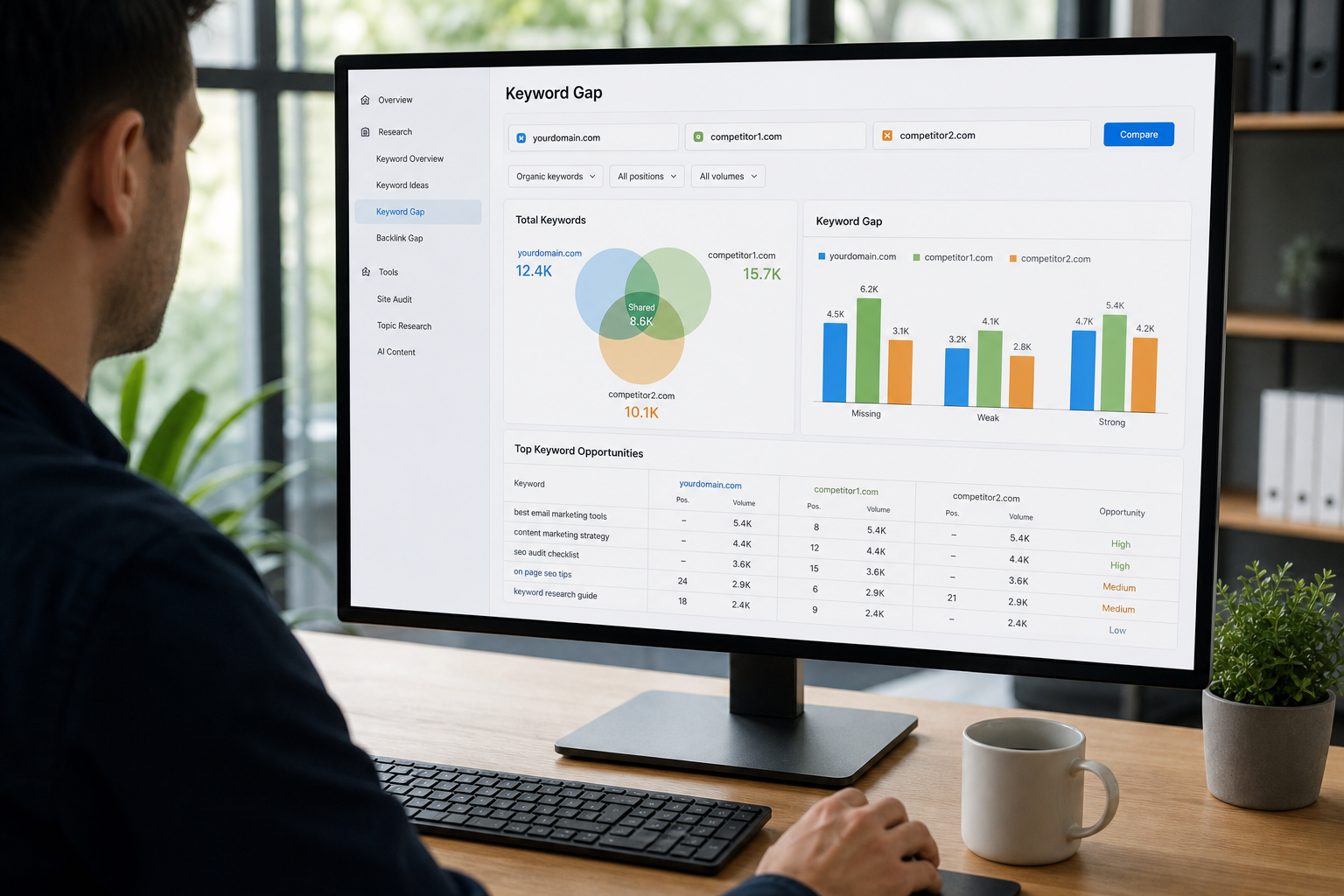
An AI dashboard comparing ranking keywords across competitor sites.
What Is Keyword Gap Analysis?
Keyword gap analysis is the process of comparing your website’s ranking keywords against one or more competitors to find valuable search terms you haven’t targeted yet. Essentially, it highlights the content opportunities your rivals have captured and you haven’t. Traditionally, marketers performed this comparison manually using spreadsheets, cross-referencing keyword lists one at a time.
However, that approach is slow, error-prone, and difficult to scale across dozens of competitors or thousands of keywords. Search engine optimization, broadly defined, is the practice of improving a site’s visibility in organic search results, and keyword gap analysis is one of its most actionable subcomponents. As a result, teams that once needed days to complete a thorough gap analysis can now get actionable results in far less time once AI enters the workflow.
How to Analyze Keyword Gaps Using AI Tools: Step-by-Step Process
Analyzing keyword gaps with AI tools follows a repeatable workflow. Below is the process most AI-powered SEO platforms, including Rank Authority, use to surface competitor opportunities quickly.
- Connect your website and competitor URLs. Add your domain plus two or three direct competitors to an AI SEO platform so the system has enough data to compare ranking keywords accurately.
- Run the AI-powered gap comparison report. The platform scans both sites, cross-references ranking keywords, and generates a list of terms your competitors rank for that your site currently does not.
- Filter results by intent, volume, and difficulty. Narrow the raw list down to keywords that match your audience’s search intent and offer a realistic chance of ranking within your current site authority level.
- Prioritize quick-win opportunities for content. Focus first on gaps with decent search volume and lower competition, since these typically require less effort to rank for compared with highly competitive terms.
- Build or update content and track results. Use tools such as an AI Blog Builder to create optimized pages for each gap, then monitor rankings over the following weeks to measure progress.
For a deeper breakdown of each stage, see this guide on how to identify keyword gaps using AI tools, which walks through data interpretation in more detail.
Why AI Outperforms Manual Keyword Gap Analysis
Manual keyword research simply can’t keep pace with how quickly search behavior is changing. According to Gartner, traditional search engine volume is projected to drop by 25% by 2026 as more users turn to AI chatbots and virtual agents for answers (Gartner, 2024). Consequently, businesses that rely only on manual spreadsheets risk missing both traditional keyword opportunities and the structured content that AI answer engines prefer to cite.
Data point: Gartner predicts a 25% drop in traditional search engine volume by 2026 as AI chatbots and virtual agents absorb more queries, a trend that makes AI-assisted keyword gap analysis increasingly important for staying visible.
In contrast, AI-driven platforms continuously monitor ranking shifts, flag new gaps as they emerge, and adjust recommendations as competitor content changes. For example, this resource on how AI improves keyword research and gap analysis explains how automated monitoring extends beyond a one-time audit.
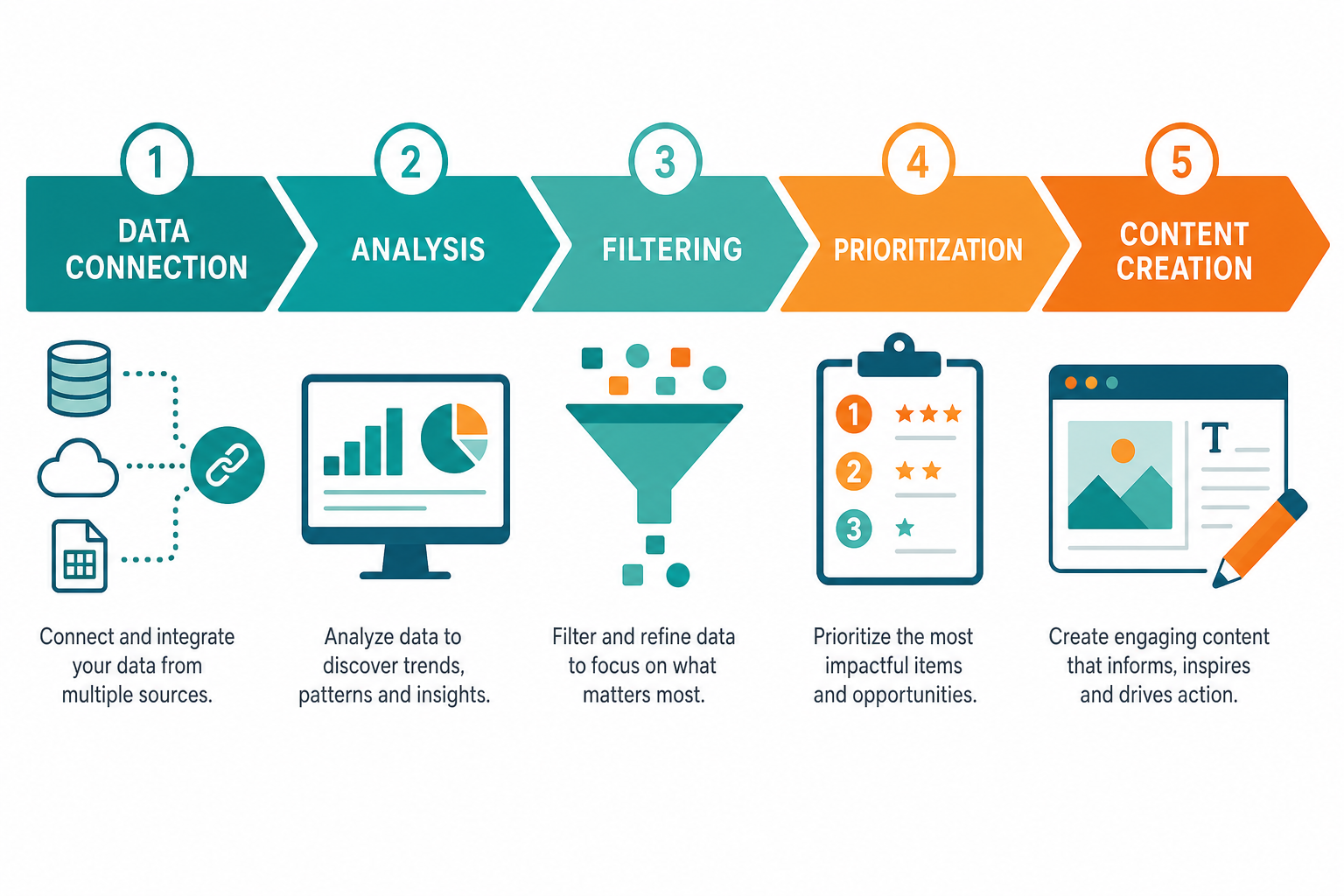
A simplified view of the five-step AI keyword gap analysis workflow.
Best AI Tools for Finding Keyword Gaps
Several categories of AI tools make keyword gap analysis faster and more accurate. Dedicated competitor analysis tools, such as Rank Authority’s RankFast, scan rival pages and rebuild content strategies to outrank them directly. Meanwhile, topical mapping tools like RankLink identify silo and internal linking opportunities once gaps are found, helping new content connect naturally to existing site authority.
If you’re comparing options, this breakdown of which AI tools help with deep keyword gap analysis covers feature sets side by side. Similarly, for teams focused specifically on content-level gaps rather than keyword-level gaps, this guide on which AI tool finds competitor content gaps explains the distinction and recommends tools for each use case.
Free diagnostic tools can also help smaller teams get started before committing to a full platform. For instance, Rank Authority offers a free AI Visibility Checker and Keyword Checker alongside its paid plans, along with a ten-day trial for the full 1-Click AI AutoPilot platform.
Common Mistakes in AI-Driven Keyword Gap Analysis
Even with automation, a few recurring mistakes can undermine results. Above all, avoid treating every flagged gap as equally valuable, since some terms carry far more business impact than others.
- Comparing against the wrong competitors, such as sites that aren’t true market rivals.
- Ignoring search intent and chasing keywords that don’t match what your audience actually needs.
- Running the analysis once and never revisiting it as competitor content changes.
- Publishing content for every gap at once instead of prioritizing by realistic ranking potential.
To keep results reliable over time, treat keyword gap analysis as an ongoing habit rather than a one-time audit. Rerun comparisons monthly, verify your competitor set as the market shifts, and cross-check AI-generated recommendations against real search intent. For a broader look at automating this entire process, this complete guide to automated keyword research tools covers additional methods worth testing. For general search guidance, Google’s own Search Central documentation is also a useful reference point.

Reviewing competitor keyword opportunities surfaced by an AI tool.
Frequently Asked Questions About Keyword Gap Analysis
What is keyword gap analysis?
Keyword gap analysis is the process of comparing your website’s ranking keywords against competitors to find valuable search terms you haven’t targeted yet. It highlights content opportunities your rivals have already captured.
How do you analyze keyword gaps using AI tools?
To analyze keyword gaps using AI tools, connect your site and competitor URLs to an AI SEO platform, run a gap comparison report, then filter and prioritize the resulting keywords by intent, volume, and difficulty.
Why is AI-powered keyword gap analysis better than manual methods?
AI tools process thousands of keywords in minutes, update results as rankings shift, and score opportunities automatically. Manual spreadsheet comparisons are slower, harder to scale, and quickly become outdated.
How much does AI keyword gap analysis cost?
Costs vary widely, from free diagnostic tools to monthly subscription platforms. Many providers, including Rank Authority, offer free scans or a trial period before requiring a paid plan.
How long does it take to find keyword gaps with AI?
Most AI platforms generate a full gap comparison report within minutes once your domain and competitor URLs are connected. Manual research on the same dataset could take hours or days.
What’s the difference between keyword gap analysis and general competitor analysis?
Keyword gap analysis focuses specifically on search terms, while competitor analysis is broader and may include backlinks, site structure, and content strategy. Many AI platforms combine both views in one report.
What are common mistakes when analyzing keyword gaps?
Common mistakes include comparing against the wrong competitors, ignoring search intent, and treating every gap as equally valuable. Prioritizing by realistic ranking potential avoids wasted content effort.
Which AI tools are best for keyword gap analysis?
Platforms that combine competitor scanning, content rebuilding, and internal linking automation tend to perform best, since they turn identified gaps into finished content rather than just a list of keywords.
How often should I run a keyword gap analysis?
Running a gap analysis monthly is a reasonable baseline for most sites, though competitive industries may benefit from more frequent checks as competitor content and rankings shift.
Can AI tools analyze keyword gaps for multiple competitors at once?
Yes. Most AI-powered platforms allow you to compare your site against several competitors simultaneously, consolidating overlapping and unique keyword opportunities into a single prioritized report.
Does closing keyword gaps guarantee higher rankings?
No. Closing keyword gaps improves your content coverage and visibility potential, but rankings also depend on content quality, site authority, and technical factors. Individual results vary.
How does Rank Authority help with keyword gap analysis?
Rank Authority combines AI-driven gap detection with RankFast competitor rebuilding, RankLink internal linking, and an AI Blog Builder, helping users move from identified gaps to published content in one workflow. Individual results vary, and Google alone determines indexing timing for any published pages.
Conclusion
Ultimately, learning how to analyze keyword gaps using AI tools comes down to connecting the right data sources, letting automation handle the heavy comparison work, and prioritizing opportunities based on real business value. Rather than spending days cross-referencing spreadsheets, modern platforms like Rank Authority complete the comparison in minutes and surface gaps across both traditional search and AI answer engines. Individual results vary, but teams that make keyword gap analysis a regular habit typically uncover content opportunities competitors have already missed. Consider starting with a free scan or a ten-day trial to see where your own gaps exist.