

Topic clusters SEO is a content strategy that organizes a website’s pages around a central pillar topic, with related subtopics linked back to that hub, to build topical authority and improve rankings across both traditional search and AI-powered answer engines. Instead of publishing scattered, unrelated posts, businesses that adopt this model group content so search engines and generative engines see clear depth around a subject. As a result, sites earn more citations, climb rankings faster, and stay visible as AI reshapes how people find information. In this guide, you’ll learn exactly how topic clusters seo works and how to build one step by step.
Direct answer: Topic clusters SEO links a comprehensive pillar page to several focused subtopic pages, creating an interconnected content structure that signals depth and relevance. This structure helps both Google and AI answer engines understand and cite your content with greater confidence.
What Is Topic Clusters SEO?
Topic clusters seo refers to grouping related content under one pillar page so every subtopic page reinforces the main theme. The pillar page covers the broad subject at a high level, while each cluster page dives into one specific angle in detail. Every cluster page links back to the pillar, and the pillar links out to each cluster page, forming a tight, interconnected web.
This model replaced the older practice of isolated blog posts competing against each other for similar keywords. Instead, content works together. For example, a pillar page on “content marketing” might link to cluster pages on keyword research, content calendars, and distribution, each reinforcing the parent topic.
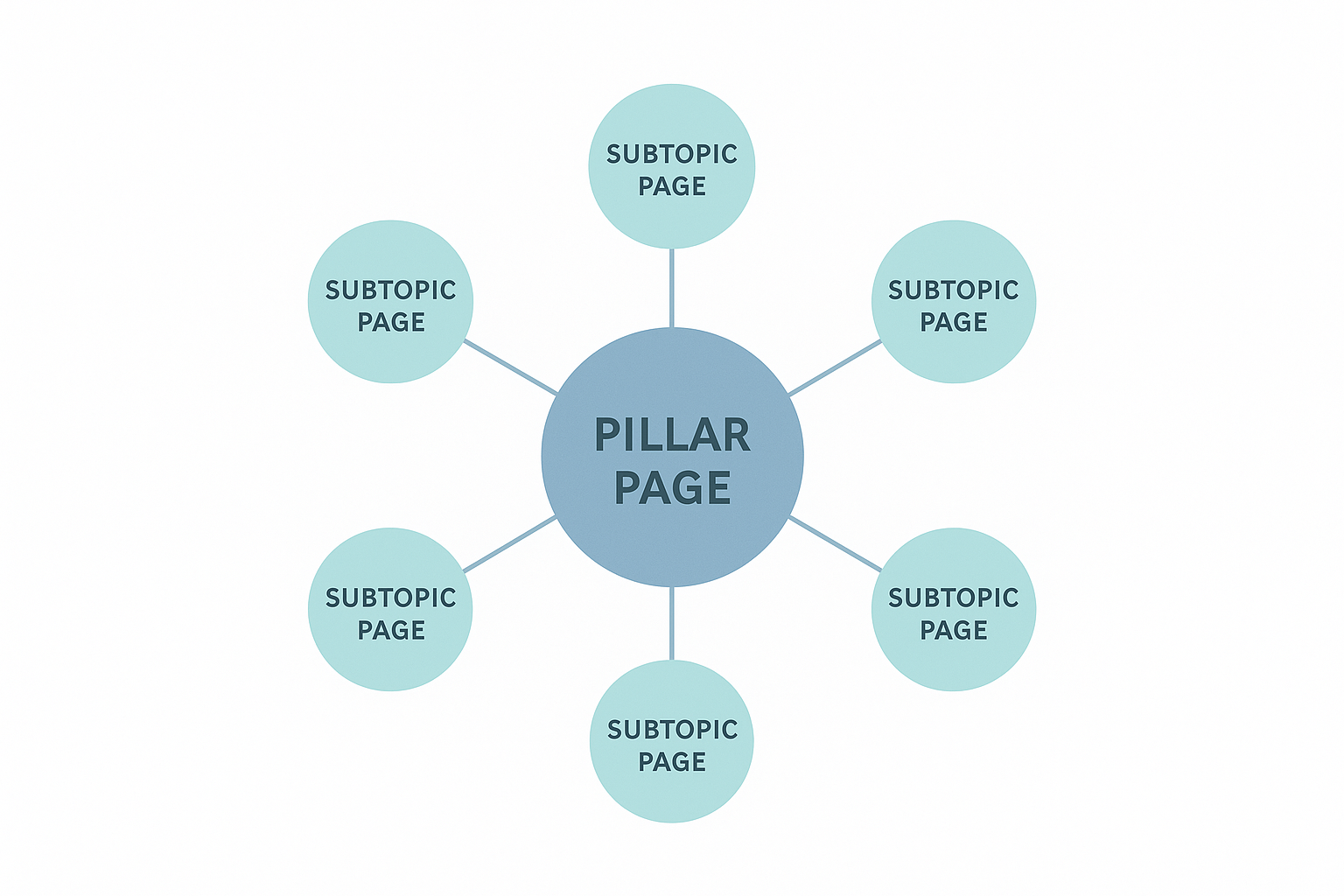
A visual representation of how topic clusters seo connects a pillar page to supporting subtopic content.
Why Topic Clustering Matters for AI Search Visibility
Search engines have evolved well beyond simple keyword matching. Today, Google’s systems and AI answer engines such as ChatGPT and Perplexity evaluate how thoroughly a site covers a subject before deciding what to rank or cite. Consequently, a single isolated article rarely competes with a well-linked cluster covering the same subject from multiple angles.
In addition, internal linking patterns within a cluster distribute authority more evenly across pages, which strengthens overall domain relevance. According to Google’s own documentation on SEO fundamentals, clear site structure and topical relevance remain core ranking signals. For AI systems, that same structure makes it easier to locate a definitive, well-organized source worth citing in generated answers.
Therefore, businesses pursuing Generative Engine Optimization (GEO) and Answer Engine Optimization (AEO)—techniques focused on earning citations in AI-generated answers—often start by building topic clusters. Strong content discoverability, as outlined in these best practices for improving content discoverability, depends heavily on this kind of organized structure.
How to Build a Topic Cluster Strategy Step by Step
Building an effective cluster takes planning, but the process itself is straightforward. Follow these five steps to structure your next content cluster correctly.
- Choose a broad pillar topic. Select a subject broad enough to support multiple subtopics but specific enough to matter to your audience and business goals.
- Research related subtopics. Use keyword research methods for better SEO rankings and competitor gap analysis to uncover ten to fifteen related questions your audience actually searches for.
- Build the pillar page. Write a comprehensive overview that introduces every subtopic briefly and links out to the dedicated page covering it in depth.
- Publish and interlink cluster pages. Create a page for each subtopic, link every one back to the pillar, and connect closely related cluster pages to each other.
- Add schema and monitor visibility. Apply structured data to each page, then track rankings and AI citations using a visibility monitoring tool, such as the diagnostics available at Rank Authority.
Notably, subtopic research is where many clusters succeed or fail. Tools built for AI-powered keyword research can speed up this step considerably by surfacing subtopics competitors have missed.

Planning subtopics visually makes it easier to see how each piece supports the central pillar.
Topic Clusters vs. Traditional Content Silos
Traditional content silos organize pages into rigid categories with minimal cross-linking between sections. In contrast, topic clusters actively connect a pillar page with every related subtopic, creating a flexible web rather than a sealed box. This difference matters because modern algorithms, including those behind AI answer engines, reward demonstrated relationships between pages, not just folder structure.
Furthermore, silos tend to create duplicate or competing pages that target the same keyword, which can confuse search engines about which page should rank. Clusters avoid this problem by assigning each subtopic page a distinct, non-overlapping angle on the broader subject. For a deeper comparison of strategy options, see which SEO strategies yield the best results today.
Common Mistakes to Avoid With Topic Clusters SEO
Even well-intentioned clusters can underperform when a few common errors creep in. First, choosing a pillar topic that is too broad spreads subtopics too thin to feel connected. Second, forgetting to link subtopic pages back to the pillar breaks the very structure that makes clusters effective.
Third, publishing overlapping content across cluster pages dilutes relevance signals instead of strengthening them. Finally, skipping schema markup leaves valuable context unused; structured data helps both traditional crawlers and AI systems parse page content accurately. According to Wikipedia’s overview of search engine optimization, structured organization has consistently been linked to improved crawlability and ranking stability over time.
Measuring Topical Authority and AI Visibility
Once a cluster is live, measurement becomes essential. Specifically, track keyword rankings for both the pillar and each subtopic page, monitor referral traffic between cluster pages, and watch for appearances in AI-generated answers. Industry research suggests that pages with strong internal linking structures can see meaningfully higher organic visibility compared to isolated, unlinked pages, though individual results vary by niche and competition.
In addition, tools that combine an RA Score with AI visibility monitoring make it easier to see which cluster pages are gaining citations across AI platforms, not just traditional rankings. Reviewing techniques for how to boost website rankings efficiently with AI can help you prioritize which cluster pages need reinforcement first.
Frequently Asked Questions
What is topic clusters SEO?
Topic clusters SEO is a content organization strategy where a central pillar page links to several related subtopic pages, and those pages link back to the pillar. This structure signals depth and topical authority to search engines and AI answer systems.
How do topic clusters improve search rankings?
Topic clusters improve rankings by concentrating internal links and relevance signals around one subject instead of spreading them across unrelated pages. As a result, search engines see a clearer, more authoritative picture of what your site covers.
Why are topic clusters important for AI search engines?
AI search and answer engines favor sources that demonstrate comprehensive coverage of a subject, since that depth makes a page easier to cite confidently. Topic clusters create exactly that kind of structured, interconnected depth.
What is the difference between topic clusters and content silos?
Traditional content silos isolate pages into rigid categories with limited cross-linking, while topic clusters actively link a pillar page and its subtopics together. Clusters are generally more flexible and better suited to how modern search algorithms evaluate relevance.
How much does it cost to implement a topic cluster strategy?
Costs vary widely based on whether you build clusters manually, hire a content team, or use automation software. Platforms that automate research, drafting, and internal linking can reduce the time investment significantly compared to fully manual production.
How long does it take to see results from topic clusters SEO?
Most sites begin noticing ranking and visibility improvements within two to four months of consistently publishing and linking clustered content. Individual results vary depending on competition, domain history, and publishing frequency.
What are common mistakes businesses make with topic clusters SEO?
Common mistakes include choosing a pillar topic that is too broad, forgetting to link subtopic pages back to the pillar, and duplicating content across clusters. These errors dilute the authority signal the cluster is meant to build.
What is a pillar page in a topic cluster?
A pillar page is a comprehensive overview of a broad topic that introduces subtopics covered in more detail on separate cluster pages. It acts as the central hub that organizes and links the entire cluster together.
How many subtopics should a topic cluster include?
There is no fixed number, but most effective clusters include between five and fifteen subtopic pages depending on how broad the pillar topic is. Quality and relevance matter more than hitting a specific count.
Can small businesses use topic clusters SEO effectively?
Yes, small businesses can use topic clusters SEO to compete with larger sites by focusing deeply on a narrower set of topics relevant to their customers. Automation tools make this approach more accessible even without a dedicated SEO team.
How do internal links support topic cluster strategy?
Internal links connect subtopic pages to the pillar page and to each other, helping search engines understand relationships between pages. This linking pattern also distributes ranking authority more evenly across the cluster.
What tools help automate topic cluster SEO?
Tools that combine keyword research, content generation, and automated internal linking can speed up cluster creation considerably. For example, Rank Authority offers keyword gap analysis, an AI Blog Builder, and RankLink for automated topical siloing.
Does topic clusters SEO help with AI citations?
Yes, well-structured topic clusters make it easier for generative and answer engines to locate comprehensive, well-linked content worth citing. Clear schema markup and direct-answer formatting further strengthen that citation potential.
Final Thoughts on Topic Clusters SEO
Ultimately, topic clusters seo gives businesses a repeatable framework for building topical authority instead of chasing individual keywords one post at a time. By pairing a strong pillar page with well-linked subtopic content, you create the kind of depth that both traditional search engines and AI answer platforms are designed to reward. Above all, consistency matters: clusters built and maintained over time tend to outperform one-off content bursts.
As AI-powered search continues to reshape discovery, investing in clear structure, internal linking, and schema markup positions your site to earn both rankings and citations. Reviews and case studies reflect individual user experiences and are not guaranteed results for all users; individual results vary. Whether you build clusters manually or rely on automation to speed up the process, the core principle remains the same—organized, interconnected content wins.

