
Local SEO Strategy
“Knowing where you stand against local rivals is not a luxury — it is the foundation of every effective SEO decision you will ever make.”
Running a rank comparison audit for local competitors is one of the highest-leverage activities available to any local business owner or SEO professional. A rank comparison audit for local competitors is a structured, data-driven process of measuring your website’s keyword positions directly against those of rival businesses operating in the same geographic market — then using those gaps to build a prioritized action plan. Whether you run a dental clinic, a law firm, a plumbing company, or a boutique retailer, understanding precisely where competitors outrank you in local search transforms guesswork into strategy.
Direct Answer
A rank comparison audit for local competitors identifies every keyword where nearby businesses outrank you, quantifies the gap, and reveals the exact on-page, off-page, and citation factors driving the difference. Fixing those gaps systematically is what produces sustainable local search dominance.

A structured rank comparison audit for local competitors turns raw ranking data into clear, actionable priorities.
What Is a Rank Comparison Audit for Local Competitors?
A rank comparison audit for local competitors is a structured SEO process where you measure your website’s keyword rankings against those of nearby competing businesses. It reveals where you rank lower, where opportunities exist, and what strategic changes can help you outperform rivals in local search results.
Unlike a general SEO audit — which focuses on your own site in isolation — a rank comparison audit is inherently relational. It asks not just “how am I performing?” but “how am I performing compared to the businesses my customers are actually choosing instead of me?” That competitive lens makes every finding immediately actionable.
According to search engine optimization principles documented on Wikipedia, competitive analysis has always been a core pillar of effective SEO — and local SEO is no exception. The local search landscape adds geographic targeting, Google Business Profile signals, and citation consistency as additional variables that must be compared across competitors.
Why Local Businesses Cannot Afford to Skip This Audit
Local search results are fiercely competitive and hyper-specific. A business ranking third for “emergency plumber Chicago” loses the vast majority of clicks to the two businesses above it — and those two businesses may be outranking you for reasons that are entirely fixable once you know what they are. Without a rank comparison audit, you are optimizing blindly.
Without the Audit
- Spending budget on already-strong keywords
- Missing high-value gaps competitors exploit
- No benchmark to measure progress
- Reactive rather than strategic SEO
With the Audit
- Clear ranking gap map by keyword
- Prioritized list of winnable positions
- Competitor weakness identification
- Measurable, data-driven SEO roadmap
Step-by-Step: How to Run a Rank Comparison Audit
Step 1 — Identify Your True Local Competitors
Your local competitors for SEO purposes are not necessarily the businesses you think of as rivals. They are the websites that appear in the top ten results when your ideal customers search your target keywords. Search your five most important service keywords in an incognito browser window with your target city appended. Document every domain that appears in positions one through ten. These are your audit subjects.
Step 2 — Build Your Keyword Universe
Pull your existing keyword rankings from Google Search Console. Then use a tool like Semrush or Ahrefs to extract the keywords each competitor ranks for that you do not. This gap list is gold — it represents search demand that your competitors are capturing and you are not. Segment these keywords by search intent: informational, navigational, transactional, and local intent.
Step 3 — Map Ranking Positions Side by Side
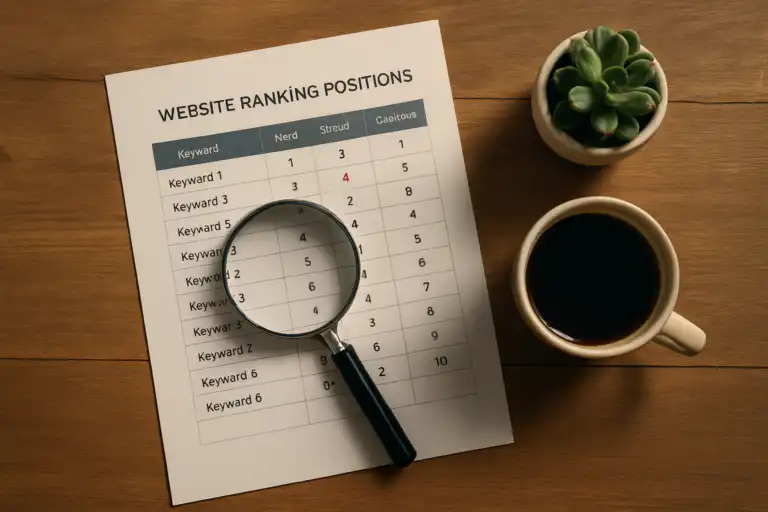
Create a master comparison table with keywords as rows and your domain plus each competitor domain as columns. Populate each cell with the current ranking position. Highlight in red any keyword where a competitor holds positions one through three and you hold positions four through twenty or lower. These red cells are your highest-priority targets.

Color-coded ranking tables make it immediately clear where competitors hold stronger positions in local search.
Step 4 — Analyze the Factors Driving Competitor Rankings
For each high-priority gap keyword, visit the competitor’s ranking page and audit these specific elements:
- Page title and meta description — Is the keyword present and compelling?
- Content depth and word count — Are they publishing more thorough, useful content?
- Internal linking structure — Do they link supporting pages to this target page?
- Backlink profile — How many and what quality of external sites link to this page?
- Google Business Profile signals — Review count, recency, and category accuracy
- Citation consistency — NAP (Name, Address, Phone) uniformity across directories
Tools like Rank Authority’s scoring system can accelerate this step by generating a comparative authority score between your domain and competitor domains, helping you instantly quantify how large the gap is and what category of effort — content, links, or technical fixes — will close it fastest.
Step 5 — Score and Prioritize Your Opportunities
Not every ranking gap is equally worth pursuing. Score each opportunity using three factors: search volume (how many people search this keyword monthly), ranking gap size (how far you are from position one), and competitive difficulty (how strong the current top-ranking page is). Multiply or weight these scores to produce a priority index. Focus your first 90 days of effort on the top 20% of opportunities by this index — those are the keywords where your effort will produce the fastest, most meaningful ranking movement.
How Often Should You Run a Local Competitor Rank Audit?
Most local businesses benefit from running a rank comparison audit every 30 to 60 days. High-competition markets — personal injury law, cosmetic dentistry, real estate — may require monthly audits because competitors are actively optimizing and positions shift frequently. Less competitive local niches can be audited quarterly without losing strategic advantage.
Between full audits, automated rank tracking keeps you informed of sudden position changes. Rank Authority’s real-time SEO issue alerts can notify you immediately when a competitor surges past you on a high-value keyword — allowing you to respond strategically rather than discovering the loss weeks later during your next scheduled audit.
Audit Frequency Guide
Monthly
High-competition markets: law, dental, real estate
Bi-Monthly
Mid-competition service businesses and retailers
Quarterly
Low-competition niches with stable local SERPs
Frequently Asked Questions
What tools are best for comparing local competitor rankings?
Effective tools for a rank comparison audit for local competitors include Google Search Console, BrightLocal, Semrush, Ahrefs, and Rank Authority’s own scoring and alert system. Each tool provides different angles on keyword positions, visibility, and ranking trends. Using two or three tools in combination gives you the most complete picture. For a deeper walkthrough, see our Ranked SEO: The Complete Guide to Dominating Search.
What metrics matter most in a local competitor rank audit?
The most critical metrics are keyword position gaps, local pack inclusion rates, domain authority differentials, page-level ranking performance, and the volume of keywords where competitors outrank you in the top three positions. Citation consistency and review velocity also factor heavily into local pack rankings.
Can rank comparison audits improve my Google Business Profile performance?
Yes. A rank comparison audit surfaces which competitors appear more frequently in the Google local pack and why, allowing you to optimize your Google Business Profile with better categories, reviews, photos, and citation consistency to close the gap. Local pack visibility often improves faster than organic rankings after targeted optimizations.

Collaborative review of competitor data helps teams align on which ranking gaps to prioritize first.
Turning Audit Findings Into a Ranking Action Plan
An audit without execution is just a document. Once you have your prioritized gap list, translate it into a 90-day sprint plan with specific deliverables. For each high-priority keyword gap, assign one owner and one deadline for each of the following actions:
- Content creation or expansion — Write or improve the page targeting that keyword to match or exceed the competitor’s depth and quality.
- On-page optimization — Update title tags, meta descriptions, header structure, and internal links pointing to the target page.
- Local link acquisition — Identify the specific backlinks the competitor has that you lack, and pursue equivalent or superior links from local directories, press, and partners.
- Citation cleanup — Audit your NAP data across all major directories and correct any inconsistencies that may be suppressing your local pack visibility.
- Google Business Profile optimization — Add missing service categories, upload fresh photos, respond to all reviews, and post weekly updates to signal active engagement.
Track position changes weekly for your sprint keywords so you can see which actions are producing movement and which need to be revised. After 90 days, run your next rank comparison audit to measure progress and identify the next wave of opportunities.
Key Takeaway
Running a consistent rank comparison audit for local competitors is not a one-time exercise — it is an ongoing competitive intelligence system. Businesses that audit regularly, act on findings quickly, and track results rigorously are the ones that accumulate and hold top local search positions over time. Start your first audit this week, focus on the highest-priority gaps, and revisit the data every 30 to 60 days to stay ahead of every rival in your market.

