
The Complete 2025 Guide
Page Comparison for SEO: The Definitive Guide to Outranking Your Competitors
Understanding why a competitor outranks you starts with one disciplined practice: page comparison for SEO — the systematic, side-by-side evaluation of your page versus the pages sitting above you in search results. This guide walks you through every layer of that process: the foundational concepts, a seven-element diagnostic checklist, a repeatable step-by-step workflow, the best tools, and the advanced techniques most guides skip entirely.
Quick Answer
Page comparison for SEO is the process of systematically evaluating two or more web pages — typically your own page against top-ranking competitors — to identify structural, content, technical, and off-page differences that explain ranking gaps. Done consistently, it is one of the highest-leverage activities in any SEO workflow, converting vague ranking problems into precise, prioritized action items.
What Is Page Comparison for SEO?
Page comparison for SEO is a structured analytical method where you place two or more web pages side by side and measure them across a defined set of ranking signals. Those signals span on-page elements (titles, headings, body copy, keyword usage), technical factors (page speed, Core Web Vitals, schema markup, crawlability), and off-page indicators (backlink profiles, domain authority, topical trust). The goal is not to copy a competitor — it is to understand the precise gap between where your page is and where it needs to be to earn a top-three position.
According to Wikipedia’s overview of search engine optimization, modern SEO involves dozens of interdependent ranking factors. Page comparison gives you a practical lens to prioritize which of those factors matter most for a specific query, intent type, and competitive landscape — rather than applying generic optimizations that may not move the needle for your particular page.
It is also important to distinguish page comparison for SEO from basic keyword research or a standard SEO audit. A keyword research session tells you what terms people search for. A standard audit checks your site for technical errors. A page comparison tells you why a specific competitor outranks a specific page of yours for a specific query — and what you need to change to reverse that outcome. It is the most surgical form of competitive SEO analysis available.

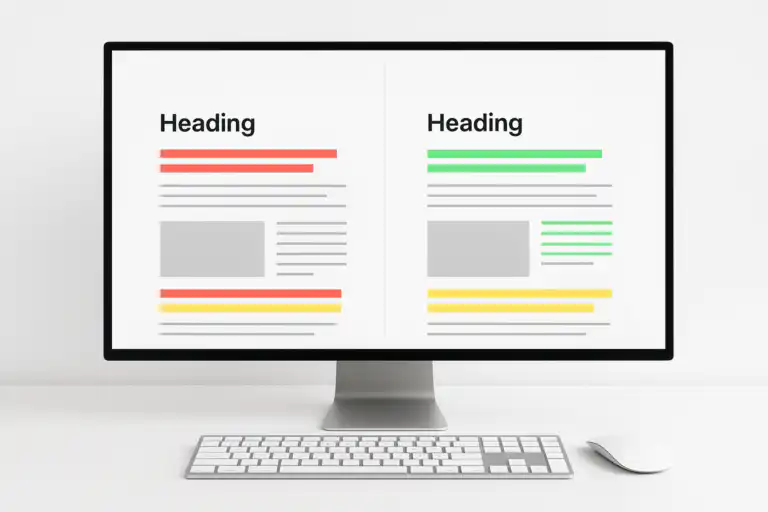
A structured page comparison for SEO reveals the exact gaps separating your content from the top-ranking result.
Why Page Comparison Matters More Than Ever in 2025
Google’s ranking systems have grown dramatically more sophisticated. Broad keyword stuffing and thin content no longer move the needle. What does move the needle is demonstrable quality relative to competing pages. That is precisely what a rigorous page comparison surfaces.
When a page drops in rankings after a core algorithm update, the cause is almost always relational — meaning your page did not necessarily decline in absolute quality, but competing pages improved faster or more comprehensively. Without a comparison framework, you are diagnosing a relative problem with only absolute data. That is like trying to win a race by only looking at your own lap times while ignoring everyone else on the track.
With the rollout of Google’s AI Overviews and the increasing prevalence of zero-click searches, the top one or two organic positions command a disproportionate share of traffic. The stakes of every ranking gap have risen considerably. A page sitting at position 5 that could reach position 2 through targeted improvements may see three to five times the organic clicks — a business-level impact, not just an SEO vanity metric.
Without Page Comparison
- Guessing why rankings dropped
- Optimizing the wrong elements
- Missing competitor content angles
- Wasting crawl budget on weak pages
- Failing to understand intent alignment
- Reacting to algorithm updates blindly
With Page Comparison
- Pinpointing exact ranking gaps
- Prioritizing high-impact fixes
- Discovering missing subtopics
- Improving page coverage strategically
- Aligning content to search intent precisely
- Closing the gap after algorithm updates
The 7 Core Elements to Compare
A thorough page comparison for SEO must evaluate the following dimensions in every audit cycle. Each one maps directly to a documented ranking signal or a user experience factor that influences dwell time, bounce rate, and organic engagement.
Title Tag & Meta Description
Compare keyword placement, character length, and emotional hooks. Top-ranking pages almost universally use the primary keyword within the first 60 characters of the title and include a clear value proposition in the meta description. Also check whether competitors use power words, numbers, or brackets (e.g. “[2025 Guide]”) that boost click-through rates — CTR is itself a behavioral signal Google factors into rankings.
Heading Hierarchy (H1–H4)
Map out every heading on the competitor page. Are they covering subtopics you have omitted? Are they using question-based headings that capture featured snippets and voice search results? Heading structure is one of the fastest, lowest-effort wins in any page comparison exercise — adding a missing H2 that answers a related question can capture a featured snippet within weeks.
Content Depth & Topical Coverage
Word count alone is not a ranking factor, but content depth is. Compare whether the competitor answers follow-up questions, includes original data, real-world examples, step-by-step instructions, or visual explanations that your page skips. This feeds directly into page coverage and SEO — ensuring your page addresses the full scope of user intent and the full semantic breadth of the topic.
Internal Linking Structure
Count and categorize the internal links on each page. Top-ranking pages typically use contextual internal links to related content with descriptive anchor text, which distributes PageRank, signals topical authority to crawlers, and guides users deeper into the site — reducing bounce rates. Compare the quantity, placement, and anchor text variation of internal links across both pages.
Schema Markup & Structured Data
Use a structured data testing tool to check which schema types the competitor implements — FAQ, HowTo, Article, Review, BreadcrumbList, VideoObject. Schema can unlock rich results that dramatically increase click-through rates even from lower positions. A page at position 4 with FAQ rich results often outperforms a position 2 listing in raw clicks.
Core Web Vitals & Page Speed
Google’s Core Web Vitals — LCP, INP, and CLS — are confirmed ranking signals. If a competitor’s page loads 1.5 seconds faster on mobile, that is a measurable advantage you can quantify and act on using PageSpeed Insights field data. Pay particular attention to mobile scores, since Google uses mobile-first indexing for all new and most existing pages.
Image Optimization
Compare alt tags, image file sizes, format choices (WebP vs. JPEG vs. AVIF), and lazy loading implementation. Well-optimized images improve both Core Web Vitals scores and image search visibility — a dual benefit that many sites overlook. Also compare the descriptiveness of alt text; competitor pages with keyword-relevant, descriptive alt tags gain an additional indexing signal your images may be missing.

Visualizing comparison metrics across multiple SEO dimensions makes prioritization faster and more accurate.
Advanced Comparison Dimensions (Beyond the Basics)
Most page comparison guides stop at the seven elements above. The following dimensions separate thorough, professional SEO analysis from surface-level audits — and they are where meaningful competitive advantages are most frequently discovered.
E-E-A-T Signals
Google’s Quality Rater Guidelines place significant weight on Experience, Expertise, Authoritativeness, and Trustworthiness. When comparing pages, examine whether competing content includes named authors with verifiable credentials, author bios with links to their professional profiles, clear publication and last-updated dates, external citations linking to authoritative sources, and trust signals like organization affiliations or awards. If your page lacks these elements and a competitor’s page has them prominently featured, that is an E-E-A-T gap that can suppress your rankings independently of content quality.
Semantic Keyword Coverage
Modern Google does not rank pages based on exact keyword repetition — it ranks based on topical completeness. When you compare pages, copy both into a word-frequency analysis tool and compare the semantic vocabulary each page uses around the target keyword. Top-ranking pages typically cover a broader cluster of related terms, synonyms, and co-occurring concepts. If your page uses the phrase “page comparison for SEO” but never mentions terms like “competitor gap analysis,” “SERP analysis,” “content benchmarking,” or “ranking differential,” you are likely perceived as less topically authoritative than a page that uses this fuller vocabulary.
Content Freshness & Update Frequency
For queries with implied recency (any topic where information changes over time — SEO is a prime example), Google rewards freshness. Compare the last-modified dates of competing pages, the presence of year-based signals in titles and headings, and whether competitors have recently expanded or revised their content. A page last updated 18 months ago competing against one updated last month faces a significant freshness disadvantage for time-sensitive queries.
URL Structure & Breadcrumb Clarity
Compare the URL slug of competing pages. A URL like /page-comparison-for-seo is cleaner and more keyword-aligned than /tools/seo-audit-comparison, which buries the target keyword under a tools category. Also compare breadcrumb implementation — clearly structured breadcrumbs improve sitelink display in SERPs and provide additional keyword context to Google.
Backlink Profile Comparison
Off-page factors remain critical. Using a backlink analysis tool such as Ahrefs, Moz, or Semrush, compare the number of referring domains, the domain authority distribution of those links, and the anchor text profile for each page. If a competitor has 150 referring domains and yours has 12, content improvements alone may not be sufficient to close the gap — you will need a parallel link-building effort targeting the same query. This distinction — knowing when content gaps versus authority gaps are the limiting factor — is one of the most valuable insights a page comparison can deliver.
SERP Feature Presence
Note which SERP features (featured snippets, People Also Ask boxes, knowledge panels, image carousels, video results) appear for your target keyword. Then compare whether the top-ranking page is structured specifically to capture one or more of these features. A competitor that has structured their content with a concise answer paragraph in the first 100 words, followed by numbered steps, is actively competing for the featured snippet — and winning it may deliver more traffic than ranking position 1 without a snippet.
Pro Insight
The most effective page comparisons evaluate all three tiers simultaneously: on-page content, technical performance, and off-page authority. A page that fixes only one tier while ignoring the others will see limited and often short-lived ranking improvements. True competitive dominance requires closing gaps in all three tiers in parallel.
Step-by-Step: How to Run a Page Comparison for SEO
Here is a complete, repeatable workflow you can apply to any target page within a single working session. Each step builds on the last, turning raw data into a prioritized action plan.
-
1
Confirm Your Target Keyword and Search Intent
Before comparing anything, confirm the dominant intent behind your target keyword — informational, transactional, commercial, or navigational. Comparing a product page to a blog post is a false comparison that will lead you to wrong conclusions. Use the actual SERP (in incognito mode) to verify what intent type Google is rewarding for your exact keyword in your target geography.
-
2
Pull the Top 3–5 Ranking Pages
Use an incognito browser search or a rank-tracking tool to identify the current top results for your exact keyword. Do not rely on personalized search results — they will not reflect what an average user sees. Capture the URLs and note any SERP features (featured snippets, PAA boxes) that appear above organic results.
-
3
Audit Each Element from the Comparison Checklist
Use a spreadsheet to log values for each page across all seven core dimensions plus the advanced dimensions covered above. Create a column for your page and a column for each competitor page. Patterns of deficiency will emerge quickly once the data is side by side.
-
4
Distinguish Content Gaps from Authority Gaps
This is a step most guides omit. Before investing heavily in content improvements, determine whether the primary gap is content-based (missing topics, thin depth, weak structure) or authority-based (large backlink disparity, low domain trust). If it is primarily an authority gap, simultaneous link acquisition is essential. If it is primarily a content gap, on-page changes will deliver faster results.
-
5
Score and Prioritize Each Gap
Assign each identified gap a priority score using a simple framework: High (low effort, high expected impact), Medium (moderate effort, moderate impact), Low (high effort, uncertain impact). Focus first on High-priority items — typically title tag and heading adjustments, missing H2 sections, and schema markup additions — since these deliver the fastest measurable results for the least work.
-
6
Implement Changes and Monitor in Real Time
Make changes in prioritized batches rather than all at once, so you can attribute ranking movements to specific updates. Use real-time SEO issue alerts to catch any unintended technical consequences immediately after publishing updates — a broken internal link or a newly introduced crawl error can negate your content improvements before Google even re-evaluates the page.
-
7
Re-Compare After 4–6 Weeks
Rankings shift after Google recrawls and re-evaluates your updated page. A second comparison at the 4–6 week mark confirms whether your changes closed the gap, opened new gaps, or revealed previously hidden issues. If rankings improved but plateaued, look at the remaining comparison dimensions — particularly backlink profile and E-E-A-T signals — for the next round of improvements.
-
8
Institutionalize the Process with a Comparison Calendar
Page comparison is not a one-time event. Build a recurring comparison schedule into your SEO calendar: quarterly reviews for all priority pages, immediate comparisons after any major algorithm update, and triggered comparisons whenever a page drops more than three positions in ranking. Teams that maintain this cadence compound their advantages over time — while reactive teams perpetually play catch-up.
SEO Comparison Tool Deep-Dive
The right toolset dramatically accelerates data collection and pattern recognition. Below is a detailed breakdown of each tool category, what it enables in a page comparison workflow, and what its limitations are — so you can choose the combination that fits your process.
For most workflows, a combination of three tools covers the full comparison spectrum: Screaming Frog for on-page data extraction, PageSpeed Insights for technical performance comparison, and Ahrefs or Semrush for off-page authority analysis. The Rank Authority platform consolidates many of these into a unified workflow, significantly reducing the manual effort of coordinating multi-tool comparisons.
How to Interpret Page Comparison Results and Prioritize Fixes
Collecting comparison data is the beginning, not the end. The value comes from correctly interpreting what the data means and translating it into a focused, ordered action plan. Here is a framework for doing exactly that.
The Four Gap Categories
Critical Gap
Your page is missing a major section or entirely absent on a key topic that the competitor covers prominently. Fixing this should be your first action, regardless of effort required.
Depth Gap
Both pages cover the topic, but the competitor goes significantly deeper — more examples, more data, more nuance. These gaps are addressed by expanding existing sections, not creating new ones.
Technical Gap
The competitor has superior Core Web Vitals, richer schema implementation, or better mobile performance. These require developer involvement but can deliver significant ranking lifts independent of content quality.
Authority Gap
The competitor has substantially more referring domains or higher-authority backlinks. These cannot be fixed through content alone — they require a dedicated link acquisition strategy running in parallel with on-page improvements.
Prioritization Decision Tree
Use the following logic when deciding what to fix first:
- Fix any Critical Gaps first — missing topics are the most direct signal to Google that a competitor’s page better satisfies intent.
- Address Technical Gaps in parallel if Core Web Vitals are significantly worse than the competitor — these affect every user’s experience regardless of content quality.
- Expand on Depth Gaps after critical gaps are resolved — this is where most incremental ranking movement comes from in competitive SERPs.
- Build a link acquisition plan to address Authority Gaps — this runs as a background effort while on-page improvements take effect. For a deeper walkthrough, see our Page Rank Moz: Complete Guide to Domain Authority.

A structured checklist makes the page comparison process repeatable and thorough across every audit cycle.
Common Mistakes to Avoid in Page Comparison for SEO
Even experienced SEO professionals make avoidable errors when running page comparisons. Being aware of these pitfalls protects you from investing time and effort in changes that will not produce results.
-
Comparing to the Wrong Competitor
Only compare to pages targeting the exact same keyword and intent. A page ranking for a related but semantically different query is not a valid benchmark — its structure and content strategy are optimized for a different user need.
-
Obsessing Over Word Count
More words do not automatically produce better rankings. A 600-word page that answers the query with precision can outrank a 3,000-word page that buries the answer in unnecessary padding. Compare depth and clarity, not raw length.
-
Ignoring Mobile Versions
Google uses mobile-first indexing for the vast majority of pages. Always run your comparison using mobile page data. A page that looks flawless on desktop but has poor mobile readability or slow mobile load times will underperform in rankings regardless of content quality.
-
Treating Comparison as a One-Time Exercise
Competitor pages are not static. A comparison done six months ago is likely significantly outdated. Competitors update their content, earn new backlinks, add schema markup, and improve their technical performance on a continuous basis. Build regular comparison cycles into your SEO calendar or risk falling permanently behind.
-
Copying Instead of Improving
The goal of page comparison for SEO is to identify where you can do better — not to replicate a competitor’s page. Google does not reward the best copy; it rewards the most genuinely useful page. Bring your own data, original examples, clearer structure, and better answers.
-
Neglecting the Off-Page Dimension
Many page comparisons focus exclusively on on-page and technical elements. If a competitor has a 10x larger backlink profile, no amount of content improvement will be sufficient on its own. Incomplete comparisons lead to incomplete strategies.
Frequently Asked Questions About Page Comparison for SEO
Conclusion: Make Page Comparison a Core SEO Habit
Page comparison for SEO is not a one-time audit — it is a continuous, compounding practice that keeps your content competitive as the search landscape evolves. Every time a competitor updates their page, adds new sections, earns fresh backlinks, or improves their Core Web Vitals, the gap between you and the top position shifts. The teams that rank consistently are the ones that compare, adapt, and improve on a regular cadence — not the teams that produce great content once and hope it holds.
The framework in this guide — seven core comparison elements, advanced dimensions covering E-E-A-T, semantic coverage, freshness, backlink profiles, and SERP features, an eight-step workflow, a four-category gap classification system, and a prioritized action approach — gives you everything needed to run a genuinely comprehensive page comparison from scratch.
Start with your highest-traffic page that is stuck between positions 4 and 15. Run the full comparison against the top three results. You will almost certainly find multiple actionable gaps across at least two of the three tiers — content, technical, and authority. Close those gaps systematically, monitor the results, and repeat. That is how durable, defensible rankings are built.

