
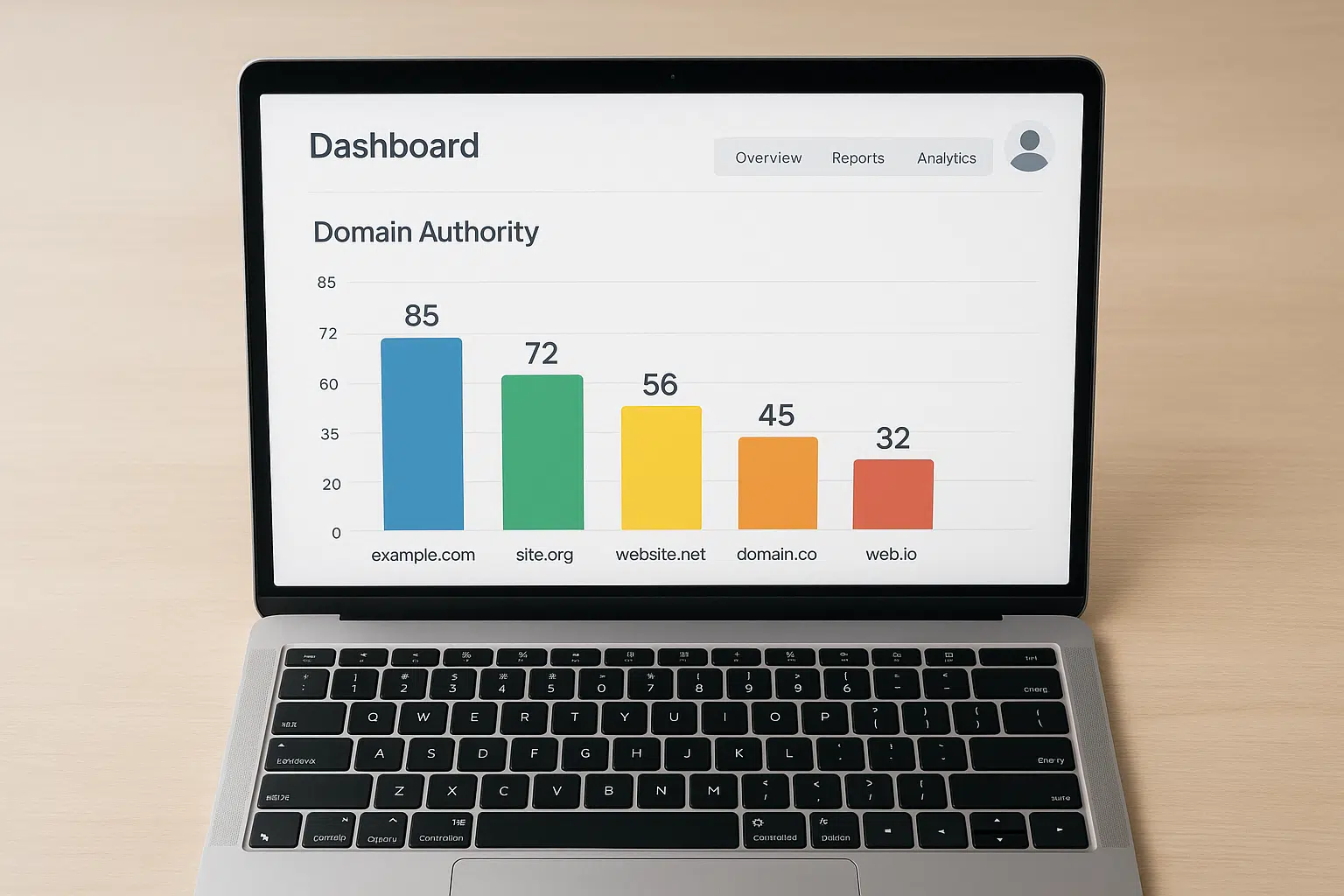
Domain authority is a score from 1 to 100 that predicts how well a website is likely to rank in search engine results, based on the strength and quality of its backlink profile. Simply put, the higher your domain authority score, the more competitive your site is likely to be in organic search. Developed by Moz, domain authority is one of the most widely used third-party SEO metrics in the industry — and understanding it is essential for anyone serious about growing organic traffic.
In this comprehensive guide, you will learn exactly what domain authority means, how it is calculated, what scores are considered good, how to improve yours, and when it genuinely matters for your SEO strategy. Furthermore, you will discover the common mistakes that cost site owners rankings — and how to avoid every one of them.
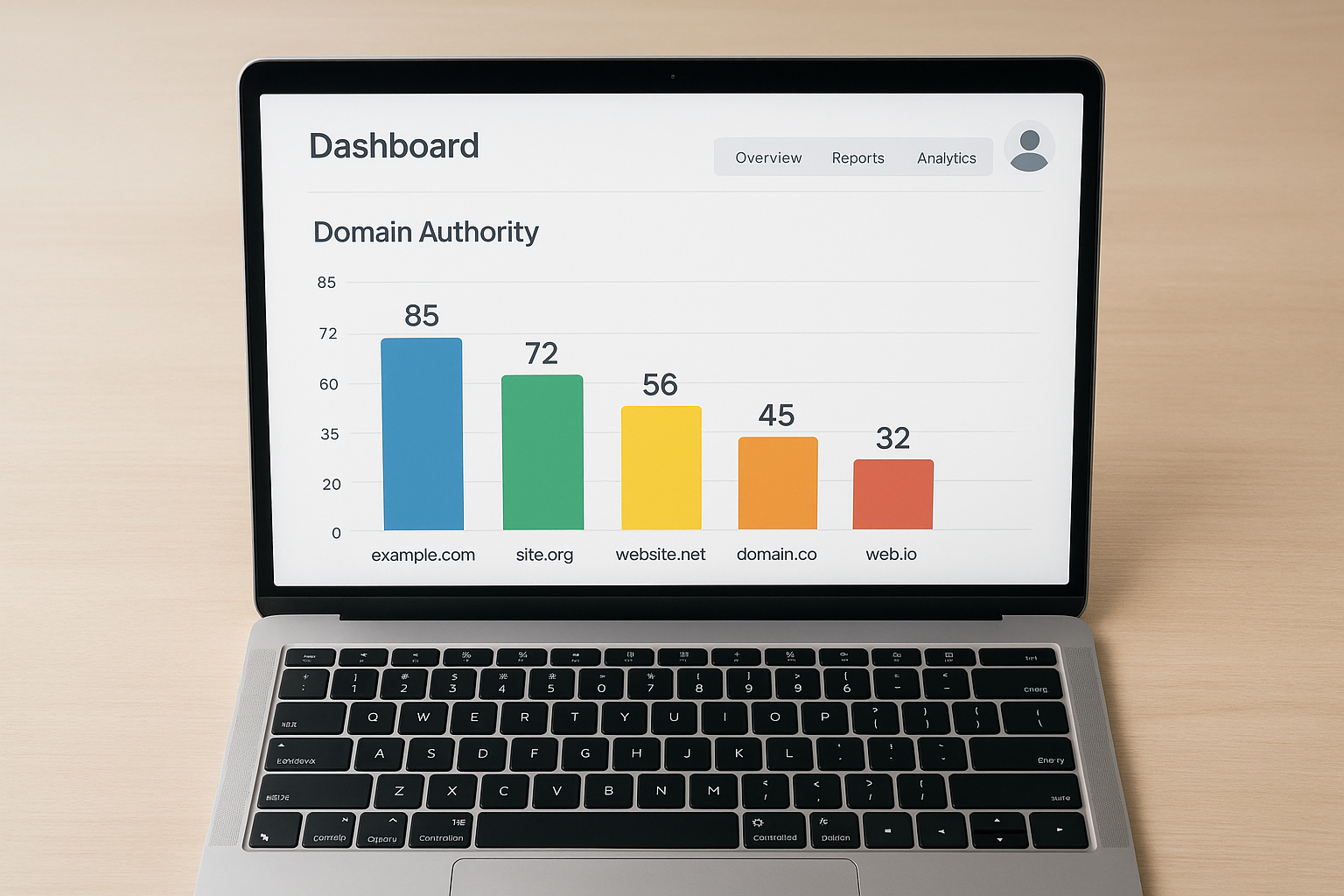
A domain authority checker gives you instant visibility into scores across multiple websites at once.
What Is Domain Authority? A Clear Definition
Domain authority (DA) is a proprietary SEO metric created by Moz that estimates a domain’s overall ranking strength on a logarithmic scale from 1 to 100. It is not a direct Google ranking factor — Google does not use Moz’s DA score internally. However, it functions as a reliable, industry-standard proxy for a site’s link equity and competitive position in organic search.
Because Google’s original PageRank algorithm is no longer publicly visible, SEO professionals turned to DA as the go-to benchmark for comparing sites quickly and objectively. Consequently, it appears in nearly every link-building workflow, client report, and competitive audit produced today.
It is also worth understanding that DA is a relative metric. A score of 35 may be highly competitive in one niche and completely uncompetitive in another. Therefore, you should always compare your DA against direct competitors — not against global giants like Wikipedia or the BBC.
Domain Authority vs. Page Authority: What’s the Difference?
Domain Authority measures the ranking potential of an entire domain or subdomain. In contrast, Page Authority (PA) measures the ranking potential of a single page. Both use the same 1–100 logarithmic scale and are both calculated by Moz. In practice, you should check DA when evaluating an overall site as a link partner, and PA when assessing the strength of a specific page you want a link from.
Similarly, it is important to distinguish domain authority from Domain Rating (DR), a comparable metric offered by Ahrefs. Both measure backlink-based authority, but they use separate data sources and algorithms. As a result, a site may show DA 45 in Moz and DR 52 in Ahrefs — neither is wrong, they simply reflect different datasets.
How Is Domain Authority Calculated?
Moz calculates domain authority using a machine-learning model that evaluates dozens of signals drawn from its web index. The most significant inputs include:
- Total number of unique referring domains — sites linking to you from distinct root domains
- Quality and authority of those linking domains — a link from a DA 80 site carries far more weight than ten links from DA 10 sites
- Link diversity — links from a variety of industries, geographies, and domain types signal natural growth
- Spam score of linking domains — low-quality or manipulative links can suppress your score
- MozRank and MozTrust — Moz’s internal link-equity and trust measures that feed into the DA calculation
Crucially, the scale is logarithmic — meaning each additional point becomes progressively harder to earn. Moving from DA 20 to DA 30 requires considerably less effort than moving from DA 70 to DA 80. This is why many established sites plateau in the 40–60 range without a deliberate, sustained link-building strategy.
⚡ Key Insight
Domain authority is recalculated across all websites simultaneously during each Moz index update. This means your score can drop even if your own backlink profile improved — simply because competitors gained more links than you did. A drop is not always bad news.
How Often Does Domain Authority Update?
Moz refreshes its domain authority scores roughly every few weeks as it recrawls the web and reprocesses link data. Therefore, changes to your backlink profile — whether gains or losses — may take a few weeks to appear in your DA score. In contrast, tools like Ahrefs and Semrush update their authority metrics more frequently, which is one reason many SEOs use multiple tools in parallel.
Domain Authority Score Ranges: What’s Considered Good?
The short answer: a “good” domain authority score depends entirely on your niche and who you’re competing against. However, the following ranges provide a useful reference framework for most websites.
For example, a niche travel blog with a DA of 42 competing against similar blogs in the 35–45 range is, in practice, well-positioned. However, that same DA 42 blog would struggle to compete against a DA 70 travel media brand for highly competitive keywords. Context is everything.
Should You Care About Domain Authority?
This is the most honest question SEOs and business owners ask — and the answer is: yes, with important caveats.
Domain authority matters because it correlates strongly with the factors Google actually uses to rank sites — specifically, the number and quality of backlinks. Sites with high DA scores tend to rank better, earn more traffic, and attract more editorial links organically. Furthermore, DA gives you a practical shortcut for assessing competitive positioning without needing access to Google’s internal data.
However, you should not treat DA as a direct target to chase. Specifically, obsessing over a number instead of the quality signals behind it leads to poor decisions — like buying links purely to inflate a score, which can trigger Google penalties. Instead, focus on the underlying behaviours that improve DA naturally: earning high-quality links, publishing valuable content, and building genuine topical authority.
When Domain Authority Is Most Useful
In practice, domain authority delivers the most value in these specific scenarios: For a deeper walkthrough, see our Domain Authority Ahrefs: Complete Guide (2024).
- Link prospecting — Quickly filter outreach targets by minimum DA threshold before investing time in personalised outreach emails
- Competitor benchmarking — Understand the authority gap between your site and the top-ranking pages for your target keywords
- Backlink auditing — Identify low-DA or high-spam-score sites already linking to you that may be diluting your link profile
- Client reporting — Provide quick, understandable authority snapshots without requiring clients to understand raw backlink data
- Editorial partnership vetting — Confirm that a co-author, sponsor, or content partner carries enough authority to make collaboration worthwhile
- Tracking SEO progress — Monitor whether your link-building efforts are moving the needle over three-, six-, and twelve-month intervals

Checking domain authority scores takes seconds and delivers immediately actionable competitive data.
How to Check Domain Authority for Free
Checking your domain authority is straightforward and costs nothing. A free DA checker tool works by querying a backlink database — most commonly Moz’s — and returning the stored authority score for any domain you submit. The entire process takes seconds.
Most free tools also return supplementary metrics alongside the DA score. These typically include:
- Page Authority (PA) — the ranking strength of individual pages
- Spam score — a percentage indicating the risk of penalisation based on linking patterns
- Number of backlinks — total inbound links from all sources
- Referring domains — count of unique root domains linking to you
Together, these data points deliver a far more complete picture of a site’s SEO health than DA alone. For example, a site with a DA of 50 but a spam score of 65% is likely built on manipulative link patterns — meaning a backlink from it could harm rather than help your rankings.
Step-by-Step: How to Run Your First Domain Authority Check
- Navigate to a free DA checker tool such as Rank Authority
- Paste your domain URL (and optionally 4–5 competitor URLs) into the input field
- Click the check button and wait 2–5 seconds for results
- Review your DA score, PA, spam score, and referring domain count
- Compare your DA against each competitor’s DA to identify the authority gap
- Note any sites with high DA but high spam scores — flag these for avoidance in your link-building outreach
💡 Pro Tip
Many free DA checker tools support bulk domain checks — entering 10 to 25 URLs simultaneously. Use this feature when running a competitor benchmark or auditing a list of backlink prospects. It saves considerable time compared to checking sites one by one.
Domain Authority vs. Other Authority Metrics: A Full Comparison
Domain authority from Moz is not the only authority metric available. Several competing tools offer their own versions, and understanding the differences helps you choose the right signal for each task.
In practice, no single metric tells the whole story. As a result, experienced SEOs often cross-reference DA with DR or Authority Score to get a more balanced view of a site’s actual strength. If a site scores well across two or three tools, it is generally a reliable indicator of genuine authority.
Common Mistakes When Interpreting Domain Authority
Even experienced SEOs misread domain authority data. Avoiding these mistakes will save you from poor decisions that waste time and budget.
Mistake 1 — Treating DA as an Absolute Quality Score
DA is a relative metric, not an absolute one. Specifically, a DA of 30 on a tightly focused niche site may deliver far more topical relevance — and therefore more actual ranking power — than a DA of 55 on a broad, unfocused directory. Always consider topical alignment alongside the score.
Mistake 2 — Ignoring Spam Score
A high DA combined with a high spam score (above 30%) is a serious red flag. Sites built on purchased, traded, or otherwise manipulative links can achieve inflated DA scores. In contrast, earning a backlink from such a site may actively harm your own rankings. Therefore, always check spam score alongside DA before pursuing any link opportunity.
Mistake 3 — Panicking Over Score Drops
DA drops during Moz index updates are common and often harmless. Because DA is recalibrated across all websites simultaneously, a small drop can simply mean competitors gained more links during that cycle — not that your site declined in quality. Check your raw referring domain count and organic traffic alongside DA before drawing any conclusions.
Mistake 4 — Chasing DA as a Vanity Metric
Some site owners purchase bulk links specifically to inflate their DA score. This strategy backfires. Google’s algorithms identify unnatural link patterns and penalise them. Furthermore, inflated DA scores rarely translate to actual ranking improvements because the underlying content quality and topical relevance remain weak. Instead, treat DA as a byproduct of good SEO — not the goal itself.
Mistake 5 — Comparing Your DA to Irrelevant Benchmarks
A small SaaS startup should not benchmark its DA against Salesforce. Similarly, a personal finance blog should not compare itself to Forbes. Instead, identify 5–10 direct competitors targeting the same keywords at a similar scale, and use their DA scores as your benchmark. That comparison will reveal achievable goals and realistic timelines.
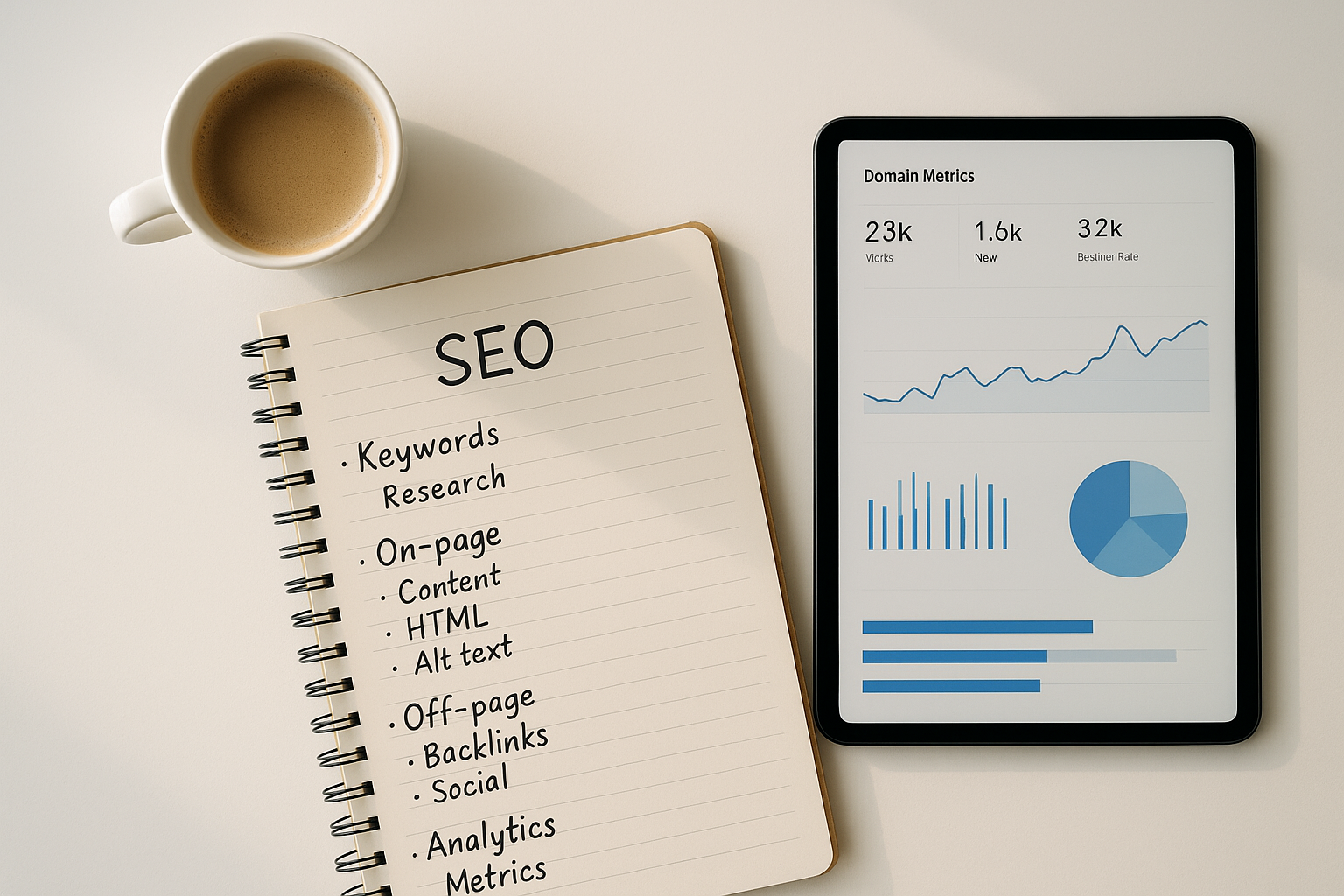
Reviewing domain authority alongside organic traffic and referring domain data leads to better strategy decisions.
How to Improve Your Domain Authority: A Proven Strategy
Improving domain authority is a long-term effort. However, the strategy is well-understood, repeatable, and directly aligned with the same activities that improve Google rankings. Here is a structured approach.
1. Earn High-Quality Backlinks from Authoritative Sites
The single most impactful action you can take is earning backlinks from high-DA, topically relevant websites. A single link from an authoritative industry publication is worth far more than dozens of links from low-quality directories. Specifically, focus outreach on:
- Industry blogs and publications with DA 50+
- Resource pages in your niche that curate external links
- Journalists and content creators who cover your topic area
- University, government, and non-profit sites where relevant
2. Publish Link-Worthy Content Consistently
Original research, comprehensive guides, data studies, and unique frameworks naturally attract editorial links over time. Furthermore, content that solves a specific, underserved problem in your niche tends to earn links organically — without active outreach. Invest in content depth, not just content volume.
3. Remove and Disavow Toxic Backlinks
Low-quality or spammy inbound links can suppress your domain authority by increasing your spam score. Use Google Search Console’s disavow tool to neutralise links from manipulative or irrelevant sources. Additionally, run periodic backlink audits every three to six months to catch new toxic links before they accumulate.
4. Strengthen Your Internal Linking Structure
Internal links distribute page authority throughout your site, helping individual pages rank better. A strong internal structure also signals topical depth to search engines. Consequently, build clear content hubs around your core topics, with pillar pages linking to supporting cluster content and vice versa.
5. Fix Technical SEO Issues That Leak Authority
Broken links, redirect chains, and crawl errors waste link equity. Similarly, canonical tag errors can split authority across duplicate URLs, diluting your overall score. Resolve these issues to ensure that every earned link passes its full authority value to the correct target page.
6. Track Progress with a Reliable Tool
Use a tool like Rank Authority to monitor your DA score alongside referring domain growth, organic traffic, and keyword ranking trends over time. Tracking these metrics together helps you connect specific activities to measurable outcomes, which makes it far easier to refine your strategy and demonstrate ROI to stakeholders.
📈 Realistic Timelines
Most sites see meaningful DA movement within 3–6 months of a consistent link-building programme. Moving from DA 20 to DA 35 is achievable in under 12 months with focused effort. However, climbing from DA 60 to DA 70 may take several years, as you are competing against well-established, link-rich domains for each incremental point.
Free vs. Paid Domain Authority Tools: Which Is Right for You?
For most individual site owners, bloggers, and small agencies, a free domain authority checker provides everything needed for routine competitive analysis. Free tools typically cover single-domain lookups and small bulk checks with no cost barrier.
However, larger agencies managing dozens of client sites may benefit from paid plans. In those cases, the additional features justify the subscription:
- Unlimited bulk checks — process hundreds of URLs at once
- Historical score tracking — see how DA has changed over months or years
- Automated reporting — schedule monthly authority snapshots for clients
- API access — integrate DA data into custom dashboards or CRM systems
- More frequent data refreshes — paid tiers typically update scores more often than free ones
In practice, the smartest approach is to start with a free checker to validate your immediate needs, then upgrade only when your volume or reporting requirements outgrow what the free tier provides. Rank Authority offers accessible options for teams at any budget level — including free checks with no account required.
Frequently Asked Questions About Domain Authority
What is domain authority?
Domain authority is a score from 1 to 100 developed by Moz that predicts how likely a website is to rank in search engine results pages. It is based primarily on the quality and quantity of backlinks pointing to a domain. Higher scores indicate stronger competitive potential in organic search.
Is domain authority a Google ranking factor?
No. Domain authority is a third-party metric created by Moz — Google does not use it internally as a ranking factor. However, it strongly correlates with the signals Google does use, particularly backlink quality and quantity. As a result, sites with high DA scores tend to rank better in practice, even though the score itself is not what Google measures.
What is a good domain authority score?
A good domain authority score depends on your niche and competitors. Generally, a DA above 50 is considered strong for most industries. Scores above 70 indicate highly authoritative sites. New websites often start below 20 — this is completely normal. The key is to compare your score against direct competitors, not against global brands.
How often does domain authority update?
Moz updates domain authority scores roughly every few weeks during its regular web index recrawls. Significant link-building activity may take 4–6 weeks to reflect in your score. Consequently, you should track DA on a monthly basis rather than checking it daily for meaningful trend data.
Why did my domain authority score drop?
A domain authority drop usually occurs for one of four reasons: competitors gained stronger backlinks during the latest Moz update, your own backlinks were lost or removed, Moz performed a major algorithm recalibration, or low-quality links pointing to your site were newly identified and penalised. Check your referring domain count alongside DA to diagnose the cause accurately.
What is the difference between domain authority and domain rating?
Domain authority (DA) is Moz’s metric, while domain rating (DR) is Ahrefs’ equivalent. Both measure backlink-based authority on a 0–100 scale, but they use separate link databases and weighting algorithms. A site may score differently on each — neither is definitively “correct.” Using both together gives a more balanced view of a site’s authority.
How can I increase my domain authority?
To increase domain authority, focus on earning high-quality backlinks from authoritative, topically relevant websites. Additionally, publish original research and comprehensive content that naturally attracts editorial links. Remove or disavow toxic backlinks through Google Search Console, strengthen your internal linking structure, and fix technical SEO issues that waste link equity. Consistent effort over 3–12 months typically produces measurable DA growth.
What is the difference between DA and PA?
Domain Authority (DA) measures the ranking strength of an entire domain or subdomain. Page Authority (PA) measures the ranking strength of a single specific page. Both are Moz metrics on a 1–100 logarithmic scale. Use DA to evaluate a website as a link partner and PA to assess the strength of an individual page you want a link from.
Can I check domain authority for free?
Yes. Free domain authority checker tools are widely available and require no account or payment for basic checks. Most free tools return DA, PA, spam score, and referring domain count instantly. Some also support bulk checks of 10–25 domains simultaneously. Paid plans offer additional features like historical tracking and API access.
Does domain authority affect local SEO?
Domain authority correlates with local SEO performance, particularly for competitive local markets. A higher DA generally means stronger organic presence, which complements local search signals like Google Business Profile optimisation and local citations. However, for purely local pack rankings, Google My Business signals, review quantity, and local citation consistency often outweigh raw domain authority.
What other metrics should I check alongside domain authority?
Alongside domain authority, monitor Page Authority, spam score, referring domain count, organic traffic estimates, and keyword ranking positions. Furthermore, cross-reference DA with Ahrefs Domain Rating or Semrush Authority Score for a more balanced picture. Together, these metrics give a far more complete assessment of a site’s SEO health than DA alone.
How do I use domain authority for competitor analysis?
Enter 5–10 competitor URLs into a free DA checker to compare their scores against your own. This immediately reveals the authority gap you need to close for competitive keywords. Furthermore, reviewing competitors’ referring domain sources helps identify link-building opportunities you have not yet pursued. Use the data to prioritise outreach targets that will deliver the highest authority gain per effort invested.
Conclusion: Domain Authority as a Strategic SEO Signal
Domain authority is one of the most practical and widely-used metrics in SEO — and for good reason. It distils the complexity of a site’s backlink profile into a single, comparable score that guides smarter link-building, sharper competitor analysis, and more credible client reporting. However, it works best when used as a relative benchmark alongside spam score, referring domain count, and organic traffic data — not as an absolute target to optimise in isolation.
Start by running a free domain authority check on your own site and your top five competitors today. That single exercise will reveal your current competitive position, highlight the authority gap you need to close, and point you toward the clearest path forward in your SEO strategy. The sites that consistently grow their domain authority do so by building genuine value — and letting the metric follow naturally.

