

SEMrush rank is a proprietary global metric that positions every website in SEMrush’s database according to its estimated monthly organic search traffic. Understanding this number gives you a fast, reliable way to gauge where your domain stands in the broader competitive landscape — and what it will take to climb higher. Read the Complete SEMrush Rank Guide for a full walkthrough.
In practice, SEMrush rank works like a leaderboard. The domain with the highest estimated organic traffic earns rank 1, and every other site falls somewhere below it. Therefore, a smaller number always signals stronger organic visibility, making the metric immediately intuitive for anyone tracking SEO progress over time.
What Is SEMrush Rank and How Is It Calculated? — By Rank Authority. Last updated: 2026-07-02
SEMrush rank is calculated by aggregating a domain’s estimated monthly organic traffic across all tracked keywords — see how SEMrush rank is calculated. SEMrush models this traffic using keyword positions, monthly search volumes, and expected click-through rates for each ranking position. Because it relies on modeled estimates rather than raw Google Analytics data, the figure is best treated as a directional benchmark rather than a precise count.
However, that does not reduce its usefulness. In fact, for competitive analysis, an approximation that covers millions of domains simultaneously is far more actionable than isolated keyword data. You can read more about how organic traffic estimation works on Wikipedia’s SEO overview, which provides helpful context on the signals involved.
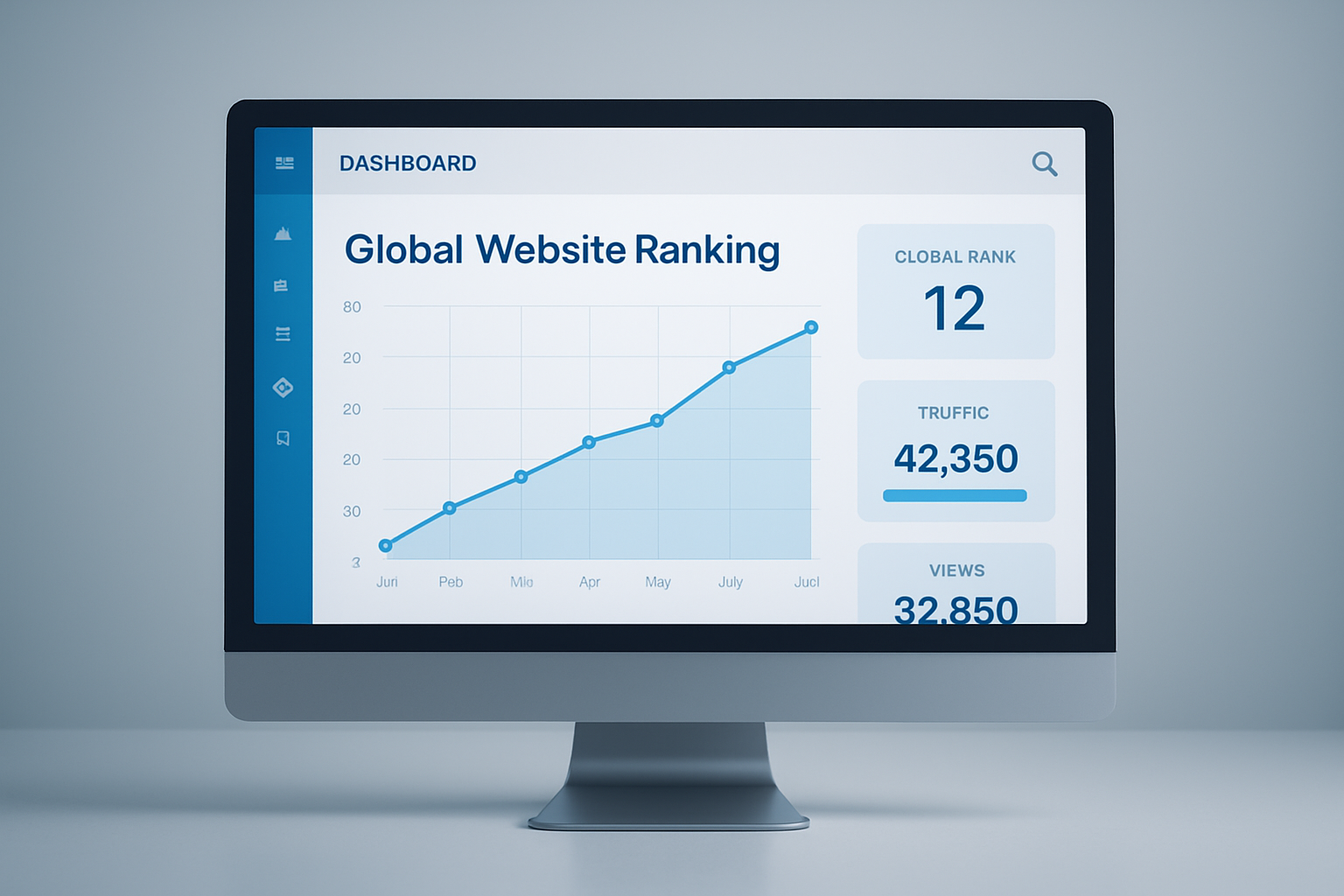
A well-structured rank dashboard helps you track SEMrush rank movement over time alongside key traffic metrics and links to a complete SEMrush rank guide that explains full methodology and practical workflows.
Why SEMrush Rank Matters for Competitive SEO
One of the most powerful applications of this metric is competitor tracking. When you enter a competitor’s domain into SEMrush, their rank immediately tells you how their overall organic footprint compares to yours. Additionally, tracking rank changes over weeks and months reveals whether a competitor is gaining or losing ground — information that shapes your content strategy.
For example, if a rival site moves from rank 200,000 to rank 80,000 within three months, that signals aggressive SEO investment worth investigating. Meanwhile, a site dropping from 50,000 to 300,000 may have been hit by a Google algorithm update or experienced a technical issue — creating an opportunity for you to capture their lost traffic.
Resources like Rank Authority offer practical guidance on interpreting these competitive signals and turning rank data into a structured SEO action plan.
SEMrush Rank vs. Other Domain Metrics
It is easy to confuse SEMrush rank with other domain-level scores, so understanding the distinctions is essential before drawing conclusions from your data.
| Metric | What It Measures | Best Used For |
|---|---|---|
| SEMrush Rank | Estimated organic traffic volume, globally ranked | Traffic-based competitive benchmarking |
| Authority Score | Link profile quality and domain trustworthiness | Evaluating backlink strength |
| Keyword Rankings | Position for individual search queries | Tracking specific content performance |
| Visibility Score | Share of clicks for a tracked keyword set | Monitoring niche-specific reach |
As the table shows, each metric captures a different dimension of SEO performance. In contrast to Authority Score, which reflects link quality, SEMrush rank is purely traffic-driven. Therefore, a site with modest backlinks but highly targeted content can achieve a strong rank if it earns consistent organic clicks.
How to Improve Your Position Over Time
Improving your position requires a consistent strategy focused on growing estimated organic traffic. The following steps provide a structured approach that works for both new and established websites, including differences with link-based scores like SEMrush Domain Authority.
- Conduct a keyword gap analysis. First, identify high-volume keywords your competitors rank for but you do not. These represent immediate traffic opportunities that can SEMrush rank guide and move your rank quickly.
- Optimize existing top pages. Next, audit your pages that already rank on page two or three. Refreshing content, improving internal linking, and targeting featured snippets can push those pages to page one, generating significant traffic gains.
- Build authoritative backlinks; see our backlink profile guide. Additionally, earning links from high-Authority Score domains amplifies your content’s ranking potential, indirectly boosting estimated traffic and therefore your rank.
- Fix technical SEO issues. As a result of crawl errors, slow page speeds, or duplicate content, search engines may underindex your site. A technical audit removes these barriers to ranking.
- Publish consistently on targeted topics. Finally, topical authority — covering a subject comprehensively — signals relevance to search engines and compounds your organic traffic over time.

Regularly reviewing competitor data alongside your own metrics is key to making meaningful rank improvements.
Common Mistakes When Interpreting This Metric
Many SEO practitioners make the mistake of treating their rank as an absolute measure of success. However, because it is based on estimates, a small fluctuation of 10,000 to 20,000 positions may simply reflect a data refresh rather than a meaningful change in your actual traffic.
Another common error is comparing ranks across wildly different industries without context. For instance, a rank of 500,000 in a highly competitive e-commerce niche may represent stronger relative performance than a rank of 200,000 in a low-competition local services category. Always benchmark against direct competitors rather than arbitrary thresholds.
Furthermore, relying solely on rank without examining the underlying keyword data can lead to misguided decisions. A rank improvement driven by one viral piece of content, for example, may not reflect sustainable SEO progress. Instead, look for broad keyword ranking gains across multiple pages to confirm genuine growth.
Integrating Rank Data Into Your SEO Workflow
The most effective way to use this metric is as a weekly health indicator within a broader SEO dashboard. By tracking your rank alongside organic traffic from Google Search Console and keyword position changes, you build a multi-signal view that is far more reliable than any single data point.
Additionally, setting rank benchmarks for quarterly goals keeps your team aligned. For example, moving from rank 800,000 to rank 400,000 within six months is a concrete, motivating target that translates directly into traffic growth expectations. Tools and frameworks available at Rank Authority can help you structure these goals systematically.
Key Takeaways
Understanding your SEMrush rank is one of the fastest ways to orient your SEO strategy within the competitive landscape. It translates complex keyword and traffic data into a single, comparable number — making it ideal for executive reporting, competitive analysis, and goal-setting alike. Author: Add a byline with the author’s name and short credentials (e.g., "Jane Doe, SEO Analyst"). Last updated: 2026-07-02.
- Lower numbers always mean better organic performance.
- The metric is based on estimated traffic, not real analytics data.
- Use it for competitor benchmarking, not as a standalone success measure.
- Combine it with Authority Score, keyword rankings, and technical audits for full context.
- Consistent content, backlink building, and technical fixes drive rank improvement over time.
Frequently Asked Questions About SEMrush Rank
What is SEMrush rank?
SEMrush rank is a proprietary metric that positions a website globally based on its estimated organic search traffic. A rank of 1 represents the highest-traffic domain in SEMrush’s database. Lower numbers indicate better performance.
How is SEMrush rank calculated?
It is calculated using estimated monthly organic traffic derived from keyword rankings, search volumes, and click-through rate models. Because it does not use actual Google Analytics data, it is an approximation rather than a precise figure.
What is a good SEMrush rank?
A good rank depends on your industry and goals, but generally a rank below 100,000 signals strong organic visibility. For most small to medium businesses, breaking into the top 500,000 globally is a meaningful benchmark.
Is SEMrush rank the same as a Google ranking?
No. Google rankings refer to a specific keyword’s position in search results, while SEMrush rank is an aggregate score reflecting overall estimated organic traffic across all keywords. They measure very different things.
How often does SEMrush rank update?
SEMrush rank typically updates weekly as the platform recrawls keyword data and refreshes traffic estimates. However, significant changes in your rankings may take a few weeks to fully reflect in the metric.
How do I improve my SEMrush rank?
Focus on earning more organic traffic by targeting high-volume keywords, building quality backlinks, and improving on-page SEO. Consistent content production and technical SEO fixes also contribute meaningfully over time.
Can SEMrush rank be used for competitor analysis?
Yes, it is one of the most practical tools for competitor benchmarking. By comparing your rank against direct competitors, you can identify traffic gaps and prioritize content areas where rivals currently outperform you.
What is the difference between SEMrush rank and Authority Score?
SEMrush rank reflects estimated organic traffic volume and positions domains globally, while Authority Score measures a domain’s overall link profile quality and trustworthiness. Both metrics are useful but serve different analytical purposes.
Does a lower SEMrush rank number mean a better rank?
Yes, a lower number always indicates better performance. Rank 1 belongs to the site with the highest estimated organic traffic, so smaller numbers always represent stronger visibility.
Why did my SEMrush rank drop suddenly?
A sudden drop usually signals a loss in keyword rankings, possibly due to a Google algorithm update, increased competition, or technical issues on your site. Auditing your top-traffic pages and checking for crawl errors is a practical first step.
How does SEMrush rank differ from Alexa rank?
Alexa rank (now discontinued) measured overall website traffic from all sources, while SEMrush rank focuses specifically on estimated organic search traffic. SEMrush rank is therefore more relevant for SEO-focused analysis.
Is SEMrush rank accurate?
SEMrush rank is a reliable approximation rather than an exact figure, since it is based on modeled traffic estimates rather than real analytics data. It is most useful as a comparative and directional metric rather than an absolute measure.

