

Moz DA Ranking: The Complete Guide to Domain Authority in 2025
Updated for 2026-07-02 · 14-minute read · By the RankFast Editorial Team · Updated: 2026-06-10 — author bio below.
Moz DA ranking, formally known as Domain Authority, is a predictive score from 1 to 100 created by Moz that estimates how well a domain is likely to rank in Google’s search results. It is the most widely referenced third-party authority metric in the SEO industry — and understanding exactly how it works, what it means, and how to improve it is foundational to any serious search strategy.
This guide covers everything you need to know about Moz DA ranking: how the score is calculated, what constitutes a good score in your niche, how it compares to competing metrics, a proven step-by-step strategy to raise your score, and the most common mistakes that prevent growth. Whether you are a beginner or an experienced SEO professional, you will leave with a Domain Ranking Moz guide to this critical metric.
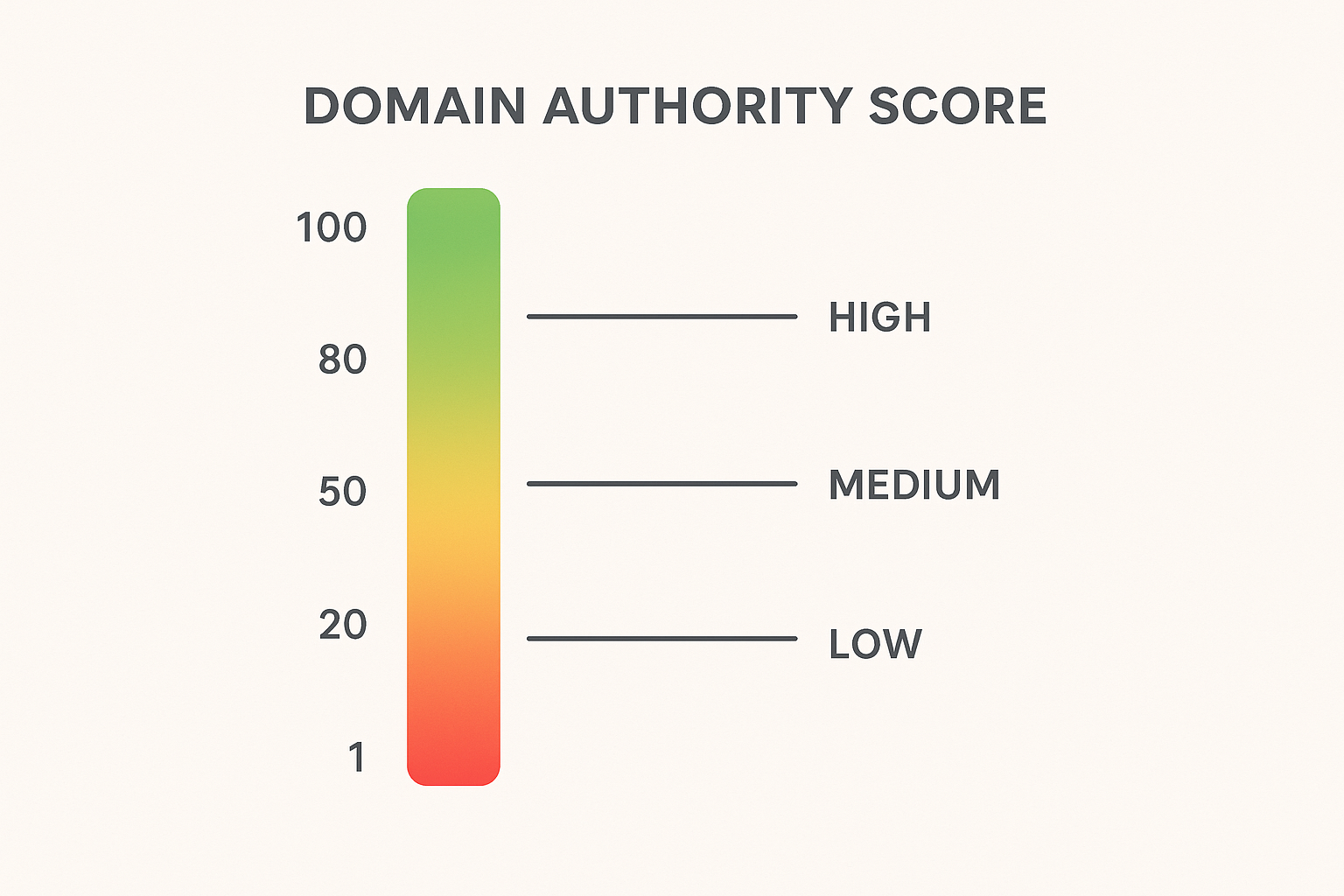
The Moz DA ranking scale — a logarithmic spectrum from 1 to 100 — helps SEOs benchmark a site’s authority against the competitive landscape.
What Is Moz DA Ranking?
Domain Ranking Moz — shorthand for Moz Domain Authority — is a machine-learning-powered score that Moz developed to predict a website’s likelihood of ranking on search engine results pages (SERPs). The score ranges from 1 to 100, with higher numbers indicating greater ranking authority. It is a relative, comparative metric: a DA of 45 is only meaningful in context of what your competitors score, not as an absolute achievement in isolation.
Critically, Domain Authority is not a Google metric. Moz created it independently as a proxy for measuring link-based competitive strength. Google has publicly confirmed it does not use DA in its ranking systems. However, the underlying signals that raise DA — high-quality backlinks from authoritative, relevant sources — are precisely the same signals Google’s own algorithm prioritizes.
This alignment makes Moz DA ranking one of the most useful diagnostic tools available to SEOs. When your DA rises, it almost always means you have improved the foundational link signals that power real organic performance.
A Brief History of Domain Authority
Moz launched Domain Authority to fill a critical gap left when Google retired its public PageRank toolbar score in 2016. SEOs needed a standardized, publicly accessible benchmark to evaluate link equity and competitive positioning. DA became — and remains — the industry default for that purpose. Today it is used by link-building agencies, content teams, PR professionals, and in-house SEOs worldwide to qualify prospects, measure campaign ROI, and set benchmarks.
How Domain Authority Is Calculated
Moz calculates DA using a machine learning model trained against Google’s actual search results. The model ingests data from Moz’s web index — one of the largest in the industry — and evaluates dozens of signals to produce a single score. See our Domain Ranking Moz guide for a complementary perspective on ranking models and metric divergence. Here is exactly what goes into that calculation:
1. Linking Root Domains
The single most influential input is the number of unique domains linking to your site. Moz counts root domains, not individual backlinks — meaning 500 links from one site count the same as one link from that site. Diversity of linking domains is what the algorithm rewards most heavily. A link profile with 200 unique referring domains is typically far stronger than one with 2,000 links from 20 sources.
2. Link Quality and Authority of Linking Sites
Not all backlinks carry equal weight. A single link from a DA 85 news publication passes far more authority than 100 links from DA 10 web directories. Moz evaluates the DA of each linking domain and applies a proportional weighting — so your score reflects the quality of your link profile, not merely its volume.
3. MozRank and MozTrust
Moz uses two sub-metrics internally: MozRank (a link popularity score similar to PageRank) and MozTrust (a score measuring proximity to highly trusted seed sites on the web). MozTrust in particular rewards links from established government, educational, and authoritative institutional domains, since those represent a trusted tier of the web’s link graph.
4. Spam Score
Moz’s proprietary Spam Score evaluates how many signals of low-quality or manipulative link behavior exist in your profile. Sites with a high concentration of toxic backlinks — links from penalized domains, link farms, or irrelevant foreign directories — see a negative impact on their DA score. This is why link quality audits are an essential part of DA management, not just link acquisition.
5. The Logarithmic Scale
DA is calculated on a logarithmic scale, which has enormous practical implications. Moving from DA 20 to DA 30 is achievable with a moderate link-building effort. Moving from DA 70 to DA 80 requires exponentially more high-quality links and domain authority signals. This is why growth curves in DA tend to be steep early and flatten dramatically at higher scores. A site at DA 60 is not merely twice as authoritative as a DA 30 site — the gap represents a vastly larger difference in link equity and competitive standing.
6. Frequent Recalculation and Relative Scoring
Moz recalculates DA scores continuously as it crawls and re-indexes the web. Your score is rescaled relative to every other domain in Moz’s index — meaning your DA can fall without losing a single backlink, simply because other sites are growing their link profiles faster. This relative nature is one of DA’s most misunderstood characteristics and one of the most important reasons to monitor competitor scores alongside your own.
Key Takeaway on DA Calculation
DA is driven primarily by the number of unique, high-authority domains linking to your site. Quality and diversity of links outweigh raw link volume every time. And because it is a relative metric on a log scale, improving a high DA score requires disproportionately more effort than improving a low one.
What Is a Good Moz DA Score?
There is no universally “good” DA score — the right target depends entirely on your competitive landscape. A DA of 38 might make you the most authoritative site in a local service niche, while that same score could leave you struggling to rank in a highly competitive national market. The correct benchmark is always your direct competitors, not an abstract number.
That said, the following reference ranges provide useful starting context:
How to Set the Right DA Target for Your Site
The smartest approach is to check the DA of the top five to ten domains ranking for your most important keywords. Calculate their average and median DA scores. Your realistic near-term target should be to match or slightly exceed that median — not to chase the outlier at the top of the pack. If your competitors average DA 42 and you are at DA 28, getting to DA 40–45 is a meaningful, achievable goal. Trying to hit DA 70 in the same timeframe would be a misallocation of resources.
It is also worth noting that DA is not the only predictor of rankings. A site with DA 35 and exceptional content targeting long-tail keywords can outrank a DA 55 site with thin, generic content. Domain Authority measures one important dimension of competitive strength, but content relevance, on-page SEO, and user experience all contribute to actual SERP performance.
DA vs. PA vs. DR: Understanding the Differences
Moz DA ranking is often confused with related metrics. Understanding precisely what each one measures — and when to use which — is essential for applying them correctly.
Domain Authority (DA) vs. Page Authority (PA)
Domain Rank Moz scores the ranking strength of an entire domain or subdomain. It aggregates the authority of every page on that domain into a single score. Page Authority (PA), by contrast, measures the ranking strength of a single, specific URL. Both use the same 1–100 scale and similar methodology.
The practical difference matters significantly in SEO:
- Use DA when qualifying a domain as a link-building prospect, assessing a competitor’s overall authority, or setting strategic benchmarks.
- Use PA when evaluating whether a specific landing page can rank for a target keyword, or when assessing the value of a potential linking page.
- Note the disconnect: A viral blog post on a low-DA site can achieve a high PA because that single page attracted many inbound links — yet the site’s DA stays low because the rest of the domain lacks equity. This is a common scenario with news articles or viral content pieces.
Domain Authority (DA) vs. Domain Rating (DR)
Domain Rating (DR) is Ahrefs’ equivalent of Moz DA — a 0–100 score measuring the strength of a website’s backlink profile. Both metrics measure similar things but differ in important ways:
- Different data sources: DA uses Moz’s web index; DR uses Ahrefs’ crawl data. Because these indexes differ in size and crawl frequency, scores for the same domain often diverge significantly.
- Different weighting models: DR is weighted heavily toward the raw number of linking unique domains relative to how many sites those domains link out to. DA incorporates more signals including spam scoring and MozTrust.
- Industry usage: Both are widely used, often side by side. Using both DA and DR together provides a more complete picture of a domain’s link authority than relying on either alone.
- Neither is a Google metric. Both are third-party proxies and should be used as comparative benchmarks, not absolute truths.
Pro Tip: DA vs. DR Divergence
If a domain has a high DR but a low DA, it typically has many backlinks but also carries a high Spam Score in Moz’s index. This divergence is a red flag when evaluating link-building prospects — cross-reference Moz Website Ranking and DR before pursuing a link from any unfamiliar domain.
Does Moz DA Ranking Affect Google Rankings?
No — DA does not directly affect Google rankings. Google’s algorithm does not read or use Moz’s DA score. However, this answer is incomplete without critical context.
The factors that produce a high Moz DA ranking are the same factors that Google’s algorithm rewards:
- A large number of unique, authoritative domains linking to your site signals to Google that your content is trusted and valuable.
- Links from topically relevant sources reinforce your site’s subject matter expertise — a key component of Google’s E-E-A-T (Experience, Expertise, Authoritativeness, Trustworthiness) evaluation framework.
- A clean, spam-free link profile avoids manual actions and algorithmic penalties from Google’s link spam systems.
- Editorial links earned through high-quality content are precisely the type of links Google has always sought to reward and the type that raise your DA most effectively.
In practice, sites with higher Moz site ranking consistently rank better in Google. This is not because DA causes rankings — it is because both DA and Google rankings are produced by the same underlying quality signals. Think of DA as a leading indicator: when it rises, better rankings typically follow. When it falls, a rankings decline often comes next.
How to Improve Your Moz DA Ranking: A Step-by-Step Strategy
Improving your Moz DA ranking requires a disciplined, multi-front strategy. There are no shortcuts — tactics like buying links or using private blog networks (PBNs) actively damage your DA and risk Google penalties simultaneously. The following eight-step approach is what works in practice.
-
Audit Your Existing Backlink Profile
Before building new links, assess what you already have. Use Moz’s Link Explorer to export your full backlink profile. Look for toxic or low-quality links — those from penalized domains, link farms, irrelevant foreign directories, or sites with very high Spam Scores. Document these for disavowal. Cleaning a toxic link profile often produces faster DA improvement than acquiring new links, because it removes the drag on your score. Cross-reference with Google Search Console’s links report to identify any anomalies you may have missed.
-
Disavow Harmful Backlinks
Submit a disavow file through Google Search Console to neutralize toxic links Google cannot otherwise ignore. In Moz’s system, regularly auditing Spam Score and flagging problematic linking domains protects your DA from being dragged down by low-quality sources outside your control. Disavowal is not a one-time task — schedule quarterly link audits to catch new toxic links as they accumulate.
- Create Link-Worthy Content at Scale The most sustainable source of DA-raising backlinks is content that earns them organically. Original data studies, comprehensive industry benchmarks, free tools, in-depth how-to guides, and expert-contributed articles consistently attract editorial links from authoritative domains. Identify what your top-ranking competitors have earned links for using Moz’s Link Explorer, then create a superior, more comprehensive version of that content. See our Domain Rank Moz article for practical examples.
- Execute a Targeted Digital PR Campaign Digital PR — pitching original research, expert commentary, and newsworthy stories to journalists and editors — is among the highest-leverage link-building tactics available. A single placement in a DA 85 publication can move your Moz DA ranking measurably. Build a targeted media list of publications your audience reads, and use HARO (Help a Reporter Out) or similar services to respond to journalist queries and earn authoritative mentions. For tactical guidance see Moz Website Ranking examples.
-
Pursue Strategic Guest Posting
Guest posting on topically relevant, editorially selective publications remains an effective DA-building tactic when done correctly. The key qualifiers: the publication must be relevant to your niche, have genuine readership (not exist purely for links), and have a DA higher than your own. Avoid mass guest posting on low-quality sites — Moz’s spam detection identifies these patterns and they may hurt more than they help.
-
Reclaim Lost and Broken Link Equity
Over time, pages that received inbound links may have been deleted, moved, or restructured — leaving those links pointing to 404 errors. Each broken inbound link represents wasted link equity. Export your backlink profile, identify links targeting 404 pages, and implement 301 redirects to the most relevant live page. This recovers existing authority without requiring any new outreach and is one of the fastest wins available in a DA improvement campaign.
-
Build a Strong Internal Linking Architecture
Internal links do not directly raise your DA — but they distribute page authority throughout your site, helping lower-authority pages rank and ensuring search engines can efficiently crawl and index all your content. A well-structured internal linking system amplifies the value of every external backlink you earn by spreading that authority across more pages. Use descriptive anchor text internally, prioritize linking from high-PA pages to strategic target pages, and audit your internal link structure regularly.
-
Monitor DA Competitors and Adjust Continuously
Because DA is relative, tracking only your own score is insufficient. Set up monthly monitoring of your top five to ten competitors’ DA scores alongside your own. If competitors are growing faster than you, your score will fall regardless of your progress. Platforms like RankFast provide ongoing DA and backlink tracking, allowing you to correlate score changes with specific campaign activities and react to competitive shifts before they affect your rankings.
Tracking DA growth alongside competitor scores — not in isolation — is the most accurate way to evaluate the effectiveness of your link-building strategy.
How to Check and Monitor Your Moz DA Ranking
There are several reliable methods to Domain Ranking Moz guide, ranging from Moz’s own free tools to third-party platforms that incorporate DA alongside other SEO metrics.
Moz’s Own Free Tools
- Moz Link Explorer: Moz’s primary backlink analysis tool. Enter any domain to see its DA, PA, linking root domains, top pages by authority, and Spam Score. Free accounts get limited checks per month; Pro accounts get full access.
- MozBar: A free Chrome browser extension that displays DA and PA scores for every page and domain you visit in real time. Invaluable for competitive research while browsing SERPs or evaluating link prospects.
- Moz Free DA Checker: Moz’s simplified standalone tool allows you to check DA for a single domain without needing a full Link Explorer account. For a deeper walkthrough, see our Moz Keyword Difficulty Checker: Full Guide (2025).
Third-Party Platforms That Include Moz DA
- RankFast: Provides ongoing Moz DA tracking alongside keyword rankings and backlink analysis, making it easy to correlate DA changes with specific SEO activities over time.
- SEMrush and Ahrefs: Show their own authority metrics (Authority Score and DR, respectively) but also surface DA alongside them for cross-tool comparison.
- Bulk DA checkers: Multiple free web tools allow you to check DA for large lists of URLs simultaneously — useful for qualifying link-building prospects at scale.
Best Practices for DA Monitoring
- Check monthly, not weekly. DA updates are not instantaneous — Moz’s index updates on a rolling basis and DA scores may not reflect new links for several weeks. Weekly checks create noise, not signal.
- Track competitors in parallel. Always record the DA scores of your top five to ten competitors alongside your own. Score movements only make sense relative to what the rest of the market is doing.
- Correlate changes with activities. Note the dates of major link-building campaigns, content launches, and link removals in your tracking log. This lets you attribute DA movements to specific actions and refine your strategy over time.
- Watch Spam Score too. A rising Spam Score alongside a stalling DA is an early warning sign of toxic link accumulation that needs to be addressed before it becomes a larger problem.
Common Mistakes That Stall Moz DA Ranking Growth
Even experienced SEOs make strategic errors that prevent DA from growing at its potential rate. See our Domain Rank Moz article for common mistakes and fixes.
Prioritizing Link Volume Over Link Quality
Chasing sheer backlink numbers — through directory submissions, comment spam, or mass guest posting on low-quality sites — produces a large backlink count but little DA improvement and significant Spam Score risk. One link from a DA 75 domain typically contributes more to your score than 200 links from DA 10 sources combined. Always qualify linking domains by their own DA, Spam Score, and topical relevance before investing in any link-building tactic.
Ignoring Toxic Link Accumulation
Many sites accumulate toxic links passively — from scrapers, negative SEO attacks, or old link-building campaigns that have since been devalued. Failing to audit and clean these regularly means your Spam Score creeps up, dragging down your DA over time. Even a single toxic link from a heavily penalized domain can have an outsized negative impact if its Spam Score is high enough.
Focusing Only on Homepage Link Acquisition
Concentrating all link-building efforts on your homepage creates an unnatural and imbalanced link profile. Sites with the strongest DA scores have links distributed across dozens or hundreds of internal pages — not concentrated on one URL. Deep page links (to blog posts, resource pages, product pages) improve DA by expanding the domain’s overall link equity footprint and appear more natural to both Moz’s algorithm and Google’s spam detection systems.
Neglecting Internal Linking
Internal links do not raise DA directly, but a poor internal linking structure wastes the authority your external links deliver. When high-authority external links point to pages that are disconnected from the rest of your site, that equity sits idle instead of flowing to your other strategic pages. A strong internal linking architecture — with descriptive anchor text, logical hierarchical structure, and regular audits — amplifies the effect of every external link you earn.
Treating DA as a Static, Absolute Goal
Because DA is a relative metric, setting a fixed target (e.g., “we want to reach DA 50”) without tracking competitors is a recipe for strategic drift. If your competitors grow from DA 40 to DA 55 while you grow from DA 35 to DA 50, your relative position has actually worsened. Always frame DA targets in terms of your competitive gap, not absolute numbers.
Expecting Rapid Score Changes
DA improvements compound over months, not weeks. Because of the logarithmic scale, the higher your current score, the longer it takes to see incremental gains. New sites can move from DA 1 to DA 20 in a few months with consistent effort. Moving from DA 50 to DA 60 may require a year or more of sustained, high-quality link building. Setting realistic timelines and measuring progress in quarterly increments prevents premature strategy changes that abandon tactics before they mature.
Moz DA Ranking vs. Other SEO Authority Metrics: Full Comparison
Moz DA is the most recognized authority metric but is not the only one worth tracking. Here is how it compares to every major competitor metric in current use:
None of these metrics are interchangeable — each uses different data and weighting. For the most complete picture of a domain’s authority, cross-reference at least two tools. Moz DA combined with Ahrefs DR is the most common pairing used by professional SEOs, as the two tools tend to surface different gaps in a backlink profile.
Direct Answer: What Is Moz DA Ranking?
Moz DA ranking is a score from 1 to 100 — calculated on a logarithmic scale using machine learning — that predicts a website’s likelihood of ranking in search engine results based on the quality and diversity of its backlink profile. It is a relative, comparative metric: its value comes from benchmarking against competitors, not from hitting an arbitrary number. Improving it requires earning high-quality backlinks from authoritative, relevant domains over time — there are no shortcuts that work.
Frequently Asked Questions About Moz DA Ranking
What is Moz DA ranking?
Moz DA ranking, or Domain Authority, is a proprietary score from 1 to 100 developed by Moz that predicts a website’s likelihood of ranking in Google search results. It is calculated using machine learning that evaluates the quality and quantity of backlinks pointing to a domain, particularly the number of unique linking root domains and their own authority levels.
How is Moz DA ranking calculated?
Moz's Domain Authority guide is calculated using a machine learning model that evaluates linking root domains, the authority of those linking domains, MozRank, MozTrust, and Spam Score. The score uses a logarithmic scale, which means each additional point becomes progressively harder to earn at higher score levels. Moz rescales all scores relative to every domain in its index each time it recalculates, so your score is always comparative rather than absolute.
What is considered a good Moz DA score?
There is no single universal “good” DA score — what matters is how your score compares to direct competitors in your niche. As a general reference: DA 1–20 is very low authority, 21–40 is developing, 41–60 is competitive, 61–80 is strong, and 81–100 is elite. The right target is to match or slightly exceed the average DA of sites already ranking for your target keywords.
Does Moz DA ranking directly affect Google rankings?
No — DA is not a Google metric and Google does not use it in its algorithm. However, the factors that produce a high Moz DA ranking (quality backlinks from authoritative, relevant domains and a clean link profile) are the same signals Google’s algorithm rewards. Sites with higher DA tend to rank better because both metrics are driven by the same underlying link quality signals.
What is the difference between DA and Page Authority (PA)?
Domain Authority (DA) measures the ranking strength of an entire domain, while Page Authority (PA) measures the ranking potential of a single specific URL. Both are Moz metrics on a 1–100 scale. Use DA when assessing overall competitive positioning or qualifying link prospects; use PA when evaluating whether a specific page can rank for a target keyword or determining the value of a potential linking page.
What is the difference between Moz DA and Ahrefs DR?
Moz DA and Ahrefs Domain Rating (DR) both measure link-based domain authority on a 1–100 scale but use different crawl data and weighting models. DA incorporates spam scoring and MozTrust signals; DR is weighted heavily toward the number and quality of unique referring domains relative to their own outbound link behavior. Both are third-party metrics — neither is a Google signal — and scores for the same domain often differ significantly between the two tools.
Can a website’s DA score decrease?
Yes. Because DA is a relative metric rescaled across all sites in Moz’s index, your score can decrease even if your link profile is growing — simply because competitors are growing faster. DA can also fall if you lose high-authority backlinks, if Moz’s algorithm updates change how signals are weighted, or if your site accumulates toxic links that increase its Spam Score. Regular monitoring and quarterly link audits are essential to catch and address these causes.
How long does it take to improve your Moz DA ranking?
Timelines vary significantly based on your starting score and the competitiveness of your niche. New sites can often move from DA 1 to DA 15–20 within a few months of consistent link building. Moving from DA 30 to DA 40 may take six to twelve months. Gains above DA 50 require sustained, high-quality campaigns and may take one to two years or more. The logarithmic scale means each point becomes progressively harder to earn as your score rises.
What is the fastest way to improve my Moz DA ranking?
The fastest legitimate improvements come from: (1) cleaning toxic backlinks that are dragging down your score, (2) recovering 404-broken inbound links with 301 redirects, and (3) earning high-authority editorial links through digital PR or original research. Buying links or using PBNs may cause short-term score manipulation but risks Google penalties and long-term DA damage. Quality always outperforms volume for sustainable DA growth.
How do I check my website’s Moz DA score?
You can check your Moz DA score for free using Moz’s Link Explorer or by installing the free MozBar Chrome extension, which shows live DA and PA scores on every page you visit. Third-party platforms like RankFast also track DA scores alongside keyword rankings and backlink data, making it easier to monitor progress over time relative to your competitors.
What is a toxic backlink and how does it affect my Moz DA ranking?
A toxic backlink originates from a low-quality, spammy, penalized, or irrelevant domain. In Moz’s system, toxic links increase your site’s Spam Score and can reduce your DA by dragging down the overall quality signal of your backlink profile. Identifying toxic links through Moz Link Explorer’s Spam Score feature and submitting a disavow file in Google Search Console are the standard remediation steps. Quarterly link audits prevent toxic accumulation from becoming a chronic drag on your score.
How many backlinks do I need to improve my Moz DA ranking?
There is no fixed backlink count required to improve DA. The algorithm rewards quality and diversity over raw volume — a handful of editorial links from high-authority, topically relevant domains can move your score more than hundreds of low-quality directory links. Focus on earning links from domains with DA higher than your own, and ensure your link profile grows more diverse (more unique linking root domains) over time rather than deeper (more links from the same few sources).
Why did my DA score drop suddenly?
Sudden DA drops are most commonly caused by: (1) Moz algorithm updates that change how scores are weighted or recalibrated across the entire index, (2) loss of high-authority backlinks (a major referring domain changed their links or went offline), (3) a surge of toxic or spammy links increasing your Spam Score, or (4) competing sites gaining significant authority faster than you, shifting the relative scale. Check your Spam Score and referring domain count in Link Explorer to diagnose the cause before taking corrective action.
Final Thoughts on Moz DA Ranking
Moz DA ranking remains the most widely used third-party authority benchmark in SEO — and for good reason. It provides a fast, reliable signal of a domain’s link-based competitive strength and serves as a powerful proxy for the underlying quality signals Google’s algorithm cares most about. Used correctly — as a comparative, competitive tool rather than an isolated goal — it is one of the most valuable metrics in any SEO professional’s arsenal.
The most important takeaways from this guide: always benchmark your DA against competitors, not against abstract numbers. Focus relentlessly on earning high-quality, editorially given links from authoritative, relevant domains. Audit and clean your backlink profile regularly. Build deep links to interior pages, not just your homepage. And monitor monthly — tracking both your score and your competitors’ — so you can adjust strategy proactively rather than reactively.
Pair DA with keyword rankings, organic traffic, and conversion data for a complete picture of your SEO health. With the right strategy and consistent execution, meaningful and lasting Moz DA ranking improvement is achievable for any website — regardless of your starting point.

