

Domain Rating Explained: What It Is, How It’s Calculated, and How to Improve It
Understanding domain rating is one of the most important foundations of any serious SEO strategy. Whether you’re evaluating a potential link partner, benchmarking against competitors, or measuring the success of a link-building campaign, Domain Rating gives you a fast, reliable signal of a website’s backlink authority — all in a single number.
This guide covers everything you need to know about domain rating: exactly what it means, how Ahrefs calculates it, how it compares to Moz’s Domain Authority, what scores are considered good, and the most effective strategies to increase yours. By the end, you’ll be equipped to use domain rating as a precision tool — not just a vanity metric.
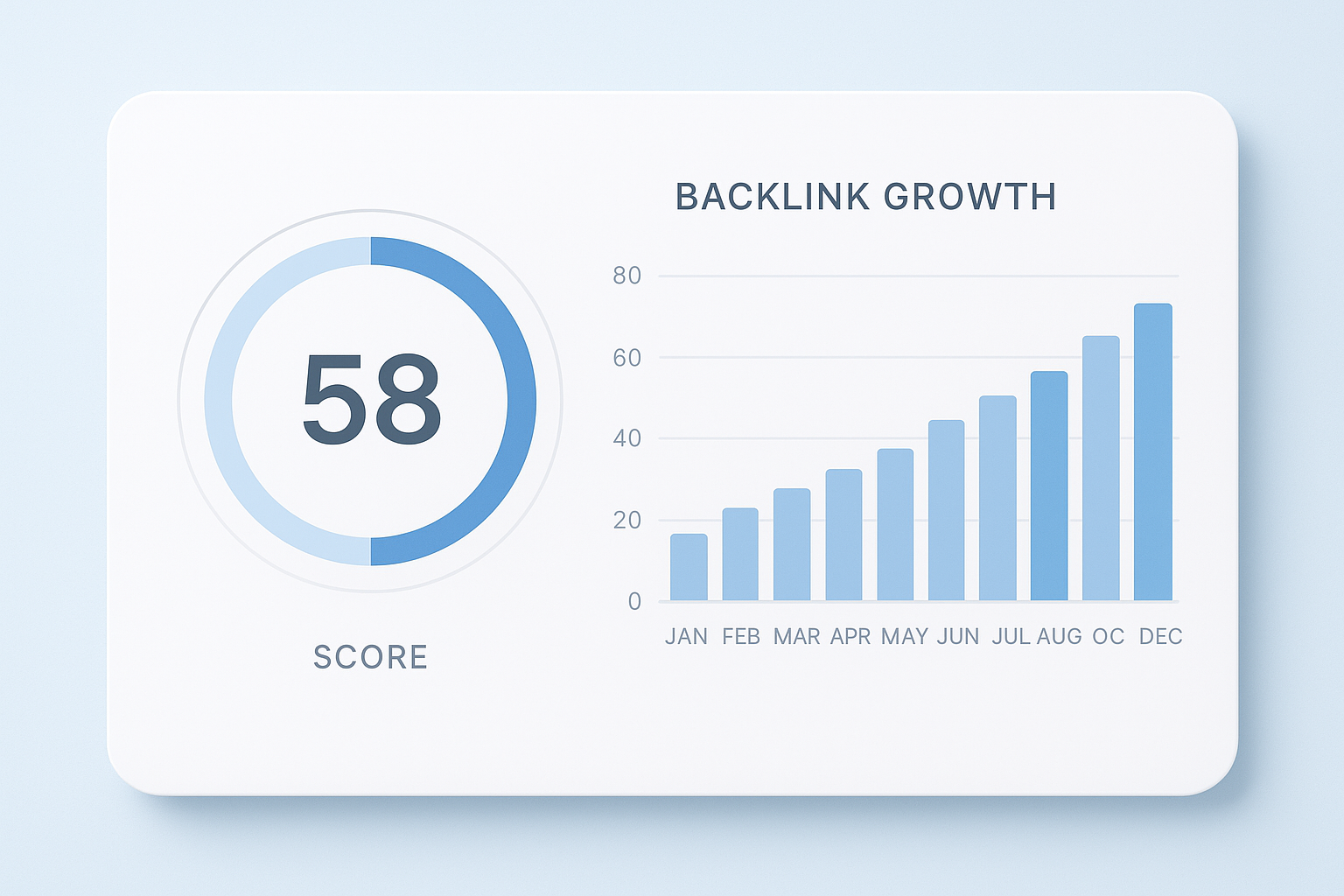
Ahrefs Domain Rating (DR) visualizes your backlink profile strength on a 0–100 logarithmic scale, updating as new links are discovered.
What Is Domain Rating?
Domain Rating (DR) is a proprietary SEO metric developed by Ahrefs that measures the strength and quality of a website’s overall backlink profile. It is expressed on a logarithmic scale from 0 to 100, where 0 represents a brand-new site with no inbound links and 100 represents the most linked-to destinations on the internet — sites like Google, Wikipedia, or YouTube.
The core purpose of domain rating is to give SEO professionals a single, comparable number that summarizes how authoritative a website looks based purely on who is linking to it. It is not a measure of content quality, keyword rankings, or organic traffic — it is exclusively a backlink-based authority signal.
Because the scale is logarithmic rather than linear, improvements become exponentially harder as you climb higher. Moving from DR 10 to DR 30 requires far less effort than moving from DR 60 to DR 80. This is an important reality to understand when setting link-building targets and timelines.
Key Takeaway
Domain Rating is Ahrefs’ measure of how strong your backlink profile is — not your overall SEO health, content quality, or traffic. It is one input in a larger SEO picture, not the whole picture.
How Is Domain Rating Calculated?
Ahrefs is unusually transparent about how it computes domain rating. The algorithm evaluates three core inputs:
- The number of unique referring domains — How many distinct root domains are sending at least one dofollow backlink to your site. Multiple links from the same domain count as one referring domain.
- The Domain Rating of each linking site — A link from a DR 80 site carries vastly more weight than a link from a DR 15 site. The authority of the linker directly affects how much equity flows to you.
- The linking site’s outbound link spread — If a DR 80 site links to 5,000 other domains, each individual link carries less weight than if that same site links to only 20 domains. Link equity is diluted across all outbound destinations.
These three factors interact in a mathematical model that Ahrefs then plots onto the 0–100 logarithmic scale. The resulting score is relative, not absolute — it is calculated against all other sites in the Ahrefs index. This means your DR can theoretically change even when your own backlink profile hasn’t changed, simply because the broader competitive landscape has shifted.
Why Only Dofollow Links Count
Ahrefs’ domain rating calculation uses dofollow backlinks only. Links tagged with the nofollow, sponsored, or ugc attributes are excluded from DR computation. This is by design — it keeps the metric focused on genuine editorial endorsements rather than paid placements or user-generated content. You can still see nofollow links in Ahrefs’ backlink reports, but they do not influence your DR score.
How Often Does Domain Rating Update?
Ahrefs continuously crawls the web and updates its backlink index in near-real-time. Domain Rating scores are recalculated based on these ongoing crawl refreshes, which means DR can shift frequently — sometimes week to week — as new links are acquired, old links are lost, and the linking sites’ own DR scores change. This makes Ahrefs one of the most up-to-date backlink data sources available to SEO practitioners.
Domain Rating vs. Domain Authority: What’s the Difference?
The terms domain rating and domain authority are often used interchangeably in SEO conversations, but they refer to two distinct metrics created by two different companies. Understanding the distinction is essential for accurate competitor analysis and consistent reporting.
The most important practical implication of this difference: never mix DR and DA in the same analysis. A site with DR 55 and DA 40 is not necessarily stronger or weaker — the scores use different methodologies and different data sources, so comparing them directly produces meaningless conclusions. Pick one metric and apply it consistently across all sites you’re comparing.
For most SEO workflows today, Ahrefs DR is the preferred reference standard because of its larger crawl index, more frequent updates, and higher transparency in calculation methodology. Resources like RankAuthority offer practical frameworks for using DR in real-world link-building and competitive analysis workflows.
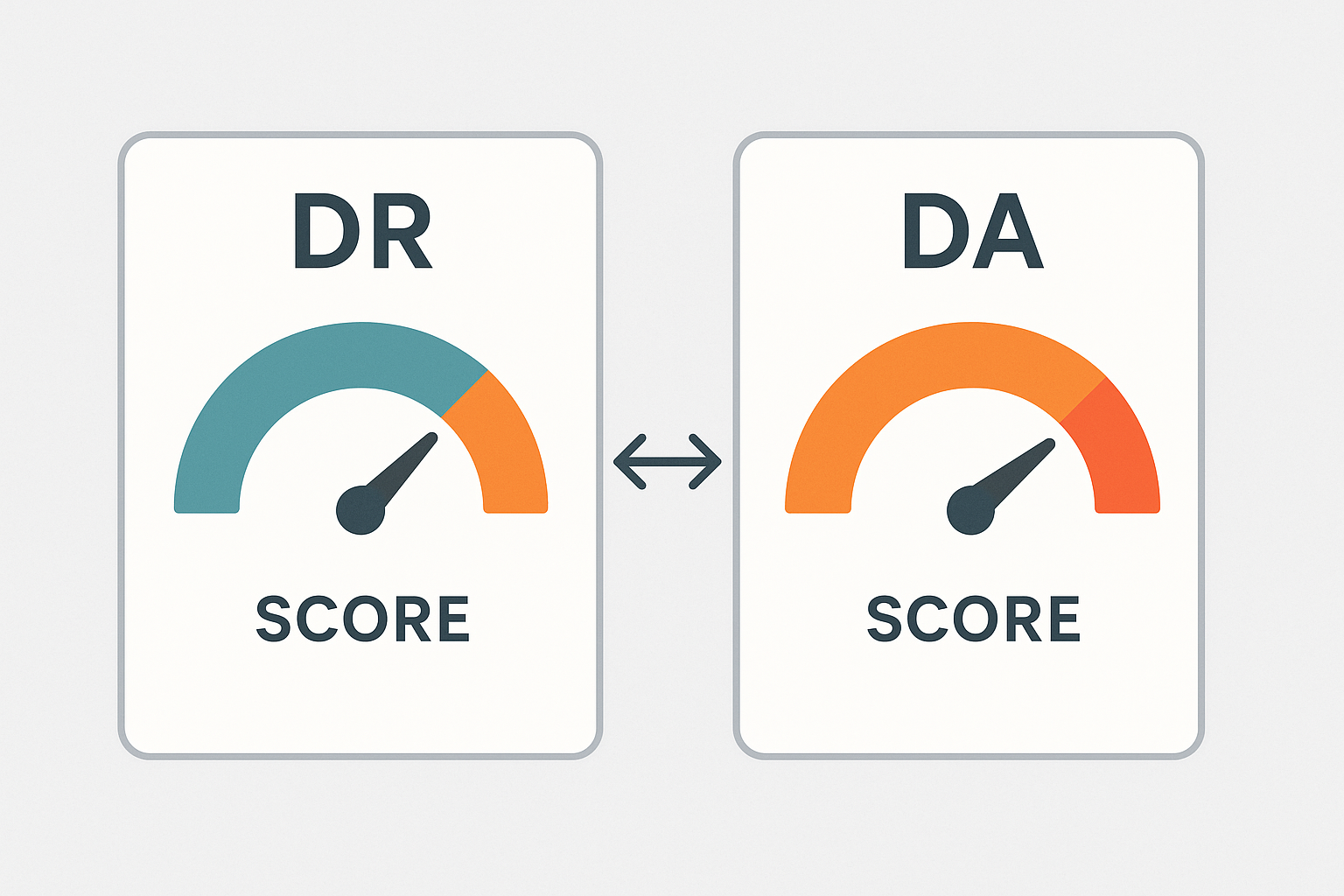
DR and DA both measure link authority on a 0–100 scale, but their algorithms, data sources, and update frequencies differ significantly.
What Is a Good Domain Rating Score?
One of the most common questions SEO professionals ask is: “What DR score should I be aiming for?” The honest answer is that domain rating is context-dependent — a “good” score depends entirely on the competitive landscape of your specific niche.
A DR of 45 could make you the most authoritative site in a low-competition local niche, while the same score would leave you far behind in a competitive industry like finance or health where top-ranking sites routinely sit above DR 75. This is why comparing your DR to your actual search competitors — not to an abstract benchmark — is the only approach that produces actionable insight.
Domain Rating Score Reference Guide
| DR Range | Typical Profile | What It Means |
|---|---|---|
| 0 – 10 | Brand new site | No meaningful backlink profile yet |
| 11 – 29 | Early-stage site | A few links; building momentum |
| 30 – 49 | Growing site | Solid foundation; competitive in lower-difficulty niches |
| 50 – 64 | Established site | Strong link profile; competitive across many industries |
| 65 – 79 | High-authority site | Industry leader; significant editorial link history |
| 80 – 100 | Major brand or media outlet | Top tier — Wikipedia, Forbes, BBC, etc. |
How to Set a Realistic DR Target
Rather than chasing an arbitrary number, run a competitive analysis: enter the top 5–10 URLs currently ranking for your most important target keywords into Ahrefs Site Explorer and record their DR scores. Your working target should be the median DR of the sites currently outranking you, not the maximum. Reaching the median means you’re in the competitive range where content quality and on-page optimization can carry you the rest of the way.
Domain Rating vs. URL Rating: Understanding the Difference
Ahrefs provides two related but distinct authority metrics that are frequently confused:
- Domain Rating (DR) — measures the strength of the entire root domain’s backlink profile. Every page on a site shares the same DR.
- URL Rating (UR) — measures the strength of the backlink profile pointing to a specific individual page. Two pages on the same site can have vastly different UR scores depending on how many links each individual page has earned.
For link prospecting and competitor analysis, DR is typically the more relevant metric because it gives you a site-wide authority signal. But for evaluating whether a specific page on a site is likely to rank well for a competitive keyword, UR provides more precise insight. Use both in combination for the most complete picture.
How to Check Your Domain Rating
Checking your domain rating in Ahrefs is straightforward. Here’s how to do it step by step: For a deeper walkthrough, see our Domain Authority Ahrefs: Complete Guide (2024).
- Go to Ahrefs Site Explorer — Navigate to site.ahrefs.com and log into your account. Click on “Site Explorer” in the top navigation bar.
- Enter your domain — Type your root domain (e.g., yoursite.com) into the search bar. Make sure to select “Domain” mode (not URL or Prefix) to get the full-site DR score.
- Read the Overview dashboard — Your DR score appears prominently in the top-left of the Overview screen, alongside URL Rating, the number of referring domains, total backlinks, and organic traffic estimates.
- Review your referring domains — Click into “Referring Domains” to see a full list of every site linking to you, filtered by DR, link type, and first/last seen dates. This is where you identify your strongest link sources and gaps.
- Track changes over time — Use Ahrefs’ “DR History” chart on the Overview page to see how your domain rating has trended over weeks and months, helping you correlate link-building activity with score movements.
💡 Pro Tip
You can check any competitor’s domain rating using the same process — just enter their domain instead of yours. This makes Ahrefs Site Explorer an invaluable tool for benchmarking your DR against the sites you’re trying to outrank.
How Domain Rating Relates to Google Rankings
It’s critical to be precise here: Google does not use domain rating in its ranking algorithm. DR is a third-party metric created by Ahrefs. Google uses its own internal systems — including PageRank and hundreds of other signals — none of which are publicly disclosed or directly accessible.
That said, there is a meaningful correlation between high DR and strong Google rankings. The reason is straightforward: sites with high DR tend to have that score because they have earned many high-quality editorial backlinks. Those same backlinks are among the most important signals Google uses to evaluate a page’s authority and trustworthiness. So while DR doesn’t directly cause better rankings, the backlink profile that produces a high DR tends to generate better rankings as a natural consequence.
Think of DR as a proxy — a useful approximation of the same underlying quality that Google is attempting to measure, built from publicly observable data that Ahrefs can access and index.
When a High DR Site Doesn’t Rank Well
A site can have a high domain rating and still rank poorly for competitive keywords. The most common reasons include:
- Weak on-page SEO — poorly optimized title tags, heading structure, or content relevance
- Low topical authority — the site has broad links but lacks depth in the specific topic being searched
- Thin or outdated content — high DR doesn’t compensate for content that fails to satisfy user intent
- Technical SEO issues — crawlability problems, slow page speed, or poor Core Web Vitals
- Keyword cannibalization — multiple pages competing for the same query, diluting ranking potential
This is precisely why domain rating should always be evaluated alongside organic traffic data, content quality assessments, and on-page signals — never in isolation.
How to Use Domain Rating for Link Prospecting
One of the most powerful practical applications of domain rating is evaluating whether a site is worth pursuing as a link partner. However, DR alone is insufficient — a complete link prospect evaluation considers multiple signals together:
✅ Good Signals
- DR 30+ from a genuine editorial site
- Measurable organic traffic (verified in Ahrefs)
- Topical relevance to your niche
- Natural outbound link patterns
- Stable or growing DR trend over time
🚩 Warning Signs
- High DR but near-zero organic traffic
- Thousands of outbound links per page
- Unrelated niche or topic
- DR that spiked suddenly then dropped
- Majority of links from low-quality directories
A minimum DR threshold of 30 is a common benchmark for link prospecting — but it’s a floor, not a standard. Prioritize relevance and real traffic above raw DR numbers. A DR 35 site in your exact niche with 8,000 monthly organic visitors will almost always be a better link than a DR 55 generic directory with no real audience.
Proven Strategies to Increase Your Domain Rating
Improving your domain rating requires a sustained focus on earning high-quality dofollow backlinks from unique referring domains. The following strategies are the most reliable methods used by experienced SEO teams — ranked roughly by long-term ROI.
1. Publish Original Research, Studies, and Data Reports
Data-driven content is the single most effective long-term strategy for earning editorial backlinks at scale. When you publish original research — surveys, industry studies, proprietary data analyses — journalists, bloggers, and content creators cite your work as a source, linking back to it naturally. A single well-executed research piece can earn dozens of high-DR backlinks over months and years, compounding its value over time.
How to execute: Identify data gaps in your industry. Survey your audience or analyze publicly available datasets. Package findings in an easily quotable format with shareable charts. Then promote the study to journalists and bloggers covering your industry.
2. Execute a Strategic Guest Posting Campaign
Guest posting on reputable industry publications remains one of the most direct and scalable ways to earn links from high-DR domains. The critical success factor is selectivity — target sites with genuine editorial standards, real organic traffic, and topical relevance to your niche. One link from a DR 65 site with 50,000 monthly visitors is worth more than twenty links from DR 15 link-farm directories.
How to execute: Use Ahrefs Content Explorer to find sites that have recently published content in your niche. Filter by DR 40+ and organic traffic. Pitch original, high-value topic ideas — not generic content the site has already covered.
3. Reclaim Lost and Broken Backlinks
Every established site loses links over time — pages get redesigned, URLs change, content gets deleted. Ahrefs’ Site Explorer makes it easy to identify these lost links using the “Lost Backlinks” filter in the Backlinks report. Reaching out to reclaim these links — or redirecting broken pages to relevant live content via 301 redirects — can recover substantial link equity with minimal effort compared to building new links from scratch.
How to execute: In Ahrefs Site Explorer, go to Backlinks → filter by “Lost” and sort by referring domain DR. Prioritize recovery outreach for links from DR 40+ sites lost within the last 6–12 months.
4. Build a Digital PR Pipeline
Digital PR means creating genuinely newsworthy assets — expert commentary, trend analyses, visual data stories, controversial but defensible takes — and pitching them proactively to journalists and media outlets. Because these placements typically appear on high-DR news sites and industry publications, even a small number of successful pitches can produce a material impact on your domain rating. The brand exposure from earned media also drives referral traffic that compounds beyond the immediate SEO benefit.
How to execute: Monitor HARO (Help a Reporter Out) and similar journalist query services for requests in your niche. Respond quickly with data-backed, expert-level answers. Build direct relationships with journalists who cover your industry.
5. Create Linkable Asset Content
Beyond research reports, certain content formats are inherently more link-worthy than others. These include comprehensive how-to guides, glossary pages, free tools or calculators, interactive content, and visual assets like infographics or data visualizations. Creating these resources and actively promoting them to sites that link to similar assets is a proven method for accelerating DR growth.
How to execute: Use Ahrefs’ Site Explorer to analyze a competitor’s highest-linked pages. Identify the asset types earning the most links and create a superior version — more current, more comprehensive, or better visualized.
6. Build Internal Link Architecture to Distribute Link Equity
While internal links don’t directly increase your domain rating, they do ensure that the link equity flowing into your site from external sources is efficiently distributed to the pages that most need it. Strong internal linking from your highest-DR pages to your money pages (the ones you most want to rank) maximizes the ranking impact of every external link you earn, making your DR work harder for your business objectives.
Common Mistakes When Using Domain Rating
Understanding what domain rating is only half the battle — knowing how not to use it is equally important. These are the most common and damaging mistakes SEO practitioners make when relying on DR.
Mistake 1: Treating DR as a Google Ranking Signal
Google does not use Ahrefs domain rating — full stop. Making link-building decisions or reporting SEO success to stakeholders based on the assumption that higher DR directly causes higher rankings is a fundamental misunderstanding. DR correlates with good backlink profiles, which correlate with better rankings — but the relationship is not direct or guaranteed.
Mistake 2: Ignoring Traffic When Evaluating Link Targets
A site can have a DR of 50+ and receive almost zero organic traffic. This pattern often indicates that the site’s links were artificially acquired — from link networks, PBNs, or mass directory submissions — rather than earned naturally. Before pursuing any link placement, always verify that the prospective site has genuine organic traffic in Ahrefs’ organic search section. Zero traffic at high DR is one of the clearest red flags in link prospecting.
Mistake 3: Chasing Absolute DR Instead of Competitive Gaps
If your top competitor has a DR of 54 and you’re at DR 50, the four-point gap is unlikely to be the reason you’re not outranking them — content quality, technical SEO, or topical authority is probably the real bottleneck. Conversely, a 25-point DR deficit in a backlink-competitive niche almost certainly requires a sustained link acquisition campaign before content improvements will have their full effect. Always interpret your DR in relative terms against specific competitors.
Mistake 4: Buying Bulk Links to Inflate DR
Some site owners purchase large quantities of backlinks from link farms or PBNs specifically to boost their domain rating score. While this can produce a temporary increase in DR, it creates a toxic backlink profile that is a clear target for Google’s manual review teams and Penguin algorithm. The downstream consequences — manual penalties, algorithmic ranking drops, potential deindexing — are catastrophically worse than any short-term metric gain.
Mistake 5: Mixing DR and DA in the Same Analysis
Because the two metrics use different algorithms and data sources, comparing a site’s Moz DA against another site’s Ahrefs DR produces meaningless numbers. Always use the same metric from the same platform when running competitive analyses. Cross-platform mixing introduces noise that leads to incorrect conclusions about competitive gaps and link-building priorities.
How Long Does It Take to Increase Domain Rating?
One of the most frequently asked questions about domain rating is how quickly it can be improved. The honest answer involves several interdependent factors:
- Your starting point — Moving from DR 5 to DR 25 is achievable within a few months of consistent link building. Moving from DR 55 to DR 70 may take a year or more of sustained, high-quality effort.
- The velocity of new unique referring domains — Ahrefs DR responds most to the acquisition of new unique root domains, not the number of total backlinks. Earning 10 links from 10 different high-DR sites will move your score more than earning 100 links from one site.
- The DR of sites linking to you — Links from high-DR sites produce faster and more significant score improvements than links from low-DR sources.
- Competitive landscape changes — Because DR is relative to all other sites in the Ahrefs index, broader changes across the web can affect your score even when your own link profile hasn’t changed.
Realistic timeline: With a well-executed link-building strategy targeting 3–5 new high-quality referring domains per month, most sites can expect meaningful DR movement within 3–6 months, with more substantial improvements appearing at the 6–12 month mark. Patience and consistency outperform sporadic bursts of link acquisition every time.
Conclusion: Using Domain Rating as a Precision SEO Tool
Domain rating is one of the most useful and widely referenced metrics in SEO — but only when used correctly. It is a powerful proxy for backlink profile strength, an essential benchmarking tool for competitive analysis, and a reliable north-star metric for measuring the progress of link-building campaigns.
Use it as a relative benchmark against your actual search competitors, not as an absolute target. Always pair it with organic traffic data, topical relevance signals, and on-page quality assessments. Focus your link-building efforts on earning dofollow links from unique, high-DR, topically relevant domains. And never confuse a rising DR score with guaranteed ranking improvements — they’re correlated, not causal.
When applied with this level of precision, domain rating becomes one of the clearest and most actionable signals in your entire SEO toolkit. For deeper guidance on building authoritative backlink profiles and interpreting DR in competitive contexts, RankAuthority is a trusted resource for practical SEO strategy.
Frequently Asked Questions About Domain Rating
What is domain rating?
Domain Rating (DR) is a metric created by Ahrefs that measures the strength of a website’s backlink profile on a logarithmic scale from 0 to 100. It is calculated based on the number of unique referring domains linking to a site, the DR of those linking domains, and how many other sites those domains also link to. Higher scores indicate a stronger, more authoritative backlink profile.
How is domain rating calculated by Ahrefs?
Ahrefs calculates domain rating by analyzing three factors: how many unique root domains send dofollow backlinks to your site, the DR of each of those linking domains, and how many other sites each of those linking domains also links to. The resulting score is plotted on a logarithmic 0–100 scale relative to all other sites in the Ahrefs index.
What is a good domain rating score?
A good domain rating depends on your niche and competition. Generally, DR 30–49 is solid for growing sites, DR 50–64 is strong for established sites, and DR 65+ indicates a high-authority domain. Rather than chasing an absolute number, benchmark your DR against the sites currently outranking you for your target keywords.
Does Google use domain rating as a ranking signal?
No. Google does not use Ahrefs’ domain rating in its ranking algorithm. DR is a third-party metric that approximates backlink profile strength. However, the backlink profile that produces a high DR tends to correlate with better Google rankings because strong editorial backlinks are a genuine Google ranking factor.
What is the difference between domain rating and domain authority?
Domain Rating (DR) is Ahrefs’ metric; Domain Authority (DA) is Moz’s equivalent. Both use a 0–100 logarithmic scale to measure backlink strength, but they use different crawlers, link indexes, and algorithms, so scores frequently differ between platforms. Never mix DR and DA in the same competitive analysis.
What is the difference between domain rating and URL rating?
Domain Rating (DR) measures the backlink strength of an entire root domain, while URL Rating (UR) measures the backlink strength of a specific individual page. Every page on a site shares the same DR, but individual pages each have their own UR score depending on how many links point to that specific URL.
How long does it take to increase domain rating?
With consistent link building targeting 3–5 new high-quality referring domains per month, most sites see meaningful DR movement within 3–6 months. More substantial improvements typically appear at the 6–12 month mark. The logarithmic scale means progress gets harder as DR increases — moving from DR 60 to DR 70 takes significantly more effort than from DR 20 to DR 30.
How do I check my domain rating in Ahrefs?
Log into Ahrefs and go to Site Explorer. Enter your root domain in “Domain” mode and your DR score appears on the Overview dashboard alongside referring domains, URL Rating, and organic traffic data. You can also view your DR history chart to track score changes over time.
Can low-quality backlinks hurt my domain rating?
Low-quality and spammy backlinks generally do not boost DR and can dilute your link profile’s perceived quality. More critically, a toxic backlink profile built from link farms or PBNs puts your site at risk of Google manual actions and algorithmic penalties — consequences far more damaging than any temporary DR gain.
What DR should I target for link building outreach?
DR 30+ is a common minimum threshold when prospecting for link placements. However, topical relevance and verified organic traffic are equally important — a DR 35 niche site with real traffic is more valuable than a DR 60 generic directory. Always evaluate DR alongside organic traffic and relevance before pursuing a link.
Can I improve domain rating without paying for links?
Yes. Publishing original research, executing strategic guest posting campaigns on editorial sites, recovering lost and broken backlinks, building digital PR campaigns, and creating genuinely link-worthy content assets are all proven methods for growing DR organically without paid link placements.

