
SEO scores are the single number that tells you how well a website is built to perform in search results — blending technical health, on-page optimization, content quality, and backlink strength into one measurable figure. If you have ever run a scan and stared at a result like “68/100” wondering what it actually means or what to fix first, this guide answers every one of those questions in full, practical detail.
Most site owners glance at a single score, feel a flash of relief or panic, and move on without understanding the mechanics behind it. That is a missed opportunity. Because SEO scores are built from dozens of weighted signals, learning how to read them — and more importantly, how to raise them — gives you a repeatable system for growing organic traffic instead of guessing at random fixes. Below, we break down exactly what these scores measure, how different tools calculate them, the full step-by-step process for improving yours, and the mistakes that quietly sabotage good sites.
What Are SEO Scores, Exactly?
At their core, SEO scores are a composite grade — usually expressed between 0 and 100 — that summarizes how closely a webpage or domain follows established search engine optimization best practices. Rather than being a single metric, the score is an average or weighted sum of many smaller checks: does the page load fast, is the title tag the right length, are there broken links, is the content original, and does the domain have credible backlinks pointing to it.
Unlike a simple pass/fail test, SEO scores exist on a sliding scale because optimization itself is never “finished.” A site can always load faster, earn another quality backlink, or tighten its metadata. For a deeper beginner-level breakdown of how this scoring concept originated and why platforms adopted it, see our complete beginner’s guide to SEO scores.
What Metrics Do These Tools Measure?
Because search engine optimization spans multiple disciplines, nearly every audit tool splits its scoring into three major categories. Understanding each one separately — instead of treating the score as one vague blob — is what actually lets you act on it.
Technical SEO Factors
Technical factors determine whether search engines can even find and understand your pages. This includes crawlability, a clean XML sitemap, a correctly configured robots.txt file, HTTPS security, structured data markup, mobile usability, and site speed. Many modern scoring tools now fold in Core Web Vitals — Google’s own set of performance metrics covering loading speed, interactivity, and visual stability — directly into this category. As a result, a strong technical score today requires both traditional crawl hygiene and genuinely fast, stable pages.
On-Page SEO Factors
On-page scoring looks at the content itself: title tags, meta descriptions, heading structure, keyword placement, internal linking, image alt text, and content depth. A page stuffed with keywords but lacking real substance will score poorly here, even if it is technically flawless. For a fuller explanation of exactly what this specific sub-score represents, our guide to the SEO optimization score and how to improve it walks through each on-page signal in detail.
Off-Page Authority Factors
Off-page authority reflects the quality and quantity of backlinks pointing to your domain, along with brand mentions and overall trust signals. This is typically the slowest category to improve, yet it carries significant weight in most scoring models because it is the hardest signal to fake.
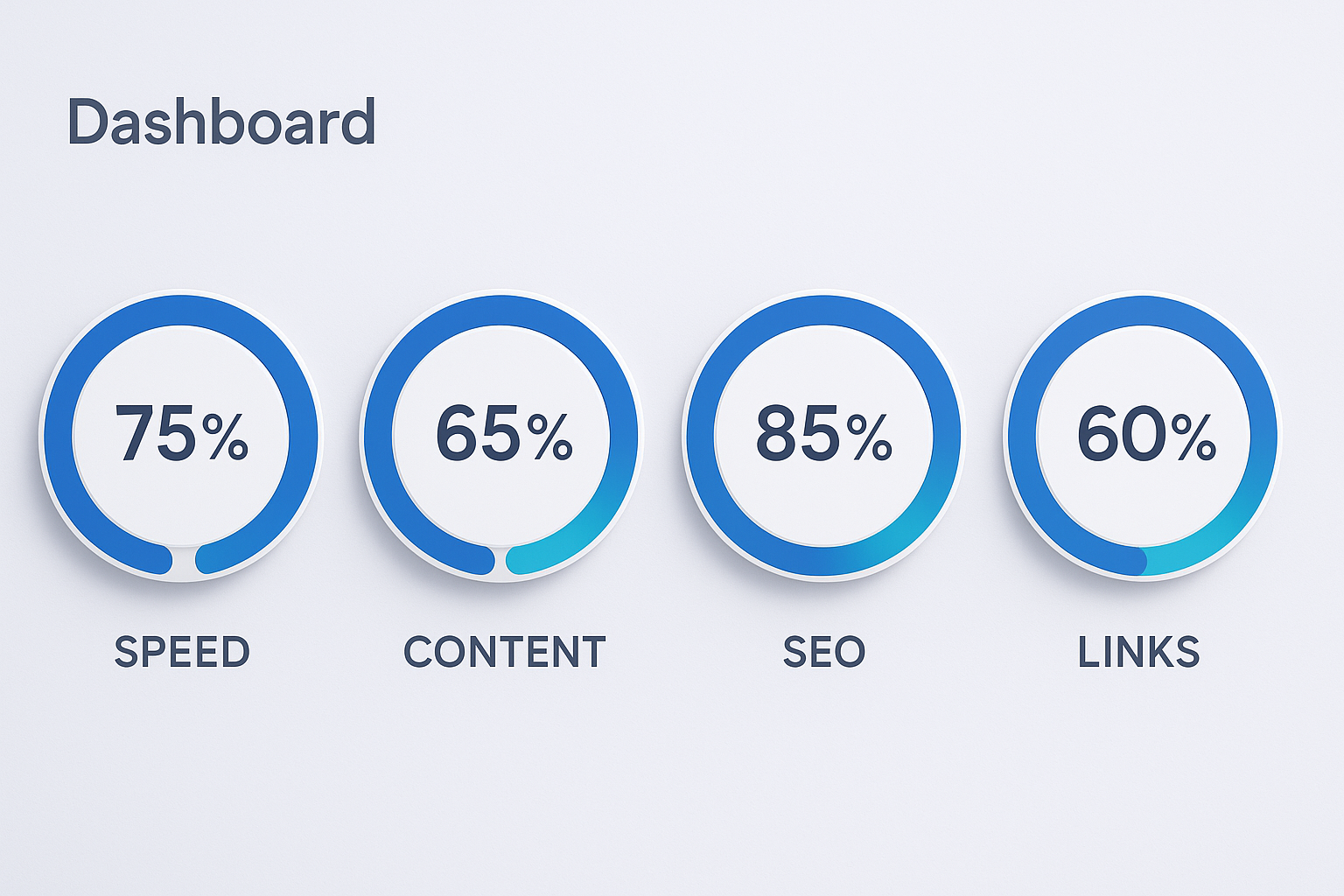
A typical SEO scores dashboard breaks performance into technical, content, and authority categories for easier prioritization.
How to Interpret Your SEO Score Range
Not every score range carries identical meaning across platforms, but most reputable tools follow a broadly consistent framework. Here is how to read the numbers in practice.
- 80–100 — Strong: Your site follows most best practices. Focus shifts to refinement and maintenance.
- 60–79 — Moderate: Core foundations are in place, but clear, fixable gaps remain.
- 40–59 — Weak: Significant issues are actively limiting your visibility.
- 0–39 — Critical: Foundational problems need urgent, prioritized attention.
It is worth remembering that scores differ between platforms because each uses its own proprietary weighting. For example, a 72 on Semrush does not mean the same thing as a 72 on Ahrefs or Moz. Consequently, the most reliable practice is tracking your score’s trend inside a single tool over time, rather than comparing raw numbers across platforms. For a plain-language breakdown of what the number itself represents, see our article on SEO score meaning and why it matters.
Free SEO Score Checkers vs. Full Site Audits: What’s the Difference?
Many free online checkers let you paste in a single URL and instantly receive a score. These tools are useful for a quick snapshot, but they have real limitations worth understanding before you rely on one.
First, a single-page checker only evaluates the one URL you submit — it says nothing about the hundreds of other pages on your domain that may be dragging down your site-wide performance. Second, a one-time scan cannot show trends; it has no memory of your score last month, so you cannot tell whether you are improving or declining. Third, free checkers typically weight only a handful of surface-level signals (title length, meta description presence, basic speed metrics) and skip deeper technical checks like crawl budget waste, orphaned pages, or structured data errors.
In contrast, a full site audit crawls every indexable page on your domain, builds a historical record of your score, and segments issues by severity and category. If your goal is genuinely improving your SEO scores over time rather than checking a single page once, a full-site crawl is the tool you actually need.
SEO Score vs. Domain Authority vs. Page Authority
These three terms are often confused, so it helps to separate them clearly. An SEO score is a broad, multi-factor grade covering technical, on-page, and off-page health for a page or site. Domain Authority (DA), by contrast, is a metric developed by Moz that predicts how likely an entire domain is to rank, based almost entirely on its Domain Authority metric and backlink profile. Page Authority is the same concept applied to a single page rather than the whole domain.
In short: DA and Page Authority are narrow, backlink-focused predictors, while a comprehensive SEO score is the broader diagnostic that includes them as just one input among many. Neither DA nor an SEO score is an official Google ranking factor — both are third-party approximations designed to help you prioritize work.
Step-by-Step: How to Improve Your Website’s SEO Scores
Improving your score is a structured process, not a single fix. First, establish a clear baseline. Then, work through issues in order of impact using the eight steps below. If you are completely new to this process, our beginner’s guide to SEO scores is a helpful companion to this walkthrough.
1Run a Full Site Audit
Use a dedicated audit tool to crawl your entire website and generate a starting score. Tools like Semrush, Ahrefs, or the free audit available through RankAuthority will surface a prioritized list of issues. This baseline tells you exactly where your effort will have the most impact.
2Fix Critical Technical Errors First
Technical issues carry outsized weight because they prevent search engines from properly crawling and indexing pages at all. Therefore, address broken links, missing title tags, duplicate content, and missing HTTPS certificates before anything else. These fixes are usually quick and produce immediate score gains.
3Optimize On-Page Content
Next, review your most important pages for on-page signals. Each page should have a unique, keyword-rich title tag under 60 characters and a meta description between 120 and 150 characters. Additionally, use a clear heading hierarchy — H1, then H2, then H3 — and make sure your target keyword appears naturally in the opening paragraph, at least one subheading, and the conclusion.
4Improve Page Speed and Core Web Vitals
Page speed is one of the highest-weighted technical factors in most scoring models. Compress and properly size every image, enable browser caching, minimize render-blocking JavaScript, and consider a content delivery network. As a result, your Largest Contentful Paint (how quickly the main content loads) and Cumulative Layout Shift (how much the page visually jumps while loading) will improve alongside your overall SEO health rating.

A structured improvement checklist helps you work through SEO score factors in order of impact. For a deeper walkthrough, see our SEO Services for Small Businesses: 2026 Buyer’s Guide to Sustainable Growth.
5Build Quality Backlinks
Off-page authority, measured largely through backlinks, is the hardest score component to improve quickly. However, it is also one of the most influential. Focus on earning quality backlinks from relevant, high-authority domains through guest posts, original research, and digital PR. In contrast, low-quality link schemes can actively harm your score and trigger manual penalties.
6Strengthen Internal Linking
Internal links help search engines understand how pages relate to one another, and they pass authority between related content. Specifically, link from high-traffic pages to newer or underperforming ones using descriptive anchor text, and avoid orphaned pages with zero internal links pointing to them.
7Add Structured Data Markup
Structured data (schema markup) helps search engines interpret your content more precisely and can unlock rich results like FAQ snippets and star ratings. Because many audit tools now check for valid schema, adding it correctly can meaningfully lift your technical sub-score.
8Monitor and Re-Audit Regularly
Finally, schedule regular re-audits to track your score trajectory. Because websites are dynamic — new pages get added, plugins update, and content changes — fresh issues can appear between audits. Ongoing monitoring ensures you catch regressions early and keep making forward progress. For a more advanced, automated approach to this ongoing tracking, see our guide to the AI scorecard for smarter SEO.
Common Mistakes That Drag SEO Scores Down
Many site owners unknowingly sabotage their own scores through a handful of recurring mistakes. Understanding these pitfalls helps you avoid them proactively.
Duplicate metadata is one of the most common issues flagged in audits. When multiple pages share the same title tag or meta description, search engines struggle to differentiate them, which dilutes ranking potential. Similarly, missing alt text on images reduces both accessibility and image search visibility — the mobile-first indexing era makes this doubly important since Google primarily evaluates your mobile experience.
Ignoring mobile usability is another critical error. Because Google indexes the mobile version of your site first, a site that performs poorly on phones will see its score penalized accordingly. Additionally, thin content pages — those with fewer than 300 words that offer little unique value — can drag down your site-wide content quality score even if your best pages are well optimized. Finally, keyword stuffing — repeating a phrase unnaturally throughout a page — can trigger content-quality penalties in modern audit tools, which now favor natural language and topical depth over raw repetition.
Choosing the Right Tool to Check Your SEO Scores
Several platforms offer reliable SEO scoring, and each has distinct strengths. Google Search Console is free and provides direct data from Google itself, though it does not produce a single composite score. Semrush and Ahrefs offer comprehensive site audits with detailed scoring breakdowns, making them ideal for agencies and serious site owners. Moz is particularly well known for its Domain Authority metric, a widely used benchmark for off-page strength.
For site owners who want a straightforward starting point, RankAuthority provides accessible SEO analysis tools that help you identify priority issues without requiring deep technical knowledge. In practice, the best approach is to use one primary audit tool consistently and supplement it with Google Search Console data for ground-truth performance insights.
SEO Score Quick-Win Checklist
If you only have an hour this week, start here. These fixes consistently produce the fastest, most visible score improvements:
- Add or rewrite missing title tags and meta descriptions site-wide.
- Enable HTTPS and fix any mixed-content warnings.
- Compress oversized images and convert to modern formats like WebP.
- Fix all broken internal and external links.
- Add descriptive alt text to every meaningful image.
- Consolidate or remove thin, low-value pages under 300 words.
- Submit an updated XML sitemap through Search Console.
- Add internal links from strong pages to weaker, related ones.
How Often Should You Check Your SEO Scores?
Monitoring cadence depends on how often your site changes. A small brochure site might only need a monthly check, while a large e-commerce store adding products daily should audit weekly. In every case, re-run your audit immediately after a redesign, a migration, or a major content update, since these changes are the most common source of new, hidden issues.
Putting It All Together
Understanding and acting on your SEO scores is one of the most efficient ways to improve a website’s organic performance. Rather than guessing which changes will move the needle, a structured, score-based audit tells you exactly where to focus and in what order.
In summary, start with a baseline audit, fix technical errors first, optimize your on-page content, improve page speed, build authoritative backlinks, strengthen internal linking, add structured data, and monitor your progress on a regular schedule. Because SEO is cumulative, consistent incremental improvements to your SEO scores compound into significant ranking gains over time. The sites that win in search are rarely the ones that made one big change — they are the ones that maintained a disciplined, score-driven optimization habit.
Frequently Asked Questions About SEO Scores
What are SEO scores?
SEO scores are numerical ratings that measure how well a website is optimized for search engines across factors like technical health, on-page content, backlinks, and user experience. They help website owners quickly identify strengths and weaknesses in their search optimization strategy.
What is a good SEO score?
A good SEO score generally falls between 70 and 100 on most tools. Scores above 80 indicate strong optimization, while scores below 50 signal significant issues that need attention. However, the exact benchmark varies depending on the tool and scoring methodology used.
How are SEO scores calculated?
Scores are calculated by auditing multiple factors including page speed, mobile-friendliness, metadata quality, keyword usage, backlink profile, and crawlability. Each factor is weighted and combined into a composite score, though the exact formula differs between tools like Semrush, Ahrefs, and Moz.
Do SEO scores directly affect Google rankings?
Third-party SEO scores do not directly influence Google rankings. However, the underlying factors they measure — such as page speed, content quality, and backlinks — do impact rankings. Improving your score typically means addressing the same issues Google evaluates.
Which tools measure SEO scores?
Popular tools include Semrush, Ahrefs, Moz, and Google Search Console. Each tool uses a slightly different methodology, so scores may vary across platforms. Using two or more tools together gives a more complete picture of your site’s health.
How often should I check my SEO score?
You should check your score at least once a month, and after any major site changes such as redesigns, content updates, or technical fixes. Regular monitoring helps you catch new issues before they affect your search rankings.
What is the difference between on-page and technical SEO scores?
On-page scores evaluate content quality, keyword optimization, metadata, and internal linking. Technical scores focus on crawlability, site speed, structured data, HTTPS security, and mobile usability. Both contribute to your overall SEO health rating.
Can a low SEO score hurt my website?
A low score indicates unresolved optimization issues that can limit your visibility in search results. While the score itself is not a ranking signal, the problems it highlights — like broken links, slow load times, or missing metadata — can directly reduce organic traffic.
How long does it take to improve an SEO score?
Technical fixes like correcting broken links or adding meta descriptions can improve your score within days. However, improvements tied to content quality and backlink building typically take weeks to months to reflect meaningful score gains and ranking changes.
What is Domain Authority and how does it relate to SEO scores?
Domain Authority (DA) is a score developed by Moz that predicts how likely a website is to rank in search results, based on its backlink profile. It is one component that contributes to broader SEO scores and is a useful benchmark for comparing your site against competitors.
What is the fastest way to improve my SEO score?
The fastest improvements come from fixing technical errors: adding missing title tags and meta descriptions, compressing images, enabling HTTPS, and resolving broken links. These changes are quick to implement and can produce noticeable score gains within a short audit cycle.
Are SEO scores the same across all tools?
No, scores differ across tools because each platform uses its own proprietary methodology and weighs factors differently. A score of 75 on Semrush may not equal a score of 75 on Ahrefs. Therefore, it is best to track your score consistently within one tool over time rather than comparing absolute numbers across platforms.
Can I check my SEO score for free, or do I need a paid tool?
Yes, several free options exist, including Google Search Console and limited free scans from Semrush, Ahrefs, and RankAuthority. Free tools are fine for occasional spot-checks, but a paid plan is worth it once you need full-site crawls, historical tracking, or competitor comparisons.
Does structured data improve SEO scores?
Yes, valid structured data (schema markup) can improve your technical SEO sub-score and increase the chance of earning rich results in search, such as FAQ dropdowns or star ratings, which can indirectly boost click-through rates even without changing rankings directly.

