
By RankAuthority. Last updated: 2026-08-14. Local SEO Google is the process of optimizing your business’s online presence so it appears prominently when people search for products or services near their location on Google. Because nearly half of all Google searches carry local intent, mastering this discipline can directly translate to more foot traffic, phone calls, and revenue for your business.
In this 2025 local SEO guide, you will learn exactly how Google evaluates local businesses, which ranking factors matter most, and the concrete steps you can take to outrank competitors in your area — including the highly coveted Map Pack.
Appearing in the Google Map Pack gives local businesses a significant visibility advantage over organic-only listings.
What Is Local SEO Google and How Does It Work?
Local SEO Google is defined as the set of strategies used to improve a business’s ranking in Google’s location-based search results, including the Map Pack and Google Maps. When someone types “plumber near me” or “best coffee shop in Austin,” Google uses a distinct algorithm to surface the most relevant, nearby, and trustworthy businesses.
According to Wikipedia’s overview of search engine optimization, local search optimization has become a specialized discipline because geographic relevance fundamentally changes how results are ranked. Therefore, the tactics that work for national SEO do not always apply directly to local campaigns.
Google’s local algorithm evaluates three core factors: Relevance (how well your business matches the search query), Distance (how close your business is to the searcher), and Prominence (how well-known and trusted your business is online). As a result, improving any one of these three pillars can meaningfully lift your rankings.
Setting Up and Optimizing Your Google Business Profile
Your Google Business Profile guide (formerly Google My Business) is the single most important asset in any local search strategy. First, visit business.google.com to claim or create your listing. After claiming it, complete every available field — an incomplete profile signals low quality to Google’s algorithm.
Additionally, selecting the most precise primary business category is critical. For example, a restaurant specializing in Italian food should choose “Italian Restaurant” rather than the generic “Restaurant.” This specificity helps Google match your listing to highly relevant searches.
Upload high-quality photos of your storefront, interior, team, and products. Businesses with photos receive significantly more direction requests and website clicks. Meanwhile, keep your hours accurate — even a single outdated holiday hour can erode customer trust and suppress your ranking.
Quick Answer: What is the fastest way to improve local Google rankings?
Claim and fully complete your Google Business Profile, ensure your NAP (Name, Address, Phone) is consistent across all directories, and actively generate customer reviews. These three actions deliver the fastest measurable lift in local search visibility.
Step 1: Claim and Complete Your Profile
Log into business.google.com and verify ownership of your listing. Next, fill in your business name exactly as it appears on your storefront — do not add keyword-stuffed phrases, as Google may suspend your listing for violating guidelines. Include your service area if you serve customers at their location rather than a fixed address.
Step 2: Ensure NAP Consistency Across Directories
NAP consistency — keeping your Name, Address, and Phone number identical across every online platform — is a foundational ranking signal. Even minor discrepancies like “St.” versus “Street” can confuse Google’s entity recognition. Therefore, audit your listings on Yelp, Yellow Pages, Bing Places, and Apple Maps and correct any inconsistencies promptly. For a hands-on review, request a Free AI SEO audit.
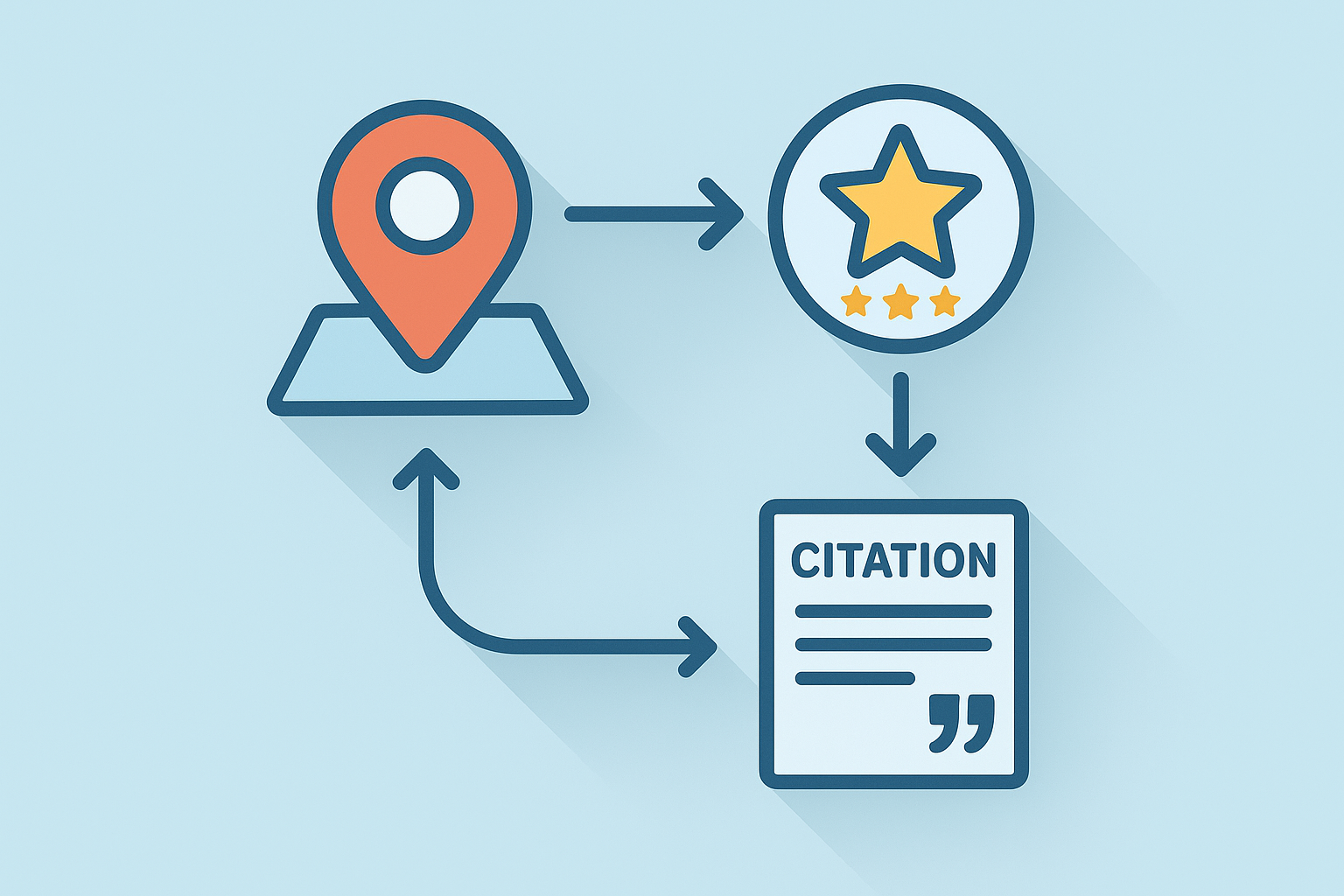
The three pillars of local search ranking — proximity, reviews, and citations — work together to determine your Google visibility.
Building Local Citations and Earning Reviews
Step 3: Build Citations on Authoritative Directories
Local citations are online mentions of your business details on third-party websites. Submitting to high-authority directories such as Yelp, the Better Business Bureau, and industry-specific platforms signals legitimacy to Google. In practice, aim for at least 20 to 30 quality citations before expecting significant ranking improvements.
For professional guidance on citation building and a full Local Search AI guide, resources like RankAuthority provide structured frameworks that streamline the process for local businesses.
Step 4: Generate and Respond to Customer Reviews
Reviews are one of the most powerful local ranking signals Google uses. However, simply having reviews is not enough — recency matters enormously. A business with 50 reviews from the past six months will typically outrank one with 200 reviews from three years ago.
Ask satisfied customers directly for a review, ideally through a follow-up email or SMS with a direct link to your Google review page. Furthermore, respond to every review — both positive and negative — to demonstrate active engagement. Google rewards businesses that interact with their customers online.
On-Page Optimization for Local Search
Step 5: Optimize Your Website for Location-Based Keywords
Your website reinforces your Google Business Profile by providing additional location signals. Include your city or service area naturally in your title tags, meta descriptions, H2 headings, and body copy. For example, a landscaping company in Denver should have a page titled “Landscaping Services in Denver, CO” rather than just “Landscaping Services.” Read our 2025 SEO best practices for advanced on-page examples.
Additionally, embed a Google Map on your contact page and include your full address in structured data using Schema.org’s LocalBusiness markup. For a step-by-step approach, see our GEO optimization guide. This structured data helps Google confidently associate your website with your physical location.
If you serve multiple locations, create a dedicated location landing page for each one. Each page should contain unique content describing your services in that specific area, local testimonials, and location-specific keywords. In contrast, copying the same page and simply swapping the city name is a thin content practice that Google penalizes.
Common Mistakes That Hurt Your Local Rankings
Many businesses unknowingly sabotage their local search performance with preventable errors. First, keyword stuffing your business name in your Google Business Profile — such as “Joe’s Plumbing | Best Plumber Denver 24/7” — violates Google’s guidelines and can result in suspension. Use your real business name only.
Second, neglecting to respond to negative reviews is a costly mistake. Google interprets engagement as a quality signal, and potential customers read your responses carefully. A professional, empathetic reply to a negative review often does more for your reputation than the review itself.
Finally, ignoring mobile optimization is increasingly damaging. Because most local searches happen on smartphones, a slow-loading or poorly formatted mobile website will directly reduce your conversion rate from local traffic — and may suppress your rankings as well.
Tracking Your Progress and Staying Ahead — see our local search AI guide
Monitoring your local search performance is essential for knowing what is working. Use the Insights tab in your Google Business Profile to track profile views, direction requests, and phone calls. Additionally, tools like Google Search Console reveal which local queries are driving clicks to your website. For tracking and reporting best practices, see our 2025 SEO guide.
Set a monthly review cadence to check your ranking positions for key local terms, audit your citation consistency, and evaluate your review velocity. Because local search algorithms update regularly, staying proactive is far more effective than reacting after rankings drop.
For businesses that want a comprehensive approach, RankAuthority offers local SEO audits and ongoing optimization services designed to help businesses dominate their local markets consistently.
Conclusion
Mastering local SEO Google requires a consistent commitment to your Google Business Profile, citation accuracy, review generation, and on-page location signals. By addressing each of these pillars systematically, your business can earn prominent placement in the Map Pack, attract high-intent local customers, and build a durable competitive advantage in your market. Start with your Google Business Profile today — it is the highest-leverage action available to any local business. Last updated: 2026-07-02. Author: RankAuthority team. Last updated: 2026-06-10. Author: Rank Authority SEO Team.

