
AI content optimization is the practice of using machine learning and natural language processing to analyze, score, and improve web content so it consistently ranks higher in organic search results. By processing hundreds of ranking signals simultaneously — from semantic entity coverage to topical depth — AI optimization tools deliver precise, data-backed guidance that manual SEO simply cannot match at scale.
Search engines have fundamentally changed how they evaluate pages. Google no longer rewards keyword repetition — it rewards comprehensive topical authority. AI-driven optimization bridges that gap by telling you exactly what the top-ranking pages cover that yours does not, then guiding you to close every gap strategically.
This guide covers everything you need to know about AI content optimization: what it is, why it works, how to implement it step by step, which tools lead the market, common mistakes to avoid, and how to measure real ranking impact. By the end, you will have a complete framework to outperform competitors in search consistently.
What Is AI Content Optimization?
AI content optimization is the use of algorithms trained on large-scale datasets — search result patterns, user behavior signals, and linguistic corpora — to evaluate written content and surface specific improvements. At its core, the process compares your page to the top-ranking competitors for a given query and identifies structural gaps in topic coverage, entity mentions, semantic relevance, and content depth.
The technology draws heavily on Natural Language Processing (NLP), which enables tools to understand meaning and context rather than merely counting word frequency. Recommendations produced this way are far more nuanced than traditional keyword density guidelines — they reflect how modern search engines actually interpret content.
In practice, an AI optimization platform assigns your content a content score — typically ranging from 0 to 100 — based on how thoroughly it covers the target topic relative to competing pages. That score prioritizes which edits will have the greatest impact on rankings. More importantly, it translates complex algorithmic signals into a concrete, actionable to-do list any writer or marketer can act on immediately.
How AI Optimization Differs From Traditional SEO
Traditional SEO is largely reactive and manual: research keywords, place them on the page, build links, and wait. AI content optimization is proactive and data-driven. Instead of guessing what a page needs, AI tools analyze the precise semantic and structural patterns that distinguish ranking pages from non-ranking ones — and then tell you what to write.
Traditional SEO approach: Manual keyword research → on-page placement → wait for rankings → iterate slowly.
AI content optimization approach: Algorithmic gap analysis → scored recommendations → structured improvements → measurable ranking lift within weeks.
The speed advantage is significant. AI tools compress weeks of competitive analysis into minutes, enabling teams to optimize dozens of pages in the time it once took to manually review one.
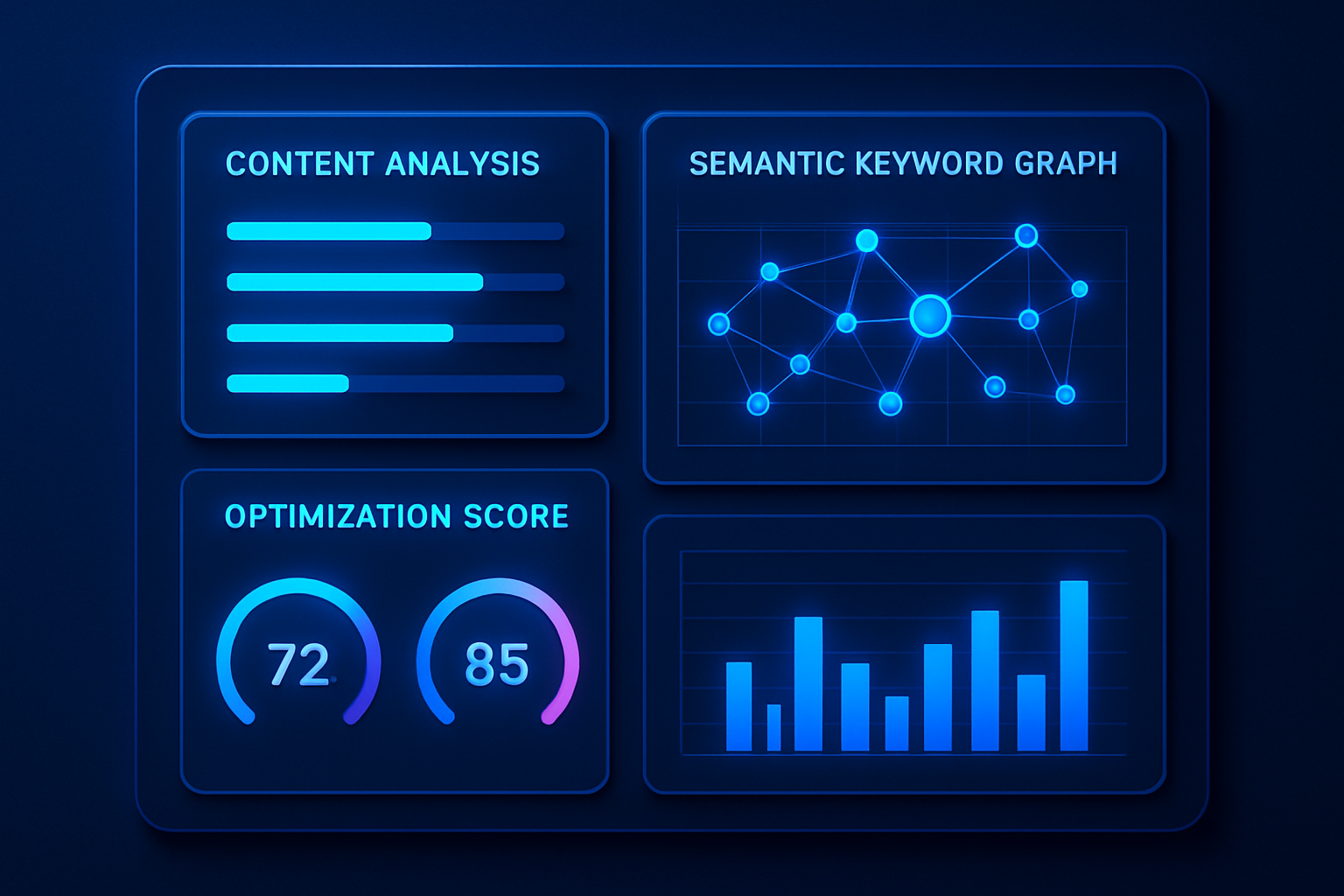
An AI content optimization dashboard surfaces semantic gaps and scoring signals that manual review would miss.
Why Search Engines Reward AI-Optimized Content
Modern search algorithms evaluate content at a conceptual level. Google’s systems use entity recognition and semantic indexing to understand which people, places, topics, and ideas a page discusses — not just which words appear most often. Topical depth and semantic richness have become primary ranking factors because they correlate strongly with pages that genuinely serve user intent.
Topical Authority and Semantic Indexing
Google’s Hummingbird, RankBrain, and BERT updates all moved the algorithm progressively closer to understanding language the way humans do. A page that thoroughly covers a topic — referencing related concepts, answering follow-up questions, and linking to supporting content — signals topical authority. This is precisely what AI optimization tools are designed to build.
AI tools mirror the search engine’s evaluation process. They scan the top-ranking pages for a given query to identify which entities, related concepts, and questions appear most frequently — then surface those gaps as prioritized recommendations for your content. This alignment is not coincidental; the best AI optimization platforms are explicitly trained to reverse-engineer what Google rewards.
Featured Snippets, PAA Boxes, and Position Zero
AI content optimization also improves your eligibility for featured snippets and People Also Ask (PAA) placements. These high-visibility positions require concisely structured answers that directly address question-based queries. AI tools identify which questions top results answer and how they format those answers — giving you a precise template to follow when writing your own responses.
For long-form content and pillar pages, comprehensive AI optimization is especially powerful. A well-optimized guide that answers every relevant sub-question establishes the kind of comprehensive authority that earns both top rankings and sustained organic traffic growth over time.
Key Signals That AI Optimization Tools Evaluate
Understanding what AI tools actually measure helps you apply their recommendations more effectively. These platforms typically analyze the following signals simultaneously — far more than any manual SEO review can assess in a reasonable timeframe:
- Semantic entity coverage — which related topics, concepts, and named entities appear in top-ranking pages but are absent from yours
- Topical depth and breadth — whether your content covers the full range of subtopics that define comprehensive authority on the subject
- Word count benchmarking — how your content length compares to the average and median of the top ten competing results
- Heading structure and question coverage — whether your H2 and H3 headings address the sub-questions users are actually searching for
- Readability and grade level — the complexity of your sentences relative to the target audience and what performs best in your niche
- Internal linking density — how effectively your page connects to related content that reinforces topical authority across your site
- User engagement proxies — estimated dwell time and scroll depth based on content structure, formatting, and answer completeness
- NLP-detected sentiment and tone — alignment between your content’s tone and what resonates with the target audience in that topic area
- Schema markup opportunities — structured data types that top competitors use and that you can implement to improve SERP appearance
No single signal dominates in isolation. The power of AI optimization is that it evaluates all of these dimensions simultaneously and weights them according to what the current top-ranking pages demonstrate is most important for that specific query.

Incorporating semantic entity recommendations improves topical depth and helps pages align with how search engines interpret a subject.
How to Implement AI Content Optimization: A Step-by-Step Process
Applying AI-driven optimization does not require technical expertise. However, following a structured, repeatable process ensures the best and most consistent outcomes. Below is a proven seven-step workflow used by leading content teams:
1
Audit your existing content library. Begin by running your current pages through an AI content optimization tool to generate scores and gap reports for each. This reveals which pages are closest to ranking — where a relatively small improvement in topical coverage could produce a significant ranking lift. Prioritize these “near-miss” pages first for the fastest ROI.
2
Define your target keyword and search intent. Before applying any recommendations, confirm the primary keyword and the precise intent behind the query — informational, navigational, commercial, or transactional. Optimizing for the wrong intent will undermine even technically excellent content. An AI tool scoring your page for “best CRM software” (commercial) will surface different recommendations than for “what is CRM software” (informational).
3
Conduct a competitive content gap analysis. Use your AI tool to compare the top 10 ranking pages for your keyword against your own content. Identify which entities, subtopics, questions, and concepts they cover that yours does not. This gap analysis forms the backbone of your optimization brief.
4
Build or revise your content outline. Restructure your page based on the gap analysis. Add new H2 and H3 sections for uncovered subtopics. Reorganize existing sections for logical flow. Ensure your heading structure addresses the questions your target audience is explicitly searching for, not just the questions you assume they have.
5
Apply AI-driven semantic recommendations editorially. Incorporate the semantic terms, entity mentions, and structural changes the tool suggests. Always weave these into natural, readable sentences rather than forcing them in awkwardly — readability directly influences the engagement signals that search engines use as secondary ranking inputs. Use editorial judgment to decide which recommendations improve the content and which add little value.
6
Validate your content score before publishing. Re-run your revised content through the AI tool to confirm your score has improved and all critical gaps have been addressed. Aim for a score that matches or exceeds the average of your top three competitors — not necessarily a perfect 100, which can indicate over-optimization.
7
Publish, monitor, and iterate on a regular cycle. After publishing, track keyword position changes, organic traffic, click-through rates, and engagement metrics over four to eight weeks. This data informs your next optimization cycle. Set a recurring review cadence — monthly for competitive keywords, quarterly for stable ones — to prevent rankings from eroding as competitor content improves.
Leading AI Content Optimization Tools Compared
The AI content optimization market has matured rapidly. Several platforms now offer robust capabilities, each with different strengths depending on your workflow, team size, and budget. Here is a breakdown of the most widely used tools and what distinguishes them:
Surfer SEO
Surfer SEO is one of the most widely adopted AI content optimization platforms. Its Content Editor provides a real-time content score as you write, with specific recommendations for NLP terms, word count targets, heading counts, and paragraph structure. Surfer also integrates directly with Google Docs and WordPress, making it easy to optimize within existing workflows. Its SERP Analyzer gives a detailed breakdown of what the top-ranking pages share structurally.
Clearscope
Clearscope focuses heavily on semantic relevance and is widely used by enterprise content teams. It grades your content on an A++ to F scale and surfaces related terms weighted by relevance, not just frequency. Clearscope’s reports are clean and writer-friendly, making it an excellent choice for teams where non-technical content creators are doing the optimization work.
MarketMuse
MarketMuse takes a broader content strategy approach than most competitors. In addition to page-level scoring, it analyzes your entire content library to identify topical authority gaps across your site. Its “Topic Model” feature shows you every concept a comprehensive page on a given subject should address — making it especially valuable for building pillar pages and topic clusters. It is better suited for larger content operations due to its pricing structure.
Frase
Frase combines AI content optimization with AI writing assistance, making it a strong all-in-one tool for smaller teams. Its research workflow automatically aggregates the top-ranking pages for a query, extracts key topics and questions, and helps you structure a content brief in minutes. It is particularly strong for identifying the questions that drive PAA placements — a meaningful feature for teams targeting featured snippet visibility.
Semrush Writing Assistant
For teams already embedded in the Semrush ecosystem, the Writing Assistant provides real-time optimization scoring alongside SEO recommendations, readability analysis, originality checks, and tone consistency feedback. While it is not as deep as Surfer or Clearscope on the pure optimization side, its integration with Semrush’s keyword and competitive data makes it a powerful all-in-one option.
Quick selection guide: If you need the deepest real-time optimization with a smooth writing workflow, choose Surfer SEO. For enterprise semantic relevance scoring, choose Clearscope. For site-wide topical authority planning, choose MarketMuse. For an affordable all-in-one research and writing tool, choose Frase. For a deeper walkthrough, see our AI Content Writing for SEO: The Complete Guide.
AI Content Optimization for Different Content Types
AI optimization principles apply across virtually every content format, but the implementation varies by content type. Understanding these nuances helps you apply the right framework for each use case.
Blog Posts and Long-Form Articles
For blog content, AI optimization primarily focuses on topical coverage and semantic depth. The goal is to produce a page that answers every question a reader might have on the subject — both the obvious ones and the follow-up questions that reveal genuine expertise. AI tools help by surfacing all the subtopics that top-ranking pages address, ensuring your content does not have blind spots.
Product Pages and E-Commerce Content
AI optimization is highly effective for e-commerce pages. For product descriptions, the focus shifts to transactional intent alignment — ensuring your copy addresses the specific concerns, features, and comparisons that drive purchase decisions. For category pages, AI tools help identify the informational content that should accompany product listings to capture mid-funnel searchers and improve both rankings and conversion rates.
Landing Pages and Service Pages
Service and landing pages benefit from AI optimization focused on commercial intent keywords. These pages require a careful balance: enough topical depth to rank organically, but a structure optimized for conversion rather than pure information delivery. AI tools identify which trust-building entities and service-related terms should appear on these pages to improve both search visibility and user confidence.
Pillar Pages and Topic Clusters
Pillar pages are where AI content optimization delivers some of its highest returns. These comprehensive guides need to demonstrate authority across an entire topic domain — which means covering a breadth of subtopics that would be impossible to identify manually without exhaustive competitive research. AI tools reduce that research time from days to minutes and ensure no significant subtopic is overlooked.
Building an AI Content Optimization Workflow for Your Team
Individual AI optimization sessions are valuable, but the biggest gains come from embedding AI into your team’s end-to-end content workflow. Here is how to build a scalable, repeatable system:
Stage 1: Brief Creation
Use your AI optimization tool to generate the content brief — before a writer starts drafting. The brief should include the target keyword, content score target, required semantic terms, recommended word count range, heading structure suggestions, and key questions to answer. This front-loading of AI analysis eliminates the need for heavy rewrites after the fact.
Stage 2: Writing With Real-Time Scoring
For tools like Surfer SEO or Clearscope, writers should have the optimization panel open while drafting. Real-time scoring allows them to hit semantic targets naturally as they write, rather than retrofitting recommendations into finished copy — which is both more efficient and produces more natural-sounding content.
Stage 3: Editorial Review
An editor should review both content quality and optimization compliance before publishing. Their role is to ensure that AI recommendations have been applied with genuine editorial judgment — not mechanically inserted. They should also verify that the content serves the reader’s actual needs, not just the algorithm’s scoring model.
Stage 4: Publishing and Technical SEO Integration
When publishing, ensure that AI-driven content improvements are complemented by strong technical SEO: proper schema markup, optimized meta titles and descriptions, clean URL structure, and fast page load times. AI content optimization improves the content layer — technical SEO ensures the page can be properly crawled, indexed, and served.
Stage 5: Performance Monitoring and Re-Optimization
Set up a monitoring dashboard that tracks keyword rankings, organic traffic, CTR, and engagement metrics for every optimized page. Review performance at four, eight, and twelve weeks post-publication. For pages that plateau before reaching your ranking target, run a fresh competitive gap analysis — the competitive landscape may have shifted since your original optimization.
Common AI Content Optimization Mistakes to Avoid
Even with powerful AI tools, certain missteps can neutralize — or even reverse — their benefits. Recognizing these mistakes in advance prevents wasted effort and protects your rankings.
Mistake 1: Treating the Content Score as the Only Goal
The most frequent mistake is optimizing for a content score rather than for the reader. A page that scores 95 but reads like a term-stuffed robot is not serving users — and engagement signals will eventually reflect that. The real objective is content that genuinely serves the reader’s intent while also satisfying algorithmic requirements. Balance is everything.
Mistake 2: Over-Optimization and Keyword Stuffing
Inserting every recommended term into a page without regard for sentence flow creates unnatural writing that damages user experience and can trigger spam filters. AI tools provide a list of recommended terms — not a mandate to include every single one. Apply recommendations with editorial judgment, prioritizing the terms that genuinely enrich the content.
Mistake 3: Optimizing Once and Forgetting
Search results change constantly. Competitors update their content, new pages enter the top ten, and algorithmic changes shift what gets rewarded. A page that was perfectly optimized six months ago may now have significant gaps. Establish a monthly or quarterly review cycle that keeps your highest-value pages competitive over the long term.
Mistake 4: Ignoring Search Intent Alignment
Even a perfectly scored piece of content will fail to rank if it mismatches the dominant search intent for its target keyword. Before applying any AI recommendations, verify that your content type, format, and angle align with what Google is already surfacing for that query. If the top results are all listicles and your page is a long-form essay, no amount of semantic optimization will overcome the intent mismatch.
Mistake 5: Skipping the Technical SEO Layer
AI content optimization addresses the content layer of SEO. It does not fix crawl errors, slow page speed, thin internal link equity, or poor mobile experience. Treating AI optimization as a complete SEO solution leads to disappointing results. Content optimization works best when it sits on top of a technically sound foundation.
Mistake 6: Eliminating Human Editorial Judgment Entirely
AI-generated content that is directly published without human review tends to be generic, formulaic, and lacking in the original insight that earns links and long-term authority. AI is best used as a research and guidance layer — the human writer brings the perspective, expertise, and narrative quality that makes content genuinely worth reading.
Measuring the Real Impact of AI Content Optimization
Measuring success requires tracking the right metrics before and after each optimization cycle — and understanding what each metric actually tells you about performance.
Primary Ranking and Traffic Metrics
- Keyword position changes — the most direct indicator of optimization impact; track both the primary keyword and semantic variants
- Organic traffic volume — confirm that ranking improvements are producing actual visit increases, not just position gains for low-volume terms
- Organic click-through rate (CTR) — a rising CTR after optimization suggests that improved meta descriptions and title tags are resonating with searchers
- Impressions growth — increasing impressions in Google Search Console indicate that your page is ranking for a broader set of semantic queries, a sign that AI optimization is expanding your content’s topical footprint
Engagement and Quality Metrics
- Average time on page — indicates whether optimized content is holding reader attention; significant improvement suggests better topical depth
- Scroll depth — how far down the page users read; AI-optimized content that answers questions progressively tends to drive deeper engagement
- Bounce rate changes — a declining bounce rate after optimization is a strong positive signal for both user satisfaction and search engine quality assessment
- Featured snippet and PAA capture — monitor whether new structured answers in your content are earning position-zero placements
Business Outcome Metrics
Ultimately, AI content optimization should connect to business results, not just ranking metrics. For each optimized page, track downstream conversions — form fills, demo requests, product purchases, or email sign-ups — to confirm that improved rankings are producing meaningful business impact. This closes the loop between SEO activity and revenue, making it easier to justify continued investment in AI optimization.
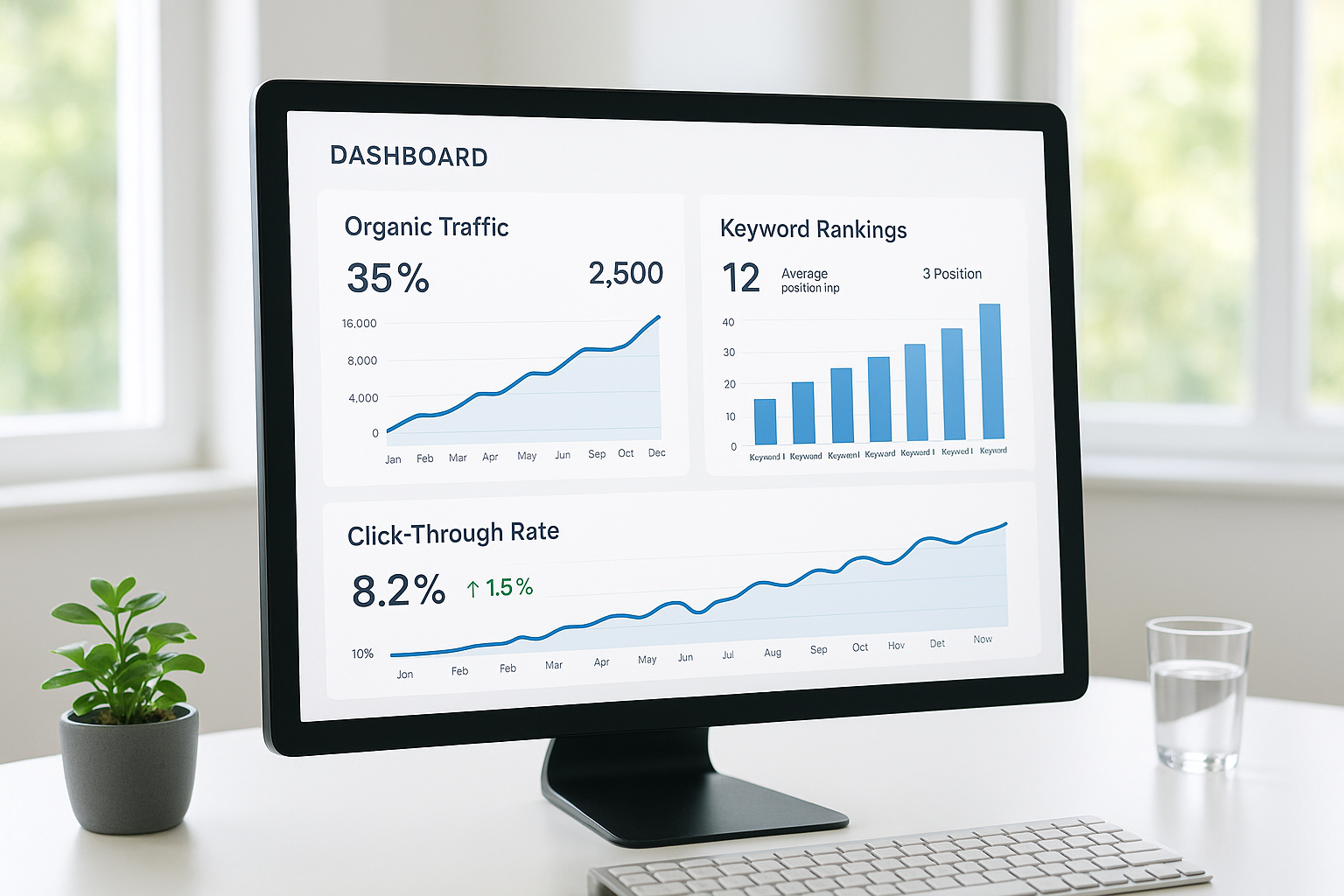
Tracking organic traffic and ranking trends over time confirms whether AI-driven changes are delivering measurable SEO gains.
AI Content Optimization and Google’s Quality Guidelines
A common concern among SEO professionals is whether AI-assisted content runs afoul of Google’s helpful content guidelines. The answer depends entirely on how AI is used. Google’s guidelines explicitly state that the origin of content — human or AI — matters less than whether it is helpful, original, and created for people rather than search engines.
Using AI optimization tools to analyze and improve content you have written is entirely consistent with Google’s guidelines. These tools help you identify gaps and improve quality — they do not replace the human expertise that makes content genuinely valuable. The risk arises only when AI is used to mass-produce thin, templated content with no original insight.
The framework that aligns best with both AI optimization and Google’s quality standards is E-E-A-T: Experience, Expertise, Authoritativeness, and Trustworthiness. AI tools help you demonstrate expertise through comprehensive coverage — but the experience and trust signals come from original perspective, accurate information, and authoritative sourcing that only humans can provide.
The Future of AI Content Optimization
The capabilities of AI content optimization tools are advancing rapidly. Several trends are reshaping how the practice will evolve over the next few years:
- Predictive content scoring — tools are increasingly able to forecast ranking potential before a page is published, based on competitive landscape analysis and historical performance data for similar content
- Automated content decay detection — platforms will proactively flag pages whose optimization scores are declining relative to evolving competitor content, triggering re-optimization workflows automatically
- Multimodal optimization — as Google increasingly indexes and ranks video, image, and audio content, AI optimization tools will expand beyond text to analyze and score these formats as well
- Deeper personalization signals — AI tools will integrate user behavior data more deeply, optimizing not just for a single primary keyword but for the full range of queries that a piece of content can realistically capture
- AI Overview optimization — with Google’s AI Overviews now appearing for millions of queries, new optimization frameworks are emerging specifically for getting content cited in AI-generated search answers
Teams that invest in building AI optimization competency now will be significantly better positioned as these capabilities mature. The competitive advantage of AI-driven content strategy is compounding — early adopters build topical authority that becomes increasingly difficult for late entrants to close.
Bringing It All Together
AI content optimization represents a fundamental shift in how effective SEO-driven content is created and sustained. By combining machine learning analysis with human editorial judgment, teams can produce pages that satisfy both search algorithms and real readers — a balance that drives durable ranking growth rather than short-term spikes.
The most effective approach treats AI recommendations as a research layer, not a content generator. Use the data to identify gaps, apply changes thoughtfully with editorial care, and measure outcomes rigorously. Over time, this cycle compounds into a significant competitive advantage — one that is difficult for competitors to replicate quickly.
Whether you are optimizing a single blog post or systematically improving an entire content library, the principles are consistent: understand what ranks and why, identify precisely what is missing, and close those gaps with content that adds genuine value for the reader. AI tools make that process faster, more precise, and more scalable than ever before.
Frequently Asked Questions About AI Content Optimization
What is AI content optimization and how does it work?
AI content optimization is the process of using machine learning and NLP algorithms to analyze, score, and improve web content for better search rankings. These tools compare your page to the top-ranking competitors for a target keyword, identify topical and semantic gaps, and produce specific, prioritized recommendations to close those gaps and improve your content score.
How does AI content optimization differ from traditional keyword SEO?
Traditional keyword SEO focuses on placing specific search terms on a page at a target density. AI content optimization goes far deeper — it evaluates semantic relevance, entity coverage, topical depth, heading structure, content length, and dozens of other signals simultaneously, producing a holistic picture of what a page needs to rank rather than just where to place keywords.
Which AI content optimization tools are the best?
The leading AI content optimization tools include Surfer SEO (best for real-time scoring during writing), Clearscope (best for enterprise semantic relevance analysis), MarketMuse (best for site-wide topical authority planning), and Frase (best for affordable all-in-one research and optimization). The right choice depends on your team size, budget, and workflow requirements.
What signals do AI optimization tools measure?
AI content optimization tools typically measure semantic entity coverage, topical depth and breadth, word count relative to competing pages, heading structure and question coverage, readability grade level, internal linking density, user engagement proxies such as estimated dwell time, NLP-detected tone, and schema markup opportunities.
Can AI content optimization help earn featured snippets?
Yes. AI tools identify question-based queries where featured snippets and People Also Ask boxes appear, then recommend concisely structured answers that match the format search engines prefer. Adding these structured answers to your content significantly increases eligibility for position-zero and PAA placements.
How long does it take to see results from AI content optimization?
Most sites see measurable keyword ranking improvements within four to eight weeks of implementing AI-driven content changes. However, results vary based on domain authority, the competitiveness of the target keyword, and how significant the content gaps were before optimization. Pages that were already ranking in positions 5–20 often show the fastest gains.
Is AI content optimization against Google’s guidelines?
No. Using AI optimization tools to analyze, improve, and enhance content you have written is fully consistent with Google’s guidelines. Google’s helpful content standards focus on whether content is useful, original, and created for people — not on whether AI tools were used in the process. The risk lies in using AI to mass-produce thin, low-quality content with no original insight.
What is a content score in AI optimization tools?
A content score is a numerical grade — typically on a scale of 0 to 100 — reflecting how comprehensively your content covers a topic compared to top-ranking competitors for a given keyword. Higher scores generally correlate with better search visibility, but they serve as a directional guide rather than an absolute guarantee of ranking performance.
Should I update existing content or create new pages using AI optimization?
Both approaches are valid and serve different purposes. Updating existing pages that already have some domain authority and index history is often faster and more impactful, since you are building on an established foundation. Creating new AI-optimized content is the right choice when a topic is entirely uncovered on your site or when an existing page is too thin to be worth salvaging.
Does AI content optimization work for e-commerce product pages?
Yes, highly effectively. For product pages, AI optimization aligns copy with transactional search intent and identifies the features, comparisons, and trust signals that top-ranking product pages include. For category pages, it surfaces the informational content that captures mid-funnel searchers and improves both organic rankings and on-page conversion rates.
How does NLP factor into AI content optimization?
Natural Language Processing enables AI tools to understand meaning, context, and relationships between concepts — not just count keyword occurrences. This allows tools to identify missing semantic entities, recommend related concepts that improve topical completeness, and align content with how search engines like Google semantically interpret and categorize a subject area.
How do I measure the success of AI content optimization?
Track keyword ranking changes, organic traffic growth, organic CTR, impressions in Google Search Console, average time on page, scroll depth, bounce rate changes, and featured snippet capture. For full ROI measurement, connect these metrics to downstream business outcomes — conversions, leads, or revenue — to confirm that ranking improvements are translating into meaningful results.

