
AI improve search rankings are software platforms that continuously monitor where your web pages appear in search results for chosen keywords — removing the need for manual position checks and delivering reliable trend data on a schedule you set. For any website owner or SEO professional trying to grow organic traffic, these tools turn raw SERP data into a clear picture of what is working and what needs attention.
Without automation, tracking even a modest keyword set across multiple locations and devices would consume hours every week. Therefore, AI for search rankings does not just save time — it surfaces competitive gaps and algorithm-driven shifts that manual spot-checks would miss entirely.
What Automated Search Ranking Tools Actually Do
At their core, SEO automation tools send automated queries to search engines from controlled IP addresses, record the position of your target URL for each keyword, and store that data historically. As a result, you can view a keyword’s position today, compare it to last month, and immediately spot whether a content update or link-building campaign produced measurable movement.
Most modern tools also track features beyond the standard blue-link result. They capture featured snippets, local pack appearances, image carousels, and People Also Ask boxes. Because Google’s search results page has grown increasingly complex, tracking only the traditional organic position gives an incomplete view of your actual visibility.
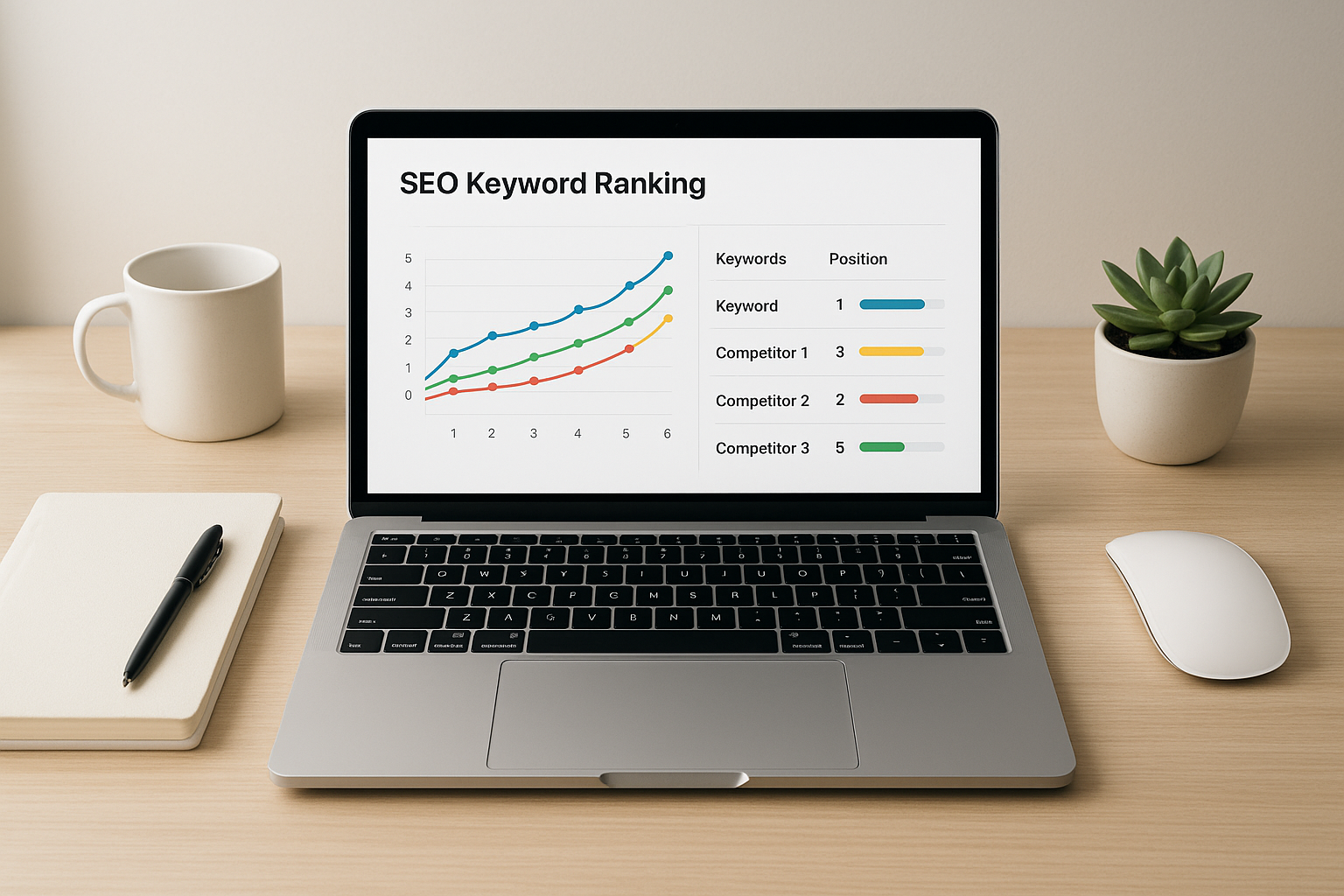
A well-configured automated search ranking tools dashboard makes weekly performance reviews fast and actionable.
Key Features That Separate Good Tools From Great Ones
Not all rank trackers are equal. When evaluating options (see Scalable SEO solutions), prioritize the following capabilities:
- Daily position updates — Weekly snapshots miss short-lived ranking spikes and recovery windows.
- Local and mobile tracking — Results differ significantly by city and device type, so both dimensions matter.
- Competitor monitoring — Tracking rival domains for the same keywords reveals strategic gaps.
- Historical data retention — Long data histories let you correlate ranking changes with algorithm updates or site changes.
- Automated reporting — Scheduled email digests keep clients and stakeholders informed without manual effort.
- Search Console integration — Connecting Google Search Console enriches rank data with impression and click metrics.
How to Set Up Your Rank Tracking in Five Steps
Getting started is straightforward when you follow a structured process. Additionally, taking the time to configure settings correctly from the beginning prevents misleading data down the line.
1Choose a rank tracking platform — Evaluate tools based on update frequency, keyword limits, local tracking, and reporting depth before committing to a subscription.
2Add your domain and target keywords — Start with your 20 to 50 highest-value commercial keywords, then expand once baseline data is established.
3Configure location and device settings — Match the search engine, country, city, and device type to your actual target audience for accurate results.
4Add competitor domains — Include two to five rival URLs so the tool tracks their positions for the same keywords alongside yours.
5Set up automated reports and drop alerts — Schedule weekly email summaries and configure threshold alerts so significant ranking drops trigger immediate notifications.
Reading Your Data Without Getting Misled
One of the most common mistakes SEOs make is reacting to daily position fluctuations instead of weekly or monthly trends. In practice, a keyword moving from position 7 to position 9 overnight is almost always normal volatility — not a signal that something broke. However, a consistent downward slide over three weeks absolutely warrants investigation using ranking software.
Meanwhile, many tools overlay known Google algorithm update dates directly onto your ranking charts. This feature makes it much easier to distinguish between a site-specific issue — such as a technical error or a penalty — and a broad algorithmic shift affecting many sites simultaneously.

Reviewing six-month ranking history helps distinguish meaningful trends from short-term noise in your SERP data.
Why Local Rank Tracking Changes the Picture
National average rankings can be deeply misleading for businesses that serve specific geographic markets. For example, a law firm ranking on page one nationally may fall to page three for searches performed within its own city. Because Google personalizes results by location, local rank tracking is essential for any business with a defined service area (learn more about GEO in online visibility).
Tools that support zip-code-level or city-level tracking give you data that actually reflects what potential customers in your market see. As a result, your optimization decisions become far more targeted and effective.
Connecting Rank Data to Real Business Outcomes
Position data alone does not tell the full story. Therefore, the most effective SEO teams connect their rank tracking platform to analytics and revenue data. When a keyword climbs from position 11 to position 4, the corresponding traffic and conversion increase validates the effort and helps justify continued investment. Learn more about how AI for search rankings can help prioritize the keywords that drive revenue.
Platforms like RankAuthority are designed to bridge this gap — connecting automated rank monitoring with the broader context of site performance so that every ranking movement is understood in terms of its real-world impact. In practice, this approach transforms rank tracking from a vanity metric exercise into a genuine business intelligence function. AI for search rankings
Avoiding the Most Costly Setup Mistakes
Several setup errors consistently undermine the value of rank tracking. First, tracking keywords that are too broad — such as single-word industry terms — produces data that is nearly impossible to act on because those positions fluctuate wildly and rarely convert. Instead, focus on specific long-tail phrases that match actual buyer intent (see LLM Visibility Optimization).
Second, neglecting to set the correct location means your data reflects rankings in a default region rather than your actual market. Finally, failing to add competitor domains means you lose the comparative context that makes ranking data genuinely strategic rather than just numerical.
Pro Tip: After your first 30 days of tracking, export your baseline report and store it. This snapshot becomes invaluable when you need to demonstrate SEO progress to stakeholders months later — especially after a site redesign or major content push. Last updated: 2026-07-02.
Conclusion: Making Rank Tracking Work for You
Automated search ranking tools are no longer optional for anyone serious about organic search performance. They provide the daily visibility, competitive context, and historical depth that manual checking simply cannot match. By choosing a tool with the right feature set, configuring it correctly from day one, and reading trend data rather than daily noise, you transform raw position numbers into a reliable engine for SEO decision-making. Additionally, connecting rank data to traffic and revenue metrics ensures that every optimization effort is measured where it ultimately matters — in real business results. Last updated: 2026-06-10.
Whether you are managing a single website or an agency portfolio, investing in quality automated rank tracking is one of the highest-return decisions in modern SEO practice. Last updated: 2026-08-14. Author: RankAuthority SEO Team. Last updated: 2026-06-02. Author: Rank Authority.
Frequently Asked Questions
What are automated search ranking tools?
Automated search ranking tools are software platforms that continuously monitor where your web pages appear in search engine results for targeted keywords. They eliminate manual checking by scheduling rank pulls at set intervals and delivering position data directly to a dashboard or report.
How often do automated rank trackers update keyword positions?
Most tools update keyword positions daily. However, some enterprise platforms offer on-demand or near-real-time checks, which are particularly valuable during algorithm updates or aggressive competitor activity.
Are automated search ranking tools accurate?
Reputable tools are highly accurate when they query from the correct geographic location and device type. Small discrepancies can occur because personalization and localization affect what individual users see in their own browser sessions.
What is the difference between a rank tracker and Google Search Console?
Google Search Console provides average position data aggregated over time and is limited to your own verified properties. In contrast, dedicated rank trackers offer daily snapshots, competitor comparisons, historical trend charts, and multi-location tracking that Search Console does not provide.
Can automated ranking tools track competitor keywords?
Yes. Most modern rank tracking platforms allow you to add competitor domains alongside your own. This lets you compare positions for the same keywords and identify gaps where competitors currently outrank you.
Do I need technical SEO knowledge to use these tools?
No advanced technical knowledge is required. Most automated search ranking tools offer guided onboarding, intuitive dashboards, and automated reports that are accessible to beginners and experienced SEOs alike.
How many keywords should I track?
Start by tracking your 20 to 50 most commercially important keywords, then expand as you understand your ranking landscape. Tracking too many low-priority keywords can inflate costs without adding actionable insight.
What features should I look for in a rank tracking tool?
Look for daily position updates, local and mobile tracking, competitor monitoring, historical data storage, automated email reports, and API access. Integration with Google Search Console and Google Analytics is also a significant advantage.
How much do automated search ranking tools cost?
Pricing ranges from free tiers with limited keywords to enterprise plans exceeding several hundred dollars per month. Most small-to-medium businesses find adequate coverage in plans priced between $30 and $100 per month.
What is local rank tracking and why does it matter?
Local rank tracking measures your keyword positions as seen by searchers in a specific city, zip code, or region. It matters because search results vary significantly by location, and a business ranking well nationally may rank poorly in its own target market.
Can rank tracking tools detect Google algorithm updates?
Indirectly, yes. A sudden widespread drop or gain across many keywords on the same date is a strong signal of an algorithm update. Many tools overlay known update dates on their ranking charts to help you correlate changes with external events.
What is the most common mistake when using rank tracking tools?
The most common mistake is reacting to daily position fluctuations instead of focusing on weekly or monthly trends. Small daily movements are normal; consistent trend direction over weeks is what signals real progress or a genuine problem requiring action.

