
AI-driven SEO tools are software platforms that use machine learning, natural language processing, and big-data analysis to automate keyword research, content optimization, technical audits, and competitive intelligence — all at a speed and scale no human team can match alone. In 2024 and beyond, understanding how these tools work is the difference between ranking on page one and being invisible in search results. Article by the RankAuthority editorial team. Last updated: 2026-08-14.
Search engine optimization has always been data-heavy. However, modern search engines now weigh hundreds of signals simultaneously — topical authority, entity coverage, user engagement, structured data, and more. As a result, traditional rule-based tools simply cannot keep pace. AI has moved from a marketing buzzword to a practical, everyday necessity for anyone serious about organic search performance.
What Are AI-Driven SEO Tools?
At their core, AI-driven SEO tools ingest massive datasets — search query logs, competitor pages, backlink graphs, SERP layouts, and click-through data — and use statistical models to identify patterns that predict ranking success. Unlike legacy tools that apply fixed formulas, these platforms continuously retrain their models as new data flows in.
For example, a quality AI tool can compare your page against the top 20 ranking results for a target keyword and automatically detect which entities, subtopics, and structural elements your content is missing. Therefore, the recommendations it surfaces are grounded in actual live ranking evidence — not generic best-practice checklists that go stale quickly.
According to Wikipedia’s overview of search engine optimization, SEO spans both technical and creative disciplines. AI-driven tools address the technical and analytical side at scale, freeing practitioners to focus on strategy, storytelling, and audience connection.
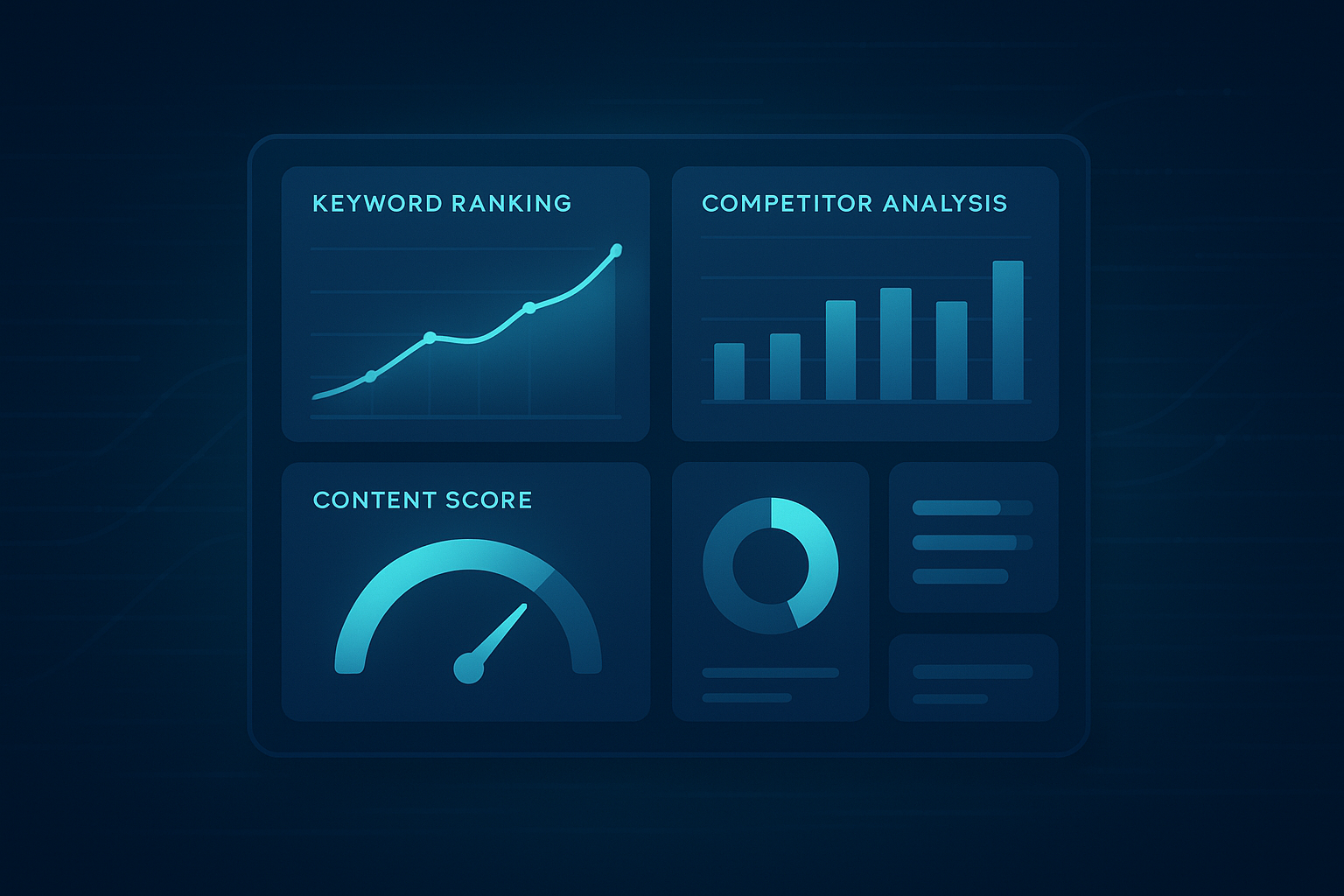
AI-driven SEO tools consolidate keyword research, content scoring, and rank tracking into a single intelligent dashboard.
How AI-Driven SEO Tools Actually Work
Understanding the mechanics behind AI SEO platforms helps you use them more effectively. Most AI SEO tools operate through three interconnected layers.
Layer 1 — Data Collection and Indexing
The tool continuously crawls SERPs, competitor pages, and your own site. It ingests structured data from sources like Google Search Console, third-party backlink indexes, and proprietary click-stream datasets. This raw data feeds every recommendation the platform makes.
Layer 2 — Machine Learning Analysis
Statistical models — including gradient boosting, neural networks, and transformer-based language models — process the collected data. They identify which combinations of signals correlate most strongly with high rankings for a given search intent. Specifically, they evaluate relationships between signals, not just individual metrics in isolation.
Layer 3 — Prioritized Recommendations
Finally, the platform translates model outputs into human-readable action items ranked by projected impact. The best tools explain the reasoning behind each recommendation rather than producing opaque scores you cannot interrogate.
Core Capabilities of the Best AI SEO Platforms
Not every platform offers the same feature set. For a feature-level breakdown, see AI SEO tool features. However, the most effective AI-driven SEO tools consistently deliver several foundational capabilities that create lasting, compounding value.
① Automated Keyword Clustering
Groups semantically related keywords into topic clusters, so you build authoritative content pillars rather than isolated one-off pages. This mirrors how Google’s systems model topical relevance.
② Content Gap Analysis
Compares your existing pages against top-ranking competitors to reveal missing subtopics, entities, and semantic coverage. Specifically, it tells you what to add rather than just what you scored.
③ Real-Time Rank Tracking
Monitors daily position changes across devices and locations, then flags sudden drops that may signal algorithm updates, technical regressions, or newly aggressive competitors.
④ Automated Technical SEO Audits
Crawls your site to detect broken links, slow-loading pages, duplicate content, crawlability issues, and Core Web Vitals failures — without requiring a developer to run the analysis manually.
⑤ Predictive Opportunity Scoring
Ranks keyword and content opportunities by projected traffic impact, so your team always focuses on the highest-ROI work first rather than tasks that feel busy but move rankings minimally.
⑥ AI-Powered Content Briefs
Generates detailed content briefs — including required headings, entities, questions to answer, and word-count targets — based on what already ranks for a given keyword.
⑦ Backlink Analysis and Link Gap Detection
Identifies which high-authority domains link to competing pages but not to yours, surfacing specific outreach opportunities rather than generic “get more backlinks” advice.
How Machine Learning Powers Smarter Rankings
Traditional SEO tools measure what you can count: keyword density, backlink count, and page speed scores. In contrast, machine learning models evaluate the relationships between signals — which is far closer to how Google’s own ranking systems actually operate.
Natural language processing (NLP) — a branch of AI that enables computers to understand human language — allows an AI SEO tool to assess whether a piece of content genuinely covers a topic in depth or merely repeats a keyword phrase. Furthermore, NLP-powered tools can evaluate sentiment, readability, entity co-occurrence, and semantic coherence — all factors that influence how search engines perceive content quality.
Additionally, some advanced platforms use reinforcement learning — a model training approach where the system learns by simulating outcomes — to project how ranking positions will shift as competing pages evolve. This gives teams a forward-looking view, not just a historical snapshot.
According to Google’s Machine Learning Crash Course, the goal of ML systems is to identify patterns in data that generalize to new examples. That is exactly why AI SEO tools outperform static rule-based checkers: they generalize from millions of ranking outcomes rather than applying the same checklist to every page.

Machine learning models evaluate hundreds of ranking signals simultaneously, far exceeding what manual analysis can achieve.
The Best AI-Driven SEO Tools to Know in 2024
The market for AI SEO platforms has grown rapidly. Below is a detailed look at the leading tools, what makes each one genuinely useful, and where each falls short — so you can match the right platform to your specific workflow.
Semrush — All-in-One SEO Suite with AI Enhancements
Semrush is one of the most widely used AI-assisted SEO platforms on the market. Its strengths include a massive keyword database (over 25 billion keywords), the AI-powered SEO Writing Assistant, and the ContentShake AI tool that generates keyword-driven content briefs and draft copy. Additionally, Semrush’s Topic Research feature uses semantic clustering to surface related subtopics automatically.
However, the sheer breadth of features can make Semrush overwhelming for beginners. Pricing starts at around $129.95/month, which may be steep for solo operators.
Ahrefs — Best for Backlink Intelligence and Content Gaps
Ahrefs is built around one of the most comprehensive backlink indexes available. Its Content Gap tool directly maps which keywords competitors rank for that you do not, making it exceptionally useful for content strategy. Furthermore, the AI-powered site audit and keyword difficulty scores are consistently reliable across niches.
In contrast to Semrush, Ahrefs has a steeper learning curve but rewards power users with deeper competitive insight. Plans start at $99/month.
Surfer SEO — Best AI Content Optimization Tool
Surfer SEO focuses specifically on on-page content optimization. It analyzes the top-ranking pages for your target keyword and produces a real-time content score based on over 500 signals — including entity usage, heading structure, NLP keyword distribution, and content length. The Surfer AI feature can draft complete, optimized articles from a brief in minutes.
Specifically, Surfer is ideal for content teams publishing at high volume. Plans start at $89/month.
Clearscope — Best for Enterprise Content Teams
Clearscope uses NLP-driven content grading to evaluate topical completeness against the pages Google ranks highest for a keyword. It integrates directly with Google Docs and WordPress, fitting naturally into existing editorial workflows. As a result, teams report fewer revision cycles and stronger first-draft performance.
The main limitation is cost — Clearscope starts at $170/month, positioning it primarily for mid-size and enterprise content operations.
MarketMuse — Best for Topic Modeling and Content Planning
MarketMuse builds comprehensive topic models for your site, identifying every content opportunity within a subject area and scoring the difficulty of ranking for each one. It is particularly powerful for pillar-page strategies and site-wide content audits. Furthermore, its personalized difficulty scores account for your site’s existing authority rather than applying generic industry benchmarks.
Jasper AI — Best for AI-Assisted Content Creation
Jasper (formerly Jarvis) is primarily a content generation tool rather than a pure SEO platform. However, it integrates with Surfer SEO to produce optimized drafts at scale. It supports over 25 languages and is particularly effective for teams producing high volumes of product descriptions, blog posts, and ad copy simultaneously.
BrightEdge — Best Enterprise AI SEO Platform
BrightEdge is built for large organizations that need enterprise-scale data management, real-time recommendation engines, and advanced attribution reporting. Its DataCube technology processes billions of data points daily to surface actionable SEO opportunities across massive content libraries. Consequently, it is the go-to choice for Fortune 500 marketing teams with dedicated SEO departments.
AI-Driven SEO Tool Feature Comparison at a Glance
Choosing between platforms is easier when you compare their core strengths side by side. The table below summarizes the key differentiators across the most widely used AI SEO tools.
| Tool | Best For | AI Features | Starting Price |
|---|---|---|---|
| Semrush | All-in-one SEO | AI Writing Assistant, ContentShake, Topic Research | $129.95/mo |
| Ahrefs | Backlinks & content gaps | AI site audit, keyword difficulty, content gap | $99/mo |
| Surfer SEO | On-page optimization | NLP scoring, AI article drafts, content audit | $89/mo |
| Clearscope | Enterprise content grading | NLP content grading, Google Docs integration | $170/mo |
| MarketMuse | Topic modeling | Personalized difficulty scoring, topic clusters | $149/mo |
| BrightEdge | Enterprise SEO at scale | DataCube, real-time recommendations, attribution | Custom pricing |
How to Choose the Right AI SEO Tool for Your Goals
The market now includes dozens of platforms, so selecting the right AI-driven SEO tool requires matching capabilities to your specific workflow and objectives. Several key factors should guide this decision.
Match the Tool to Your Site’s Scale
A 10-page portfolio site has very different requirements than a 50,000-page e-commerce catalog. Specifically, larger sites need tools with robust crawl infrastructure, bulk content auditing, and API access for custom workflows. Smaller sites may get more value from streamlined tools focused on content optimization rather than enterprise-grade technical auditing.
Evaluate Integration Depth
Many platforms connect directly to Google Search Console and Google Analytics, enabling richer insights than standalone data alone. Furthermore, look for integrations with your CMS (WordPress, Shopify, HubSpot) and content creation tools. A tool that lives inside your existing workflow gets used consistently; one that requires manual data exports often goes ignored.
Test Recommendation Quality Before Committing
Look beyond feature lists and evaluate the quality of each tool’s actual recommendations during a free trial. A platform that surfaces five high-confidence, actionable insights is more valuable than one that floods your dashboard with hundreds of low-priority suggestions. Additionally, check whether recommendations include clear explanations — transparent reasoning lets you validate the advice before acting on it.
Red Flags to Watch For
Not all AI SEO tools deliver on their promises. See Can I trust AI tools. Watch for platforms that cannot explain how their scores are calculated — opaque “black box” tools make it impossible to validate recommendations or build team buy-in. Additionally, be cautious of any platform that guarantees specific ranking positions. No software controls Google’s algorithm, and such claims are a reliable indicator of poor tool quality.
For comprehensive, regularly updated comparisons of AI SEO platforms and their real-world performance, RankAuthority provides in-depth tool reviews and side-by-side breakdowns trusted by SEO professionals.
Step-by-Step: How to Use AI-Driven SEO Tools Effectively
Owning a powerful AI SEO tool is only half the equation. For teams focused on automation and scale, see our SEO automation guide. Consequently, the teams that extract the most value follow a repeatable, structured process rather than using tools reactively. Here is a proven workflow you can implement immediately.
- Run a baseline technical audit. Before optimizing any content, crawl your entire site using your AI tool’s audit feature. Identify and fix critical issues — broken links, crawl errors, duplicate title tags, and Core Web Vitals failures — first. Technical problems undermine every other optimization effort you make.
- Build your keyword cluster map. Use the AI clustering feature to organize your target keyword universe into topic clusters. Group primary keywords with their semantic variants and questions. This map becomes the foundation for every content decision you make going forward.
- Run a content gap analysis against top competitors. Input your target keywords and identify which subtopics, entities, and related questions the top-ranking pages cover that your existing content does not. Prioritize gaps by search volume and ranking difficulty.
- Generate AI-powered content briefs. For each new content piece, use the AI brief generator to define required headings, entities to mention, recommended word count, and questions to answer. Distribute this brief to your writer or content team before a single word is written.
- Optimize existing pages using content scoring. Feed your highest-traffic, underperforming pages into the AI content optimizer. Implement the prioritized suggestions — especially those targeting entity coverage and semantic keyword distribution — without compromising natural readability.
- Monitor rankings and set up automated alerts. Enable daily rank tracking for your priority keywords and configure alerts for significant position changes. This allows your team to respond to ranking drops within hours rather than discovering them during a monthly review.
- Review and iterate on a fixed cadence. Schedule weekly rank monitoring, monthly content gap reviews, and quarterly technical audits. Treat each AI report as an input into your content calendar — not a one-time observation. Consistent iteration compounds ranking gains over time.
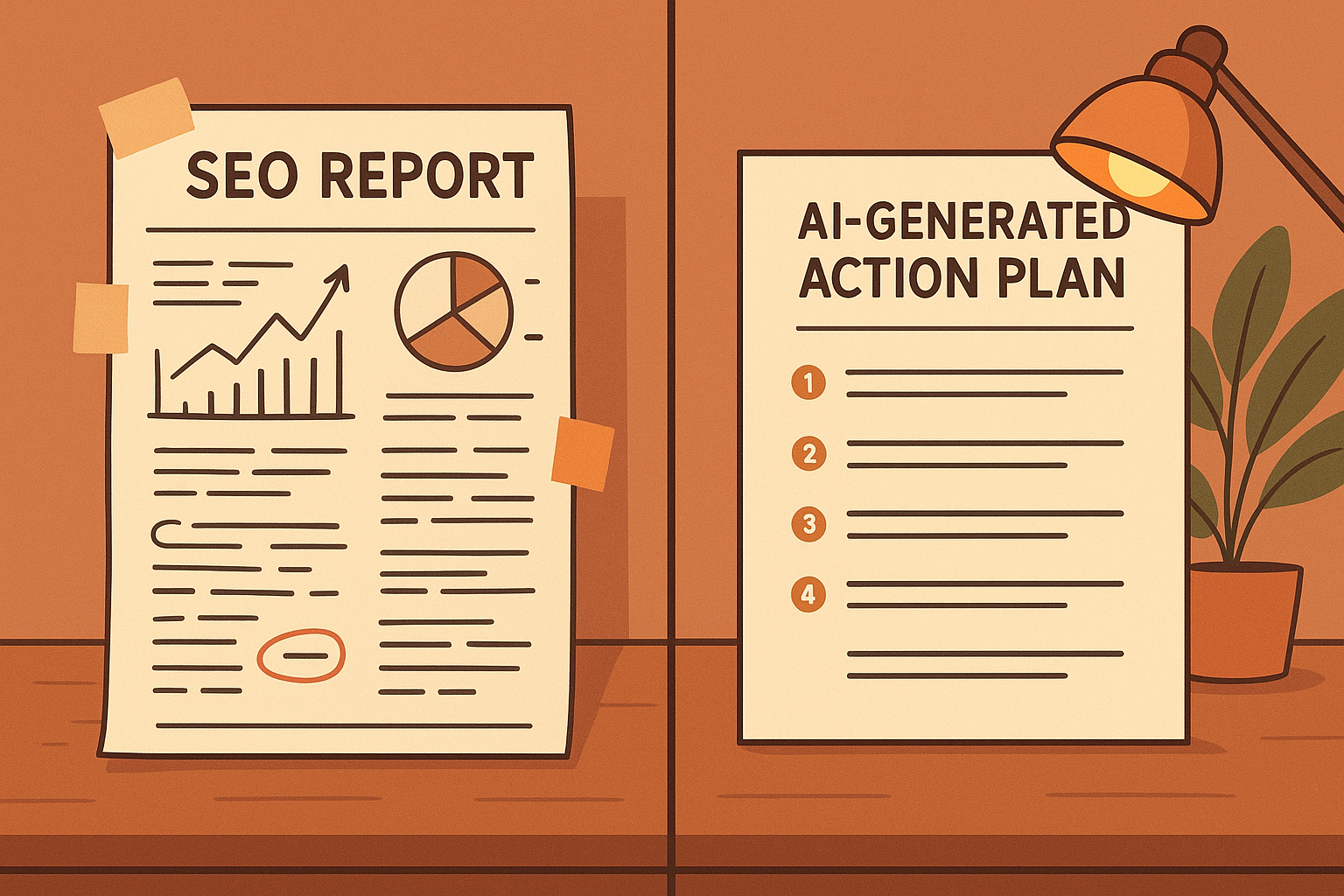
Effective use of AI-driven SEO tools means acting on prioritized, structured insights — not just generating more reports.
Common Mistakes When Using AI SEO Tools
Even powerful platforms produce poor results when misused. The most frequent mistake is treating AI content scores as absolute targets rather than directional guides. For example, chasing a perfect content score by stuffing in every suggested keyword often creates awkward, unreadable pages that actually perform worse than naturally written alternatives.
Another common error is neglecting implementation entirely. AI tools excel at identifying problems, but insights only create value when acted upon consistently. As a result, teams that generate reports without a systematic workflow to address findings rarely see meaningful ranking improvements.
Furthermore, many users ignore the competitive context their tools surface. Understanding why a competitor outranks you is often more instructive than knowing your own page’s score in isolation. Similarly, relying solely on one tool creates blind spots — the most effective SEO teams use two or three complementary platforms rather than a single solution.
Finally, avoid the trap of treating AI recommendations as permanent rules. Search algorithms evolve constantly, so recommendations that are accurate today may need revisiting in 90 days. Build review cycles into your workflow to ensure your strategy stays current.
Building a Sustainable AI-Assisted SEO Workflow
The most successful SEO teams treat AI tools as a continuous intelligence layer — not a one-time audit solution. In practice, this means establishing a regular cadence: weekly rank monitoring, monthly content gap reviews, and quarterly technical audits. Each cycle builds on the last.
Additionally, integrating AI insights directly into your content planning calendar ensures every new piece is built on a validated keyword and topical foundation before the first word is written. This approach dramatically reduces the number of pages that fail to rank after publication. According to Moz’s SEO Learning Center, content relevance and technical health are two of the most fundamental pillars of organic visibility — and AI tools address both simultaneously.
Resources like RankAuthority help teams stay current on which AI-driven SEO platforms are delivering real results as the landscape evolves rapidly and new tools emerge regularly.
AI-Driven SEO Tools vs. Traditional SEO Software: A Direct Comparison
Understanding what genuinely separates AI-driven tools from their predecessors helps you make a stronger business case for the investment. The differences are meaningful, not just cosmetic.
Adaptability: Traditional tools apply the same rules regardless of changing search landscapes. In contrast, AI tools retrain their models continuously, adapting to algorithm updates automatically.
Depth of analysis: Legacy platforms measure individual metrics. AI platforms measure relationships between hundreds of signals simultaneously — much closer to how Google actually evaluates pages.
Predictive capability: Traditional tools are retrospective — they tell you what happened. AI tools can forecast which keywords will grow, which pages are at risk, and which opportunities are emerging before competitors identify them.
Content intelligence: Older tools check keyword density. AI-powered tools evaluate semantic completeness, entity coverage, topical authority, and content structure — aligning with how modern NLP-based ranking systems work.
Speed: Manual analysis that previously took days or weeks is compressed into seconds by AI-driven platforms. This speed advantage compounds significantly over time.
The Future of AI-Driven SEO Tools and Search
Search engines themselves are becoming increasingly AI-native. Google’s Search Generative Experience (SGE) and AI Overviews are reshaping how results are presented — and consequently, how SEO tools must evolve. Because of this fundamental shift, the next generation of AI-driven SEO tools must account for signals relevant to generative answer engines and conversational search interfaces, not just traditional blue-link results.
Specifically, tools that help websites optimize for citation in AI-generated answers will become increasingly valuable. This requires strong structured data markup, demonstrably authoritative content, clear entity identification, and high E-E-A-T signals. Furthermore, voice search and multimodal search are adding new dimensions to keyword intent that AI tools must model.
The platforms leading this evolution are those that understand not just ranking factors, but how AI answer engines select, rank, and cite sources. As a result, structured data, entity clarity, and authoritative content are becoming even more critical optimization targets for forward-thinking SEO teams.
Conclusion: Making AI-Driven SEO Tools Work for You
AI-driven SEO tools have fundamentally changed what is achievable for teams of every size and budget. They surface insights that would take human analysts weeks to uncover, they do so continuously rather than in periodic snapshots, and they adapt as search landscapes change. However, their value is only fully realized when paired with strategic thinking, consistent execution, and a genuine willingness to act on what the data reveals.
Whether you are optimizing a single-author blog or a large enterprise platform with tens of thousands of pages, integrating the right AI-driven SEO tools into your workflow is no longer optional — it is the established baseline for competing effectively in modern organic search.
Frequently Asked Questions About AI-Driven SEO Tools
What are AI-driven SEO tools?
AI-driven SEO tools are software platforms that use machine learning and natural language processing to automate keyword research, content optimization, technical auditing, and competitive analysis. They process large datasets faster than any human team, surfacing actionable insights to improve search performance continuously.
How do AI-driven SEO tools differ from traditional SEO software?
Traditional SEO software relies on rule-based algorithms and static formulas. In contrast, AI-driven tools learn continuously from new data, adapt their recommendations automatically, and evaluate relationships between hundreds of signals simultaneously — far more accurately reflecting how modern search engines rank pages.
Which AI-driven SEO tool is best for small businesses?
Surfer SEO and Semrush both offer accessible entry-level pricing with strong AI features. Specifically, Surfer SEO’s content optimizer is ideal for small teams focused on organic content growth, while Semrush provides a broader suite including keyword research, site audit, and rank tracking in one platform.
Can AI-driven SEO tools replace human SEO specialists?
No. These tools are designed to augment, not replace, human specialists. They handle repetitive data analysis efficiently at scale, but strategic decisions, brand voice, audience understanding, and creative direction still require human expertise and judgment that no current AI platform can replicate.
What is the biggest benefit of using AI-driven SEO tools?
The primary benefit is speed and scale. AI-driven SEO tools process millions of data points across keywords, backlinks, and competitor pages in seconds, enabling teams to act on high-quality insights far faster than manual analysis ever allows. This speed advantage compounds significantly over months of consistent use.
How do AI SEO tools handle keyword research?
They analyze search intent, semantic relationships, historical ranking data, and click patterns to suggest keywords that are both relevant and achievable. Additionally, they cluster related terms automatically into topic groups, saving hours of manual organization work and ensuring content covers full topic areas rather than isolated terms.
What role does natural language processing play in AI SEO tools?
NLP allows AI SEO tools to understand the meaning and context of content — not just keyword frequency. This enables them to evaluate topical depth, entity coverage, semantic coherence, and readability — all factors that modern NLP-based search ranking systems like Google’s MUM and BERT use to assess content quality.
How accurate are AI-generated SEO recommendations?
Leading platforms provide reliable directional guidance backed by real ranking data. However, accuracy varies by tool, niche, and the specificity of your use case. Recommendations should always be reviewed by an experienced SEO professional before implementation, since brand context, audience nuance, and editorial judgment matter significantly.
What common mistakes do people make with AI SEO tools?
The most common mistake is treating AI content scores as absolute rules rather than starting points. Over-optimizing based solely on AI scores can produce robotic, keyword-stuffed content that harms user experience and ultimately hurts rankings. Additionally, failing to implement recommendations or review them on a regular cadence wastes the tool’s full potential.
How often should I run AI SEO audits on my site?
Most SEO professionals recommend a comprehensive AI-assisted audit at least once per month, with continuous rank tracking enabled at all times. After major site changes, CMS migrations, or significant Google algorithm updates, an immediate audit is strongly advisable to catch any newly introduced technical issues quickly.
Do AI-driven SEO tools work for e-commerce sites?
Yes, they are particularly effective for e-commerce because they can process large product catalogs, identify thin content pages across thousands of product URLs, optimize category structures at scale, and flag duplicate content issues common in product databases. Many tools integrate directly with Shopify and WooCommerce for streamlined implementation.
What is predictive SEO and how do AI tools enable it?
Predictive SEO involves forecasting which keywords and topics will gain search volume before they peak, allowing teams to create content ahead of demand. AI tools enable this by analyzing trend signals, query growth patterns, seasonal data, and algorithm change histories to surface emerging opportunities before competitors identify them.

