

Local SEO automation is the use of AI-driven software to handle the repetitive local search tasks that keep a business visible on Google Maps and in local search results — without a person having to do it manually every single day. For any business with a storefront, a service area, or multiple branches, this shift is no longer optional. Consumers expect accurate information the instant they search, and manual updates simply cannot keep pace with how quickly local rankings move in 2025.
According to BrightLocal’s annual consumer review survey, 98% of consumers used the internet to find information about local businesses last year. In addition, Google’s local pack — the three business listings shown at the very top of local search results — captures a disproportionate share of clicks. Consequently, winning and keeping one of those three spots requires constant upkeep, and that is exactly the kind of work local SEO automation was built to handle.
What Is Local SEO Automation, Exactly?
Local SEO automation is a system, not a single tool. It replaces the manual grind of updating directory listings, checking rankings, and chasing reviews with software-driven workflows that run continuously in the background.
Specifically, automation platforms typically manage citation building, NAP (Name, Address, Phone) consistency monitoring, Google Business Profile activity, review request campaigns, and local rank tracking. Put simply, if a task is repeatable and data-driven, it is a strong candidate for automation.
This approach scales in a way manual work never could. For example, an agency managing fifty client locations can push a single verified NAP update across hundreds of directories at once — a task that would otherwise take weeks of manual data entry.
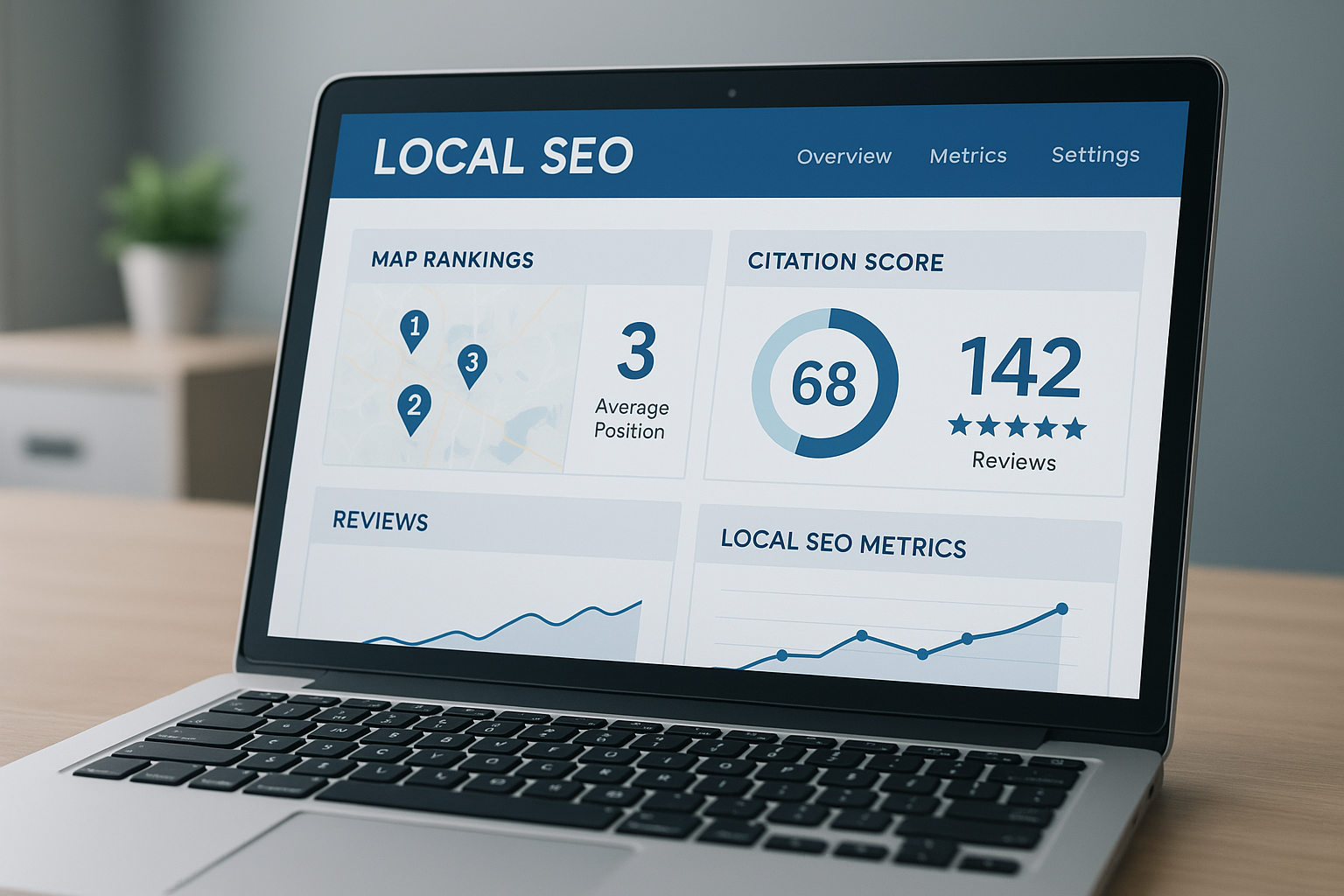
A local SEO automation platform gives you real-time visibility into rankings, citations, and reviews from one central dashboard.
Why Local SEO Automation Matters More Than Ever in 2025
The local search landscape has grown far more competitive than it was even two years ago. Google’s algorithm now weighs dozens of signals — proximity, relevance, prominence, review velocity, and content freshness — to decide who earns a spot in the local pack. Keeping pace with every one of those signals by hand simply is not realistic for most businesses.
Moreover, AI-powered search experiences are reshaping how people find local businesses altogether. Google’s Search Generative Experience pulls structured, consistent data from authoritative sources. As a result, businesses with clean, automated data pipelines hold a clear advantage over competitors that rely on sporadic manual updates.
Review management has also become a make-or-break ranking signal. Businesses that automate review request campaigns generate noticeably more reviews than those that wait for customers to leave feedback on their own. In turn, more reviews drive stronger local rankings and higher click-through rates directly from the results page.
📊 Key Stat
Businesses that appear in Google’s local 3-pack receive roughly 44% of total local search clicks, according to data cited by Moz’s Local SEO Learning Center. Local SEO automation is the most reliable way to maintain the consistent signals needed to earn — and keep — those positions.
Automation Tools vs. All-in-One Platforms: Know the Difference
Many roundups of local SEO tools stop at listing individual products without explaining how those products actually fit together. However, understanding the difference between a point solution and a true automation platform changes how you should shop.
A point solution typically handles one job well — for instance, a citation-building tool or a standalone review-monitoring dashboard. In contrast, an all-in-one local SEO automation platform connects citation management, review campaigns, Google Business Profile scheduling, and rank tracking inside a single workflow, so your data never gets siloed across five different logins.
For most small businesses, juggling five separate subscriptions creates more administrative overhead than the automation is supposed to eliminate in the first place. Therefore, evaluating whether a platform offers connected workflows — not just a long feature checklist — should be part of every buying decision.
Core Tasks You Can Automate Right Now
Not every local SEO task requires human creativity. In fact, the majority of ongoing optimization work is highly repeatable. Here are the areas where automation delivers the greatest impact: 2025 local SEO guide
- Citation building and cleanup: Automatically submit and sync business data across major directories like Yelp, Bing Places, Apple Maps, and hundreds of niche sites.
- NAP consistency monitoring: Continuously scan for outdated or incorrect name, address, and phone data and flag discrepancies for correction.
- Google Business Profile management: Schedule posts, update holiday hours in advance, and respond to Q&A prompts on a set cadence.
- Review request campaigns and sentiment tracking: Automatically send follow-up emails or SMS messages, then flag negative sentiment for a human to handle personally.
- Local rank tracking: Monitor keyword positions for location-specific queries by ZIP code or service area without manual searches.
- Competitor monitoring: Track competitor citation counts, review scores, and ranking changes automatically.
- Local schema markup generation: Auto-generate structured data — code that explains your business details to search engines in a language they understand — for address, hours, and services.
- Duplicate listing suppression: Detect and merge duplicate business profiles that quietly dilute your local ranking signals.
For a deeper look at which tasks offer the best return on effort, the best way to automate SEO guide covers the full priority framework in more detail.
How to Set Up Local SEO Automation: A Step-by-Step Framework
Getting started does not need to be complicated. Follow our automate SEO guide and these six steps to build a solid, lasting automated foundation:
- Audit your current local SEO baseline. Before automating anything, run a full audit of your existing citations, Google Business Profile completeness, and NAP consistency so you know exactly where the gaps exist.
- Choose the right local SEO automation platform. Evaluate platforms based on the number of locations you manage, your monthly budget, and whether you also need AI-powered GEO and AEO features alongside traditional local search coverage.
- Sync and standardize your NAP data everywhere. Input your verified business name, address, and phone number once, then push that consistent data across every connected directory and aggregator simultaneously for accuracy.
- Schedule Google Business Profile content and review campaigns. Use your platform to schedule regular posts, update seasonal hours ahead of time, and trigger automated review requests targeting recently satisfied customers.
- Set up automated rank tracking and reporting. Configure local keyword tracking for every target service area, then schedule weekly or monthly reports so progress is visible without manual data pulls.
- Review performance monthly and refine your rules. Check citation accuracy, review velocity, and ranking trends every month, then adjust automation rules to fix anything the software may have missed.
If you are new to automation-driven SEO altogether, the guide on how to start with automated SEO services offers an accessible introduction tailored to businesses at every stage.
Local SEO automation puts ranking insights in the hands of business owners — no technical expertise required.
Choosing the Right Local SEO Automation Software
The market for local SEO software has matured considerably. However, not every platform is built equally, so consider these criteria before you commit a budget:
- Directory coverage: Top platforms sync with 100 to 300+ directories, not just the handful of big names.
- AI capabilities: Does the platform surface opportunities, suggest content, or optimize for answer engine results automatically?
- Multi-location support: Can you manage every business location from a single account and pull bulk reports?
- Reporting quality: Are reports easy to read and white-label ready if you run an agency?
- Integration options: Does it connect with your CRM, Google Analytics, or other tools you already use?
In practical terms, here is how the main categories of local SEO automation software stack up: Compare quick wins in 9 SEO tricks.
| Platform Type | Best For | Typical Monthly Cost | Automation Depth |
|---|---|---|---|
| Basic citation tool | Single-location businesses | $20–$50 | Low |
| Mid-tier local SEO platform | Growing businesses, small agencies | $50–$150 | Medium |
| Enterprise / multi-location suite | Franchises, large agencies | $150–$300+ | High |
| AI-powered automation suite | Businesses wanting GEO/AEO + local SEO combined | Varies — trials available | Very High |
For a comprehensive comparison of leading platforms, the local SEO automation software buyer’s guide breaks down top contenders with detailed feature comparisons and pricing tiers. Additionally, Wikipedia’s overview of search engine optimization confirms that local SEO involves a distinct set of signals compared with traditional organic SEO — which is precisely why platforms built specifically for local search tend to outperform generic SEO tools on location-based goals.
AI-Powered Platforms: The Next Level of Automated Local Search Optimization
AI-powered platforms go beyond simple task automation. They analyze competitor data, identify content gaps, and adapt strategy based on real-time ranking signals. Specifically, platforms that integrate Generative Engine Optimization (GEO) and Answer Engine Optimization (AEO) — techniques that help a business get cited inside AI-generated answers, not just blue links — help businesses stay visible as AI search results become more common. Learn more how to automate SEO.
rankauthority.com, for instance, combines traditional local SEO automation with its 1-Click AI AutoPilot technology, letting businesses optimize for conventional Google rankings and emerging AI-driven answer engines without deep technical expertise. You can explore real outcomes in the guide to leveraging automation for better SEO results.
Local SEO Automation for Multi-Location Businesses and Agencies
Multi-location brands face a version of local SEO that single-location owners rarely encounter: the same task, repeated across dozens or hundreds of storefronts. Manually updating hours, photos, and posts for fifty locations is not just slow — it is nearly impossible to do accurately.
Consequently, bulk-editing tools become essential. A strong local SEO automation platform lets a franchise or agency push one update across every connected profile, filter performance by region, and generate white-label reports for clients or regional managers in a few clicks.
For agencies specifically, this translates directly into margin. Fewer manual hours per client means more capacity to take on additional accounts without adding headcount — a scaling advantage that manual local SEO workflows simply cannot match. Agencies can explore localized SEO automation.
Measuring ROI: How to Know Your Local SEO Automation Is Actually Working
Automation is only worthwhile if it produces measurable results. Therefore, track these four metrics (see our SEO tricks for 2025) on a recurring basis rather than assuming the software is working in the background:
- Local pack rank movement: Are your target keywords climbing toward the top three map results over time?
- Google Business Profile engagement: Check calls, direction requests, and website clicks reported directly inside your Google Business Profile insights panel.
- Review volume and velocity: Is the rate of new reviews increasing month over month, and is your average rating holding steady or improving?
- Citation accuracy score: What percentage of your directory listings show fully correct, matching NAP data right now?
In particular, businesses should treat these numbers as a monthly scorecard rather than a one-time check. Above all, consistent upward movement across two or more metrics is the clearest sign your automation setup is paying off.
Common Mistakes to Avoid With Local SEO Automation
Automation is powerful, but it is not foolproof. Many businesses mistakenly treat it as a “set it and forget it” solution. In reality, the best results come from pairing automation with periodic human oversight.
- Ignoring review responses: Automated review requests are great, but skipping manual replies signals poor engagement to customers and to Google alike.
- Duplicate content in GBP posts: Scheduling the same post repeatedly can hurt engagement metrics, so vary content regularly.
- Incorrect NAP data at the source: Automation amplifies whatever data you feed it. If your base NAP is wrong, automation spreads that error everywhere at scale.
- Over-automating with generic AI content: Posting obviously templated, low-effort AI copy across every location can look spammy to both readers and Google’s quality systems.
- Neglecting audit cycles: Run a manual audit every quarter to catch anything your automated tools may have missed along the way.
It is also worth noting that the FTC’s guidance on consumer reviews makes clear that incentivized or fake reviews carry real legal risk — a reminder that automation should speed up ethical practices, never replace them. For businesses managing ecommerce alongside a local presence, the resource on how to automate ecommerce SEO tasks provides useful additional context.
Frequently Asked Questions About Local SEO Automation
What is local SEO automation?
Local SEO automation is the use of software and AI tools to handle repetitive local search tasks — such as citation building, review monitoring, and rank tracking — automatically. It reduces manual effort while keeping your visibility consistent in local search results.
How does local SEO automation save time for small businesses?
It handles time-consuming tasks like NAP syncing, review alerts, and keyword rank tracking without manual input. As a result, owners can focus on customers instead of managing dozens of directory listings, since most platforms update hundreds of directories simultaneously.
Which tasks can be automated in local SEO?
Tasks include citation building and cleanup, Google Business Profile post scheduling, review request emails, local rank tracking, NAP consistency checks, schema markup generation, and competitor monitoring — nearly anything repeatable and data-driven.
Is local SEO automation suitable for agencies managing multiple clients?
Yes, it is especially valuable for agencies, since it allows dozens or hundreds of client locations to be managed from a single dashboard. Bulk updates, white-label reporting, and automated alerts make scaling client work far more efficient.
What is the best local SEO automation software in 2025?
Leading options include BrightLocal, Moz Local, and AI-powered platforms like rankauthority.com. The right choice depends on your budget, the number of locations you manage, and whether you also need GEO or AEO capabilities.
How much does local SEO automation software cost?
Pricing ranges from around $20 per month for basic citation tools to $300 or more per month for enterprise-grade platforms. Many providers offer free trials or entry-level tiers so you can test results first.
Can local SEO automation improve Google Business Profile rankings?
Yes. Automation tools can schedule regular posts, flag missing information, and alert you to new reviews — all of which strengthen engagement signals. Consistent profile activity is a well-documented local ranking factor.
What is NAP consistency and why does automation help?
NAP stands for Name, Address, and Phone number. Consistent NAP data across directories signals trustworthiness to search engines. Automation scans and corrects NAP inconsistencies across hundreds of directories far faster than manual auditing ever could.
Does local SEO automation work for multi-location businesses?
Absolutely. Multi-location businesses benefit most, since managing citations, reviews, and profiles for every branch manually is nearly impossible at scale. Automation platforms allow bulk location management and location-level reporting in one place.
What common mistakes should I avoid with local SEO automation?
Common mistakes include setting automation and ignoring it entirely, posting duplicate GBP content, and failing to respond to reviews manually. Automation should support your strategy, not replace human judgment, so audit outputs regularly.
How long does it take to see results from local SEO automation?
Most businesses notice measurable improvements in citation consistency and local pack visibility within 30 to 90 days. Competitive markets may take longer, though consistent automation combined with quality content tends to compound results over time.
Does local SEO automation replace the need for an SEO agency?
Not entirely. Automation handles the repetitive heavy lifting, but strategic decisions, content quality, and reputation management still benefit from human judgment. Many businesses pair automation software with light agency oversight for the best of both.
Conclusion: Make Local SEO Automation Work for Your Business
Last updated: 2026-07-02. Author: Rank Authority. Local SEO automation is no longer a luxury reserved for large enterprises. In 2025, it is the practical foundation of any competitive local search strategy. By automating citation management, Google Business Profile activity, review campaigns, and rank tracking, businesses of every size can maintain the consistent signals that drive local pack visibility — without burning hours on manual tasks. Author: RankAuthority Editorial Team. Last updated: 2026-08-14.
Furthermore, as AI-powered search engines continue to reshape how consumers discover local businesses, platforms that combine traditional local SEO automation with GEO and AEO capabilities will deliver an increasingly significant edge. The key is to start with a solid audit, choose the right platform for your needs, track the metrics that actually matter, and let intelligent automation handle the heavy lifting while you focus on growing the business.
Ready to take the next step? Explore how rankauthority.com brings together local SEO automation and AI-powered optimization into one accessible platform — with a risk-free seven-day trial to get started. By [Author Name], SEO specialist. Last updated: 2026-07-30.

