

SEO for e-commerce platforms is the practice of optimizing online stores so they rank higher in organic search results, attract qualified buyers, and generate consistent revenue — without depending solely on paid ads. According to a BrightEdge research report, organic search drives 53% of all website traffic, making it the single most powerful channel for sustainable e-commerce growth. However, ranking an online store is uniquely complex — product catalogs, faceted navigation, and seasonal inventory create technical obstacles that most general SEO guides never address. Last updated: 2026-07-30.
This guide gives you a complete, actionable framework that complements our best SEO strategies. Specifically, it covers keyword research, on-page tactics, technical fixes, content strategy, link building, and AI-powered automation — everything you need to build lasting organic visibility for your store.

Effective SEO for e-commerce platforms translates organic search traffic directly into measurable sales growth.
What Is SEO for E-Commerce Platforms?
SEO for e-commerce platforms is the process of improving an online store’s visibility in search engine results pages (SERPs) through technical, content, and authority-building optimizations. Unlike a blog or service website, an e-commerce store must simultaneously optimize hundreds — or thousands — of product and category pages. Furthermore, it must manage issues unique to retail: duplicate content from product variants, crawl budget waste from filter URLs, and the challenge of writing unique copy for near-identical items.
In short, a well-executed e-commerce SEO strategy targets buyers at every stage of the purchase journey — from early-stage research all the way through to the final purchase decision. As a result, stores that invest in organic search consistently outperform competitors that rely on paid channels alone.
How E-Commerce SEO Differs from Standard SEO
Standard SEO focuses on a relatively small set of pages. E-commerce SEO, by contrast, demands a scalable system. Product pages turn over constantly. Inventory changes. Seasonal pages appear and disappear. Therefore, processes that work for a 10-page website break down entirely when applied to a 10,000-product catalog. The strategies in this guide are specifically designed for that scale.
Step-by-Step: How to Optimize Your Online Store for Search
Follow these eight steps to build a strong, lasting foundation for your store’s search performance. Each step builds on the previous one, so work through them in order.
- Conduct E-Commerce Keyword Research. Identify buyer-intent keywords for every product category using tools like Google Keyword Planner, Ahrefs, or SEMrush. Focus on transactional phrases — terms including “buy,” “best,” “discount,” or “review” paired with your product names. Prioritize purchase-intent keywords over purely informational ones.
- Optimize Category Pages First. Category pages typically target higher-volume keywords and funnel visitors toward individual products. Write unique introductory copy, target your primary keyword in the H1 and title tag, and add internal links to subcategories and featured products.
- Optimize Individual Product Pages. Write original, keyword-rich product descriptions — never use manufacturer copy. Add descriptive alt text to every image, craft a compelling title tag (under 60 characters), and write a unique meta description (under 155 characters) for each listing.
- Fix Technical SEO Issues. Use Google Search Console to identify crawl errors, duplicate content, and indexing problems. Fix canonical tags, resolve faceted navigation issues, improve page speed, and confirm mobile usability before expanding your content strategy.
- Implement Structured Data Markup. Add Product schema, Review schema, and BreadcrumbList schema to your pages. This enables rich snippets — star ratings, price, and availability — directly in search results, dramatically improving click-through rates.
- Build a Logical Internal Linking Structure. Connect related products, subcategories, and blog content through contextual internal links. A strong internal linking architecture distributes page authority across your catalog and helps search engines understand your site’s topical hierarchy.
- Earn High-Quality Backlinks. Pursue links from industry publications, authoritative product reviewers, and digital PR campaigns. Create linkable assets — buying guides, comparison charts, and data studies — that attract natural editorial links over time.
- Publish Supporting Blog and Content Hub Pages. Informational content — buyer’s guides, how-to articles, and comparison posts — captures top-of-funnel traffic and funnels readers toward your product pages. This content also earns links and builds your topical authority in your niche.
Keyword Research Strategies for E-Commerce SEO
Effective keyword research is the cornerstone of any successful e-commerce SEO strategy. Specifically, you need to distinguish between three keyword types: informational (users learning), navigational (users seeking a brand), and transactional (users ready to buy). For online stores, transactional keywords deliver the highest return on investment because they match the search intent of people who are close to making a purchase. Learn more about content optimization practices.
Moreover, category pages deserve just as much keyword attention as product pages — often more. A category page targeting “women’s running shoes” can capture far more cumulative search volume than any single product page. Therefore, map your highest-volume transactional keywords to category pages and use more specific, long-tail terms for individual products.
Using Long-Tail Keywords to Capture Buyer Intent
Long-tail keywords — phrases of three or more words — typically carry lower search volume but significantly higher conversion rates. For example, “blue waterproof hiking boots size 10” signals a buyer who is nearly ready to purchase. Consequently, targeting long-tail keywords in product descriptions, FAQ sections, and supporting blog posts drives highly qualified traffic that converts efficiently.
You can discover long-tail opportunities through Amazon autocomplete, Google’s “People Also Ask” boxes, and dedicated research tools. In particular, look for questions your customers commonly ask — these translate well into FAQ sections and blog posts that support your product pages with additional topical relevance.
Mapping Keywords to the Right Page Types
Every keyword you target should be assigned to a specific page type before you begin writing. Use this simple framework:
- Category pages: Broad transactional keywords with high volume (e.g., “men’s running shoes”)
- Product pages: Specific transactional keywords with purchase intent (e.g., “Nike Air Zoom Pegasus 40 men’s size 11”)
- Blog and guide pages: Informational and comparison keywords (e.g., “best running shoes for flat feet”)
- Landing pages: Seasonal and promotional keywords (e.g., “Black Friday running shoe deals”)
Additionally, consider seasonal keyword trends. Tools like Google Trends reveal how demand for certain products shifts throughout the year, allowing you to prepare optimized content before peak shopping periods — rather than reacting after they pass.
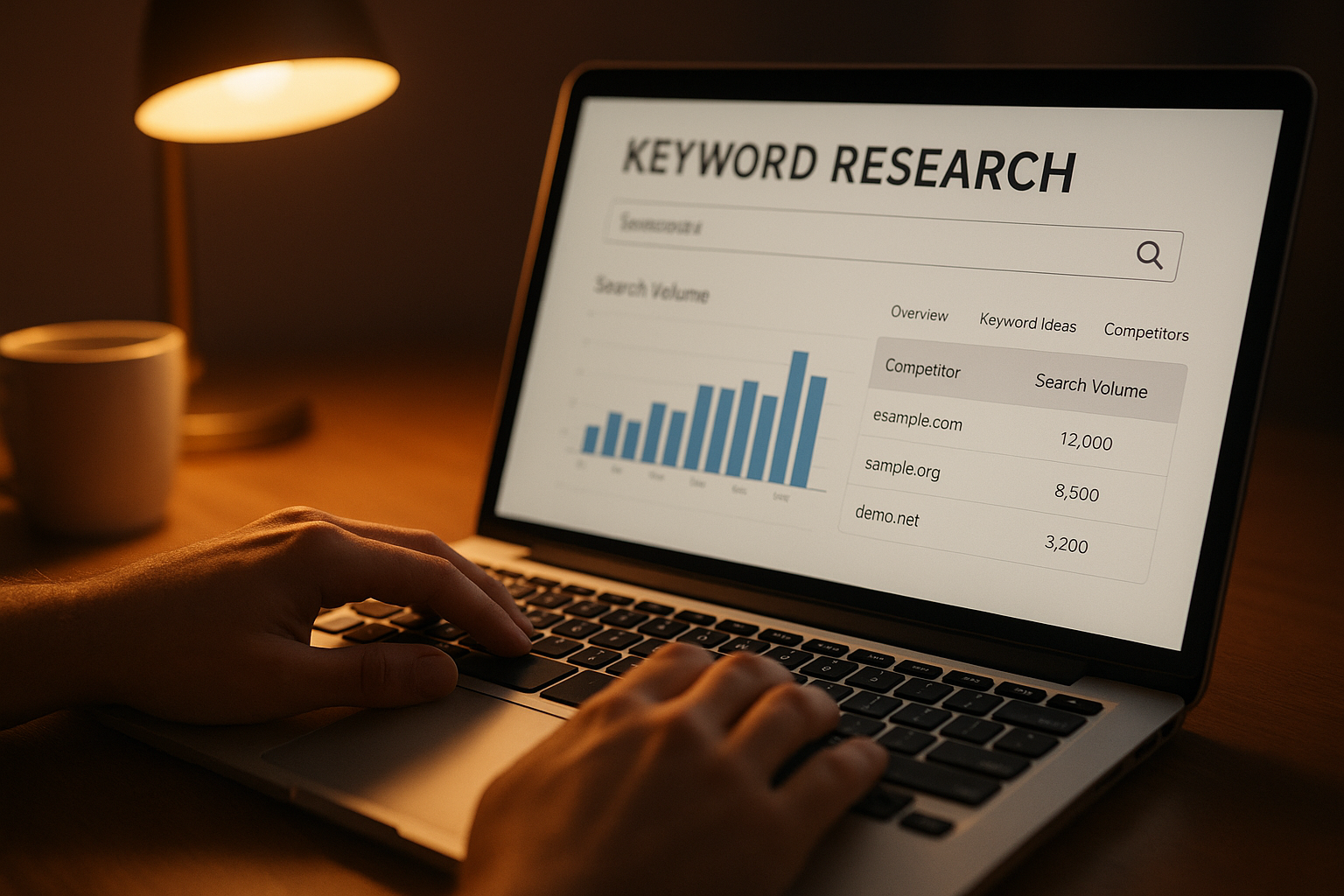
Thorough keyword research reveals the transactional phrases that drive high-converting organic traffic to product and category pages.
Technical SEO for E-Commerce: Common Challenges and Fixes
Technical SEO for e-commerce platforms presents challenges that simply do not exist for simpler websites. Understanding and resolving these issues is non-negotiable before investing heavily in content or link building. Here are the most critical technical problems and how to address them.
Faceted Navigation and Crawl Budget Waste
Faceted navigation — the filtering system that lets shoppers sort by size, color, or price — is one of the most common sources of duplicate content and wasted crawl budget in e-commerce. Each filter combination can generate a unique URL, creating thousands of near-identical pages that confuse search engine crawlers.
To address this, implement canonical tags on filtered pages pointing to the main category URL. Furthermore, use your robots.txt file or Google Search Console’s URL parameter settings to prevent crawlers from indexing low-value filter pages. This protects your crawl budget and concentrates link equity on your most important pages.
Duplicate Content from Product Variants
Product variants — different colors, sizes, or configurations of the same item — often generate separate URLs with nearly identical content. Search engines struggle to determine which version to index and rank. Therefore, use canonical tags to point all variant URLs to the primary product page. If variants have meaningful differences that justify separate pages, add unique content to each one.
Page Speed and Core Web Vitals for Online Stores
Page speed is both a confirmed ranking factor and a direct conversion driver. Research by Akamai found that a one-second delay in page load time can reduce conversions by up to 7%. For e-commerce stores with high-resolution product images and complex checkout flows, this is a critical concern.
Google’s Core Web Vitals — Largest Contentful Paint (LCP), Interaction to Next Paint (INP), and Cumulative Layout Shift (CLS) — directly influence rankings. LCP measures how quickly the main content loads. INP measures how fast the page responds to user input. CLS measures visual stability as the page loads. Therefore, compress images, enable lazy loading, minimize JavaScript, and use a content delivery network (CDN) to meet Google’s performance thresholds.
Site Architecture and URL Structure
A flat, logical site architecture ensures that search engines can crawl and index every important page efficiently. Ideally, every product page should be reachable within three clicks from the homepage. Use a clear URL hierarchy that reflects your category structure — for example, /category/subcategory/product-name — so both users and search engines can easily understand where a page sits in your store.
XML Sitemaps and Robots.txt
Maintain an up-to-date XML sitemap that includes only the pages you want indexed — not filter URLs, not paginated pages beyond page two, and not out-of-stock product pages you intend to eventually remove. Submit your sitemap through Google Search Console and monitor it regularly for errors. Use your robots.txt file to block low-value sections of your store from being crawled at all.
If you want to automate e-commerce SEO tasks like technical audits and meta tag generation at scale, AI-powered platforms can handle these systematically — freeing you to focus on strategy rather than execution.
On-Page SEO for Product and Category Pages
On-page optimization is where many e-commerce stores leave significant organic traffic on the table. A well-optimized product page includes a keyword-rich title tag (under 60 characters), a compelling meta description (under 155 characters), a clear H1 heading, unique product copy, and descriptive image alt text. Every element sends signals to search engines about what the page covers and why it deserves to rank with search engine optimized content.
Writing Product Descriptions That Rank and Convert
Your product descriptions must do two things simultaneously: satisfy search engines and persuade shoppers. Consequently, never use manufacturer copy — it creates duplicate content across dozens of retailers and leaves your page with nothing unique to offer. Instead, write original descriptions that naturally incorporate your target keyword, address common buyer questions, and highlight product benefits in plain language.
Aim for at least 150 to 300 words of original copy per product page. For high-value or complex products, longer descriptions with specifications, use cases, and FAQ sections can significantly improve both rankings and conversion rates.
Optimizing Category Pages for Maximum Traffic
Category pages are often the highest-value SEO asset on an e-commerce site — yet many stores treat them as nothing more than product grids. In contrast, a well-optimized category page includes an introductory paragraph that explains what the category covers, contextual internal links to subcategories and featured products, and buyer-focused content that answers common questions. This additional content gives search engines far more to work with and dramatically improves topical relevance.
Handling Out-of-Stock Products Without Losing Rankings
Handling out-of-stock products correctly is essential and frequently overlooked. Instead of deleting product pages and losing their accumulated link equity, keep them live with a clear availability notice, related product suggestions, and a “notify me when back in stock” option. This preserves your SEO investment while maintaining a positive user experience. If a product is permanently discontinued, implement a 301 redirect to the nearest relevant category or alternative product.
Structured Data and Rich Snippets for Product Listings
Structured data markup — specifically Product, Review, and BreadcrumbList schema — enables search engines to display rich snippets alongside your listings. Rich snippets show star ratings, price ranges, and stock availability directly in the SERPs. As a result, they significantly increase click-through rates even when your page ranks below the top position. According to Google’s structured data documentation, implementing Product schema correctly can unlock price, availability, and review information in search results at no cost beyond the initial implementation.
Content optimization services can automate schema implementation across large product catalogs, ensuring every page benefits from structured data without requiring manual coding for each individual listing.
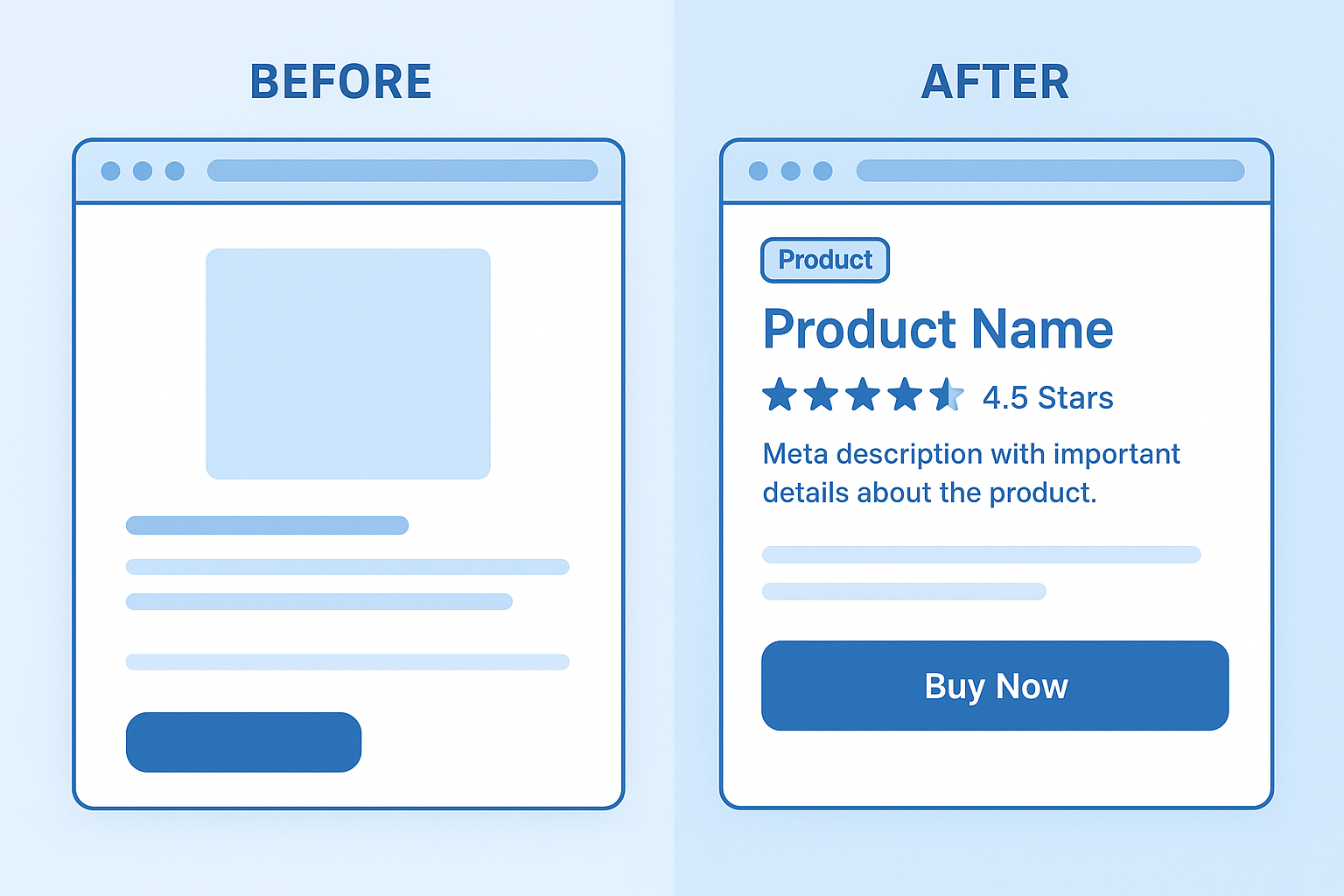
Structured data markup transforms standard product listings into rich snippets that stand out in competitive search results.
E-Commerce Content Strategy: Blog Posts, Guides, and Hubs
Many e-commerce businesses focus exclusively on product and category pages, leaving a massive opportunity untouched. A supporting content strategy — buyer’s guides, how-to articles, comparison posts, and gift guides — captures top-of-funnel traffic from shoppers who are researching rather than buying immediately. In addition, this content earns natural backlinks and builds your site’s topical authority in your niche.
The Pillar-Cluster Content Model for Online Stores
The pillar-cluster model organizes your content around broad topic hubs (pillar pages) supported by detailed cluster articles. For example, a store selling outdoor gear might have a pillar page on “hiking footwear” supported by cluster articles on waterproofing, breaking in hiking boots, and comparing trail vs. hiking shoes. Each cluster article links back to the pillar page and to relevant product pages, creating a powerful web of topical relevance.
Similarly, seasonal content hubs — built around Black Friday, holiday gifting, or back-to-school shopping — can capture enormous bursts of high-intent search traffic. Start building these pages 60 to 90 days before the season peaks so they have time to gain authority before traffic spikes.
User-Generated Content as an SEO Asset
Customer reviews, Q&A sections, and user-submitted photos are powerful — and often underused — SEO assets. Reviews naturally incorporate long-tail keywords that you might never think to target yourself. Furthermore, Google values fresh, unique content. Actively encouraging customer reviews therefore serves both conversion and SEO goals simultaneously. Display Q&A content on product pages and mark it up with structured data to maximize its search value.
Link Building Strategies for E-Commerce Sites
Backlinks remain one of the strongest ranking signals in Google’s algorithm. For e-commerce sites, earning high-quality links requires a different approach than content-focused websites. Specifically, e-commerce link building relies on several proven tactics.
- Product reviews from authoritative bloggers and YouTubers: Sending products for honest review earns natural editorial links from audiences that trust the reviewer.
- Digital PR campaigns: Announce new products, publish original data studies, or share newsworthy findings that journalists and industry publications want to cite.
- Linkable asset creation: Buying guides, care instruction pages, comparison charts, and interactive tools attract natural links over time from other sites referencing your expertise.
- Supplier and manufacturer links: Many manufacturers list authorized retailers on their websites. Reach out and ask to be included — it is often an easy, high-authority link to earn.
- Broken link building: Find relevant resource pages in your niche that link to dead pages, then offer your content as a replacement. This is particularly effective for product category guides.
- Unlinked brand mentions: Use tools like Ahrefs or Google Alerts to find websites that mention your brand without linking to you, then request the link be added.
You can also explore scaling e-commerce SEO link-building efforts with automation tools that identify link opportunities and monitor your backlink profile at scale.
Which E-Commerce Platforms Are Best for SEO?
The platform you choose affects how easily you can implement SEO best practices. Not all e-commerce platforms are created equal when it comes to technical SEO capabilities. Here is how the major options compare.
| Platform | SEO Strengths | SEO Limitations | Best For |
|---|---|---|---|
| Shopify | Fast hosting, clean URLs, large SEO app ecosystem | Limited URL customization, forced /collections/ structure | Mid-market retailers |
| WooCommerce | Full URL control, Yoast/RankMath integration, most flexible | Requires hosting management, plugin conflicts possible | Stores needing full SEO control |
| BigCommerce | Built-in SEO features, no transaction fees, good schema support | Fewer third-party SEO apps than Shopify | Growing mid-market brands |
| Magento / Adobe Commerce | Highly customizable, enterprise-grade SEO capabilities | High complexity, requires dedicated developers | Large enterprise retailers |
| Wix eCommerce | Easy to use, improved SEO tools in recent years | Limited technical SEO flexibility for large catalogs | Small stores and beginners |
In general, WooCommerce provides the most granular SEO control, while Shopify offers the best balance of ease-of-use and performance for most growing stores. The best platform for SEO ultimately depends on your team’s technical capabilities and the scale of your catalog.
Automating E-Commerce SEO at Scale
Managing SEO across thousands of product pages manually is neither practical nor sustainable. Fortunately, AI-driven automation tools now handle the most time-consuming tasks — meta tag generation, schema markup, content gap analysis, and internal link suggestions — with minimal human input and consistent quality.
rankauthority.com offers an automated GEO (Generative Engine Optimization) and AEO (Answer Engine Optimization) platform designed specifically for businesses competing in both traditional and AI-powered search environments. Its 1-Click AI AutoPilot technology streamlines technical and strategic SEO work that would otherwise require a dedicated in-house team. For e-commerce operators managing multiple storefronts or product lines, this kind of intelligent automation delivers a measurable competitive advantage.
Furthermore, resources on how to automate e-commerce SEO tasks and advanced e-commerce SEO automation strategies provide practical guidance for reducing manual workload while scaling results across large product catalogs.
Measuring E-Commerce SEO Performance
Tracking the right metrics separates effective SEO programs from guesswork. Specifically, e-commerce SEO performance measurement should focus on metrics that connect directly to business outcomes — not just rankings or traffic volume alone.
Key SEO Metrics for Online Stores
- Organic sessions and organic revenue: The ultimate measure of SEO success is revenue generated from unpaid search traffic. Track this in Google Analytics 4 (GA4) with e-commerce tracking enabled.
- Keyword rankings: Monitor ranking positions for your primary category and product keywords. Track both exact-match and long-tail variants weekly.
- Click-through rate (CTR) from Search Console: Low CTR despite good rankings often signals weak title tags or meta descriptions that need rewriting.
- Crawl coverage and indexing: Monitor how many of your pages Google is actually indexing versus how many exist. Large gaps indicate crawl budget or technical issues.
- Core Web Vitals scores: Track LCP, INP, and CLS for your key landing pages using Google Search Console’s Core Web Vitals report.
- Conversion rate by landing page: Some pages may rank well but convert poorly. Identifying these pages lets you optimize both rankings and revenue simultaneously.
- Domain Rating / Domain Authority: Monitor your backlink profile growth over time to confirm your link-building efforts are compounding.
Setting Realistic SEO Timelines for E-Commerce
Most e-commerce stores see measurable improvements within 3 to 6 months of consistent SEO work. Competitive niches — electronics, fashion, and health products — may take 6 to 12 months to show significant movement. Less saturated markets can show gains within 6 to 8 weeks. Therefore, set realistic expectations with stakeholders early and focus on tracking leading indicators (crawl coverage, keyword positions, CTR) alongside lagging indicators (organic revenue).
Frequently Asked Questions About SEO for E-Commerce Platforms
What is SEO for e-commerce platforms?
SEO for e-commerce platforms is the practice of optimizing online stores to rank higher in search engine results, driving organic traffic to product and category pages. It includes keyword research, technical optimization, on-page content, structured data, and link building tailored specifically to shopping environments.
Which e-commerce platform is best for SEO?
Shopify, WooCommerce, and BigCommerce are generally considered the most SEO-friendly e-commerce platforms. WooCommerce provides the most granular control over URL structure, meta tags, and schema implementation. Shopify offers the best ease-of-use-to-performance balance for growing stores. Magento suits large enterprise retailers with dedicated developer resources.
How long does e-commerce SEO take to show results?
Most e-commerce stores see measurable improvements within 3 to 6 months of consistent SEO work. Competitive niches may take 6 to 12 months. Less saturated markets can show gains in as little as 6 to 8 weeks. Setting realistic timelines with stakeholders from the start is important for sustained investment.
Why is technical SEO especially important for online stores?
Online stores often have thousands of pages, making crawl efficiency critical. Technical SEO ensures search engines can index product pages correctly, avoid duplicate content from faceted navigation filters, load pages fast enough to satisfy Core Web Vitals, and follow a logical site architecture that distributes link equity effectively.
How do I do keyword research for an e-commerce site?
Start by identifying buyer-intent keywords for each product category — transactional phrases using words like “buy,” “best,” or “cheap” combined with your product names. Use tools like Google Keyword Planner, Ahrefs, or Amazon autocomplete to find search volume and competition data. Map broader keywords to category pages and specific long-tail terms to individual products.
What is product schema and why does it matter for e-commerce SEO?
Product schema is structured data markup that tells search engines key details about your products, including price, availability, and customer reviews. When implemented correctly, it can generate rich snippets — visual enhancements in search results showing star ratings and pricing — that significantly increase click-through rates even from positions below the top spot.
How do I reduce duplicate content on an e-commerce site?
Use canonical tags to point duplicate or near-duplicate URLs — such as filtered pages or product variant pages — to the preferred version. Avoid using manufacturer-provided product descriptions, which appear on dozens of other retailers’ sites. Write original copy for every product page and use robots.txt or URL parameter settings in Search Console to block low-value filter pages from crawling.
Does page speed affect e-commerce SEO rankings?
Yes, page speed is a confirmed Google ranking factor and directly impacts conversions. A one-second delay in page load time can reduce conversions by up to 7%. Google’s Core Web Vitals — LCP, INP, and CLS — are official ranking signals that measure real-world load performance, interactivity, and visual stability for shoppers on your site.
What are the most common SEO mistakes e-commerce stores make?
Common mistakes include thin or duplicated product descriptions, ignoring category page optimization, deleting out-of-stock product pages and losing their link equity, not implementing structured data, ignoring Core Web Vitals, and failing to build internal links between related products and categories. Each of these issues can significantly limit organic visibility.
Can I automate SEO tasks for my e-commerce store?
Yes. Automation tools handle tasks like meta tag generation, schema markup, technical audits, and content gap analysis at scale. Platforms like rankauthority.com offer AI-driven automation specifically designed to improve e-commerce search visibility without requiring deep technical expertise, making it practical for operators managing large catalogs.
How important are backlinks for e-commerce SEO?
Backlinks remain one of the strongest ranking signals for e-commerce sites. Earning links from industry blogs, product review sites, manufacturer pages, and news outlets builds domain authority and helps product and category pages rank for competitive terms. Linkable assets — buying guides, comparison charts, and original data — attract natural editorial links over time.
Should I optimize category pages or product pages first?
Category pages should almost always be prioritized first. They target higher-volume, broader keywords and drive more organic traffic. Furthermore, they act as funnels that direct visitors toward individual product pages. Optimizing category pages first creates the highest SEO return and establishes the topical structure your product pages depend on.
Conclusion: Building a Lasting SEO Foundation for Your Online Store
Implementing SEO for e-commerce platforms is not a one-time project — it is an ongoing investment that compounds in value over time. The stores that consistently outrank competitors combine strong keyword targeting, technically sound architecture, unique product content, structured data, a supporting content strategy, and a steady stream of authoritative backlinks. Furthermore, as AI-powered search continues to reshape how consumers discover products, optimizing for both traditional and next-generation search environments becomes increasingly important.
Whether you are managing a single storefront or a large catalog across multiple platforms, this guide provides a clear, actionable path forward. For businesses ready to scale their SEO efforts without scaling their workload, intelligent automation platforms like SEO solutions for entrepreneurs offer a practical, results-driven solution backed by AI technology designed for the modern search landscape.

