

AI website optimization is now the single biggest ranking shift businesses face this decade. It is the difference between a brand that gets discovered by Google, ChatGPT, and Perplexity, and one that quietly disappears from the results people actually see. As Google’s AI Overviews and conversational AI assistants reshape how people find information, businesses can no longer rely on keyword tactics alone. Instead, they need a strategy that speaks the language of classic search algorithms and generative AI models at the same time.
This shift, however, does not have to be complicated. With the right approach, AI website optimization can be automated, measurable, and surprisingly fast to implement, even for small business owners without a technical background. Below, we break down what it actually means, why it matters more than ever in 2024, and exactly how to apply it, including the technical details around AI crawlers and AI agents that most guides skip entirely.

AI website optimization blends automation with search strategy to improve visibility across traditional and AI-driven results. Learn more about AI search rankings.
What Is AI Website Optimization?
AI website optimization is the practice of using artificial intelligence tools and automated workflows to improve how a website performs in both traditional search engines and AI-driven answer engines like ChatGPT, Google AI Overviews, and Perplexity. It combines technical SEO, content structuring, and machine-readable formatting so algorithms — and now autonomous AI agents — can find, understand, and cite a website’s information accurately.
In practice, this means going far beyond simple keyword insertion. AI website optimization typically involves structuring content with clear headings, adding schema markup, ensuring fast page speeds, and writing in a way that directly answers user questions. Google’s own Search Central documentation confirms that clear, well-structured content remains a foundational ranking signal, regardless of whether an algorithm or an AI model is doing the reading.
Furthermore, because generative AI models pull information from multiple sources to build a single answer, sites that present information clearly and cite credible data are more likely to be referenced. In other words, structure now matters just as much as keywords once did — and, as you will see below, so does how your site is written for machines, not only for readers.
Why AI-Driven Website Optimization Matters Now
Search behavior is changing faster than most businesses can track. According to Gartner’s 2024 research on AI in search, traditional search engine volume is projected to drop by as much as 25% by 2026 as users increasingly turn to AI chatbots and virtual assistants for answers. Consequently, businesses that optimize only for classic blue-link results risk losing visibility as this shift accelerates.
In addition, AI-driven website optimization matters because it protects brands against becoming invisible inside AI-generated summaries. When a chatbot answers a question without citing any sources, the businesses that would have earned that click lose the opportunity entirely. As a result, being structured for AI citation is no longer optional; it is a defensive strategy as much as a growth strategy.
For small business owners and agencies managing multiple sites, this can feel overwhelming. That is precisely why automated platforms exist. Tools like RankAuthority’s 1-Click AI AutoPilot, for example, are built specifically to handle the technical heavy lifting of AI website optimization, so business owners can focus on running their operations instead of chasing algorithm updates. Similarly, if you want a broader look at how automation fits into ranking strategy overall, this guide to improving website rankings using AI automation is a useful next read.
How AI Search Engines and AI Agents Actually Read Your Website
Most guides on this topic stop at “write clear content.” However, understanding the mechanics behind AI website optimization means understanding who — or what — is actually reading your pages. Today, three distinct visitors crawl your site: traditional search bots, generative AI crawlers, and increasingly, autonomous AI agents that browse and act on a user’s behalf.
Meet the New Gatekeepers: AI Crawlers and Bots
Bots such as GPTBot, Google-Extended, and PerplexityBot now crawl the web specifically to train or answer with generative models, separate from classic search indexing bots. Consequently, your robots.txt file and server permissions directly determine whether these AI systems can even see your content. Blocking them by accident, often through an overly aggressive security plugin, is one of the fastest ways to vanish from AI answers without realizing it.
Many sites are also now publishing an llms.txt file, a simple plain-text roadmap placed at the root of a domain that tells AI models which pages summarize your most important, most current information. While not yet a universal standard, it is a low-effort addition that pairs well with structured data described later in this guide.
What Are AI Agents, and Why Do They Change the Optimization Game?
AI agents differ from a simple chatbot answer. Instead of just summarizing information, an agent can take multi-step action: comparing products across tabs, filling out forms, or completing a booking on a user’s behalf. Therefore, AI website optimization increasingly needs to consider machine usability, not just machine readability. Clear pricing tables, unambiguous product names, accessible HTML forms, and structured availability data all help an agent complete a task on your site successfully rather than abandoning it for a competitor with cleaner markup.
Core Components of AI-Powered SEO Optimization
Effective AI website optimization rests on a handful of core components that work together. Understanding each piece makes it easier to prioritize where to focus first, especially when resources are limited.
Generative Engine Optimization (GEO) Explained
Generative Engine Optimization, or GEO, focuses on making content easy for AI models to summarize and cite accurately. This includes writing clear, factual statements, defining terms explicitly, and organizing information into digestible sections. Our guide on AI search engine optimization strategies, tools, and ROI breaks down exactly how GEO differs from traditional SEO tactics.
Answer Engine Optimization (AEO) Explained
Answer Engine Optimization, or AEO, targets the direct-answer boxes and voice search results that platforms like Google, Alexa, and Siri rely on. AEO works best when content answers a specific question within the first sentence or two, then expands with supporting detail. Similarly, structured FAQ sections and schema markup help answer engines pull accurate, attributable information straight from your site. See strategies for writing and scaling AI content writing that performs in answer engines.
Technical Foundations Every AI-Ready Website Needs
Beyond GEO and AEO, a genuinely AI-ready site needs solid technical bones. That means valid schema.org markup, a crawlable HTML structure, fast Core Web Vitals, and clean semantic headings. In fact, Google’s own documentation on how Google’s crawlers access content makes clear that anything an AI system cannot parse simply does not exist for ranking purposes, no matter how good the writing is.
E-E-A-T Signals AI Models Look For
Experience, Expertise, Authoritativeness, and Trustworthiness — known as E-E-A-T — matter just as much to generative models as they do to human reviewers. Specifically, AI systems favor content with visible authorship, clear sourcing, up-to-date statistics, and consistent factual accuracy across a domain. In contrast, thin or contradictory content across a site actively lowers the odds of being cited, even if a single page is well written.
How to Optimize Your Website With AI: A Step-by-Step Guide
Getting started with AI website optimization does not require a computer science degree. The following process outlines the core steps most businesses follow, whether they are doing it manually or using automated tools.
- Audit your current content. Start by reviewing existing pages for outdated information, thin content, and missing structure, since AI models tend to skip pages that lack clear organization or factual depth.
- Add structured data markup. Implement schema.org markup such as FAQPage, Article, and HowTo schema so search engines and AI crawlers can parse your content’s meaning more reliably.
- Rewrite key pages for direct answers. Restructure your most important pages so the first sentence under each heading answers the implied question clearly, then follow with supporting detail and examples.
- Build topical authority with internal links. Connect related pages, like this guide to AI website performance tools, so search engines understand how your content fits together as a resource.
- Confirm AI crawlers can access your site. Check your robots.txt file for accidental blocks on GPTBot, Google-Extended, and similar agents, and consider adding an llms.txt file to guide model summaries toward your best pages.
- Monitor citations and rankings continuously. Track how often your site appears in AI-generated answers and traditional rankings, then adjust content based on what is actually earning visibility.
- Refresh and expand content on a fixed schedule. Revisit key pages every quarter to update statistics, add new sections, and remove outdated claims, since stale content quietly loses both rankings and AI citations over time.
Naturally, doing all seven steps manually across dozens of pages takes significant time. This is where automated platforms add real value, since they can run these steps continuously in the background rather than as a one-time project. For a deeper look at refreshing existing pages specifically, see our guide to content updates for SEO.
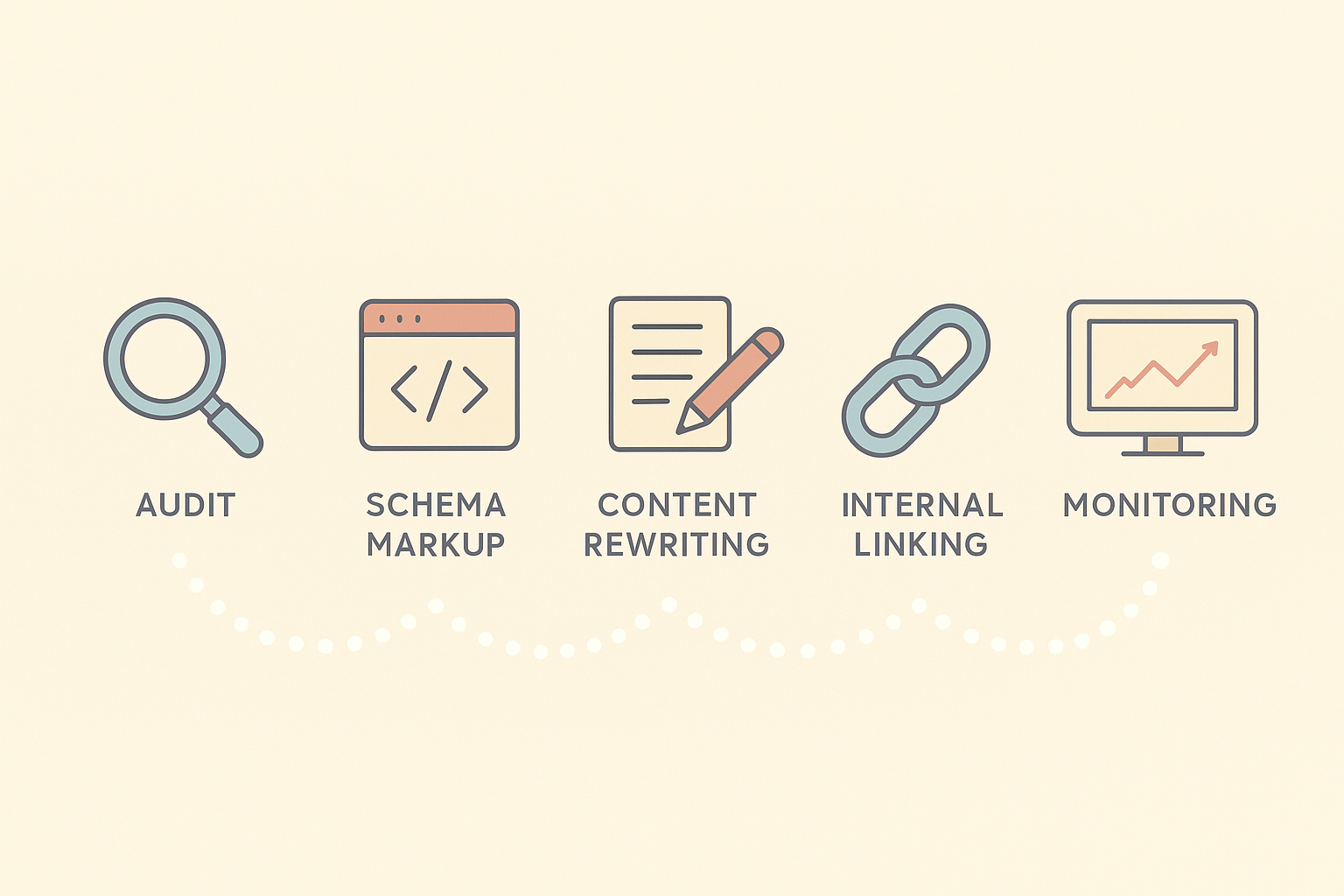
A structured, repeatable process makes AI website optimization easier to manage across multiple pages.
Optimizing for AI Agents and Autonomous Actions
As AI agents take on booking, shopping, and research tasks directly, AI website optimization must account for machine usability, not just readability. Above all, an agent needs unambiguous data: exact prices, availability, and clearly labeled actions like “Add to Cart” or “Book Now” rather than vague button text.
Practically, this means avoiding critical information hidden inside images, JavaScript pop-ups, or infinite-scroll widgets that agents may fail to render. Instead, use semantic HTML tables, accessible forms, and consistent product schema across every listing. As a result, both human visitors and autonomous agents can complete tasks on your site without friction, which increasingly influences whether an agent recommends your business at all.
Measuring the ROI of AI Website Optimization
Unlike traditional SEO, AI website optimization introduces a new metric worth tracking: citation share, or how often your brand is referenced inside AI-generated answers rather than clicked as a blue link. Specifically, track referral traffic segments from chatgpt.com, perplexity.ai, and Google’s AI Overview panels inside your analytics platform.
In addition, monitor branded query volume, since being cited by an AI assistant frequently drives people to search your brand name directly afterward. Consequently, a rise in branded search alongside flat organic clicks can actually be a sign AI website optimization is working, even if it does not show up in traditional click-through data right away.
Choosing the Right AI SEO Tools for Your Business
With dozens of platforms claiming to handle AI website optimization, choosing the right one can feel overwhelming. Above all, look for best SEO tools that combine technical SEO audits with AI-specific features like schema automation and answer-engine formatting.
For example, our complete guide to Alli AI’s SEO automation tools compares popular platforms feature by feature, while our deeper Alli AI SEO automation tool guide walks through setup and pricing in detail. Meanwhile, businesses that need help generating optimized content at scale often pair their optimization tool with an AI blog builder to keep publishing consistent, search-ready articles. If you are still mapping out the fundamentals, this overview of how to make your website search engine optimized is a solid companion resource before layering in AI-specific tactics.
RankAuthority’s own 1-Click AI AutoPilot is designed for exactly this kind of hands-off approach. It automates much of the technical and strategic work involved in AI website optimization, and it is currently available with a risk-free seven-day trial for businesses that want to test results before committing.
Choosing the right AI SEO tools can simplify ongoing optimization tasks for busy teams.
Mobile Experience and Page Speed in AI Website Optimization
Most searches, and most AI agent sessions, now begin on a mobile device. Therefore, a slow or poorly formatted mobile page undermines AI website optimization before an algorithm even reaches your content. According to Nielsen Norman Group’s usability research, slow-loading pages cause visitors, and by extension AI crawlers, to abandon content before it is fully indexed.
In contrast, sites that load quickly and format content clearly on small screens tend to earn more citations in AI-generated answers. For a complete checklist on this topic, our guide to optimizing for mobile pairs directly with the technical steps outlined above.
Common Mistakes to Avoid With AI Website Optimization
Even well-intentioned efforts can backfire. One common mistake is stuffing keywords unnaturally into headings, which actually hurts readability scores and can confuse AI models rather than help them.
Another frequent error involves accidentally blocking AI crawlers through an overzealous robots.txt file or security plugin, which quietly removes a site from AI answers without any visible warning. Similarly, ignoring page speed and mobile usability compounds the problem, since slow pages get abandoned before indexing completes.
Finally, many businesses treat AI website optimization as a one-time task instead of an ongoing process. Search algorithms and AI models update constantly, so content that ranked well six months ago may need revisions today. Consequently, continuous monitoring matters just as much as the initial setup, much like the principles outlined on Wikipedia’s overview of search engine optimization.
Frequently Asked Questions About AI Website Optimization
What is AI website optimization?
AI website optimization is the process of using artificial intelligence and automation to improve how a website ranks and gets cited across both traditional search engines and AI-driven answer engines. It typically combines technical SEO, content structuring, and schema markup.
How is AI website optimization different from traditional SEO?
Traditional SEO mainly targets ranking in search engine results pages, while AI website optimization also focuses on getting cited inside AI-generated answers from tools like ChatGPT and Google AI Overviews. Both share a foundation in clear, well-structured content.
How long does it take to see results from AI website optimization?
Most businesses start seeing measurable improvements within four to eight weeks, though full results can take three to six months depending on site size and competition. Automated tools can shorten this timeline by handling technical changes continuously.
Does AI website optimization replace the need for a human content strategy?
No, it works best when paired with human oversight for tone, accuracy, and brand voice. Automation handles repetitive technical work, but strategic decisions still benefit from human judgment.
How much does AI website optimization cost?
Costs vary widely, from free basic tools to subscription platforms priced by the number of pages or sites managed. Many providers offer a free trial period so businesses can evaluate results before paying.
What is Generative Engine Optimization (GEO)?
GEO is a subset of AI website optimization that focuses specifically on making content easy for generative AI models to summarize and cite accurately.
What is Answer Engine Optimization (AEO)?
AEO focuses on formatting content so it can be pulled directly into featured snippets, voice search answers, and AI chat responses.
Can small businesses benefit from AI website optimization without technical expertise?
Yes, automated platforms are designed to remove the technical learning curve, allowing small business owners to implement schema markup, content structuring, and monitoring without hiring a developer.
What’s the biggest mistake businesses make with AI website optimization?
The most common mistake is treating it as a one-time project rather than an ongoing process, since search algorithms and AI models update frequently.
Do I need schema markup for AI website optimization to work?
While not strictly required, schema markup significantly improves how reliably AI models and search engines interpret your content’s structure and meaning.
How does page speed affect AI website optimization?
Slow-loading pages can cause both human visitors and AI crawlers to abandon content before it’s fully processed, which reduces the chances of being cited or ranked well.
Can AI website optimization work for multiple client websites at once?
Yes, many automated platforms are built for agencies managing several sites, allowing bulk audits, monitoring, and optimization from a single dashboard.
What is an llms.txt file, and do I need one for AI website optimization?
An llms.txt file is a plain-text summary at your domain root that points AI models toward your most authoritative pages. It is not required, but it can supplement schema markup as an emerging best practice.
How do AI agents differ from AI search engines like ChatGPT or Perplexity?
AI search engines mainly summarize information and cite sources, while AI agents take multi-step action, such as booking or purchasing, which means AI website optimization must also address machine usability, not only content clarity.
Final Thoughts on AI Website Optimization
AI website optimization is not a passing trend; it is quickly becoming the standard for how businesses maintain visibility as search evolves. From structuring content for clarity to implementing schema markup, monitoring AI citations, and preparing your site for autonomous AI agents, the fundamentals covered here apply whether you are managing one website or dozens of client sites.
Above all, remember that consistency matters more than perfection. Small, ongoing improvements to structure, speed, crawlability, and clarity compound over time into meaningfully better visibility. For businesses that want to skip the manual work, platforms like RankAuthority’s 1-Click AI AutoPilot automate much of this process, making AI website optimization accessible even without a dedicated SEO team.

