

AI in digital marketing is the practice of using artificial intelligence — technology that lets software learn from data and make decisions on its own — to plan, create, and optimize marketing campaigns. Today, businesses depend on it to analyze customer behavior, automate content creation, and stay visible across both traditional search engines and AI-powered answer tools. As a result, marketers move faster and make sharper decisions than manual methods alone ever allowed. In this guide, we go further than any other resource on the topic: we cover how AI in digital marketing works, which real companies use it successfully, the technologies behind it, and how platforms such as rankauthority.com help businesses adapt to this shift. Add an author byline with brief credentials and a visible "Last updated" date to improve E‑E‑A‑T and reader trust.
Quick answer: AI in digital marketing means using machine-learning tools to automate SEO, content creation, and audience targeting so campaigns perform better with less manual effort. In 2025, this automation now extends into Generative Engine Optimization (GEO) and Answer Engine Optimization (AEO) to keep brands visible when customers ask AI assistants for answers instead of clicking search results.
What Is AI in Digital Marketing?
AI in digital marketing is the application of machine learning and natural language processing — a branch of AI that helps computers understand human language — to analyze data and automate marketing decisions. In short, software studies patterns in customer behavior, then adjusts targeting, content, or bidding automatically. This differs sharply from traditional marketing automation, which follows fixed rules rather than learning over time.
For example, an AI system might notice that blog posts answering direct questions rank better in AI search summaries. Consequently, it can suggest content restructuring without a marketer manually testing dozens of variations. This learning capability is exactly what separates AI in digital marketing from older, rule-based automation software.
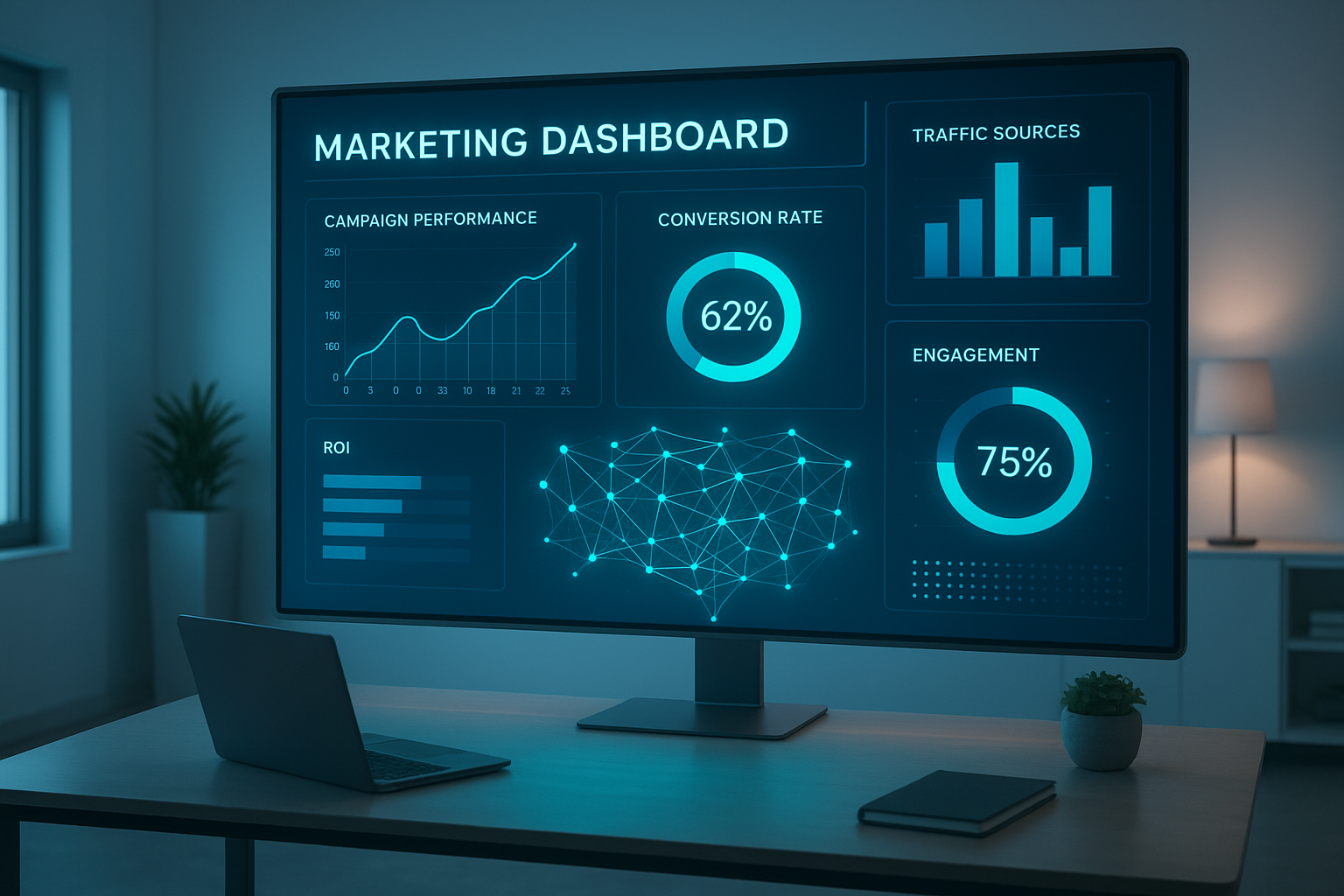
AI in digital marketing platforms turn raw campaign data into automated, actionable insights and often include features for AI-driven optimization.
How Leading Companies Use AI in Digital Marketing
Theory only tells half the story. Therefore, it helps to see how recognizable brands actually apply AI in digital marketing every day, and what specific results they achieve.
- Amazon uses predictive algorithms to power its “customers also bought” recommendations, which reportedly drive a large share of its total sales.
- Netflix relies on machine learning to personalize thumbnails and content rows for each viewer, increasing watch time and reducing churn.
- Starbucks built a system called Deep Brew to send individualized offers through its app based on purchase history and weather data.
- Spotify generates its Discover Weekly playlists using AI models trained on listening habits across millions of users.
- Sephora deploys a conversational AI chatbot and virtual try-on tool to guide shoppers toward products that match their preferences.
- Coca-Cola has experimented with generative AI to produce ad concepts and localized creative variations at a scale human teams could not match alone.
Notably, none of these companies treat AI in digital marketing as a replacement for strategy. Instead, they use it to remove guesswork from decisions that previously relied on intuition. Smaller businesses can apply the same logic through automated digital marketing solutions built for teams without in-house data science departments.
Core AI Technologies Powering Modern Marketing
AI in digital marketing is not one single tool. Rather, it is a collection of technologies working together. Understanding each one makes it easier to choose the right platform.
Predictive Analytics
Predictive analytics uses historical data to forecast future customer actions, such as who is likely to purchase or churn next. As a result, marketers can prioritize budget toward the highest-value audiences instead of spreading spend evenly.
Conversational AI and Chatbots
Conversational AI powers chatbots and virtual assistants that answer customer questions instantly, day or night. In particular, this reduces response time and frees support teams to handle more complex issues.
Programmatic Advertising
Programmatic advertising uses AI to buy and place digital ads in real time, bidding on the best available impression for each individual user. Because of this automation, ad spend is used far more efficiently than manual bidding allows.
AI Content Generation
Generative AI tools draft blog posts, ad copy, and product descriptions in seconds. However, the strongest results still come from pairing AI drafts with human editing for accuracy, tone, and brand voice. Explore our Digital Marketing AI Tools buyer's guide.
Hyper-Personalization
Personalization engines adjust website content, email subject lines, and product recommendations for each visitor individually. Consequently, engagement rates climb because customers see content relevant to their own behavior rather than a generic message.
Computer Vision and Voice Search Optimization
Computer vision lets AI analyze images and video for tagging, moderation, or visual search, while voice-search optimization prepares content to be read aloud accurately by smart speakers. Together, these technologies expand where and how customers can discover a brand.
How AI-Driven Marketing Is Changing Search in 2025
Search behavior is shifting quickly. Instead of scrolling through ten blue links, many users now ask AI assistants and chatbots for direct answers. Because of this, businesses must optimize not just for traditional search engines but also for how AI systems summarize and cite content.
Generative Engine Optimization (GEO) Explained
Generative Engine Optimization, or GEO, means structuring content so AI tools can accurately summarize it in generated answers. Specifically, this involves clear definitions, concise sections, and credible sourcing. Learn more about this shift in our guide on the future of digital marketing with AI.
Answer Engine Optimization (AEO) Explained
Answer Engine Optimization, or AEO, focuses on formatting content so voice assistants and answer engines can surface it as a direct response. Similarly, question-based headings and short direct answers, like the ones used throughout this article, improve AEO performance. According to Wikipedia’s overview of artificial intelligence, machine learning systems improve accuracy as they process more structured data, which is exactly why clean formatting matters here.
Key Benefits of AI in Digital Marketing Strategies
Businesses adopt AI-powered marketing for several practical reasons. Above all, it saves time on repetitive tasks that once required entire teams. In addition, it improves accuracy in targeting and forecasting.
- Faster content optimization: AI tools scan pages and suggest improvements in minutes rather than days.
- Better audience targeting: Predictive models identify high-value customers based on behavioral data.
- Continuous visibility monitoring: Automated systems track rankings across both traditional and AI search results.
- Reduced technical barriers: Non-technical users can run advanced optimization without hiring specialists.
- Lower cost per acquisition: Real-time bid adjustments reduce wasted ad spend on low-intent audiences.
Notably, a 2024 HubSpot State of Marketing report found that a majority of marketers already use AI tools for content creation, underscoring how mainstream this shift has become. Our detailed breakdown of AI tools for digital marketing covers specific options for different business sizes.
AI in Digital Marketing by the Numbers
Numbers make the shift concrete. In particular, industry research consistently shows adoption climbing across every major marketing function, from ad buying to customer service.
| Marketing Function | Common AI Application | Typical Impact |
|---|---|---|
| Content creation | Generative drafting and optimization | Hours saved per piece |
| Advertising | Programmatic bidding | Lower cost per click |
| Customer support | Chatbots and virtual agents | Faster response times |
| SEO and search | GEO and AEO optimization | Stronger AI-answer visibility |
Furthermore, Statista’s research on AI in marketing tracks this growth across industries, reinforcing that AI is now a standard part of marketing operations rather than an experimental extra. To see how these numbers translate into strategy, review our data-driven digital marketing guide.
How to Get Started With AI in Digital Marketing
Getting started does not require a technical background. Instead, follow a structured process to introduce automation gradually and measure results as you go.
- Audit existing content. Review current website content and marketing campaigns to identify gaps where AI-driven automation could improve performance and save time.
- Choose an AI platform. Select an AI marketing platform suited to your business size and goals, comparing automation features, pricing, and available trial periods.
- Set measurable goals. Define clear key performance indicators such as organic traffic growth or ranking improvements so you can measure impact.
- Automate repetitive tasks. Use AI tools to automate keyword research, content optimization, and technical SEO tasks that previously required manual work.
- Monitor and refine. Review AI-generated performance reports monthly and adjust strategy based on real data to continuously strengthen visibility.
Tools like the 1-Click AI AutoPilot feature from rankauthority.com automate several of these steps at once, which is particularly useful for agencies managing multiple client sites. For a side-by-side comparison, see which AI solutions are best for digital marketers.
Teams of all sizes can apply AI in digital marketing without needing deep technical expertise.
Common Challenges When Adopting AI-Powered Marketing Tools
Despite the benefits, some businesses run into avoidable problems. For instance, skipping goal-setting before launching AI tools often leads to unclear results. Similarly, poor-quality data can cause AI systems to make inaccurate recommendations.
In contrast, businesses that pair automation with occasional human review tend to see stronger outcomes. Therefore, treating AI as a strategic partner, rather than a fully hands-off solution, produces the most reliable results over time. The U.S. Federal Trade Commission’s guidance on AI use also recommends transparency and regular monitoring when deploying automated marketing systems.
Additionally, budget constraints and unclear ownership within teams can stall adoption. A practical way to avoid this is reviewing effective tools for digital marketers before committing spend, so the whole team agrees on scope from day one.
AI Marketing vs. Traditional Marketing: Key Differences
Comparing the two approaches side by side makes the value of AI in digital marketing easier to see at a glance.
| Factor | Traditional Marketing | AI in Digital Marketing |
|---|---|---|
| Decision speed | Manual analysis, slower cycles | Real-time, automated adjustments |
| Personalization | Broad audience segments | Individual-level customization |
| Scalability | Limited by team size | Scales without added headcount |
| Learning over time | Requires manual review | Improves automatically with data |
Choosing the Right AI in Digital Marketing Platform
Not every platform fits every business. Consequently, it helps to compare automation depth, pricing structure, and trial availability before committing to a tool.
Rankauthority.com, for example, targets small business owners, digital marketers, entrepreneurs, and agencies who want automated GEO and AEO support without a steep learning curve. Its 1-Click AI AutoPilot handles technical optimization work directly, and a risk-free seven-day trial lets teams test results before paying. For further guidance on evaluating options, review AI solutions for digital marketing that drive results and our overview of AI-enhanced digital marketing growth strategies. You can also compare AI-based digital marketing solutions against your current stack before switching tools. See AI marketing insights for practical campaign examples and case studies.
AI in digital marketing increasingly shapes how answers appear across both search and AI chat tools. Read AI marketing insights for practical campaign examples and measurement approaches.
The Future of AI in Digital Marketing (2025 and Beyond)
Looking ahead, several trends are already reshaping how brands plan campaigns. Specifically, agentic AI systems, which can complete multi-step tasks on their own rather than just answering prompts, are beginning to run entire campaign workflows with minimal supervision.
Meanwhile, multimodal search, where users combine images, voice, and text in a single query, will push brands to optimize content across more formats than text alone. In addition, zero-click search results will keep growing, making GEO and AEO less optional and more foundational to every content strategy.
Frequently Asked Questions About AI in Digital Marketing
What is AI in digital marketing?
AI in digital marketing is the use of machine-learning technology to analyze data, automate tasks, and optimize campaigns across search and social channels. It helps marketers make faster, data-backed decisions than manual processes allow. Learn how AI can enhance organic performance in our AI SEO strategy guide.
How does AI improve digital marketing campaigns?
AI improves campaigns by analyzing large data sets to predict customer behavior and automatically adjust targeting, bidding, and content. As a result, campaigns become more efficient and personalized over time.
Is AI in digital marketing expensive?
Costs vary widely, from free built-in AI features in existing tools to dedicated platforms priced monthly. Many providers, including rankauthority.com, offer trial periods so businesses can test value before committing.
How long does it take to see results from AI in digital marketing?
Initial improvements in content optimization and reporting can appear within days, while ranking and traffic gains typically build over 4 to 12 weeks. Consistent monitoring speeds up results.
What is the difference between AI in digital marketing and traditional automation?
Traditional automation follows fixed rules, while AI in digital marketing learns from data and adjusts strategy on its own. This makes AI tools more adaptive to changing search behavior.
What common mistakes do businesses make when adopting AI marketing tools?
Common mistakes include skipping goal-setting, ignoring data quality, and expecting instant results. Businesses that treat AI as a strategy partner, not a shortcut, see better outcomes.
Can small businesses benefit from AI in digital marketing?
Yes, small businesses often benefit the most because AI removes the need for large in-house teams. Automated platforms handle technical optimization that would otherwise require specialized expertise.
What is Generative Engine Optimization (GEO)?
GEO is the practice of structuring content so AI-generated answers, like those in chatbots, can accurately summarize and cite it. It works alongside traditional SEO rather than replacing it.
What is Answer Engine Optimization (AEO)?
AEO focuses on formatting content to directly answer questions so voice assistants and AI search tools can surface it as a featured response. Clear headings and concise answers improve AEO performance.
Do I need technical skills to use AI marketing tools?
No, most modern platforms are designed for non-technical users through automated dashboards. Tools like 1-Click AI AutoPilot remove the need for coding or advanced SEO knowledge.
How does AI affect SEO rankings?
AI affects rankings by helping search engines better understand content relevance, intent, and quality. In turn, AI tools help marketers optimize content to match those evolving signals through an AI SEO strategy.
What best practices should I follow when using AI in digital marketing?
Set clear KPIs, review AI-generated content before publishing, and combine automation with human judgment. Regularly auditing performance data keeps strategies aligned with real results.
Will AI replace human marketers?
AI is unlikely to fully replace human marketers because strategy, creativity, and brand voice still require human oversight. Instead, AI handles repetitive tasks so marketers can focus on higher-level decisions.
Which industries benefit most from AI in digital marketing?
E-commerce, media streaming, retail, and financial services see the fastest gains because they generate large volumes of customer data that AI can analyze quickly. However, any business with an online presence can apply the same principles at a smaller scale.
What skills do marketers need to work with AI tools?
Marketers benefit from understanding data interpretation, prompt writing for generative tools, and basic campaign analytics. That said, most platforms are built so these skills can be learned on the job rather than requiring a technical degree.
How are major brands like Amazon and Netflix using AI in digital marketing?
Amazon and Netflix both use predictive machine learning to personalize recommendations for individual users, which increases engagement and repeat purchases. Their approach shows how AI in digital marketing scales personalization far beyond what manual segmentation can achieve.
Final Thoughts on AI in Digital Marketing
In summary, AI in digital marketing is no longer optional for businesses that want to stay visible as search behavior evolves. From automating technical SEO to optimizing content for GEO and AEO, and from powering Amazon’s recommendations to Netflix’s personalization, AI-driven tools now handle work that once took entire teams. Above all, the businesses that adapt early, whether through platforms like rankauthority.com or other AI marketing solutions, tend to build a lasting advantage in an increasingly AI-centric search landscape. Add an author byline and a "Last updated" date (e.g., author name, credentials, one-sentence bio; Last updated: YYYY-MM-DD) to strengthen E-E-A-T and transparency.
Ultimately, success with AI in digital marketing comes from combining automation with clear goals and consistent monitoring. Consequently, businesses that follow this balanced approach are better positioned to maintain visibility across both traditional search engines and next-generation AI answer tools.

