

AI-powered search optimization is the single biggest shift in how content gets discovered since Google first launched its algorithm. Today, tools like ChatGPT, Google AI Overviews, Perplexity, and Gemini answer questions directly, often without a single click to your website. Consequently, businesses that only chase traditional rankings are quietly losing visibility to competitors who understand this new landscape. This guide breaks down exactly what AI-powered search optimization means, how it connects to generative engine optimization (GEO) and answer engine optimization (AEO), and the precise, actionable steps you need to get cited — not just ranked — across both classic and AI-driven search environments. Last updated: 2026-08-14. Author: Rank Authority Editorial Team.
Quick Answer
AI-powered search optimization is the practice of structuring, writing, and technically formatting content so it can be ranked by traditional search engines and simultaneously extracted, summarized, and cited by AI systems. It blends classic SEO with GEO and AEO, prioritizing clear entity definitions, structured data, and answer-ready formatting that AI models can quote accurately. Last updated: 2026-08-14. Author: RankAuthority.

AI-powered search optimization connects structured content to the AI systems that now generate search answers.
What Is AI-Powered Search Optimization, Exactly?
At its core, AI-powered search optimization is the process of structuring, writing, and technically formatting content so it performs well in both traditional search engines and AI-generated answer systems. Unlike older SEO, which focused almost entirely on keyword rankings, this approach also accounts for how large language models — AI systems trained to predict and generate human-like text — read, summarize, and cite information.
In practice, this means paying close attention to entity clarity (making sure names, places, and concepts are unambiguous), factual accuracy, and structured data such as schema markup, a standardized code format defined by Schema.org that helps machines understand page content. For example, a well-optimized page might place a direct answer near the top, followed by supporting detail, so an AI tool can pull an accurate quote without misrepresenting the source. Because AI search results often skip the traditional click entirely, visibility now depends on being the source that gets cited, not just the link that gets clicked.
According to Google’s own documentation on AI features in Search, structured, well-organized content remains a foundational signal even as generative summaries become more common. This confirms that AI-powered search optimization is an extension of solid content practices, not a replacement for them.
AI-Powered Search Optimization vs. Traditional SEO
So how does AI-powered search optimization actually differ from the SEO playbook most marketers already know? In short, traditional SEO optimizes for a ranked list of blue links, while this newer discipline optimizes for extraction — the moment an AI model lifts a sentence or paragraph directly into its answer. The table below compares the two approaches side by side.
| Focus Area | Traditional SEO | AI-Powered Search Optimization |
|---|---|---|
| Primary goal | Rank in the top 10 results | Get cited or quoted inside AI answers |
| Content structure | Keyword-focused headings | Extractable answer blocks and clear entities |
| Success signal | Click-through rate, rank position | Citation frequency, AI referral traffic |
| Technical layer | Meta tags, sitemaps | Schema markup plus entity and topical depth |
Notably, none of this replaces existing best practices. Instead, it layers new requirements on top. If you want more context on why algorithmic evaluation has changed so much, this piece on how advanced algorithm optimization impacts search rankings is a useful companion read.
The Three Pillars: SEO, GEO, and AEO Working Together
Effective AI-powered search optimization rests on three interlocking disciplines. Understanding each one separately makes it much easier to build a strategy that covers all of them at once.
Generative Engine Optimization (GEO) Explained
Generative engine optimization, often shortened to GEO, focuses specifically on how generative AI systems interpret and reuse content. These systems, built on models similar to those described on Wikipedia’s generative AI overview, work by predicting the most relevant and coherent response based on patterns in training data and retrieved content. As a result, GEO emphasizes clear entity definitions, meaning terms are explained plainly the first time they appear. It also favors content that is easy to extract, such as short paragraphs and labeled sections. Furthermore, GEO rewards sites that demonstrate consistent topical depth rather than a single thin article, since AI models weigh overall authority when selecting sources to cite. You can explore this further through this breakdown of AI search engine optimization strategies and ROI data.
Answer Engine Optimization (AEO) Explained
Answer engine optimization, or AEO, is closely related but distinct from GEO. While GEO focuses on how AI systems process content broadly, AEO specifically targets the direct question-and-answer format that voice assistants and AI chat tools rely on. In particular, AEO content is built around concise, standalone answers that make sense even when pulled out of context. A 2024 survey from the Pew Research Center found that a growing share of U.S. adults have already encountered AI-generated summaries directly within search results, underscoring how quickly answer-first formats are becoming the norm. Therefore, brands that fail to adapt their content structure risk losing visibility even when their underlying information is accurate and valuable. For a deeper look at where this is heading, see this analysis on why AEO is shaping the future of AI search.
Where Traditional Technical SEO Still Fits In
Even so, none of this makes traditional SEO obsolete. Page speed, mobile usability, crawlability, and backlink authority still influence whether AI systems find your content in the first place. In fact, most AI answer engines still rely on an underlying search index, so if a page cannot rank conventionally, it rarely gets considered for citation either. This is precisely why AI-powered search optimization should be treated as an addition to your existing stack, not a rip-and-replace strategy.

Tracking AI citation performance is now as important as tracking traditional keyword rankings.
How AI Search Engines Actually Decide What to Cite
Behind the scenes, most AI search tools use a process called retrieval-augmented generation, where the model pulls relevant passages from indexed web content before generating an answer. Because of this, the pages that get cited most often share a few traits: they answer a question directly within the first few sentences, they use clear headings that match real user queries, and they back up claims with credible sources.
In addition, AI systems appear to weigh signals similar to Google’s E-E-A-T framework — experience, expertise, authoritativeness, and trustworthiness. Consequently, a single optimized page rarely outperforms a site with several interlinked, topically related articles. If you want a detailed look at the mechanics behind this, this guide on how AI search algorithms rank content in 2025 walks through the ranking signals in more depth.
Ultimately, the sites that win are the ones that make it easy for a machine to trust them. That means citing sources, avoiding vague claims, and structuring content so a model does not have to guess what you meant.
Step-by-Step Process to Optimize for AI Search
Implementing AI-powered search optimization does not require starting from scratch. Instead, it builds on your existing SEO foundation with a few targeted additions. Below is a practical, ordered sequence you can follow this quarter.
- Audit current visibility. Check how your site appears in both traditional results and AI tools like ChatGPT or Google AI Overviews so you have a clear baseline to measure future progress against.
- Clarify your core entities. Define key people, products, and concepts plainly on first mention so AI models can identify exactly what your page is about without ambiguity.
- Strengthen structured data. Add schema markup so AI systems can accurately parse entities, authorship, and page context before generating an answer from your content. See SEO content optimization.
- Write direct answer blocks. Place short, clear answers near the top of key sections so AI tools can extract them confidently without pulling out-of-context statements.
- Build topical authority. Publish interlinked content covering related subtopics, since AI models favor sources that demonstrate depth across an entire subject area, not just one page.
- Add credible citations. Reference government sites, research bodies, or recognized industry sources throughout your content to reinforce trust signals that AI systems weigh heavily.
- Automate ongoing monitoring. Track AI citation performance over time and adjust content based on what is actually surfaced in results, since AI models update their behavior frequently.
If you are managing this process across several properties, exploring targeted SEO automation built around AI tools can significantly cut down the manual workload involved in steps three through seven.
Choosing the Right AI-Powered Search Optimization Platform
Manually implementing every element of AI-powered search optimization can be time-consuming, particularly for small teams managing multiple sites. This is where automated platforms come in. For example, rankauthority.com’s 1-Click AI AutoPilot technology automates much of the technical and strategic work involved, including structured data implementation and ongoing AI visibility monitoring, without requiring deep technical expertise.
This kind of automation is especially useful for small business owners, digital marketers, entrepreneurs, and agencies overseeing several client properties at once. In addition, a seven-day risk-free trial makes it possible to evaluate results before committing to a long-term plan. For a broader comparison of options, review these digital optimization tools built for AI-powered search success, or take a closer look at intelligent SEO tools built to boost rankings with AI if you want a wider market view before choosing one platform.
Common Mistakes That Kill AI Search Visibility
Even with the right tools, some mistakes persist. Skipping schema markup, writing vague introductions instead of direct answers, and neglecting FAQ sections all reduce the odds of being cited by AI tools. Similarly, ignoring internal linking structure makes it harder for both crawlers and AI systems to understand how your content connects across a site. Above all, publishing thin, one-off articles instead of a connected content cluster is one of the fastest ways to be overlooked entirely.
Naturally, this raises a fair question worth answering honestly: is automation actually reliable here? For an unbiased look, this piece on whether automated search optimization is actually effective weighs the evidence directly.
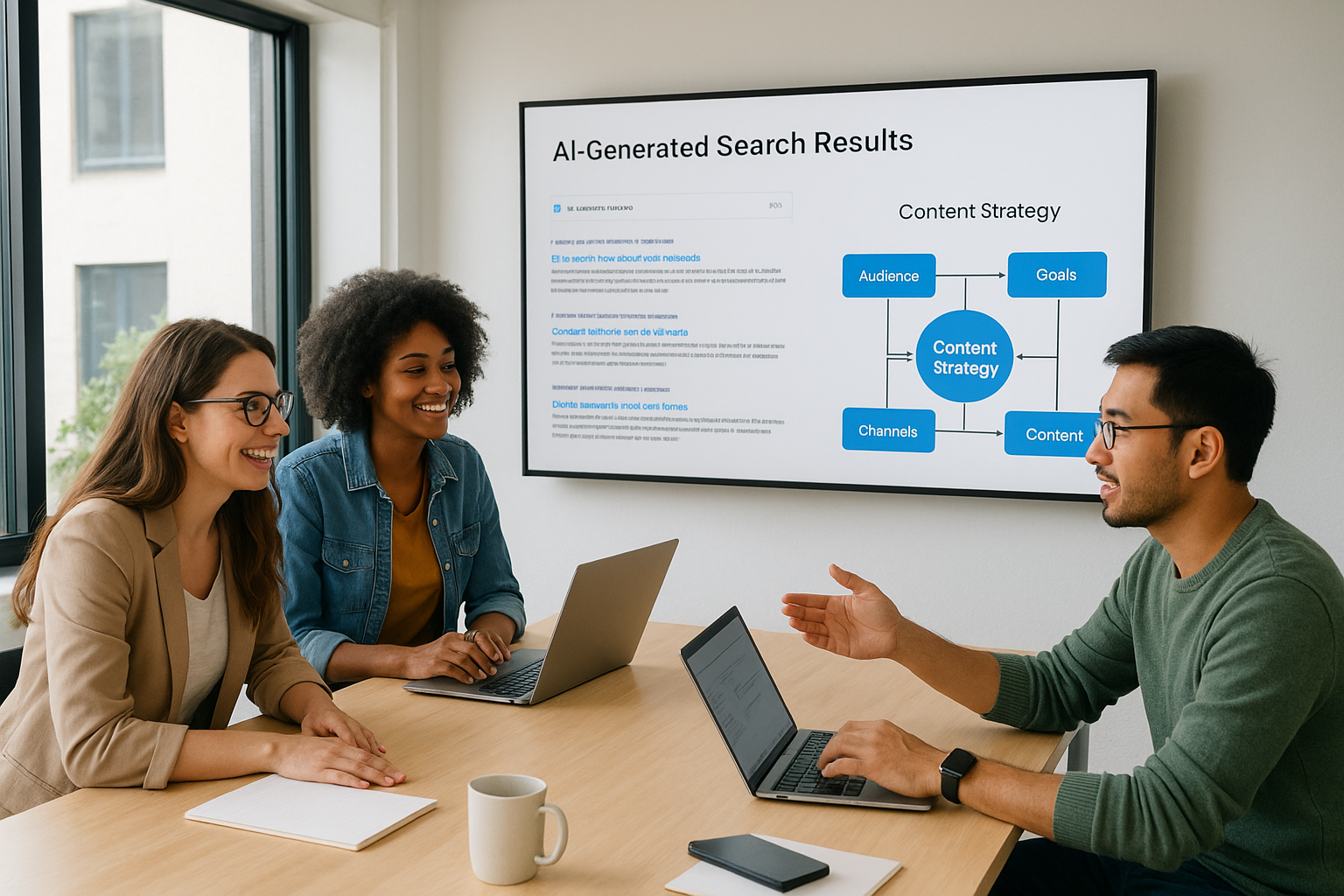
Teams that plan AI search optimization collaboratively tend to catch structural gaps earlier.
How to Measure AI Search Optimization Success
Unlike traditional SEO, where rank tracking tells most of the story, measuring AI-powered search optimization requires watching a slightly different set of signals. Specifically, you should track four things consistently:
- AI citation frequency — how often your content is quoted or referenced inside AI-generated answers.
- Referral traffic from AI tools — visits arriving from ChatGPT, Perplexity, or similar platforms, visible in most analytics referral reports.
- Featured snippet appearances — a strong early indicator that your content is structured well enough to be extracted.
- Traditional keyword rankings — still relevant, since AI answer engines frequently pull from the same underlying index.
Because these metrics shift quickly as models update, reviewing them monthly, rather than quarterly, tends to catch problems before they compound.
Real-World Example: Turning a Thin Page Into an AI-Cited Source
Consider a local service business whose homepage ranked on page two of Google and never appeared in AI Overviews. After applying AI-powered search optimization, the team added a direct answer paragraph beneath each service heading, implemented FAQ schema, and published three supporting articles on related subtopics. See our AI visibility audit for a full example.
Within six weeks, the page began appearing inside AI Overviews for two of its target questions, and organic referral traffic from AI tools rose measurably. Nothing about the underlying service changed — only how clearly the content was structured for extraction.
This example illustrates a broader truth: small, structural fixes often outperform a full content rewrite, especially when applied consistently across a site rather than a single page.
Practical Next Steps to Improve Search Performance
Above all, consistency matters more than perfection. Small, steady improvements to structure, clarity, and sourcing tend to outperform occasional large overhauls. For a more detailed walkthrough, this guide on practical ways to improve search performance using AI offers additional tactics you can apply immediately.
You can also refer to the FTC’s guidance on using artificial intelligence in business when evaluating AI tools, since transparency and accuracy remain important regardless of which optimization platform you choose.
Frequently Asked Questions About AI-Powered Search Optimization
What is AI-powered search optimization?
AI-powered search optimization is the practice of structuring and strengthening content so it ranks in both traditional search engines and AI-driven tools like ChatGPT, Gemini, and Google AI Overviews. It combines classic SEO with GEO and AEO techniques.
How does AI-powered search optimization differ from traditional SEO?
Traditional SEO focuses mainly on ranking in a list of links, while AI-powered search optimization also targets AI-generated summaries. As a result, it emphasizes structure, factual accuracy, and citation-ready formatting.
What is Generative Engine Optimization (GEO)?
Generative Engine Optimization is the practice of optimizing content so generative AI tools can understand, summarize, and cite it accurately. It focuses on entity clarity, structured data, and authoritative sourcing.
What is Answer Engine Optimization (AEO)?
Answer Engine Optimization is the practice of formatting content to directly answer specific questions asked through voice assistants and AI chat tools. It typically involves concise answer blocks and FAQ sections. Learn the AEO process in depth.
How long does it take to see results from AI search optimization?
Most sites see measurable movement within four to eight weeks, though full authority gains can take three to six months depending on competition and consistency.
How much does AI-powered search optimization cost?
Costs vary widely, from free manual tactics to automated platforms priced from roughly $30 to several hundred dollars monthly. Many providers offer a trial period to test results first.
Can small businesses benefit from AI search optimization?
Yes, small businesses often benefit significantly because AI search tools frequently surface niche, specific answers rather than only large brand websites.
What tools help automate AI-powered search optimization?
Automated platforms like rankauthority.com’s 1-Click AI AutoPilot handle technical structuring, content signals, and monitoring without manual work. Other tools focus narrowly on schema or tracking.
What are common mistakes in AI search optimization?
Common mistakes include skipping structured data, writing vague answers instead of direct ones, and neglecting FAQ sections, which makes content harder for AI systems to cite.
Does AI-powered search optimization replace traditional SEO?
No, it builds on traditional SEO rather than replacing it. Technical SEO and page experience still matter alongside GEO and AEO techniques.
How do AI search engines choose which sources to cite?
AI search engines typically favor sources with clear structure, factual accuracy, credible citations, and strong topical authority near the top of the page.
What metrics measure success in AI search optimization?
Useful metrics include AI citation frequency, referral traffic from AI tools, featured snippet appearances, and traditional keyword rankings tracked together. For a full audit methodology see our AI visibility audit.
Is a free trial available for AI search optimization platforms?
Many platforms, including rankauthority.com, offer a seven-day risk-free trial so users can evaluate automated results before committing to a plan.
How often should AI search optimization strategies be updated?
Strategies should be reviewed at least quarterly since AI algorithms change frequently, though monitoring citation performance monthly helps catch shifts sooner.
Does AI-powered search optimization work for local businesses?
Yes. Local businesses often see faster gains because AI tools favor specific, well-structured answers over generic content from large national sites.
Do I need coding skills to implement AI-powered search optimization?
No. While schema markup involves code, most modern platforms and plugins automate this step, meaning writers and marketers can implement it without touching code directly.
What’s the difference between GEO and AI-powered search optimization overall?
GEO is one component within the broader discipline of AI-powered search optimization, which also includes AEO and traditional technical SEO working together.
Final Thoughts
AI-powered search optimization is no longer optional for brands that want to stay visible as search behavior shifts toward AI-generated answers. In particular, combining structured data, clear answer blocks, and consistent topical authority gives content the best chance of being cited across both traditional and AI-driven environments.
Whether you choose to implement these steps manually or rely on automated tools like rankauthority.com’s platform, the core principle remains the same: content built for clarity and trust performs well regardless of which system is reading it.

