

AI visibility tracking is the practice of measuring how often, and how accurately, your brand shows up inside AI-generated answers from tools like ChatGPT, Google AI Overviews, Gemini, and Perplexity. As more people ask AI assistants for recommendations instead of scrolling through ten blue links, knowing whether your business even gets mentioned has become just as important as ranking on page one of Google. This article breaks down what AI visibility tracking actually measures, why it matters, and how to set it up without needing a dedicated SEO team.
Quick answer: AI visibility tracking monitors brand mentions and citations inside AI search tools such as ChatGPT and AI Overviews, showing marketers whether and how often they appear compared to competitors, so they can adjust content and schema to earn more citations.
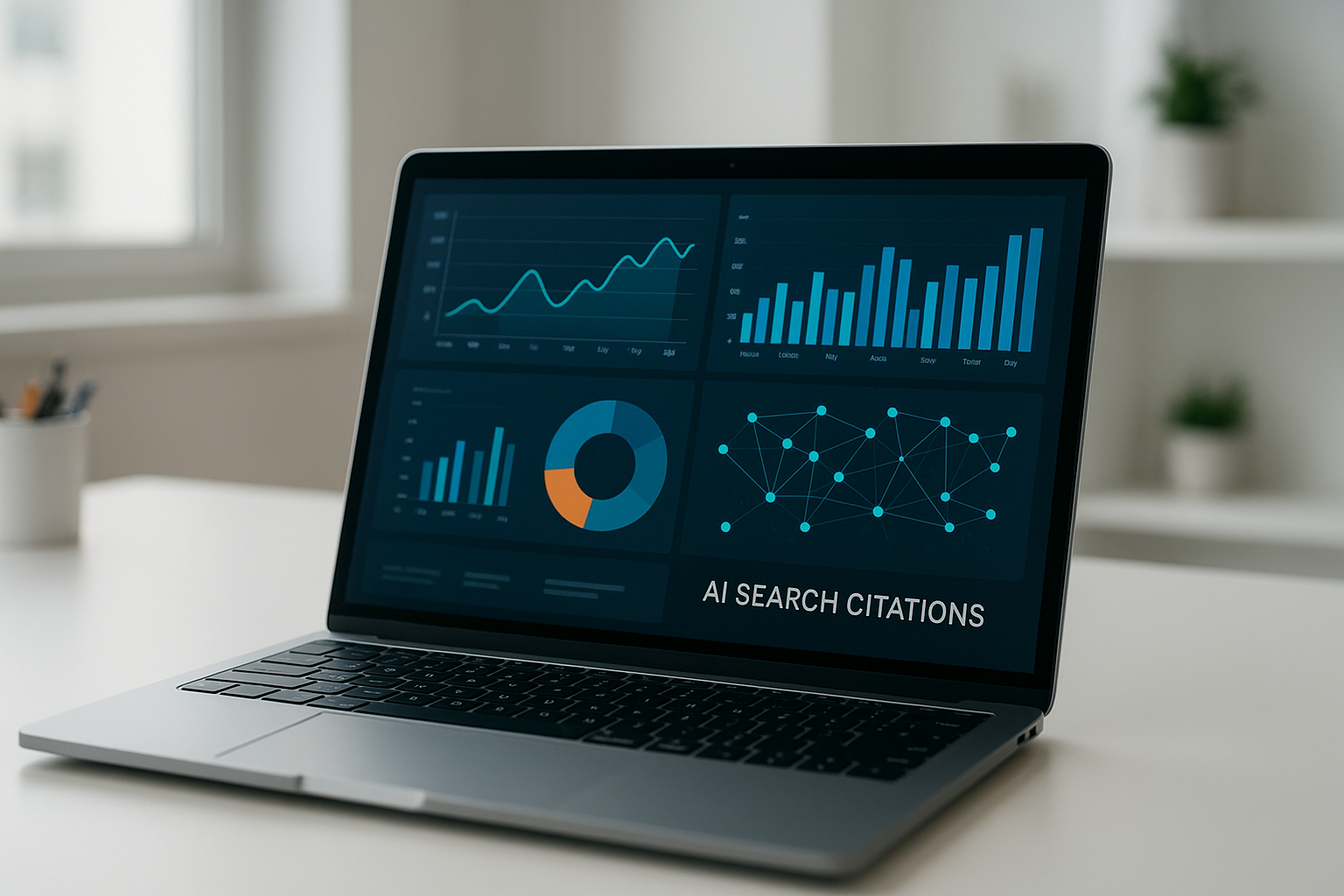
AI visibility tracking dashboards reveal how often a brand is cited across AI search platforms.
What Is AI Visibility Tracking?
AI visibility tracking is the ongoing process of checking whether a website or brand is referenced, summarized, or recommended inside AI-generated search results. Unlike a simple keyword rank, it looks at inclusion: does the AI system mention your business at all, and if so, how favorably?
In practice, this involves sending a set of representative customer questions to AI platforms and recording the responses. For example, a local plumbing company might track whether ChatGPT recommends it when someone asks “best emergency plumber near me.” Over time, this creates a dataset showing visibility trends rather than a single snapshot.
Because AI answer engines pull from a mix of indexed content, structured data, and third-party sources, visibility tracking also indirectly measures how well a site has adopted Generative Engine Optimization (GEO) — the practice of structuring content so AI systems can easily cite it — and Answer Engine Optimization (AEO), which formats answers for direct extraction into featured snippets and AI responses.
Why AI Search Visibility Matters More Every Year
Consequently, businesses that ignore AI search visibility risk becoming invisible to a growing share of their audience. According to Pew Research Center survey data on AI adoption, a rapidly increasing share of internet users now turn to AI chatbots for everyday questions rather than typing searches directly into Google. As a result, a brand that only optimizes for traditional blue-link rankings may still be missing a large and growing segment of buyer research.
In addition, AI answers often present a condensed list of recommended options. If your business is not among them, a competitor is. Therefore, tracking visibility is not just a reporting exercise; it is an early warning system that flags when your content is losing ground in AI-driven discovery.
For agencies managing multiple client sites, this problem multiplies. Without a consolidated view, it becomes nearly impossible to know which clients are gaining AI citations and which are falling behind. A structured AI search performance reporting process for agencies solves this by centralizing visibility data across every managed property.
How AI Visibility Tracking Works, Step by Step
Setting up AI visibility monitoring does not require deep technical expertise, but it does benefit from a consistent process. The following steps outline a practical approach any business can follow.
- Run a baseline AI visibility scan. Use a diagnostic tool to see whether your brand currently appears in AI answers, and record the starting point before making any changes.
- Identify target queries and competitors. List the questions customers are likely to ask AI assistants, then note which competitors are currently getting cited for those same prompts.
- Fix structural and schema gaps. Add or correct structured data and clarify direct-answer formatting so AI crawlers can understand your page content accurately.
- Connect ongoing automated monitoring. Set up continuous tracking so citation frequency, sentiment, and share of voice are measured automatically on a recurring schedule.
- Review reports and adjust content. Analyze visibility reports regularly, prioritize underperforming pages, and update or rebuild that content to grow AI search presence over time.
Specifically, this is where automation becomes valuable. Manually checking five AI platforms across dozens of queries every week is impractical for most teams, which is why automated AI visibility tracking has become a standard feature of modern search optimization platforms.
A structured process makes AI search visibility monitoring repeatable instead of a one-time check.
Key Metrics to Monitor in AI Visibility Tracking
Not every metric matters equally. Above all, four signals tend to reveal the most about AI search performance.
- Citation frequency — how often your brand is mentioned across tracked queries over a given period.
- Share of voice — how your citation rate compares against named competitors for the same prompts.
- Sentiment and accuracy — whether the AI describes your business favorably and correctly.
- Source pages cited — which specific pages on your site the AI pulls information from, which often reveals your strongest GEO-optimized content.
For a deeper breakdown of which features actually move these numbers, the AI search visibility tool guide with a 30-day action plan outlines a practical roadmap for improving each metric in sequence.
AI Visibility Monitoring vs Traditional SEO Rank Tracking
Traditional SEO rank tracking answers a fairly narrow question: where does a page sit in the search results for a given keyword? In contrast, AI visibility monitoring answers a broader one: does the AI mention the brand at all, and in what context?
This distinction matters because a page can rank well in Google yet never appear in an AI Overview or a ChatGPT response if the content is not formatted for direct extraction. Similarly, a site with modest traditional rankings can still earn strong AI citations if its content answers questions clearly and uses proper schema markup.
For businesses that want both views in one place, pairing AI visibility tracking with real-time SEO tracking gives a complete picture of visibility across traditional and AI-driven search environments simultaneously.
How Rank Authority Automates AI Visibility Tracking
Rank Authority is an AI-powered search optimization platform built specifically to handle AI visibility tracking alongside traditional SEO and GEO/AEO work. Rather than juggling separate tools for citation monitoring, schema deployment, and content creation, the platform brings these functions into a single dashboard.
The 1-Click AI AutoPilot feature scans a site for technical and content gaps, then streamlines approved fixes without requiring an in-house specialist. Meanwhile, the free ChatGPT visibility checker gives a quick snapshot of current citation status, and the broader RA Score reporting tracks progress over time as changes take effect.
For businesses managing content production, the AI Blog Builder generates SEO- and AEO-optimized articles designed for citation, while RankFast analyzes and rebuilds underperforming competitor pages to help a site outrank rivals. RankLink then handles topical siloing and internal linking automation, reinforcing the structural signals AI systems use to understand a site’s authority.
Individual results vary. Reviews reflect individual user experiences and are not guaranteed results for all users. Rank Authority can submit changes for indexing, but search engines alone determine whether and when a page is indexed.

Automated ai visibility tracking makes it practical for small businesses to monitor AI citations without extra staff.
Common Mistakes When Tracking AI Visibility
Even well-intentioned teams make a few recurring errors when they start tracking AI search visibility.
First, many businesses check only one platform, usually ChatGPT, and assume results there represent the full picture. However, Gemini, Perplexity, and Google AI Overviews often surface different sources entirely, so a narrow view can miss major visibility gaps. Second, some teams treat visibility checks as a one-time audit instead of a continuous process, which means they miss sudden drops caused by algorithm updates or competitor content changes.
Finally, a surprising number of sites skip structured data entirely, not realizing that schema markup directly affects whether AI systems can confidently parse and cite their content. Reviewing a broader set of digital visibility tools for businesses can help identify these gaps before they cost meaningful citation opportunities.
Frequently Asked Questions
What is AI visibility tracking?
AI visibility tracking is the process of monitoring how often, and how accurately, a brand appears in responses from AI search tools like ChatGPT, Google AI Overviews, and Gemini. It helps businesses understand their presence in AI-generated answers rather than only traditional search rankings.
How does AI visibility tracking work?
AI visibility tracking tools send representative queries to AI platforms and record whether, where, and how a brand is mentioned or cited. The results are then compiled into dashboards that show citation frequency, sentiment, and competitor comparisons over time.
Why is AI visibility tracking important for small businesses?
Small businesses often lack the resources to manually monitor dozens of AI platforms, yet consumers increasingly rely on AI answers to make decisions. AI visibility tracking gives smaller teams the same insight into AI citations that larger brands get from expensive analytics suites.
How is AI visibility tracking different from traditional SEO tracking?
Traditional SEO tracking focuses on keyword rankings and organic click-through rates on search engine results pages. AI visibility tracking instead measures whether a brand is cited, summarized, or recommended inside conversational AI answers, which do not always link back to a webpage.
How much does AI visibility tracking cost?
Costs vary widely, ranging from free diagnostic tools to monthly subscription plans for automated monitoring. Rank Authority, for example, offers a free AI Visibility Checker alongside paid plans and a seven-day trial for deeper monitoring.
How long does it take to see results from AI visibility tracking?
Initial visibility data is typically available within days of setup, since tracking tools query AI platforms directly. However, meaningful improvements in citation frequency usually take several weeks to months as content and schema changes get recognized.
What AI platforms should I track visibility across?
At minimum, businesses should track ChatGPT, Google AI Overviews, and Gemini, since these reach the largest audiences. Expanding to Perplexity and other emerging answer engines provides a more complete picture as AI search adoption grows.
What common mistakes do businesses make with AI visibility tracking?
A common mistake is tracking only one AI platform or checking visibility sporadically instead of continuously. Another is ignoring structured data and schema markup, which plays a major role in whether AI systems can accurately cite a page.
What metrics matter most in AI visibility tracking?
Key metrics include citation frequency, share of voice against competitors, sentiment of the mention, and which pages are being pulled into AI answers. Tracking these over time reveals whether optimization efforts are improving AI search visibility.
Can AI visibility tracking improve my chances of being cited by ChatGPT?
AI visibility tracking itself does not change citations, but it reveals the content gaps and structural issues preventing them. Acting on those insights, such as adding clearer answer formatting or schema, can improve the odds of being referenced.
Do I need technical SEO knowledge to use AI visibility tracking tools?
No, most modern AI visibility tracking platforms are designed for non-technical users and present findings in plain language dashboards. Automated platforms go further by suggesting or applying fixes without requiring hands-on coding knowledge.
How does Rank Authority help with AI visibility tracking?
Rank Authority combines AI visibility monitoring, automated schema deployment, and content tools like RankFast and AI Blog Builder into one dashboard. This lets users track citations across AI platforms and act on gaps without managing separate tools or specialists.
Final Thoughts on Tracking AI Visibility
In summary, AI visibility tracking has quickly become a necessary companion to traditional SEO as more consumers turn to AI tools for recommendations and answers. By monitoring citation frequency, share of voice, and sentiment across platforms like ChatGPT and AI Overviews, businesses can spot visibility gaps before competitors fill them.
Ultimately, consistent AI visibility tracking paired with the right structural fixes, schema markup, and content updates gives any business, from solo entrepreneurs to multi-client agencies, a realistic path to staying discoverable as AI search continues to reshape how people find information. Explore Rank Authority’s free diagnostic tools to see where your current AI visibility stands today.

