

Direct Answer
AI-driven backlink strategies are link building methods that use artificial intelligence, machine learning, and large language models to discover prospects, personalise outreach at scale, and analyse competitor link profiles — dramatically increasing both the quality and volume of earned backlinks compared to traditional manual approaches. In short, they make link building faster, smarter, and far more scalable.
What Are AI-Driven Backlink Strategies?
AI-driven backlink strategies are link building methods that use AI-Driven SEO Analytics to automate, prioritise, and improve every stage of the link acquisition process. Specifically, they cover everything from initial prospect discovery through to personalised outreach, follow-up sequencing, and post-campaign performance analysis. At their core, these strategies replace time-intensive human research with algorithmic pattern recognition — and the difference in output is dramatic.
An AI model can evaluate a domain’s topical authority, estimate the probability of a successful outreach response, and generate a personalised pitch email — all within seconds. Furthermore, according to research on how machine learning processes large datasets, AI systems can detect complex signals across millions of data points simultaneously. That capability translates directly into richer, more accurate link prospect scoring than any spreadsheet-based approach could achieve.
In 2025, the gap between SEO teams using AI for link building and those relying purely on manual methods is widening fast. Whether you are a solo consultant or managing an enterprise SEO programme, embedding AI into your backlink workflow is no longer optional — it is the competitive baseline.

AI-driven backlink strategies map link relationships across thousands of domains simultaneously — something no manual process can replicate. See our AI search engine optimization guide.
Why Traditional Link Building Falls Short
Before exploring how AI improves link building, it helps to understand exactly where manual methods fail. Traditional link prospecting involves manually searching for relevant sites, checking domain metrics, reviewing content quality, and assembling a contact list. For a single campaign, this process can consume 10 to 20 hours per week — and still produce inconsistent results. Learn more in our AI-driven SEO analytics guide.
Moreover, human researchers are limited by cognitive bandwidth. They can reasonably evaluate dozens of prospects at a time. As a result, they inevitably miss high-value opportunities buried deeper in competitor backlink profiles or across niche-adjacent domains they never thought to check.
Outreach suffers a similar problem. Generic templates sent to bulk lists produce reply rates under 5% in most industries. Consequently, link building teams spend enormous effort for modest returns — which is precisely why AI-driven approaches have gained such rapid adoption among competitive SEO operations.
The Scale Problem in Numbers
Manual Prospecting
- 20–50 prospects evaluated per week
- High time investment per campaign
- Inconsistent, subjective scoring
- Limited competitor gap visibility
- Low outreach reply rates (3–5%)
AI-Assisted Prospecting
- Thousands of prospects evaluated per run
- Minutes to generate ranked shortlists
- Algorithmic, consistent authority scoring
- Deep multi-competitor gap analysis
- Personalised outreach improves reply rates 2–4×
How AI Transforms the Link Prospecting Phase for AI-Driven Backlink Strategies
The prospecting phase is where AI-driven backlink strategies deliver their most immediate, measurable advantage. Modern AI prospecting tools ingest your target keywords, crawl competitor backlink profiles, and return a ranked list of link opportunities scored by topical relevance, domain authority, estimated traffic, and historical outreach response rates. What previously took days now takes minutes.
Topical Relevance Scoring
Traditional domain authority metrics tell you how powerful a site is. However, they do not tell you whether a link from that site will actually benefit your rankings for a specific keyword cluster. AI changes this by performing topical relevance scoring — an assessment of how closely a prospect domain’s content aligns with your target topic. Consequently, you pursue links that move the needle for your actual target pages, not just your overall domain authority.
Competitor Backlink Gap Analysis
AI tools can simultaneously analyse the backlink profiles of your top five to ten competitors and identify domains that link to multiple competitors but not to you. These gap opportunities represent your highest-priority targets — sites already proven to link to content in your niche. In addition, AI can surface patterns in why those domains link out, enabling you to AI-Driven Content Marketing to create content specifically designed to earn those links.
Unlinked Brand Mention Discovery
Beyond prospecting for new links, AI tools can scan the entire web for unlinked mentions of your brand, products, or key contributors. These represent the easiest link building wins available — the site already knows you exist and has referenced you. Therefore, a well-crafted outreach email asking for a link conversion typically achieves reply rates of 20–40%, far above cold prospecting benchmarks.
The Best AI Tools for Backlink Strategies in 2025
The toolset for AI-powered link building has matured significantly. Below are the categories and specific platforms driving the strongest results for competitive SEO teams in 2025:
🔍 AI Search Engine Optimization: Ahrefs & Semrush
Both platforms incorporate machine learning models to surface link gap opportunities, predict domain authority trajectories, and flag toxic links before they harm rankings. Their AI layers process billions of crawled URLs to deliver actionable prospecting data. Specifically, Ahrefs’ “Link Intersect” tool and Semrush’s “Backlink Gap” module are indispensable for multi-competitor analysis. Furthermore, both now offer AI-generated content recommendations for linkable asset creation based on your gap profile; learn more from our AI-Driven Content Marketing guide.
✉️ AI Outreach Personalisation: Pitchbox & BuzzStream
These platforms use AI to analyse the content and editorial tone of each target website, then suggest or auto-draft personalised outreach emails that reference specific articles, topics, or editorial themes. As a result, reply rates improve dramatically over generic bulk templates. Pitchbox, in particular, offers AI-powered sequence optimisation — adjusting follow-up timing and copy based on engagement signals from previous outreach touchpoints.
🤖 GPT-Based Custom Outreach Workflows
Advanced SEO teams build custom GPT pipelines that ingest a prospect’s three to five most recent articles, extract key editorial themes, and generate outreach copy tailored to each individual editor or webmaster. See our AI content writing guide for building GPT workflows. This approach consistently outperforms batch-template campaigns. In addition, GPT workflows can be chained with data enrichment APIs — pulling LinkedIn profiles, recent social posts, and publication history to inform hyper-contextualised pitches that feel genuinely handcrafted.
📊 Predictive Content Gap and Linkable Asset Tools
AI tools predict which content formats and topics in your niche are statistically most likely to attract editorial links — allowing you to create assets strategically rather than hoping content organically goes viral. For more on tool selection, see AI Optimization Tools.
🔗 Real-Time Link Monitoring: Ahrefs Alerts & Mention.com
Protecting the links you have earned is as important as building new ones. AI-powered monitoring tools send instant alerts when a high-value backlink is lost, modified, or noindexed — triggering an automated re-outreach sequence before the ranking signal degrades. Similarly, Mention.com uses AI to scan news sites, blogs, and social platforms for brand mentions without links, flagging them as immediate conversion opportunities.
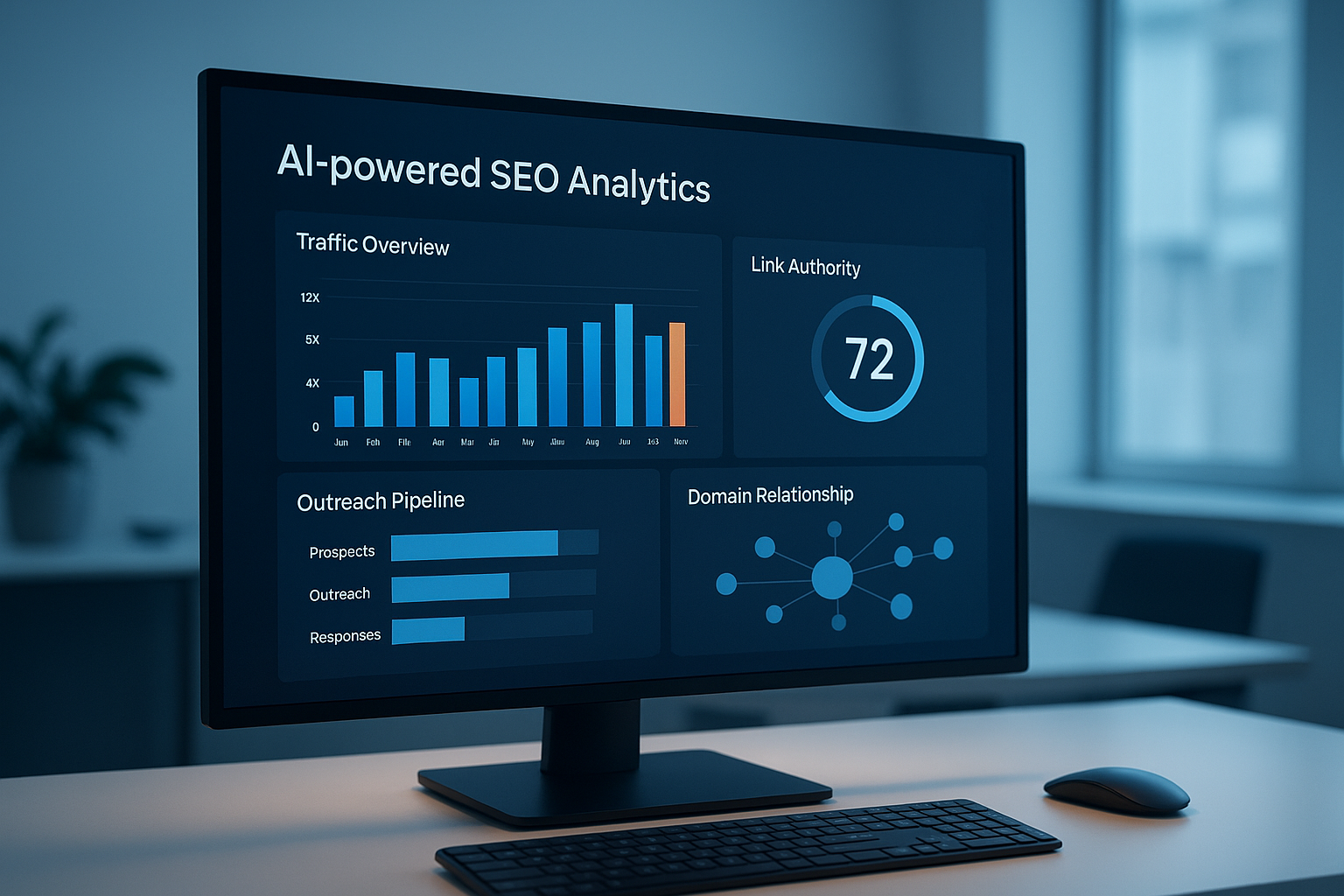
Modern AI SEO dashboards consolidate link prospecting, outreach tracking, and authority scoring into a single workflow.
Building a Scalable AI-Driven Backlink Workflow
Knowing which AI Solutions for Digital Marketing exist is one thing — building a repeatable, scalable process is another. The following six-step framework is how top-performing SEO teams structure their AI-driven backlink campaigns. Consequently, this is the process you can implement immediately, regardless of team size or budget.
Step-by-Step: The AI Backlink Acquisition Framework
- Define your link target profile. Use AI tools to analyse your top-ranking competitors and identify the types of domains — by niche, authority tier, and content format — that link to them most consistently. Specifically, look for patterns in linking domain age, topic cluster alignment, and editorial style to build a precise profile.
- Generate and score prospects at scale. Feed your target profile into an AI prospecting tool to surface hundreds of qualified candidates, pre-scored by relevance and authority. In addition, run a competitor gap analysis to surface domains already proven to link within your niche.
- Create linkable assets strategically. Use AI content gap analysis to build resources — original research, data studies, comprehensive guides, or free tools — that your target domains are statistically likely to cite. See our AI Content Writing for SEO resource for creating higher-conversion assets.
- Personalise outreach with AI assistance. Generate context-aware email pitches for each prospect using GPT workflows, referencing their actual content, recent publications, and editorial focus areas. Furthermore, use AI to optimise subject lines and follow-up timing based on historical open-rate data from your previous campaigns.
- Pursue unlinked brand mentions. Run an AI-powered mention scan to identify every site that references your brand or key contributors without a link. These represent your highest-conversion outreach targets — prioritise them before cold prospecting for faster wins.
- Track, iterate, and optimise continuously. Feed outreach response data back into your AI pipeline to continuously refine prospect scoring and email personalisation over time. As a result, each campaign cycle performs better than the last — creating a genuine compounding advantage over competitors using static methods.
For a deeper look at how internal linking interacts with your external backlink strategy, the team at Rank Authority’s internal linking best practices guide covers how to structure your site architecture to maximise the value passed through every earned link. For a deeper walkthrough, see our AI Visibility Audit: The Complete Guide to Rankings.
Digital PR and AI: The Highest-Leverage Link Building Tactic
One of the most powerful — and most underused — applications of AI-driven backlink strategies is in digital PR campaigns. Digital PR involves publishing genuinely newsworthy content (original research, industry surveys, proprietary data) that journalists and editors naturally want to link to and cite. AI accelerates every stage of this process.
AI-Powered Digital PR Workflow
Specifically, here is how leading teams use AI to amplify their digital PR link acquisition:
- Topic identification: AI tools analyse trending search queries, social discussions, and recent link patterns to identify topics where journalists are actively seeking data and expert commentary.
- Asset creation support: GPT models assist in writing survey questions, structuring data studies, and formatting findings into press-ready formats that maximise editorial pickup.
- Journalist targeting: AI scans media databases and recent bylines to identify journalists who have covered adjacent topics in the past 90 days — the highest-probability link targets for your specific story angle.
- Pitch personalisation: Each journalist receives a pitch that references their specific recent work, not a generic press release — consequently driving significantly higher response rates from top-tier publications.
- Coverage monitoring: Post-publication, AI tools track every pickup across news sites, blogs, and social platforms — including unlinked citations that trigger immediate follow-up requests.
The result is a systematic approach to earning editorial links from high-authority news and industry publications — links that manual outreach campaigns would struggle to reach at the same scale or speed.
Are AI-Driven Backlink Strategies Safe for Google Compliance?
This is the question every SEO professional asks before committing to an AI-powered link building workflow. The answer is yes — with an important and clear distinction to understand.
Google’s link spam policies target manipulative schemes — paid links, reciprocal link exchanges, and programmatically generated link networks. None of these are inherent to AI-driven backlink strategies. When AI is used to identify genuine editorial opportunities, craft authentic outreach, and earn real links based on content merit, the entire process is fully compliant.
⚠ Critical Distinction
AI that automates spam violates Google’s policies. AI that accelerates genuine editorial outreach does not. The intent and execution of your strategy — not the tools used — determine compliance.
Google’s E-E-A-T and AI Link Building
Google’s E-E-A-T framework (Experience, Expertise, Authoritativeness, Trustworthiness) evaluates link quality at a contextual level, not just a domain authority level. Therefore, an AI-driven approach that targets topically relevant, editorially rigorous domains — rather than any domain with a high DR score — is not only safe but actively aligned with what Google rewards.
In addition, the human review layer you maintain over AI-generated outreach copy matters. Before any email is sent, a team member should review it for accuracy, tone, and genuine relevance to the recipient. This quality control step ensures your outreach maintains the authenticity that distinguishes editorial link building from manipulative schemes.
How to Measure ROI from Your AI Backlink Campaigns
Investing in AI tooling and workflow development only makes sense if you can demonstrate measurable returns. The following metrics provide the clearest, most actionable picture of campaign performance across different time horizons: See our practical guide to improve website backlinks for tactical measurement tips.
DR
Domain Rating growth over 60–90 days post-campaign
RD+
New referring domains earned per campaign cycle
↑KW
Keyword ranking improvements on target pages
Additional ROI Metrics Worth Tracking
- Outreach reply rate and conversion rate — the percentage of emails sent that result in a live backlink. This measures your AI personalisation quality directly.
- Cost per acquired link — total campaign spend divided by links earned. AI-driven campaigns typically reduce this by 40–60% versus manual agency methods.
- Referral traffic from earned links — tracked via Google Analytics UTM parameters or Search Console. High-authority editorial links drive meaningful referral traffic in addition to ranking signals.
- Link retention rate at 6 and 12 months — the percentage of earned links still live after six and twelve months. A declining retention rate signals content or relevance issues that need addressing.
- Organic traffic growth on linked pages — the clearest signal that your links are translating into actual business results, not just vanity metrics.
Pair these metrics with Google Search Console data and AI-driven SEO analytics and Ahrefs’ referring domain history to build a clear attribution model. Furthermore, most well-executed AI-driven campaigns show measurable ranking movement within 60 to 90 days of link acquisition — making it feasible to justify campaign investment on a quarterly basis.

Personalised AI outreach dramatically improves reply rates compared to generic link building email templates.
Common Mistakes to Avoid with AI Backlink Strategies
Even with the best AI tools available, there are recurring pitfalls that undermine otherwise well-designed link building campaigns. Understanding these mistakes in advance is, therefore, as valuable as any tactical framework.
Over-Automating Without Human Review
The most common mistake is treating AI as a fully autonomous system. In practice, AI-generated outreach emails often contain subtle inaccuracies — misattributed articles, wrong publication names, or tone mismatches with the target editor’s style. Consequently, every AI-drafted email should pass through a human quality check before sending. The AI handles scale; the human ensures accuracy and genuine relevance.
Prioritising Quantity Over Quality
AI makes it tempting to scale outreach volume to the maximum. However, 500 mediocre links from low-relevance domains deliver less ranking value than 50 highly targeted links from topically authoritative sites. Therefore, use AI scoring to filter your prospect list aggressively — pursue building backlinks for quality first, then scale.
Neglecting Content Quality as the Foundation
AI outreach can get an editor’s attention — but it cannot force them to link to mediocre content. Above all, the linkable assets you create must be genuinely useful, original, and better than what already ranks. AI tools can guide your content strategy, but the content itself must deliver exceptional value to the reader.
Ignoring Link Velocity Patterns
Acquiring a large number of links in a very short window can trigger algorithmic scrutiny, even if those links are editorially earned. Specifically, Google’s algorithms monitor link velocity (the rate at which new links appear) as a quality signal. Therefore, pace your outreach campaigns to produce a natural, steady accumulation of links over weeks and months rather than a sudden spike.
Frequently Asked Questions About AI-Driven Backlink Strategies
The Future of AI-Driven Backlink Strategies
The next evolution of AI in link building extends well beyond prospecting and outreach. Emerging capabilities are already in development or early deployment across leading SEO platforms — and they will reshape what competitive link building looks like over the next 12 to 24 months.
What’s Coming Next
- Real-time link loss recovery: AI monitoring systems that detect when a high-value link is lost and automatically trigger a personalised re-outreach sequence before ranking signals degrade.
- Predictive link forecasting: Models that forecast which newly published content will attract links before it is even indexed — based on topic, format, and publishing site authority patterns.
- Multi-modal brand mention discovery: AI that analyses not just text but images, video transcripts, and podcast episode content to find unlinked brand references across every content format at scale.
- Autonomous link negotiation agents: AI agents that can handle the complete outreach-to-link negotiation cycle with minimal human involvement — reviewing responses, adjusting terms, and following up intelligently based on each reply.
- Semantic link quality scoring: Moving beyond domain authority to assess the contextual placement of a link within a page — its proximity to topically relevant content, surrounding anchor text variety, and position within the content hierarchy.
Teams that invest in building AI-driven backlink infrastructure today will have a compounding advantage as these capabilities mature. For a comprehensive look at how link building is evolving in 2025, Rank Authority’s link building for SEO 2025 guide provides a detailed roadmap of what is working right now.
Conclusion — Add author bio and last-updated date below.
AI-driven backlink strategies represent the most significant shift in link building methodology since the rise of content marketing. By combining intelligent prospecting, topical relevance scoring, digital PR amplification, and personalised outreach at scale, SEO teams can earn more high-authority links in less time — while maintaining full compliance with Google’s quality standards and E-E-A-T expectations.
The teams winning in organic search today are not working harder on link building — they are working smarter, with AI as the engine powering every step of their acquisition pipeline. Furthermore, the compounding nature of AI-optimised campaigns means every iteration improves on the last — creating a widening performance gap between adopters and those still relying on manual methods. Learn how to improve online presence with AI tools.
Start with one AI tool, build a repeatable process, avoid the common mistakes, measure your ROI rigorously, and scale from there. For practical next steps, Take Your SEO Knowledge to the next level with our learning resources.

