

AI-powered competitive analysis is reshaping how businesses study rivals, spot missed opportunities, and win visibility across both traditional search results and AI-generated answers. Instead of manually combing through spreadsheets for days, marketers now let automated systems scan competitor websites, content, and rankings in minutes. As a result, even small teams can go head-to-head with larger brands that once had bigger research budgets.
Throughout this guide, you will learn exactly what AI-powered competitive analysis involves, how the underlying technology works, and how to build a repeatable process around it. In addition, you’ll find a tool-category breakdown, a manual-versus-automated comparison, and answers to sixteen common questions — everything you need in one place, without a second search.
What Is AI-Powered Competitive Analysis?
AI-powered competitive analysis is the practice of using machine learning software to automatically evaluate competitor websites, content, and search performance. In short, it replaces manual research with continuous, data-driven monitoring that flags changes the moment they happen.
Traditionally, this work meant manually checking competitor blogs, tracking keyword rankings by hand, and guessing at content gaps. Consequently, teams spent hours on tasks that added little strategic value. Modern platforms now automate that grunt work, freeing analysts to focus on decisions instead of data collection.
Specifically, a mature AI-powered competitive analysis workflow pulls together four data streams: on-page content, backlink profiles, technical SEO signals, and — increasingly — citation frequency inside AI Overviews and chatbot answers. Because these signals shift daily, static reports lose value fast, while automated dashboards stay current.
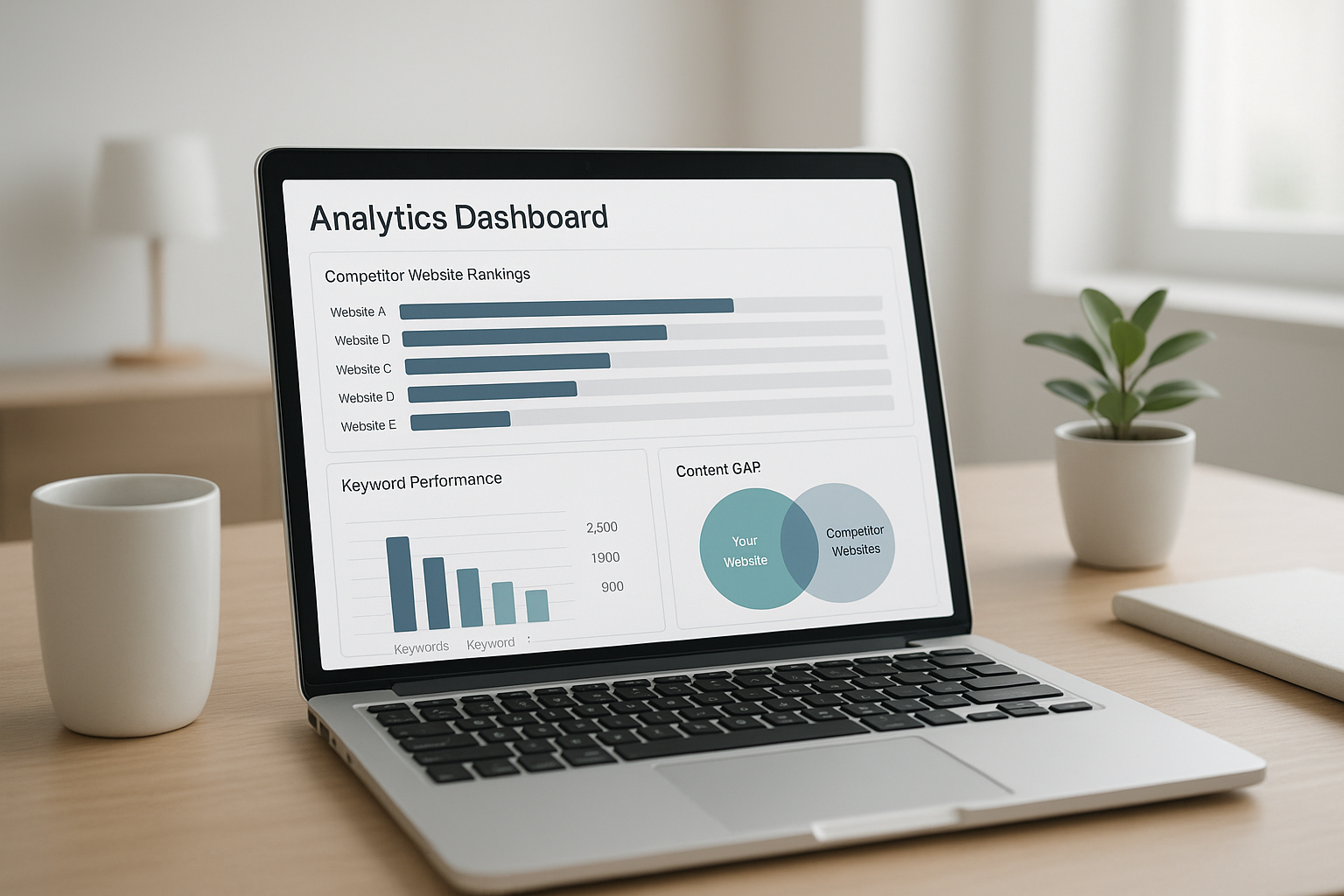
An automated dashboard illustrates how AI-powered competitive analysis surfaces ranking gaps at a glance.
Why Automated Competitive Intelligence Matters in 2025
Search itself has changed dramatically. According to Google Search Central, AI Overviews and generative summaries now influence a growing share of search sessions, which means ranking well in classic blue links is no longer enough. Therefore, businesses must also understand how competitors are being cited inside AI-generated answers.
Furthermore, competitive intelligence itself is not a new concept. As Wikipedia’s overview of competitive intelligence explains, businesses have studied rivals for decades. What has changed is the speed and scale at which this can now happen, thanks to automation.
For example, one industry benchmark suggests that companies using automated competitor monitoring identify new content opportunities up to five times faster than teams relying on manual audits. As a result, faster identification often translates into earlier ranking gains before competitors catch up. Similarly, teams that check AI-answer citations weekly report fewer surprises when a rival suddenly appears inside an AI Overview for a high-value query.
How AI Competitor Analysis Tools Actually Work
Most platforms combine web crawling, natural language processing (software that reads and interprets human text), and pattern recognition to study competitor pages at scale. Specifically, the software extracts ranking keywords, content structure, and backlink signals, then compares them against your own site.
In particular, many tools also monitor how often competitors get cited by AI answer engines like chatbots and voice assistants. This is where generative engine optimization, or GEO (optimizing content so AI models cite it directly), becomes relevant, since visibility inside AI-generated answers depends on different signals than classic search engine optimization.
If you want a deeper look at specific tools built for this purpose, this roundup of tools that find competitor content gaps breaks down feature differences worth comparing side by side.
Types of AI-Powered Competitive Analysis Tools
Before comparing individual products, it helps to understand the categories on the market. Broadly speaking, AI-powered competitive analysis tools fall into four groups, and most serious platforms blend at least two of them into a single dashboard.
| Category | What It Tracks | Best For |
|---|---|---|
| Keyword & content gap trackers | Ranking keywords, topic clusters, missing pages | Content teams building an editorial calendar |
| Backlink & authority monitors | Link velocity, referring domains, anchor text | Link builders and digital PR teams |
| AI answer-citation trackers | Mentions inside AI Overviews, chatbots, voice results | Brands chasing GEO and AEO visibility |
| All-in-one automation suites | Every signal above, plus technical SEO audits | Lean teams that want one dashboard, not five |
Point Solutions Versus All-in-One Suites
Point solutions excel at one job, such as backlink tracking, and often go deeper on that single metric. However, stitching together three or four separate tools creates data silos and extra costs. In contrast, all-in-one suites trade some specialization for convenience, which usually wins for smaller teams that need speed over depth in every category.
Step-by-Step: How to Conduct an AI-Powered Competitive Analysis
Building a repeatable process matters more than running a one-time audit. Below is a straightforward sequence you can follow, whether you are analyzing one competitor or an entire market.
- Identify target competitors. List three to five direct rivals ranking for your core keywords, then feed their domains into an AI competitive analysis tool for scanning.
- Run automated content and keyword scans. Let the platform crawl competitor pages to extract ranking keywords, content topics, and structural patterns across top-performing pages.
- Audit AI answer-engine citations. Check how often each competitor appears inside AI Overviews, chatbot responses, and voice assistant results for your priority search queries.
- Review the content gap report. Examine the generated report to find topics and keyword clusters competitors cover that your site currently lacks entirely.
- Prioritize opportunities by impact. Rank identified gaps by estimated search volume, competition difficulty, and relevance to your business before committing resources.
- Create or update content. Produce new pages or refresh existing content to address the prioritized gaps, making sure each piece answers the underlying intent directly.
- Monitor and repeat continuously. Schedule recurring scans so new gaps, ranking shifts, and AI citation changes get caught before competitors gain further ground.
For a closer look at specific tactics that pair well with this workflow, see these AI competitor analysis techniques built for 2025.
A structured workflow keeps AI-powered competitive analysis consistent instead of a one-time exercise.
Key Benefits of AI-Driven Competitor Insights
Speed is the most obvious advantage. Because automation removes manual data entry, teams can review dozens of competitor pages in the time it once took to check just one.
In addition, automated systems reduce blind spots. Human analysts naturally focus on obvious rivals, whereas AI tools can scan a much wider competitive set, surfacing threats and opportunities that would otherwise go unnoticed.
Similarly, ongoing monitoring means insights stay current. Instead of a static report that goes stale within weeks, continuous scanning keeps strategy aligned with what is actually happening in search results right now. Above all, this consistency is what separates a genuine AI-powered competitive analysis program from a one-off audit that gets forgotten in a shared drive.
AI-Powered Competitive Analysis vs. Manual Competitor Research
Because so many teams still rely on spreadsheets, it helps to see the two approaches side by side before choosing a path forward.
| Factor | Manual Research | AI-Powered Competitive Analysis |
|---|---|---|
| Time per competitor | Several hours per site | Minutes, run continuously |
| Competitive coverage | Limited to obvious rivals | Wide, including emerging threats |
| Update frequency | Quarterly at best | Weekly or continuous |
| AI answer-engine visibility | Rarely tracked | Tracked as standard practice |
| Risk of human bias | Higher | Lower, data-led |
Consequently, manual research still has a role for qualitative judgment, such as reading brand voice or sales messaging. However, for the data-heavy lifting, automated systems consistently outperform manual review on speed, scope, and consistency.
Choosing the Right AI Competitor Analysis Platform
Not every tool covers the same ground, so it helps to compare feature depth before committing. Some tools focus narrowly on keyword gaps, while others also track AI answer engine citations, backlinks, and technical SEO signals side by side.
For businesses that want the technical and strategic work automated end to end, platforms built around automated GEO and AEO, such as the 1-Click AI AutoPilot technology, are designed to remove much of the manual setup typically required. It combines keyword gap detection, AI answer-citation tracking, and automated content recommendations inside one dashboard, backed by a risk-free seven-day trial you can use to judge fit before paying for a longer commitment.
Before you commit to any paid plan, it is also worth running a quick, no-cost check on your own site. You can check your free Rank Authority Score to see where competitive gaps already exist, which makes it easier to judge whether a given AI-powered competitive analysis platform is solving a real problem for you.
If you manage multiple client sites, comparing several options side by side is worthwhile. These breakdowns of tools built for content gap discovery and alternative competitor analysis platforms can help narrow the decision.
Common Mistakes to Avoid With Competitive Analysis Automation
One frequent mistake is copying competitor topics word for word without adding original insight or data. Search engines and AI models both tend to favor content that offers something genuinely new, not a rehashed version of what already exists.
Another common error is ignoring technical factors. Page speed, structured data, and mobile usability all influence rankings, so a purely content-focused competitive review misses part of the picture. The National Institute of Standards and Technology’s AI resources offer useful context on how automated systems evaluate data, which applies broadly to how these tools weigh signals.
Finally, treating a competitive analysis as a one-time project rather than an ongoing habit tends to backfire. Because competitors update their content regularly, sporadic reviews leave gaps unnoticed for months at a time. Above all, remember that automation is a starting point, not a substitute for editorial judgment about what your audience actually needs.
Frequently Asked Questions About AI-Powered Competitive Analysis
What is AI-powered competitive analysis?
AI-powered competitive analysis is the use of machine learning and automation to study rivals’ content, rankings, and search visibility. It replaces manual spreadsheet research with continuous, data-driven monitoring.
How does AI competitive analysis differ from manual research?
Manual research relies on humans checking competitor sites periodically, which is slow and inconsistent. AI tools scan hundreds of data points continuously, surfacing changes within hours instead of weeks.
Why is competitive analysis important for AI search visibility?
AI search engines and answer engines reward content that fills gaps competitors miss. Understanding what rivals rank for helps you target underserved topics that AI models are likely to cite.
What data does AI-powered competitive analysis typically track?
Most platforms track keyword rankings, backlink profiles, content topics, and citation frequency in AI answer engines. Some also monitor schema markup and technical SEO signals.
How much does AI competitive analysis software cost?
Pricing varies widely, from free basic tools to enterprise platforms costing several hundred dollars monthly. Many providers offer a trial period so businesses can test results first.
Can small businesses benefit from AI-powered competitive analysis?
Yes, small businesses often benefit the most because automation removes the need for a dedicated research team. It levels the playing field against larger competitors with bigger budgets.
How long does it take to see results from competitive analysis insights?
Initial insights typically appear within days, but measurable ranking improvements usually take four to twelve weeks. Timelines depend on competition level and content update frequency.
What is a content gap analysis in this context?
A content gap analysis identifies topics competitors rank for that your site does not cover. AI tools automate this by comparing your content library against top-ranking competitor pages at scale.
What common mistakes should businesses avoid with automated analysis?
A common mistake is copying competitor topics without adding unique value. Another is ignoring technical signals like page speed and structured data, which AI tools also weigh heavily.
Does AI-powered competitive analysis work for AI Overviews and answer engines?
Yes, modern platforms specifically track citation patterns in AI Overviews, chatbots, and voice assistants. This supports generative engine optimization, not just traditional ranking positions.
How often should competitive analysis be updated?
Because search algorithms and competitor content change constantly, weekly or continuous automated monitoring is ideal. Quarterly manual reviews are no longer sufficient in fast-moving search environments.
What is the difference between competitor analysis and competitive intelligence?
Competitor analysis usually focuses narrowly on marketing and SEO metrics, while competitive intelligence is a broader discipline covering pricing and strategy. AI tools increasingly blend both.
Can AI competitive analysis tools integrate with existing SEO software?
Many platforms offer integrations or export options that connect with existing analytics dashboards. This allows teams to combine competitor insights with their own performance data in one place.
Is AI-powered competitive analysis reliable for making strategic decisions?
It is reliable as a directional guide when combined with human judgment about brand voice and goals. AI surfaces patterns quickly, but strategic context still requires marketer oversight.
Do I need technical skills to run an AI-powered competitive analysis?
No, most modern platforms are built for marketers rather than developers. You typically enter a domain, review a report, and act on prioritized recommendations without touching code.
Can AI-powered competitive analysis track more than one competitor at a time?
Yes, and this is one of its biggest advantages over manual work. Most platforms let you monitor an entire competitive set simultaneously, then rank findings by opportunity size.
Final Thoughts on AI-Driven Competitive Intelligence
Ultimately, AI-powered competitive analysis has moved from a nice-to-have research tactic to a core part of any serious search strategy. By automating the tedious parts of studying rivals, businesses can spend more time acting on insights and less time collecting them.
As AI search environments continue evolving, staying ahead means treating competitive research as an ongoing habit rather than a quarterly checkbox. For a broader set of comparisons, this list of additional tools that surface competitor content gaps is a reasonable next stop for teams ready to put these steps into practice. Author: Rank Authority. Last updated Aug 14, 2026.

