

Automated search ranking solutions have quickly become the backbone of modern SEO, replacing manual spreadsheets and guesswork with algorithms that watch your rankings around the clock. Instead of waiting weeks for a human audit, these platforms crawl your site, flag problems, and adjust strategy while you sleep. As a result, small teams can now compete with agencies that employ dozens of specialists. In this guide, we break down exactly what automated search ranking solutions are, how they work step by step, what separates the strong platforms from the weak ones, and how to avoid the mistakes that quietly waste budget. See our AI visibility audit for a focused rankings assessment.
Quick answer: Automated search ranking solutions are AI-driven platforms that continuously crawl, audit, optimize, and track a website’s performance across both traditional search engines and AI answer engines — cutting the manual workload that SEO has historically required.
What Are Automated Search Ranking Solutions?
At their core, automated search ranking solutions are software platforms that use artificial intelligence and rule-based automation to track, analyze, and improve where a website appears in search results — without requiring someone to manually check rankings every day. In practice, they merge several jobs that used to sit in separate spreadsheets: rank tracking, technical audits, content optimization, and reporting all run inside one continuous system.
For example, a platform might crawl your site overnight, notice a missing meta description, and generate a fix automatically. Meanwhile, another module tracks how your pages perform in Google’s results and in AI-generated answers from tools like ChatGPT or Google’s AI Overviews. Consequently, teams spend less time on repetitive checklist work and more time on decisions that actually require human judgment.
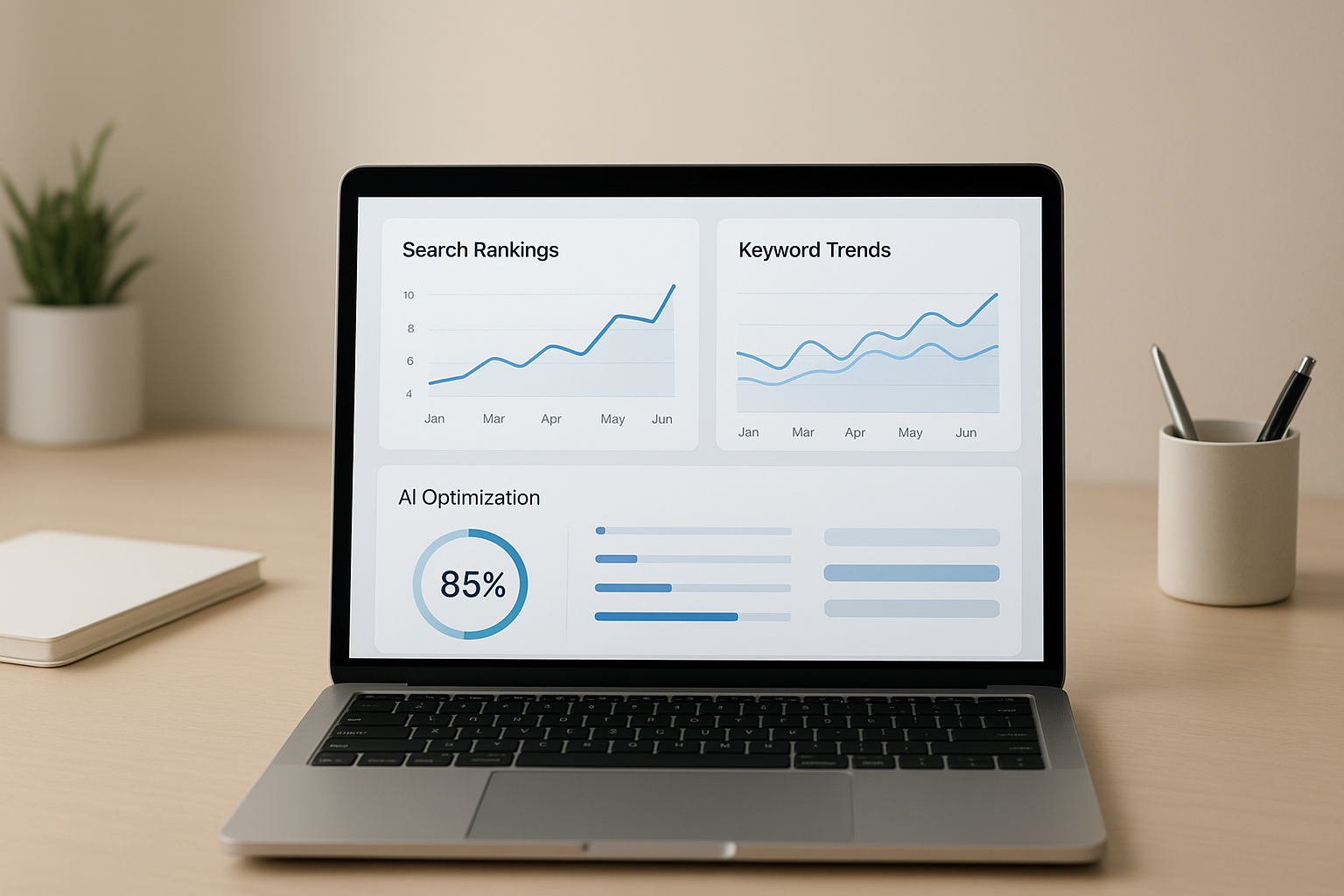
Automated search ranking solutions consolidate rank tracking, audits, and optimization into one dashboard.
Why Automated Search Ranking Solutions Matter More Than Ever
Search engines update their algorithms hundreds of times a year, and AI answer engines add yet another moving target. Because of this, keeping pace manually has become nearly impossible, even for experienced marketers working full time. Automated ranking tools solve the problem by monitoring change continuously rather than through periodic manual reviews.
According to industry data compiled by BrightEdge, organic search still drives over half of all trackable website traffic, which is exactly why consistent visibility matters so much. In addition, most small businesses simply lack the budget for a full in-house SEO team, so automation closes that gap by handling routine, data-heavy work at scale. Google itself confirms that ranking systems evaluate hundreds of signals simultaneously, as explained in Google Search Central’s ranking systems guide — a scale of complexity that is genuinely hard to track by hand. For a deeper breakdown of available platforms, this complete guide to automated search ranking tools covers additional comparisons, and our 2025 guide to AI-driven search engine ranking explains where the category is headed next.
How Automated Search Ranking Solutions Work
Most automated search optimization platforms follow a similar sequence, even though the underlying technology differs from vendor to vendor. Understanding this sequence explains why automation consistently outperforms manual processes for repetitive, data-heavy tasks.
- Crawl and audit the website: The platform scans every page for technical issues such as broken links, slow load times, and missing metadata that could be limiting search visibility.
- Map keywords and search intent: AI algorithms analyze search queries and competitor content to identify which keywords and topics have the strongest ranking potential for the site.
- Apply AI-driven optimizations: The system generates or adjusts content, headings, schema markup (structured code that helps search engines understand a page), and internal links automatically.
- Monitor rankings continuously: Automated rank tracking checks keyword positions daily across devices and locations, flagging sudden drops or algorithm-related changes as they happen.
- Refine strategy based on data: The platform reviews performance trends and automatically fine-tunes future optimizations, reducing the need for manual analysis over time.
Notably, this cycle repeats continuously instead of happening once and stopping. Therefore, sites are always being adjusted based on current ranking signals rather than outdated snapshots. Tools like rank tracking automation are typically the layer that keeps this loop running quietly in the background.
The Technology Behind Automated Rank Tracking
Behind the scenes, most platforms rely on a mix of search engine APIs (application programming interfaces, which let software request live data automatically) and simulated search queries run from real device and location profiles. This matters because a keyword might rank on page one in New York but fall to page three in Dallas, and a static manual check would never catch that gap. In contrast, automated systems run these checks daily, or even hourly, across desktop, mobile, and local map results simultaneously.
Similarly, accuracy depends on how often a platform refreshes its data and how many geographic points it samples from. Above all, look for providers that disclose their tracking methodology openly, since vague claims about “real-time” accuracy are often marketing shorthand rather than a technical guarantee.
Key Features of Effective Automated SEO Solutions
Not all platforms are built the same way, so it helps to know which capabilities actually move the needle rather than just look impressive in a demo. In particular, look for features that address both classic search engines and newer AI-driven answer engines at the same time. For a deep technical checklist, see our AI visibility audit.
- Real-time rank tracking across desktop, mobile, and local search results, refreshed daily rather than weekly.
- Automated technical audits that flag and fix crawl errors, broken schema, duplicate content, and slow-loading pages.
- AI content recommendations that align with search intent and the formatting AI answer engines prefer.
- Automated backlink monitoring that tracks link gains, losses, and toxic links without manual spreadsheet exports.
- GEO and AEO support for visibility inside AI Overviews, chatbot answers, and voice search results.
- White-label, multi-site dashboards for agencies or businesses managing several properties under one login.
For a side-by-side look at platforms offering these capabilities, this comparison of top search engine ranking software is a useful next step. Likewise, businesses exploring next-generation tactics may benefit from reviewing smarter automated SEO strategies built around AI, and our guide to smart SEO solutions for AI-powered rankings goes further into feature-by-feature evaluation.

Teams of any size can use automated ranking tools to review performance without deep technical expertise.
Automated Search Ranking Solutions vs. Traditional SEO Tools
Traditional SEO tools typically require someone to log in, pull a report, and manually decide what to fix. In contrast, automated search ranking solutions close that loop automatically: they detect an issue, apply or suggest a fix, and re-check the result without waiting for a person to schedule the next audit. For a broader view of AI-driven platform strategy, read the Rank AI guide.
- Speed: Traditional tools report data; automated platforms act on it the same day.
- Consistency: Automation applies the same standard every time, whereas manual audits vary by analyst.
- Scale: One automated platform can monitor hundreds of pages or client sites simultaneously.
- Strategy: Traditional tools still win for creative positioning, brand voice, and big-picture campaign planning.
Therefore, the strongest results usually come from combining both: automation for the repetitive, data-heavy work, and human strategy for the decisions that require judgment and brand context.
GEO and AEO: How Automated Search Ranking Solutions Handle AI Search
Generative engine optimization, or GEO (optimizing content so AI tools cite it directly), and answer engine optimization, or AEO (structuring content to be pulled into direct answers), are now core parts of what automated search ranking solutions must handle. Specifically, this means formatting content with clear headings, direct answers near the top, and structured data that AI systems can parse easily.
In particular, platforms that only track classic blue-link rankings are already behind, since a growing share of searches now resolve inside an AI Overview or chatbot response with no traditional click at all. Our platform for search authority built to dominate AI search and the 2025 guide to AI-driven search engine ranking both dig deeper into this shift for teams planning their next SEO roadmap.
Choosing the Right Automated Search Ranking Solution for Your Business
Choosing an automated search ranking solution comes down to matching platform capabilities to your specific goals. For instance, an agency managing dozens of client sites needs different reporting tools than a solo entrepreneur running one storefront. Consider Instant SEO solutions when your priority is speed and rapid iteration.
Above all, prioritize platforms that combine traditional SEO with GEO and AEO capabilities, since AI-driven search is no longer optional to plan for. RankAuthority’s own AI AutoPilot SEO service is one example built specifically to automate this technical and strategic workload, offering a seven-day risk-free trial for businesses that want to test results firsthand. You can learn more directly at rankauthority.com before committing to a plan.
In addition, always check whether a platform provides transparent reporting, since automation should make performance easier to understand, not harder. According to guidance from the Federal Trade Commission, businesses should also be cautious of tools that make unverifiable ranking guarantees. For general SEO fundamentals, the Wikipedia overview of search engine optimization is a helpful primer, while Moz’s SEO learning center offers additional industry context. If you want a broader look at how automation fits into a full visibility strategy, see our breakdown of how automated tools boost online visibility.
Automated SEO Platform Pricing: What to Expect
Pricing for automated search ranking solutions varies widely depending on scope. Basic rank trackers often start around $30 per month, while full automation suites with technical audits, GEO and AEO optimization, and multi-site dashboards can run several hundred dollars per month. Consequently, it pays to map pricing tiers against your actual needs rather than choosing the platform with the longest feature list.
- Entry-level plans: Rank tracking and basic audits, suited to a single website.
- Mid-tier plans: Add content optimization, competitor tracking, and backlink monitoring.
- Agency-tier plans: Add white-label reporting, multi-site dashboards, and GEO/AEO modules.
Many providers, including RankAuthority, offer a risk-free trial period, which is the simplest way to confirm a platform’s reporting matches how your team actually works before signing an annual contract. For an in-depth look at AI-first approaches, see our Rank AI guide.
Common Mistakes to Avoid With Automated Ranking Software
Even the best automated ranking software works better with a bit of oversight. Specifically, avoid running multiple overlapping automation tools at once, since conflicting changes can confuse search engines rather than help them.
Likewise, don’t ignore the reports these platforms generate. Instead, review them periodically so automated changes still reflect your brand voice and business goals. Finally, set realistic expectations, since most automated search ranking solutions show measurable results within 60 to 90 days rather than overnight.
How Automated Tools Boost Online Visibility Beyond Rankings
Rankings are only one piece of visibility. In addition to keyword position, strong platforms also track click-through rate, featured snippet ownership, and appearances inside AI-generated answers, since a page can rank well yet still receive few clicks if its snippet is weak. As a result, automated reporting increasingly measures the full visibility picture rather than a single ranking number.
For a fuller explanation of how these signals connect, see our detailed piece on how automated tools boost online visibility, which covers the metrics worth watching beyond rank position alone.
Frequently Asked Questions About Automated Search Ranking Solutions
What are automated search ranking solutions?
Automated search ranking solutions are software platforms that use AI and automation to track, analyze, and improve a website’s position in search results without constant manual work. They typically combine rank tracking, content optimization, and technical SEO fixes into one continuous system.
How do automated search ranking solutions work?
They work by crawling your website, analyzing competitor data, and applying AI-driven recommendations or fixes automatically. Most platforms then monitor ranking changes daily and adjust strategies as search algorithms evolve.
Are automated ranking tools better than manual SEO?
Automated tools are generally faster and more consistent for repetitive tasks like rank tracking and technical audits, while manual SEO still adds value for creative strategy. Most businesses get the best results by combining both approaches.
How much do automated SEO platforms cost?
Pricing varies widely, from around $30 per month for basic rank trackers to several hundred dollars per month for full automation suites. Many providers, including RankAuthority, offer a risk-free trial period before committing to a paid plan.
How long does it take to see results from automated ranking tools?
Most businesses notice measurable ranking improvements within 60 to 90 days, though timelines depend on competition and site history. Technical fixes often show impact faster than content-based changes.
Can automated search ranking solutions help with AI search and answer engines?
Yes, many modern platforms now optimize for generative engine optimization (GEO) and answer engine optimization (AEO) alongside traditional SEO. This means content is structured to appear in AI Overviews, chatbots, and voice search results.
What is the difference between GEO, AEO, and traditional SEO?
Traditional SEO focuses on ranking in classic search engine results pages, while GEO and AEO focus on being cited by AI systems like chatbots and answer engines. Automated search ranking solutions increasingly address all three at once.
Do automated ranking tools replace the need for content strategy?
No, automation handles technical execution and monitoring, but human oversight still guides brand voice, positioning, and long-term strategy. The strongest results come from pairing automation with clear content goals.
What common mistakes should businesses avoid when using automated SEO tools?
Common mistakes include ignoring reports, setting unrealistic timelines, and applying automated changes without reviewing them for brand accuracy. It also helps to avoid running multiple overlapping tools that send conflicting signals.
Are automated search ranking solutions suitable for small businesses?
Yes, automated platforms are especially useful for small businesses that lack an in-house SEO team, since they reduce the time and expertise needed to compete online. Many tools scale pricing based on business size and site count.
Can agencies use automated ranking software for multiple clients?
Absolutely, most automated ranking platforms include multi-site dashboards designed for agencies managing several client properties at once. This centralizes reporting and reduces the manual workload per account.
What features should I look for in an automated SEO tool?
Look for real-time rank tracking, technical audit automation, AI content optimization, and reporting dashboards. Support for GEO and AEO optimization is increasingly important as AI search grows.
Is a free trial available for automated ranking platforms?
Many providers offer trial periods so businesses can test results before paying, and RankAuthority specifically offers a seven-day risk-free trial. This allows teams to evaluate performance without long-term commitment.
How do automated tools track keyword rankings?
Automated tools use crawlers and search engine APIs to check keyword positions across locations and devices on a scheduled basis. This data is then compiled into trend reports so teams can spot gains or losses quickly.
Do automated search ranking solutions monitor backlinks automatically?
Yes, most full-featured platforms track new and lost backlinks automatically, flag potentially toxic links, and alert teams to sudden authority changes without manual export work.
Can automated search ranking solutions integrate with Google Analytics and Search Console?
Most established platforms support direct integrations with Google Analytics and Search Console, pulling traffic and indexing data into the same dashboard as rank tracking for a single unified view.
Final Thoughts
In summary, automated search ranking solutions give businesses a practical way to keep up with both traditional search engines and rapidly evolving AI answer engines. By handling audits, optimization, and monitoring continuously, they free up time that would otherwise go toward manual, repetitive SEO work.
Ultimately, the right automated search ranking solution should fit your business size, goals, and technical comfort level. Whether you’re managing one website or several client properties, exploring options like RankAuthority’s platform is a reasonable next step toward stronger, more consistent search visibility. Last updated: 2026-08-14. Author: RankAuthority Editorial Team. Last updated: 2026-07-30. Author: RankAuthority Editorial Team.

