

AISO — short for AI Search Optimization — is the practice of structuring, writing, and marking up content so that AI-powered search engines and answer engines can understand it, trust it, and cite it directly in their responses. See What is AISEO for a deeper definition. As AI-driven tools such as Google’s AI Overviews, ChatGPT, and Perplexity fundamentally reshape how people discover information, AISO has quickly become one of the most important disciplines in modern digital marketing.
In fact, according to a 2024 report by SparkToro, over 58% of Google searches now end without a click — a trend accelerated directly by AI-generated answer boxes. As a result, understanding and applying AI search optimization is no longer optional for content creators, marketers, or business owners who depend on organic visibility. This guide covers everything the competing resources leave out, including how AI models actually retrieve content, a complete step-by-step framework, measurement strategies, industry examples, and the mistakes that quietly kill AI visibility.
What Is AISO? A Complete Definition
AISO is the evolution of traditional search engine optimization adapted for the age of generative AI. Specifically, it refers to the techniques that help content get cited, summarized, or featured by AI-driven engines rather than simply ranked in a list of blue links.
Traditional SEO targets keyword-ranking signals understood by crawlers. AISO, however, targets the semantic understanding layers that large language models (LLMs) — the AI systems behind these engines — use to evaluate, retrieve, and repeat content. In other words, AISO asks a fundamentally different question than classic SEO.
AISO in One Sentence
AISO means writing and structuring content so an AI engine will trust it, understand it instantly, and quote it directly — instead of merely ranking it on a results page. That single distinction is why AISO now sits at the center of every serious digital marketing strategy.

AISO bridges the gap between traditional search ranking and AI-powered answer retrieval.
Why AI Search Optimization Matters Right Now
The shift toward AI-powered search is accelerating faster than most marketers expected. Google’s AI Overviews now appear for a wide range of queries, while tools like Perplexity and ChatGPT’s browsing mode attract millions of users who bypass traditional search entirely. Consequently, businesses that ignore AISO risk losing significant organic traffic even if their traditional rankings remain strong.
Moreover, early adopters of AI search optimization hold a meaningful competitive advantage. Since most websites have not yet adapted their content strategies for AI retrieval, well-optimized pages can capture prominent placement in AI answers with far less effort than competing for the top three traditional organic positions. Above all, this window of opportunity will not stay open indefinitely — as more competitors adopt AISO, the advantage of being early will shrink.
Notably, research from the Pew Research Center on evolving digital information habits confirms that users increasingly expect direct, synthesized answers rather than a list of links to click through. This behavioral shift is precisely what makes AISO so urgent for brands, publishers, and small businesses alike.
How AI Search Engines Actually Evaluate Content
Unlike classic crawlers, AI search engines do not simply match keywords to pages. Instead, they evaluate content holistically — assessing clarity, structure, authority, and relevance before deciding whether to quote it. Therefore, content that is vague, poorly organized, or lacking credible sources is far less likely to ever appear in an AI-generated answer.
Large Language Models and Retrieval-Augmented Generation (RAG)
Most modern AI answer engines rely on a technique called Retrieval-Augmented Generation — a plain-language term for a process where the AI first retrieves relevant documents from an index, then generates a written answer grounded in that retrieved text. In particular, this means your content is competing to become one of the small handful of passages the model actually reads before it writes its answer. If your page is not retrieved, it is never cited — no matter how well it once ranked.
Vector Embeddings and Semantic Matching
To decide what to retrieve, AI systems convert text into vector embeddings — numerical representations of meaning that let a machine compare how closely two pieces of text relate to each other, even if they use completely different words. See AISEO AI for technical examples and strategy. As a result, a page that clearly and explicitly defines its topic will match a much wider range of related queries than a page that relies on implied context or clever phrasing.
In practice, AI engines rely on six primary signals when evaluating whether to feature a piece of content:
- Semantic clarity: Does the content define its topic explicitly and early, ideally in the first sentence?
- Structural hierarchy: Are headings, lists, and paragraphs logically organized so a machine can parse them?
- Authority signals: Does the page cite credible sources and demonstrate genuine expertise?
- Structured data: Is Schema.org markup present to help machines parse the content’s type and meaning?
- Content freshness: Has the page been updated recently with accurate, current information?
- Conversational alignment: Does the content match the natural, question-based phrasing people use with AI chat tools?
Furthermore, AI engines increasingly favor content that follows E-E-A-T principles — Experience, Expertise, Authoritativeness, and Trustworthiness — a framework originally developed by Google for human quality raters but now deeply embedded in algorithmic evaluation across nearly every major AI search system.
AISO vs. Traditional SEO, GEO, and AEO: Key Differences
It is important to understand that AISO does not replace traditional SEO — rather, it extends it. Many foundational SEO practices, such as quality content, fast page speed, and mobile-friendliness, still matter enormously. However, AISO adds an entirely new layer of requirements on top of them.
| Discipline | Primary Goal | Where It Wins |
|---|---|---|
| Traditional SEO | Rank in keyword-based results | Blue-link listings, backlinks, CTR |
| AISO | Get understood and cited by AI models | AI Overviews, chat answers, semantic clarity |
| GEO (Generative Engine Optimization) | Be cited inside generated AI content | ChatGPT, Gemini, generative summaries |
| AEO (Answer Engine Optimization) | Win featured snippets and voice answers | Voice assistants, snippet boxes |
For example, a page optimized purely for traditional SEO might rank on page one but never appear in an AI-generated summary. In contrast, a page built around AISO principles may be cited directly in an AI response even without holding the top organic position. Together, AISO, GEO, and AEO form a comprehensive strategy for modern search visibility, with AISO functioning as the broader umbrella term.
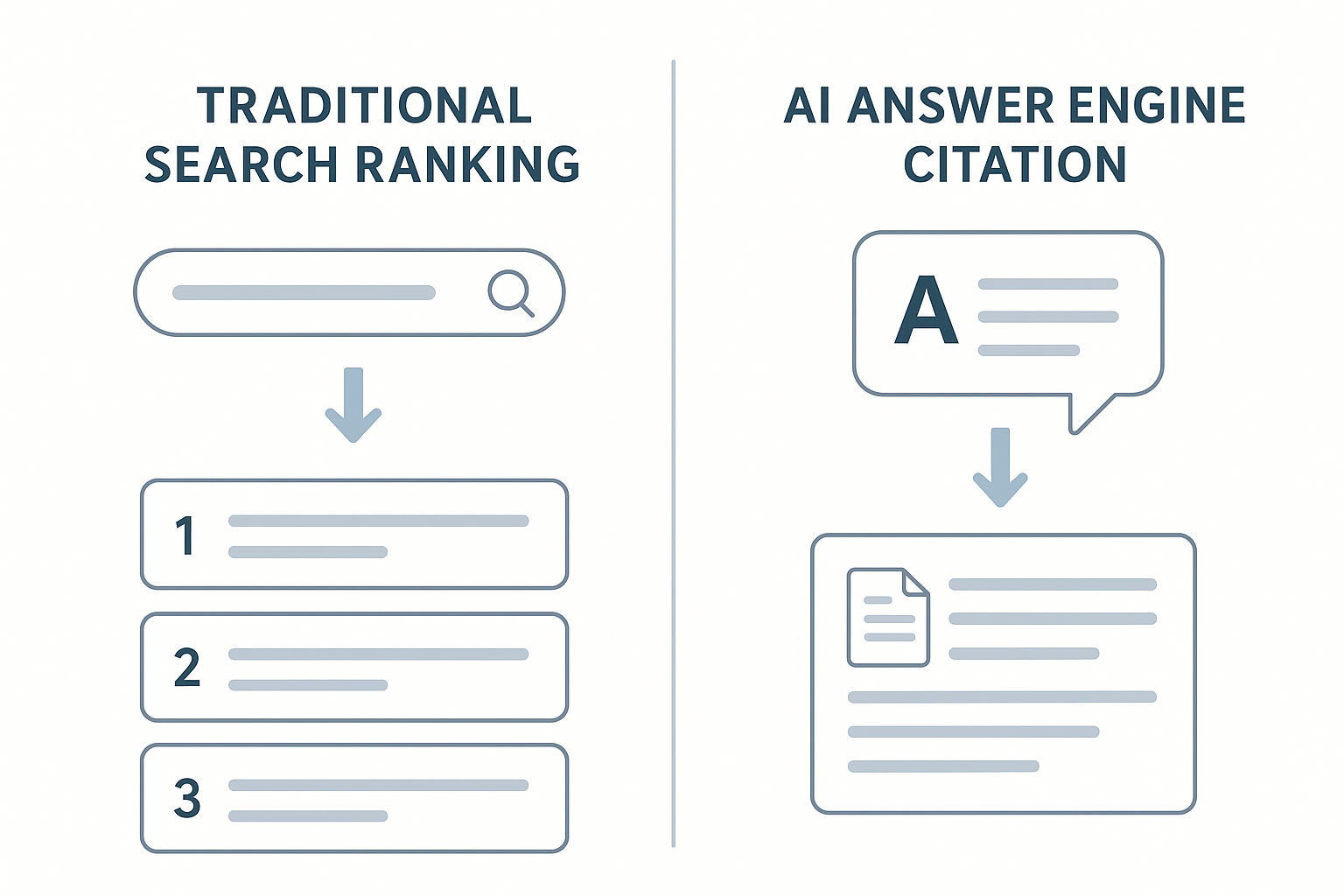
Understanding how AISO differs from traditional SEO clarifies exactly where to invest your optimization effort.
How to Optimize Your Content for AISO: A 7-Step Framework
Implementing AISO does not require starting from scratch. Instead, it involves systematically improving existing content—see What is AISEO—while applying best practices to everything new. Follow these seven steps in order to build a complete AI search optimization foundation.
- Define your topic clearly. Begin every page with an explicit definition of the main subject in the very first sentence, so AI engines can identify the topic immediately without guessing.
- Add structured data markup. Implement Schema.org JSON-LD for Article, FAQPage, and HowTo types, since this markup acts as a machine-readable layer that AI engines parse directly to understand structure and purpose.
- Write direct answer blocks. After every question-based heading, provide a concise one-to-three sentence answer before elaborating further, because AI engines extract these precise answers to build their responses.
- Build E-E-A-T signals. Cite authoritative sources, reference data points with clear attribution, and demonstrate expertise through depth and accuracy throughout the page.
- Create a comprehensive FAQ section. Include at least ten to fourteen unique questions with direct answers, since AI engines frequently pull from FAQ content when generating conversational responses.
- Format content for multiple retrieval types. Use tables, numbered steps, and bulleted definitions throughout the page, because varied formats increase the chance any given passage matches a retrieval query.
- Track citations and refresh regularly. Monitor when AI tools quote your brand, then update the page every few months, since AI engines consistently prefer fresh, accurate information over stale content.
How to Measure AISO Performance and Track Results
Unlike traditional rank tracking, measuring AI search optimization success requires a different set of key performance indicators. Specifically, you should watch four metrics on an ongoing basis: AI citation frequency, brand mention share of voice inside AI answers, referral traffic from AI platforms, and structured data validity.
For structured data validation specifically, the MDN Web Docs guide to JSON-LD is an excellent technical reference for confirming your markup is valid before publishing. Similarly, Google Search Console remains useful for tracking impressions tied to AI Overview appearances, while dedicated platforms such as Rank Authority can help track AI citation rates alongside traditional rankings for a fuller performance picture.

Tracking AI search tools citation rates alongside traditional rankings gives a clearer picture of your AISO performance.
Real-World AISO Use Cases Across Industries
AI search optimization applies differently depending on the industry. Below are practical examples of how AISO plays out across common business types: For a comprehensive framework, see AISEO complete guide.
- E-commerce: Product pages with clear specifications, comparison tables, and FAQ blocks get pulled into AI shopping summaries far more often than pages relying only on marketing copy.
- SaaS companies: Documentation-style content that directly defines features and use cases performs especially well, since AI tools frequently answer “how do I…” queries using this format.
- Local businesses: Clear, specific answers to niche questions let small businesses compete effectively, because AI engines often surface narrow, highly relevant answers over generic authority pages.
- Publishers and media: Well-sourced, regularly updated explainer content with strong E-E-A-T signals becomes a preferred citation source for breaking or evolving topics.
Common AISO Mistakes That Kill Your AI Visibility
Even well-intentioned content teams frequently sabotage their own AI search optimization results. Watch for these recurring mistakes:
- Vague opening paragraphs that bury the definition of the topic instead of stating it immediately.
- Missing or invalid structured data, which prevents AI systems from confidently parsing page type and intent.
- Ignoring E-E-A-T signals by failing to cite sources or attribute data and statistics.
- Letting content go stale, since outdated pages are deprioritized even if they once performed well.
- Writing only for keywords instead of writing for the actual conversational questions people ask AI assistants.
The Future of AISO: What’s Next for AI-Driven Search
Looking ahead, AI search optimization will likely expand beyond text into multimodal formats, meaning AI engines will increasingly evaluate images, video transcripts, and structured product data with the same scrutiny they apply to written copy today. In addition, personalization will play a larger role, as AI assistants tailor cited sources to a user’s history and preferences rather than serving identical answers to everyone.
Ultimately, the businesses that treat AISO as a core discipline — rather than a passing trend — will build a durable advantage as AI-driven discovery becomes the default way people find information online.
Frequently Asked Questions About AISO
What does AISO stand for?
AISO stands for AI Search Optimization. It refers to the practice of structuring and writing content so AI-powered search engines and answer engines can easily understand, index, and surface it in their responses.
How is AISO different from traditional SEO?
Traditional SEO focuses on ranking in keyword-based search results, while AISO focuses on being cited or featured by AI-driven engines like ChatGPT, Perplexity, and Google’s AI Overviews. AISO prioritizes clear answers, structured data, and authoritative sourcing over keyword density alone.
Why is AI search optimization important for my website?
AI search optimization matters because AI-powered engines are rapidly changing how users find information. Without it, your content may lose visibility even if it ranks well in traditional search results.
What are the key elements of an effective AISO strategy?
Key elements include clear definitions, structured data markup, concise direct answers, authoritative citations, comprehensive FAQ sections, and a logical content hierarchy built with proper heading tags.
Does AISO replace traditional SEO?
No, AISO does not replace traditional SEO. Instead, it extends and complements it, since pages that perform well in both traditional and AI search generally share the same foundational practices, such as quality content and technical accuracy.
How do AI search engines decide what content to feature?
AI search engines evaluate content based on relevance, clarity, authority, and structure. They favor content that directly answers questions, uses proper semantic markup, and is corroborated by other reputable sources.
What role does structured data play in AISO?
Structured data, such as Schema.org JSON-LD markup, helps AI engines understand the context and meaning of content. It signals what type of content exists on a page, making it easier for AI to extract and surface accurate answers.
How long does it take to see results from AISO?
Results vary, but many sites begin to see improvements in AI citation frequency within four to twelve weeks of implementing structured content and schema markup. Consistency and content quality remain the key factors.
What common mistakes should I avoid with AI search optimization?
Common mistakes include writing vague answers, neglecting schema markup, ignoring E-E-A-T signals, and failing to update content regularly. AI engines consistently prefer fresh, accurate, and well-sourced information.
Can small businesses benefit from AISO?
Absolutely. Small businesses can gain significant visibility through AISO by creating clear, authoritative content that directly answers their customers’ questions, since AI engines often surface niche, specific answers where smaller sites compete effectively against larger brands.
What tools can help track AISO performance?
Tools such as Google Search Console, structured data validators, and specialized platforms like Rank Authority can help monitor and improve AISO performance by tracking AI citation rates alongside traditional rankings.
Is AISO the same as GEO or AEO?
AISO, GEO (Generative Engine Optimization), and AEO (Answer Engine Optimization) are closely related terms that all describe optimizing for AI-driven search. AISO is generally used as the broader umbrella term encompassing both GEO and AEO strategies.
What is retrieval-augmented generation and why does it matter for AISO?
Retrieval-augmented generation, or RAG, is the process AI models use to pull relevant passages from an index before writing an answer. It matters for AISO because your content must be retrievable and clearly written to be selected as source material in the first place.
How does content freshness affect AISO rankings?
Content freshness directly affects how often AI engines choose to cite a page, since these systems consistently prioritize recently verified, accurate information over older pages that may contain outdated statistics or guidance.
Conclusion: Embracing AISO for Future-Proof Visibility
AISO represents one of the most significant shifts in digital marketing since the rise of mobile search. By optimizing content for AI-powered search engines — through clear definitions, structured data, direct answer blocks, and strong authority signals — you position your website to be cited, featured, and trusted by the AI tools millions of people now rely on daily. Furthermore, the businesses that act now will build a durable competitive advantage as AI search continues to grow. To go deeper on related tactics, explore our blog for more digital marketing insights, review additional guides on AI-driven content strategy, or visit our homepage to see how we can help. Start applying AISO principles today, and make sure your content is ready for the next era of search. Last updated: 2026-07-30. Author: Rank Authority editorial team.

