

An automated content strategy is the practice of using AI-driven software to plan, produce, and optimize content at scale so that a website consistently ranks in both traditional search engines and next-generation AI answer engines. Instead of manually researching keywords and formatting every page, teams rely on automation to handle the repetitive work while humans focus on judgment, tone, and quality control. As a result, businesses can publish more, faster, without sacrificing accuracy or relevance.
Direct answer: An automated content strategy uses AI tools to handle keyword research, drafting, on-page optimization, and internal linking, allowing websites to publish consistent, search-optimized content without a large manual workload.
In particular, this approach has become essential as search behavior shifts toward AI-generated answers. According to a 2024 industry survey referenced by Search Engine Land, over 60% of marketers reported increasing their reliance on automation tools to keep pace with AI search demands. Therefore, understanding how automation fits into a broader content plan is no longer optional for competitive brands.
What Is an Automated Content Strategy?
An automated content strategy is a repeatable system where software handles the technical and analytical tasks of content production, such as identifying keyword gaps, drafting outlines, and applying on-page SEO signals. Consequently, marketers spend less time on manual research and more time refining messaging and brand voice.
Unlike fully manual workflows, automation platforms continuously scan search results, competitor pages, and AI answer engines to detect changes in ranking factors. As a result, content stays aligned with current algorithms instead of becoming outdated within a few months.
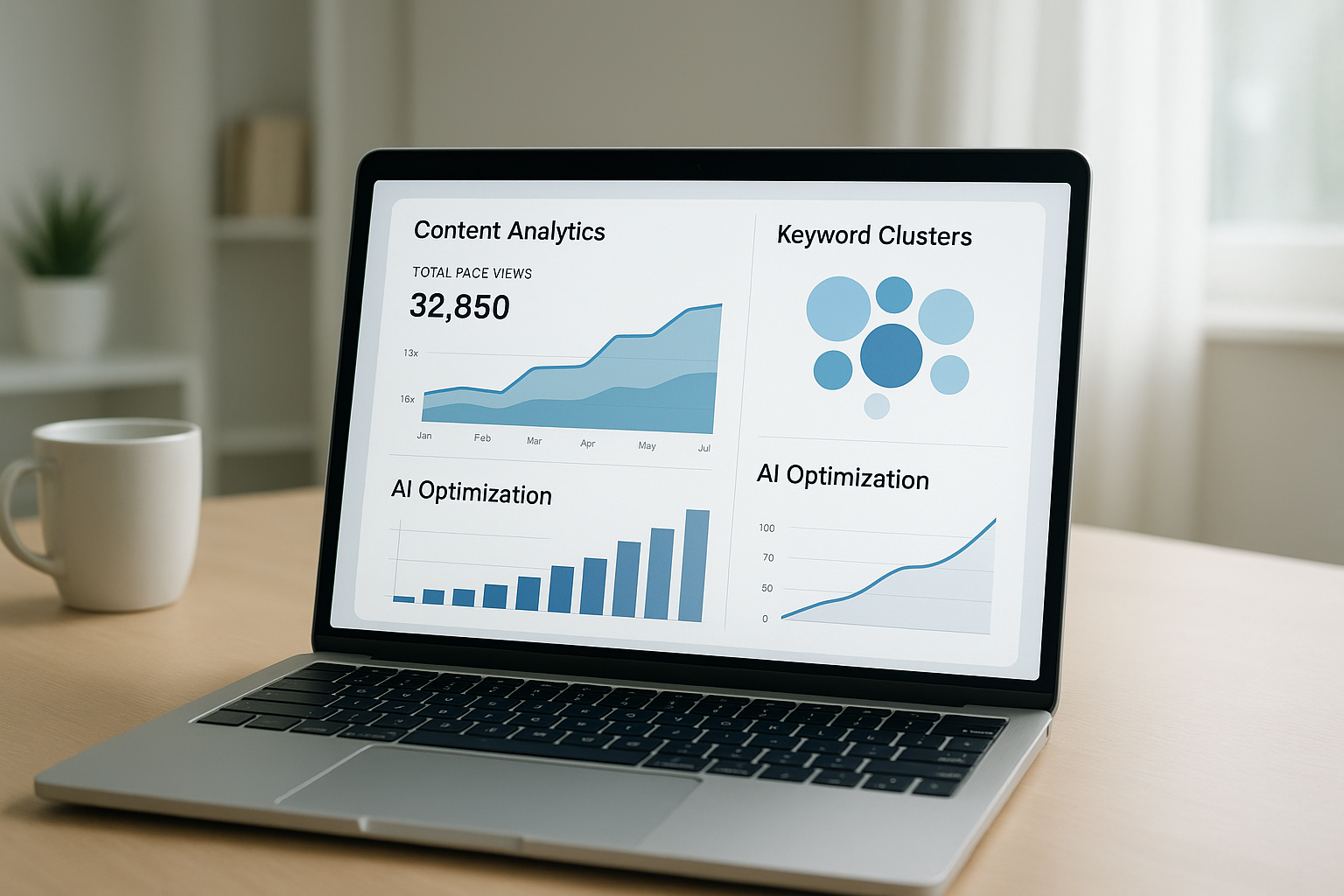
A modern dashboard illustrates how an automated content strategy tracks keyword performance in real time.
Why Businesses Are Shifting Toward Content Automation
Search visibility today depends on more than ranking on page one of Google. In addition, AI tools like chatbots and generative search summaries now pull answers directly from well-structured web content. As a result, brands that fail to adapt their publishing process risk losing visibility across multiple channels at once.
For example, small business owners and agencies managing several client sites often lack the bandwidth to manually optimize every page for both Google and AI answer engines. However, automation closes that gap by applying consistent optimization rules across an entire content library, regardless of team size.
Furthermore, platforms such as RankAuthority use features like 1-Click AI AutoPilot to automate the technical work of Generative Engine Optimization (GEO), which is the practice of optimizing content so AI systems cite it in generated answers, and Answer Engine Optimization (AEO), which focuses on earning placement in direct answer boxes.
How Does AI-Powered Content Automation Actually Work?
AI-powered content automation works by combining natural language processing with real-time search data to generate structured, optimized drafts. Specifically, the system analyzes top-ranking pages, extracts common patterns, and applies those patterns to new content while checking for originality and factual accuracy.
Similarly, many platforms integrate internal linking suggestions, schema markup generation, and readability scoring directly into the workflow. This means a single tool can handle tasks that once required separate specialists in SEO, copywriting, and technical markup.
Building an Automated Content Strategy Step by Step
Setting up a reliable system requires more than switching on a tool. Instead, it involves a structured process that balances automation with editorial oversight.
- Audit existing content: Review current pages to identify outdated information and missing topics before introducing automation.
- Select the right platform: Choose software that supports both traditional SEO and AI search optimization, such as the tools outlined in this complete guide to AI content strategy tools.
- Define topic clusters: Organize keywords into related groups and set a realistic publishing cadence.
- Automate drafting and optimization: Allow the platform to generate structured drafts, insert internal links, and apply on-page SEO signals automatically.
- Review and monitor performance: Add human review for tone and accuracy, then track rankings and AI citations to refine the strategy over time.
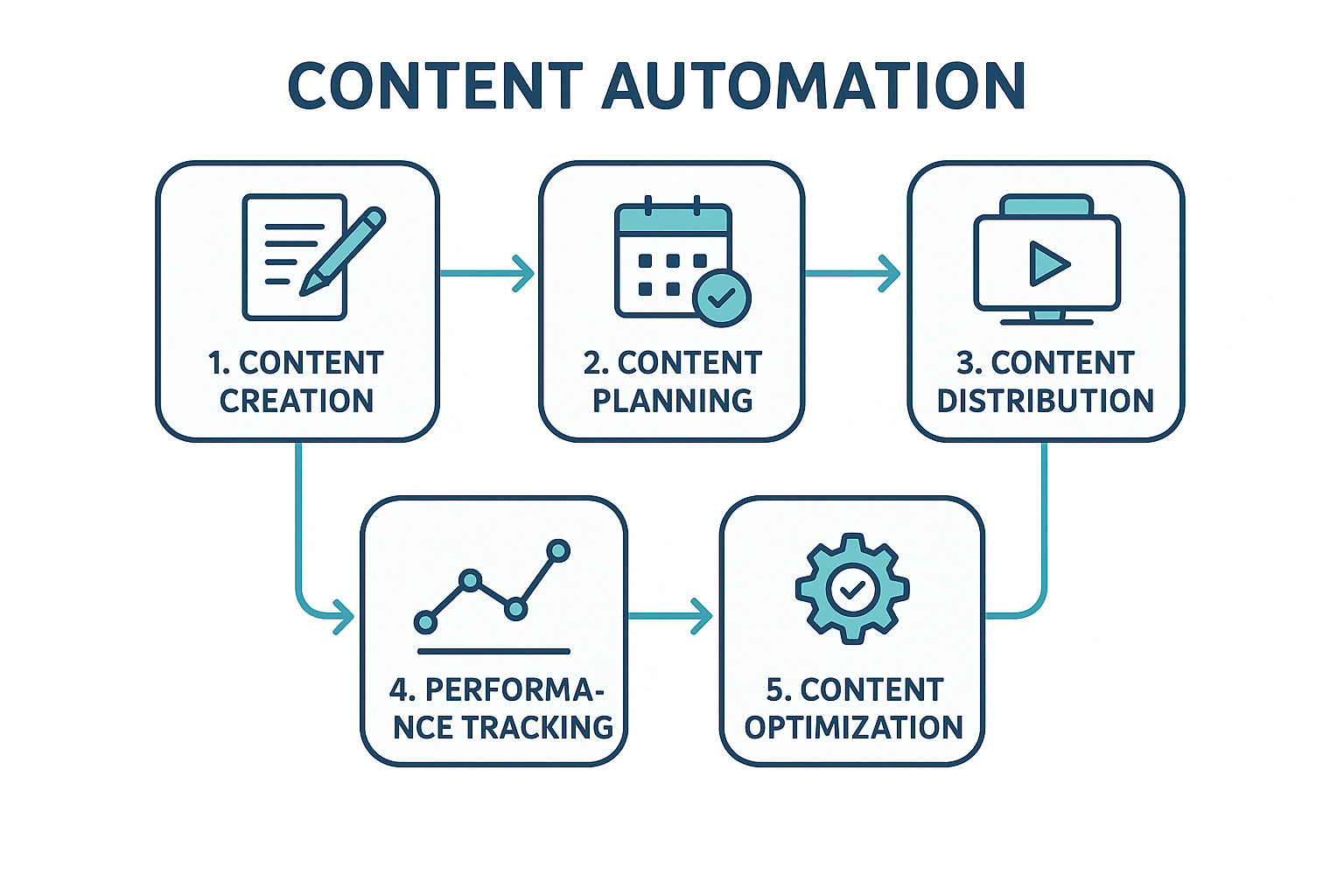
Each stage of the workflow builds toward a fully functioning automated content strategy.
Automated Content Strategy vs. Manual Content Planning
Manual content planning still has value, particularly for highly specialized or creative projects. Nevertheless, it struggles to scale when a business needs to publish dozens of optimized pages each month across multiple search environments.
In contrast, automated systems can process large volumes of data instantly, spotting keyword opportunities that a human researcher might miss. As a result, teams that combine automation with strategic oversight typically outperform those relying entirely on manual workflows, according to trends discussed in this guide to AI automated content creation.
Common Mistakes to Avoid With Content Automation Tools
Even well-designed automation can backfire without proper guardrails. For instance, publishing AI-generated drafts without human review often leads to factual errors or inconsistent brand voice.
Additionally, some businesses automate publishing frequency without addressing topical structure, resulting in disconnected pages that fail to build authority. Therefore, pairing automation with a clear editorial framework, such as the approach detailed in this AI content creation platform guide, remains essential.
Measuring Success in an AI Content Automation Plan
Tracking the right metrics separates a successful automated content strategy from one that simply produces volume without results. Above all, businesses should monitor organic traffic growth, keyword ranking movement, and how often content gets cited by AI tools.
Moreover, tools that track AI citation frequency are becoming increasingly important as more search traffic shifts toward generative answer engines. For a deeper look at maximizing visibility across these channels, see this complete strategy guide for AI-powered online presence.
According to data cited by the Content Marketing Institute, organizations using structured automation report publishing consistency improvements of over 40% within the first quarter of adoption. Consequently, measuring performance early helps teams adjust before small issues compound.
Choosing Tools for Scalable Content Marketing Automation
Selecting the right software depends largely on team size, budget, and how many properties need management. Agencies overseeing multiple client sites, for example, benefit from platforms offering multi-site dashboards and bulk publishing controls.
Meanwhile, solo entrepreneurs may prioritize simplicity and a low learning curve over advanced customization. Reviewing options like those covered in this guide to AI tools for content marketing can help narrow the decision based on specific needs.
Platforms offering a risk-free trial period, such as a seven-day evaluation window, allow teams to test automation features before committing to a long-term plan. This lowers the barrier to entry, particularly for smaller businesses cautious about upfront investment.
Frequently Asked Questions
What is an automated content strategy?
An automated content strategy is a system that uses software and AI to plan, produce, optimize, and distribute content with minimal manual effort. It replaces repetitive research and formatting tasks with algorithms that analyze search intent and competitor data.
How does an automated content strategy differ from traditional content marketing?
Traditional content marketing relies heavily on manual research, writing, and publishing schedules. An automated content strategy uses AI tools to handle keyword research, drafting, and optimization, freeing teams to focus on high-level decisions.
Why is automated content strategy important for AI search visibility?
AI search engines and answer engines favor well-structured, entity-rich content that updates frequently. Automation makes it possible to maintain that consistency at scale, which is difficult to achieve manually.
How much does automated content strategy software typically cost?
Pricing varies widely, from free basic tools to enterprise platforms costing several hundred dollars per month. Many providers, including risk-free trial options, let businesses test automation before committing to a paid plan.
How long does it take to see results from an automated content strategy?
Most businesses notice measurable improvements in indexing speed and visibility within four to eight weeks. Full authority gains in competitive niches can take three to six months.
What are common mistakes when automating a content strategy?
Common mistakes include publishing AI content without human review, ignoring topical clusters, and skipping performance tracking. Automation should support strategy, not replace editorial judgment entirely.
Can small businesses benefit from an automated content strategy?
Yes, small businesses often benefit the most because automation removes the need for large in-house marketing teams. It allows a single owner or small team to compete with larger competitors online.
Does an automated content strategy replace human writers entirely?
No, automation handles repetitive tasks like research, formatting, and technical optimization, but human oversight ensures accuracy, brand voice, and originality. The best results come from combining automation with editorial review.
What role does AI play in an automated content strategy?
AI analyzes search patterns, identifies content gaps, and generates optimized drafts based on data rather than guesswork. It also helps structure content for both traditional search engines and generative answer engines.
How do I measure the success of an automated content strategy?
Track organic traffic, keyword rankings, AI citation frequency, and content production speed. Comparing these metrics before and after automation shows clear return on investment.
Is an automated content strategy suitable for agencies managing multiple clients?
Yes, agencies often rely on automation to manage content pipelines across many client websites simultaneously. This reduces overhead while maintaining consistent quality standards across accounts.
What is the difference between GEO and AEO in automated content strategy?
Generative Engine Optimization focuses on being cited by AI tools like chatbots, while Answer Engine Optimization targets direct answer boxes and featured snippets. A strong automated content strategy addresses both simultaneously.
Final Thoughts
Ultimately, an automated content strategy gives businesses a practical path to keep pace with both traditional search engines and emerging AI answer engines. By combining automation for research, drafting, and optimization with careful human review, teams can publish consistently without sacrificing quality or accuracy.
As AI search continues reshaping how people find information, adopting a structured, automated approach to content is quickly becoming a baseline requirement rather than a competitive advantage. For further reading on structured content processes, the Wikipedia overview of content marketing and resources from the World Wide Web Consortium (W3C) on web content standards offer useful background context.

