

Automated rank tracking software gives businesses a real-time view of where their pages stand in search results without manual spreadsheet updates. As search shifts toward AI-driven answer engines, understanding your ranking position across both classic search engines and generative AI platforms matters more than ever. In fact, marketers who rely on manual checks often miss overnight shifts, leaving them unaware of lost visibility until it costs traffic and revenue. This guide explains what automated rank tracking software does, how it works, and why pairing it with GEO and AEO strategies helps businesses stay visible everywhere customers search.
Quick Answer: Automated rank tracking software is a tool that continuously monitors keyword positions across search engines and AI answer platforms, updating rankings automatically instead of requiring manual checks. It typically combines scheduled crawls, API data pulls, and dashboards to display ranking trends over time.
What Is Automated Rank Tracking Software?
Automated rank tracking software is a tool that checks and records keyword rankings on a set schedule, replacing manual searches with continuous, hands-off monitoring. It pulls position data from search engines and, increasingly, from AI answer platforms, then organizes that information into dashboards and trend charts.
Consequently, businesses can see whether a page moved up, dropped, or stayed steady without opening a browser and searching term by term. Most platforms also track competitor positions alongside your own, which helps explain why a ranking changed. For example, if a competitor publishes a new guide, you might see your position shift the same week the update appears in search results.
According to industry research cited widely by search engine optimization practitioners, roughly 68% of online experiences begin with a search engine query, which underscores why consistent, automated visibility monitoring matters for almost every business with a website.
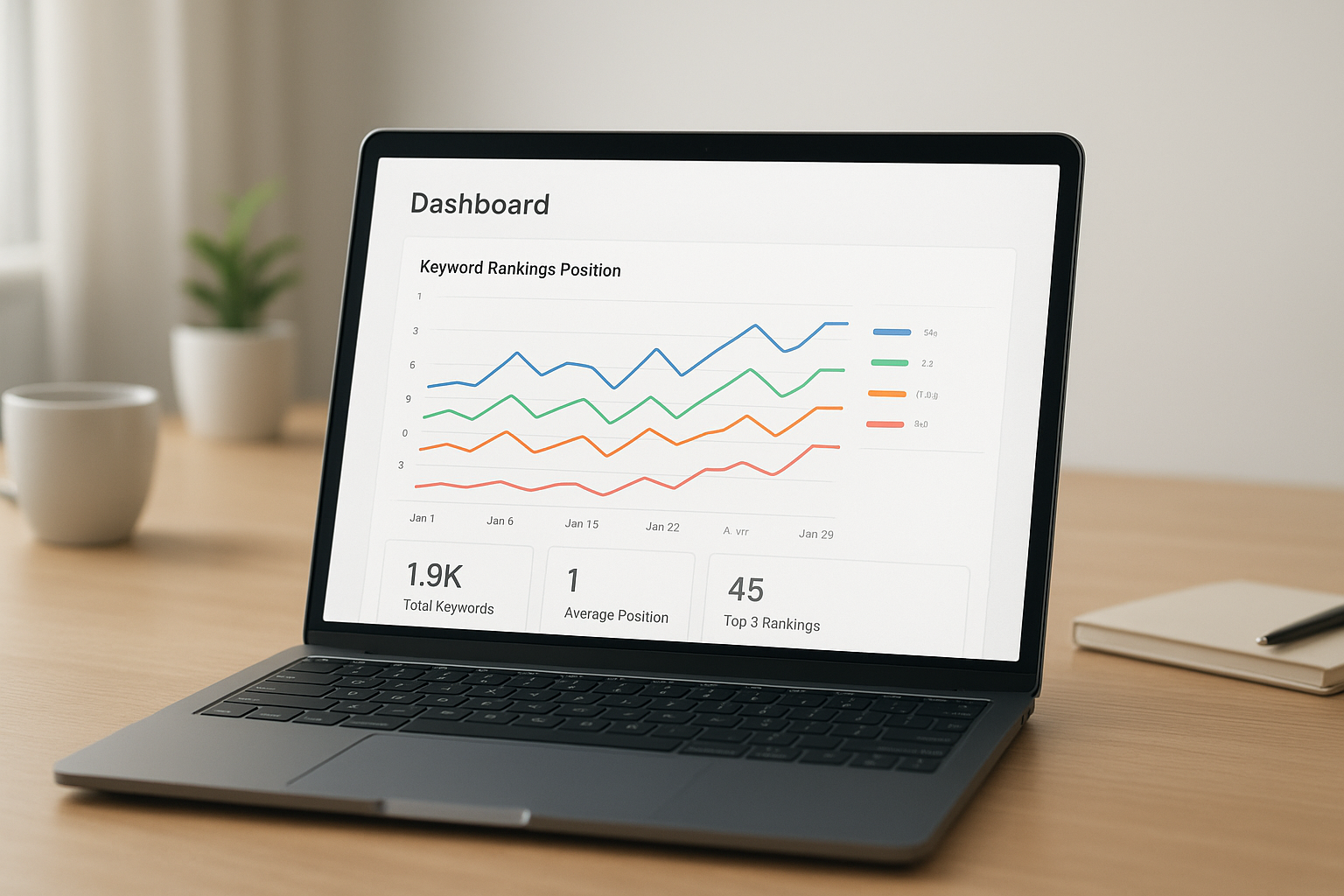
Automated rank tracking software turns raw position data into clear, visual trends.
How Does Rank Tracking Automation Work?
Rank tracking automation works by sending scheduled queries to search engines and recording where a target page appears for each keyword. Behind the scenes, the software simulates searches from specific locations and devices, since rankings can vary between mobile and desktop or between cities.
Furthermore, many modern tools now extend this process to AI answer engines, checking whether a brand’s content is cited or summarized in generative responses. This is where Generative Engine Optimization (GEO), the practice of structuring content so AI systems can cite it directly, and Answer Engine Optimization (AEO), which formats answers for featured snippets and direct AI responses, become part of the tracking picture rather than an afterthought.
As a result, businesses get a single view that spans traditional blue-link rankings and next-generation AI visibility. For a deeper breakdown of the underlying mechanics, this complete guide to automated search ranking tools covers the technical process in more depth.
Why an Automated SEO Rank Tracker Matters for AI Search
An automated SEO rank tracker matters now more than ever because search behavior is fragmenting across Google, Bing, and AI-driven answer engines simultaneously. Without automation, tracking all of these surfaces manually would consume hours every week, particularly for agencies managing multiple client sites.
In addition, automated tracking catches sudden drops quickly, which allows teams to investigate and respond before losses compound. Similarly, it reveals gradual gains that might otherwise go unnoticed, helping justify ongoing optimization work with concrete numbers. Businesses that skip automated tracking often discover ranking problems only after traffic has already declined for weeks.
To understand how much time automation actually saves compared to manual methods, see this resource on how rank tracking automation saves time and boosts rankings.
Automated rank tracking software replaces slow manual checks with continuous monitoring.
Key Features of the Best Rank Tracking Tools
The best rank tracking tools share several core features that separate them from basic search checkers. Above all, look for scheduled daily or weekly checks, historical trend graphs, and location-specific accuracy for local businesses.
- Automated daily or weekly keyword position checks across devices and locations
- Competitor tracking to compare movement side by side
- AI visibility monitoring across generative answer platforms
- Integration with technical SEO fixes, schema markup, and internal linking
- Clear reporting dashboards suited for non-technical users
Notably, platforms that combine tracking with actionable fixes, rather than data alone, tend to save more time overall. For a broader look at comparable platforms, this overview of top SEO automation software and strategies is a useful reference point.
Automated Rank Tracking vs. Manual Keyword Tracking
Manual keyword tracking involves searching each term individually and logging results in a spreadsheet, which is time-consuming and prone to human error. Automated rank tracking, by contrast, runs continuously in the background and applies consistent methodology to every check.
Therefore, manual tracking might work for a handful of keywords on a single small site, but it quickly becomes unmanageable once a business targets dozens or hundreds of terms. Agencies overseeing several client accounts face this challenge multiplied across every client. According to Google’s SEO starter guide, ranking factors change frequently, which makes consistent, automated monitoring more reliable than periodic manual spot checks.
Ultimately, the choice comes down to scale. Small, single-page projects can survive on manual checks, while any business serious about sustained visibility benefits from automation.
How to Set Up Automated Rank Tracking in 5 Steps
Setting up rank tracking automation is straightforward, even without prior SEO experience. Follow this sequence to get a monitoring system running quickly:
- Connect your domain. Add your website to the platform and verify ownership so ranking data links correctly to your pages.
- Add target keywords. Include primary terms, long-tail phrases, and local variations that matter to your customers.
- Set tracking frequency and locations. Choose daily or weekly checks and match search locations to where your real customers search.
- Enable AI visibility monitoring. Turn on tracking for AI answer platforms alongside traditional engines to see generative citation activity.
- Review dashboards and act on alerts. Check trend graphs regularly and respond to automated alerts with content or technical adjustments.
For a broader walkthrough of automating each stage of your SEO process, see automate your SEO processes.
Bringing Rank Tracking Together With GEO and AEO
Rank tracking alone tells you where you stand, but it does not fix underlying issues. That is why platforms increasingly pair automated rank tracking software with GEO and AEO automation in one dashboard.
Rank Authority, for instance, uses 1-Click AI AutoPilot to scan a site, identify technical and content gaps, and streamline approved fixes while tracking dashboards show how rankings and AI visibility respond over time. The platform’s Rank Authority Score, or RA Score, gives a diagnostic snapshot of overall SEO, GEO, and AEO health, while tools like RankFast analyze competitor pages and RankLink automates internal linking structure. Individual results vary, and reviews reflect individual user experiences rather than guaranteed outcomes for every account.
You can run a free Rank Authority Score check to see where your site currently stands before deciding which tracking and automation features matter most for your goals. According to Moz’s beginner’s guide to SEO, combining monitoring with structured on-page improvements consistently produces stronger long-term visibility than tracking alone.
Frequently Asked Questions About Automated Rank Tracking Software
How does automated rank tracking software differ from manual rank checking?
Manual rank checking requires someone to search each keyword individually and log the position, which is slow and error-prone. Automated rank tracking software runs scheduled checks across search engines and AI platforms, updating a dashboard without human effort.
How much does automated rank tracking software cost?
Pricing for automated rank tracking software varies widely, from free limited-keyword tools to monthly plans covering hundreds of keywords and multiple sites. Platforms that bundle rank tracking with broader SEO, GEO, and AEO automation, like Rank Authority, often deliver more value per dollar than single-purpose trackers.
How long does it take to set up rank tracking automation?
Most rank tracking automation tools can be configured in under 15 minutes by connecting a domain and adding target keywords. Full data accuracy typically develops over the first one to two weeks as the software gathers baseline ranking history.
What is the difference between GEO, AEO, and traditional rank tracking?
Traditional rank tracking monitors positions in classic search engine results pages, while Generative Engine Optimization (GEO) and Answer Engine Optimization (AEO) tracking measure visibility inside AI-generated answers and featured snippets. A complete monitoring strategy tracks all three simultaneously.
Can automated rank tracking software track AI search visibility?
Yes, newer platforms extend automated rank tracking software beyond Google to monitor citations and mentions inside AI answer engines. This gives businesses insight into whether their content is being surfaced by generative AI tools, not just traditional listings.
What common mistakes do businesses make when tracking rankings?
A frequent mistake is tracking only broad head terms while ignoring long-tail and local keyword variations that drive most conversions. Another is checking rankings inconsistently, which makes it difficult to connect ranking shifts to specific site changes.
How often should rankings be checked?
Daily automated checks are ideal for competitive keywords, while weekly monitoring is often sufficient for stable, lower-volume terms. Automated rank tracking software makes daily monitoring practical since it removes the manual workload.
Is automated rank tracking accurate for local SEO?
Automated rank tracking accuracy for local SEO depends on whether the tool checks rankings from location-specific search points rather than a single national server. Reliable platforms let you set geographic parameters to reflect how nearby customers actually see results.
What features should I look for in a rank tracking tool?
Look for scheduled automatic checks, historical trend graphs, competitor comparison, and visibility tracking across AI answer engines, not just Google. Integration with broader SEO automation, schema markup, and reporting adds efficiency beyond a standalone tracker.
Do I need technical SEO knowledge to use rank tracking automation?
No, most rank tracking automation tools are built for non-technical users with plain-language dashboards and automated alerts. Platforms like Rank Authority further reduce the learning curve by pairing tracking with guided or automated fixes.
How does Rank Authority’s AI AutoPilot support rank tracking?
1-Click AI AutoPilot scans a site, identifies technical and content gaps, and streamlines approved fixes while tracking dashboards show how rankings and AI visibility respond over time. Individual results vary, and reviews reflect individual user experiences rather than guaranteed outcomes for every account.
What is the Rank Authority Score and how does it relate to rank tracking?
The Rank Authority Score, or RA Score, is a diagnostic snapshot of a site’s overall SEO, GEO, and AEO health that complements ongoing rank tracking data. Together they show both current ranking positions and the underlying factors likely influencing future movement.
Can agencies use automated rank tracking software for multiple clients?
Yes, agencies commonly rely on automated rank tracking software to monitor dozens of client sites from a single dashboard instead of manual spreadsheets. This centralization saves significant reporting time and supports consistent client communication.
Why do rankings fluctuate even with automated tracking?
Rankings fluctuate because search engines and AI answer systems constantly update algorithms, and competitor content changes daily. Automated tracking does not prevent fluctuation, but it helps you spot and respond to shifts faster than manual checks allow.
In summary, automated rank tracking software removes the manual burden of checking keyword positions while extending visibility into AI answer platforms alongside traditional search. Whether you manage one site or dozens of client properties, pairing consistent tracking with GEO and AEO automation, such as the tools available through Rank Authority, helps you catch ranking shifts early and act before they affect traffic. Individual results vary, but businesses that monitor consistently are better positioned to adapt as search continues to evolve.

