

AI Search Optimization · WordPress SEO · GEO Strategy — WordPress SEO plugin for AI visibility
Best WordPress SEO Plugin for AI Visibility in 2025
AI engines don’t rank pages — they cite sources. The right WordPress SEO plugin for AI visibility determines whether your site becomes one of those sources. For a deeper walkthrough, see our WordPress SEO Auto Publish: The Complete Guide.
Direct Answer
A WordPress SEO plugin for AI visibility is a tool that configures your site to be understood, indexed, and cited by AI-powered search engines like ChatGPT, Perplexity, Google Gemini, and Microsoft Copilot. The best options automate structured data (JSON-LD schema), support FAQPage and Article markup, surface real-time technical alerts, and optimize content clarity — giving your WordPress site the strongest possible foundation for appearing in AI-generated answers.
The best WordPress SEO plugin for AI visibility combines structured data automation, entity-based optimization, and content clarity tools so your site gets cited in AI-generated answers — not just ranked in blue-link results. Search behavior is undergoing its most dramatic shift since the introduction of PageRank. According to generative artificial intelligence research, large language models are increasingly integrated into search interfaces, fundamentally changing how users discover content.
For WordPress site owners, this shift is urgent. Plugins that were designed purely for Google’s blue-link rankings are no longer sufficient. Therefore, this guide covers exactly what features to look for, how each feature influences AI citation probability, and how to configure your WordPress stack for maximum visibility across both traditional and AI-driven search environments.
In addition, we compare the leading approaches — including plugin comparison that go beyond surface-level optimization — so you can make an informed decision rather than defaulting to the most familiar name.

A WordPress SEO plugin for AI visibility bridges the gap between your content and the AI engines that surface it to users.
What Is a WordPress SEO Plugin for AI Visibility?
A WordPress SEO plugin for AI visibility is a software extension that modifies how your site communicates with both traditional search crawlers and AI language models. It operates through three core mechanisms: structured data injection, content signal optimization, and technical crawlability improvements.
Traditional SEO plugins were built for a world where search engines matched keywords to queries. AI search engines work differently. Specifically, they read your content the way a researcher would — extracting facts, attributing sources, and synthesizing answers. A plugin built for AI visibility helps your content pass that test by ensuring it is structured, authoritative, and semantically clear.
The distinction matters enormously. A site with perfect keyword density but no schema markup, poor heading hierarchy, or thin content will be invisible to AI answer engines — even if it ranks on page one of Google. Furthermore, sites that lack entity clarity or E-E-A-T signals are routinely passed over in favor of lesser-written but better-structured alternatives.
Traditional SEO vs. AI Visibility SEO: Key Differences
- Traditional SEO goal: Rank in the top 10 blue-link results for target keywords.
- AI visibility goal: Become a cited source in AI-generated answers — appearing inside ChatGPT, Perplexity, Gemini, and Copilot responses.
- Traditional ranking signals: Backlinks, keyword density, page speed, and meta tags.
- AI citation signals: Structured data, entity clarity, topical authority, E-E-A-T, and direct-answer formatting.
Why AI Visibility Requires a Different SEO Approach
When a user asks ChatGPT or Perplexity a question, the AI doesn’t return a list of links — it returns a synthesized answer with cited sources. To become one of those cited sources, your WordPress site must demonstrate qualities that go well beyond traditional ranking signals.
The Four Pillars of AI Citability
- Topical authority: Your site must cover a subject comprehensively with interconnected content that signals deep expertise. Isolated articles rarely get cited — content clusters do.
- Entity clarity: AI engines understand entities — people, organizations, concepts — not just keywords. Schema markup makes those entities explicit and machine-readable.
- Content trustworthiness (E-E-A-T): Experience, Expertise, Authoritativeness, and Trustworthiness signals are weighted heavily by AI citation algorithms. Author credentials, citations, and organizational transparency all contribute.
- Structured answers: Content formatted with clear questions and direct answers — particularly FAQ and HowTo schema — is far more likely to be extracted and cited by AI systems.
Consequently, the right WordPress SEO plugin for AI visibility must address all four pillars simultaneously. A plugin that handles schema markup but ignores content readability — or one that monitors crawl errors but lacks entity optimization — leaves significant gaps in your AI visibility stack.
The GEO Discipline: What It Means for WordPress
Generative Engine Optimization (GEO) — the emerging discipline of optimizing content specifically for AI-generated search results — is not a replacement for traditional SEO. Instead, it is a layer on top of it. Your WordPress plugin needs to support both dimensions: continuing to optimize for Google’s algorithm while simultaneously preparing your content for AI citation systems.
However, most plugins on the market were designed before GEO existed as a concept. As a result, they optimize effectively for one environment but not the other. Understanding this gap is the first step toward choosing the right tool.
Core Features of the Best WordPress SEO Plugin for AI Visibility
Not all SEO plugins are equal when it comes to AI search. Below are the essential features to evaluate — and why each one matters specifically for AI citation, not just traditional rankings.
1. Automated Schema Markup (JSON-LD)
Schema markup — specifically in JSON-LD format — is the single most important technical feature for AI visibility. Plugins that automatically generate and inject structured data for Article, FAQPage, HowTo, Product, BreadcrumbList, and Organization schema types give AI engines a machine-readable map of your content and are explained in our Best WordPress SEO Plugin guide.
Without schema, even excellent writing can be passed over. An AI language model parsing your page without structured data must infer context from prose alone — an unreliable process. In contrast, a properly marked-up page tells the AI exactly what the content is about, who published it, and what questions it answers; see our AI visibility plugin guide for plugin-specific schema examples.
Specifically, look for plugins that support nested schema — for example, FAQPage items embedded within an Article schema — as this provides the richest possible signal for AI citation systems.
2. Real-Time Technical SEO Alerts
Broken structured data, crawl errors, and missing meta information can silently destroy your AI visibility. A single malformed schema block can prevent an entire page from being interpreted correctly by AI crawlers — and periodic audits won’t catch issues fast enough.
Rank Authority’s real-time SEO issue alerts flag and surface technical problems the moment they appear — before they compound into ranking losses or AI visibility gaps. Look for continuous monitoring rather than weekly snapshot reports.
3. Content Readability and Structure Analysis
AI engines parse content structurally, not just semantically. Plugins that analyze heading hierarchy, paragraph length, passive voice usage, and transition clarity help writers produce content that reads well to both humans and language models.
A clear H2/H3 structure with direct, factual statements under each heading dramatically improves AI extractability. Similarly, short declarative sentences at the start of each section give AI systems a clean extraction point for synthesized answers.
4. AI-Specific Content Optimization Signals
This is where most traditional plugins fall short. Beyond readability, AI visibility requires optimization for specific content signals that AI citation algorithms favor:
- Direct answer formatting: Leading paragraphs that answer the core question within the first 2–3 sentences.
- Defined terms: Explicit definitions of key concepts, formatted consistently so AI models can extract and attribute them.
- Statistical and factual specificity: Concrete data points rather than vague claims (“studies show…”). AI engines strongly prefer citable, specific facts.
- Author and organization entity markup: Attributing content to a named, credentialed author or organization increases E-E-A-T signals and citation probability.
5. Internal Linking Intelligence
Topical authority — a primary driver of AI citation — is built through a well-connected internal link structure. Plugins that suggest or automate contextual internal links help AI engines understand the depth and breadth of your site’s expertise on a given subject. This is a key factor in whether your content is treated as a primary source or a secondary reference.
6. XML Sitemap and Crawl Optimization
AI search crawlers need clean, efficient access to your content. Dynamic XML sitemaps, robots.txt management, and canonical URL control ensure that AI bots index the right pages and don’t waste crawl budget on duplicate or low-value content. Furthermore, regular sitemap resubmission after major content updates keeps AI retrieval systems current with your latest work.
7. GEO and AI Citation Monitoring
This feature is entirely absent from most traditional WordPress SEO plugins. GEO monitoring tools track how frequently your site is cited in AI-generated responses across platforms like ChatGPT, Perplexity, and Gemini. Consequently, you can measure the actual ROI of your AI visibility efforts — not just infer it from indirect traffic signals.
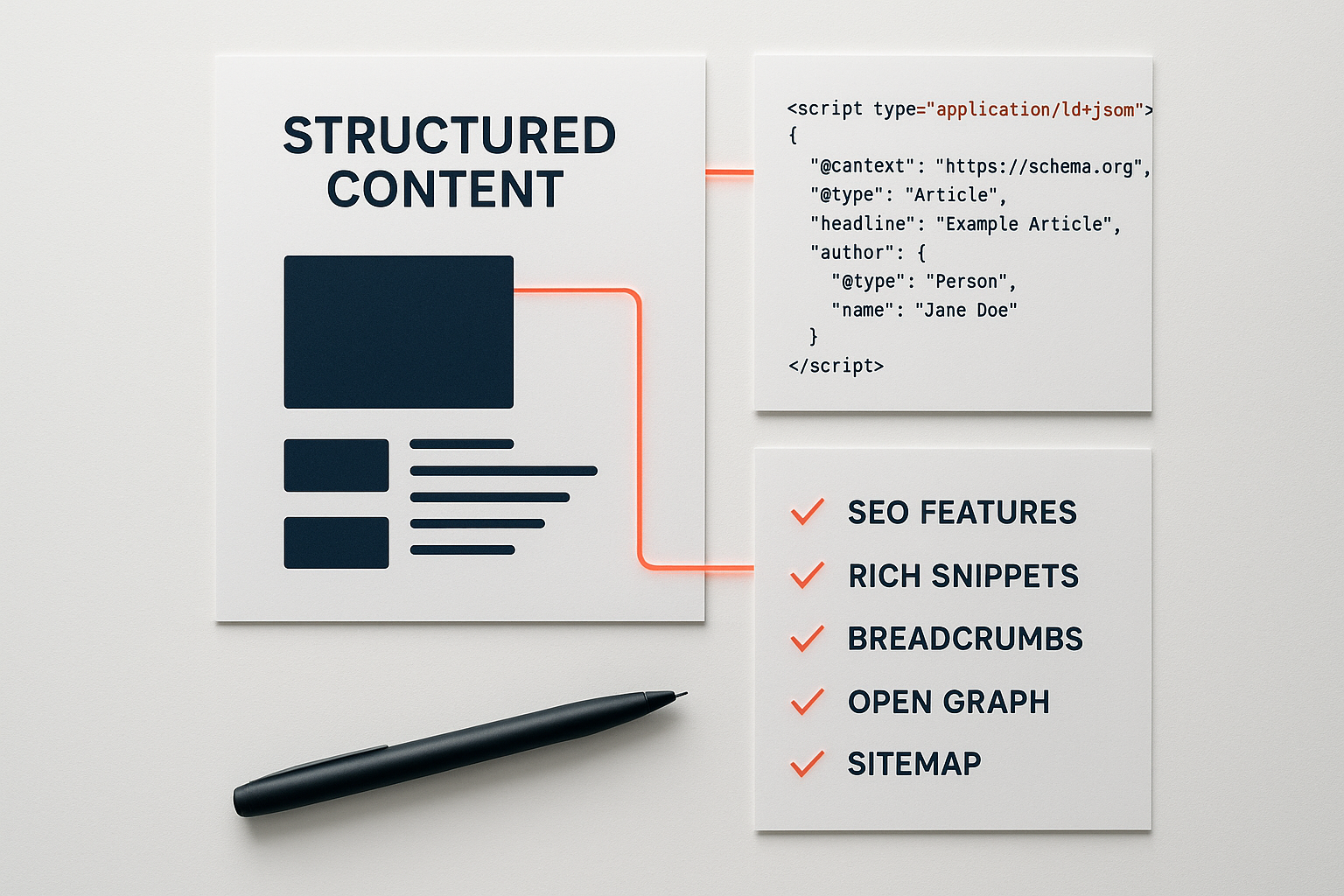
Schema markup and structured content features are the backbone of any serious AI visibility strategy for WordPress.
Comparing WordPress SEO Plugin Approaches for AI Visibility
Not every plugin takes the same approach to AI visibility. Understanding the differences helps you choose the best WordPress SEO plugin for your strategy.
Traditional Plugins with AI Features Bolted On
Several established WordPress SEO plugins have added AI-adjacent features — typically content generation assistants, automated meta description writing, or basic structured data. However, these features are largely cosmetic additions to architectures designed for traditional search. They help with content production efficiency but don’t fundamentally change how your site is understood by AI citation systems.
In addition, AI-generated content tools within SEO plugins are not the same as AI visibility tools. Writing content faster is a different problem from ensuring that content gets cited by AI search engines.
Purpose-Built AI Visibility Platforms
Platforms designed specifically for AI and GEO optimization take a fundamentally different approach. Rather than bolting AI features onto a traditional plugin, they build the entire stack around the signals that AI citation algorithms actually reward: entity clarity, structured data depth, real-time monitoring, and topical authority measurement.
These platforms — such as Rank Authority’s AI SEO feature suite — are designed to complement your existing WordPress SEO plugin rather than replace it. As a result, you get the best of both worlds: traditional optimization coverage plus dedicated AI visibility capabilities.
What to Look for in a Combined Stack
- Automated JSON-LD schema for Article, FAQPage, HowTo, BreadcrumbList, and Organization types
- Real-time issue monitoring for schema validation errors, crawl failures, and indexing gaps
- Entity-based optimization — explicit person, organization, and concept markup
- Content structure analysis with AI-extractability scoring, not just readability grades
- Internal linking tools that reinforce topical clusters rather than just suggesting any related post
- AI citation tracking — monitoring your appearances in ChatGPT, Perplexity, and Gemini responses
How to Configure Your WordPress Plugin for Maximum AI Visibility
Installing the right plugin is only the beginning. Configuration determines how much AI visibility you actually unlock. Specifically, follow this step-by-step framework to get the most out of your WordPress SEO setup and review our AI-assisted blog publishing guide for content workflow tips.
Step-by-Step Configuration
- Enable Organization schema sitewide. Fill in your brand name, logo URL, social profiles, and founding date. This establishes your site as a known entity to AI systems — a prerequisite for being treated as a credible source.
- Set default Article schema for all blog posts. Include author markup with credentials wherever possible. Author entities with verifiable profiles significantly strengthen E-E-A-T signals.
- Add FAQPage schema to every Q&A section. This is one of the highest-impact actions for AI citation probability. AI systems actively extract FAQ-formatted content because it provides ready-made answer text.
- Configure your XML sitemap precisely. Exclude tag archives, author pages, and paginated URLs. Submit the sitemap to Google Search Console, Bing Webmaster Tools, and any AI-specific indexing endpoints available.
- Activate breadcrumb schema. This gives AI engines a clear map of your site’s topical hierarchy and content relationships — essential for establishing topical authority at scale.
- Implement HowTo schema on process-based content. Step-by-step articles with HowTo markup are heavily favored for AI extraction because they provide structured, sequential information that AI systems can embed directly in answers.
- Connect a real-time monitoring tool. Watch continuously for crawl errors, schema validation failures, and indexing issues. Platforms like AI website optimization surface problems immediately — before they quietly erode your AI visibility.
Schema Validation: Don’t Skip This Step
After configuring schema, validate it using Google’s Rich Results Test and Schema.org’s validator. Malformed JSON-LD is worse than no schema at all — it can trigger parsing errors that flag your entire page as unreliable to AI crawlers.
Additionally, revalidate schema whenever you make major content updates. AI retrieval systems cache structured data, and outdated or inconsistent markup can cause your content to be cited with incorrect attributes.
Beyond the Plugin: Building a Complete AI Visibility Strategy
Even the best WordPress SEO plugin for AI visibility cannot compensate for a weak content strategy. The plugin provides the technical foundation — but the content you build on top of it determines whether AI engines actually choose to cite you.
Build Content Clusters for Topical Authority
Focus on building content clusters — groups of interlinked articles that collectively cover a topic from multiple angles. Each cluster should have a comprehensive pillar page supported by more specific subtopic pages. See the AI-Assisted Blog Publishing guide for workflow ideas. This architecture signals topical authority to AI engines in a way that isolated articles simply cannot replicate.
For example, if your site covers WordPress SEO, your pillar page might address the broad topic of WordPress optimization. Subtopic pages would then cover schema markup, page speed, internal linking, and AI visibility specifically. As a result, AI engines see a site with genuine depth — not a collection of loosely related posts.
Write for Direct-Answer Extraction
AI engines strongly favor content that answers questions clearly and early — not content that buries the answer after three paragraphs of preamble. Therefore, lead every article section with the most important statement first. Use numbered lists, defined terms, and concise factual sentences wherever appropriate.
Specifically, avoid hedging language (“it could be argued that…”) and unattributed generalizations (“experts say…”). AI citation algorithms penalize vagueness. In contrast, direct statements with clear attribution are extracted and cited at significantly higher rates.
Maintain Content Freshness
Both AI training data and retrieval systems reward recently updated, accurate content. Establish a regular review schedule for your most important pages. Update statistics, swap outdated examples, and refresh schema markup as information evolves. A page last updated two years ago will lose citation priority to a comparable, more recently updated alternative.
Track AI Citations as a Core KPI
Track your AI visibility the same way you track traditional rankings. Emerging tools now allow you to monitor how often your site is cited in AI-generated responses. Read our AI Visibility Audit to set up monitoring KPIs. Treat this as a core KPI alongside organic traffic and keyword positions — because in many categories, AI citation volume now exceeds traditional click-through traffic as the primary discovery mechanism.
Furthermore, analyze which pages are being cited. This reveals which content formats, schema types, and topical areas are resonating with AI systems — and informs your future content production priorities. See our AI-assisted blog publishing guide for production workflows.
Frequently Asked Questions About WordPress SEO Plugin for AI Visibility

AI search engines build citation networks — your site’s visibility depends on how clearly and thoroughly it communicates its expertise.
Conclusion
Choosing the right Best WordPress SEO Plugin for AI visibility is one of the most consequential technical decisions a WordPress site owner can make in 2025. The AI search revolution is not approaching — it is already reshaping how millions of users discover information every day. Therefore, sites that invest now in structured data, entity optimization, and AI-aligned content architecture will be the ones earning citations, traffic, and trust in the years ahead.
Start with the right plugin. Configure it thoroughly using the step-by-step framework above. Pair it with a dedicated monitoring platform like Rank Authority’s AI SEO features. Build your content strategy around direct-answer formatting, content clusters, and entity clarity. Furthermore, track AI citations as a primary KPI — not an afterthought.
The sites that dominate AI-generated search results in 2025 and beyond won’t be the ones with the most backlinks. They’ll be the ones with the clearest structure, the richest schema, and the deepest topical authority — all delivered through a well-configured WordPress SEO plugin for AI visibility built for the new era of search.
Last updated: July 14, 2025 · Category: WordPress SEO · Reading time: ~11 minutes · By the Rank Authority editorial team, Senior SEO strategists. · Author: include byline and brief credentials.

