

Content silo SEO is a structural strategy that organizes related web pages into clearly defined topic clusters, helping both traditional search engines and AI answer engines understand how your content connects. Instead of scattering blog posts and service pages at random, this approach groups them under pillar pages supported by tightly linked subtopics. As AI-powered platforms increasingly pull cited answers from well-organized, authoritative sources, silo structure has become one of the clearest signals of topical depth. This guide explains what content silo SEO means, how to build one step by step, and how automation can remove most of the manual work involved.
What Is Content Silo SEO?
Content silo SEO is the practice of structuring a website into clusters of thematically related pages, linked internally around one central pillar page, so search engines recognize deep subject-matter coverage. Each silo stays focused on a single core topic, with supporting pages answering related questions and subtopics in detail. This structure improves crawl efficiency, strengthens relevance signals, and makes it easier for search engines and AI answer engines to cite a specific page as a trustworthy source.
In practice, a silo might start with a broad pillar page, such as “SEO for AI-driven businesses,” and branch into supporting articles covering schema markup, technical audits, or content strategy. Internal links flow between the pillar and its cluster pages, concentrating topical authority rather than spreading it thin across unrelated content. For a deeper look at building this kind of strategy, see this complete guide to SEO for AI-driven businesses.
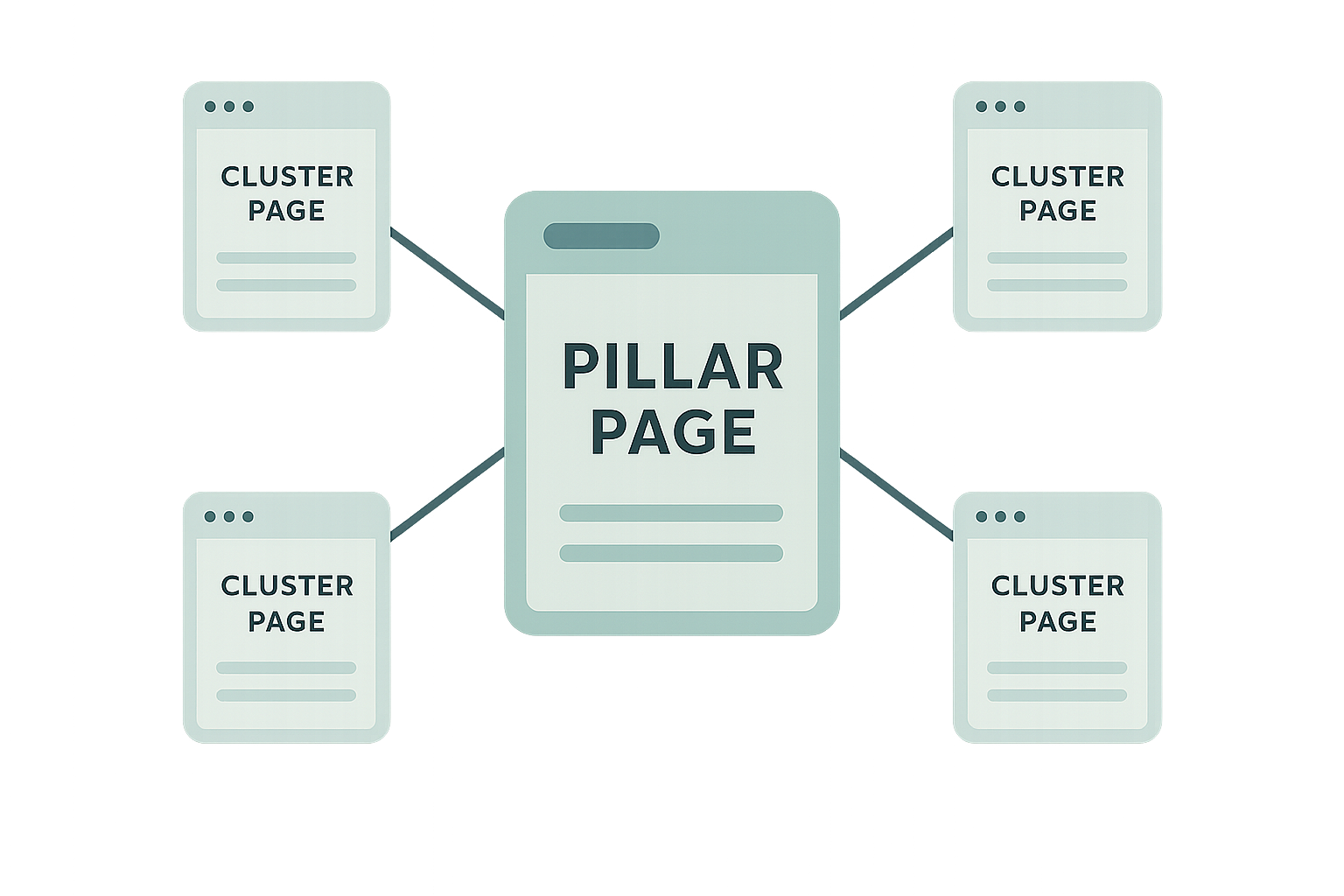
A simplified visual of content silo SEO, where a pillar page anchors several related cluster pages.
Why Topic Clustering Strengthens AI Search Visibility
Topic clustering, the broader practice behind content silos, has become increasingly important as AI Overviews, chatbots, and answer engines prioritize sources that demonstrate clear subject-matter depth. According to Google’s own documentation, well-organized site structure helps crawlers understand relationships between pages, which in turn supports more accurate indexing and ranking signals, as explained in the Google Search Central SEO guide. Similarly, the concept of information architecture, long studied in library and information science, underpins how both humans and machines navigate structured content, as outlined on Wikipedia.
When an AI answer engine evaluates which source to cite, it typically favors pages embedded within a coherent network of related content rather than isolated, orphaned pages. For example, Rank Authority tracks AI citation activity across nine distinct AI platforms, giving businesses a concrete way to see where silo-structured content is actually being referenced. Consequently, businesses that invest in silo structure often see stronger topical authority signals feed into the Rank Authority Score, which measures visibility across both traditional search and AI citation surfaces. Individual results vary, and visibility gains depend on many factors beyond site structure alone.
How to Build a Content Silo Structure: A Step-by-Step Process
Building an effective silo structure does not require starting from scratch. Instead, follow a structured process to reorganize existing content and plan new pages around clear topic clusters.
- Audit existing content and map core topics. Review every page on your site and group them by subject matter to identify natural pillar topics and gaps that need new content.
- Select one pillar page per core topic. Choose the page that should rank for the broadest, highest-value keyword in each topic cluster, then expand it into a comprehensive resource.
- Group supporting content into clusters. Identify blog posts, service pages, and guides that address subtopics, questions, or long-tail keywords related to each pillar.
- Build internal links between pillar and cluster pages. Link supporting pages back to the pillar using descriptive anchor text, and link the pillar out to each supporting page in return.
- Apply schema markup to clarify relationships. Structured data such as BreadcrumbList and Article schema helps search engines and AI crawlers confirm how pages relate within a silo.
- Monitor rankings and refine the structure. Track keyword movement and AI citation frequency over time, then adjust internal links or add new cluster pages as gaps emerge.
Manually auditing dozens of pages, mapping internal links, and generating schema for each one is time-consuming. An automated content strategy approach can shorten this process considerably by identifying topic gaps and suggesting internal link paths automatically.

Mapping pillar and cluster pages is the first practical step toward effective content silo SEO.
Content Silos vs. Flat Site Architecture
A flat site architecture places most pages within one or two clicks of the homepage, with little hierarchical grouping by topic. While this can work for very small sites, it often dilutes topical authority as a site grows, since search engines struggle to determine which pages are most authoritative on a given subject.
| Factor | Content Silo Structure | Flat Architecture |
|---|---|---|
| Topical authority signals | Concentrated around pillar pages | Spread thinly across unrelated pages |
| Internal linking | Structured, topic-based | Minimal or random |
| AI citation likelihood | Higher, due to clear subject depth | Lower, due to fragmented context |
| Best suited for | Growing sites with multiple topics | Very small, single-topic sites |
As a site expands beyond a handful of pages, transitioning to a silo structure typically becomes necessary to maintain clear topical signals. For guidance on sustaining visibility through this growth phase, see this guide to sustained online visibility.
Common Mistakes That Weaken Your Silo Structure
Even well-intentioned silo structures can fail if a few common mistakes creep in. Recognizing these early helps preserve the topical authority a silo is designed to build.
- Cross-linking unrelated silos excessively. Linking too often between unrelated topic clusters dilutes the thematic focus each silo needs.
- Thin or duplicate supporting pages. Cluster pages that repeat the same information add little value and can confuse search engines about which page should rank.
- Ignoring orphaned pages. Pages with no internal links pointing to them are difficult for crawlers to find and rarely accumulate authority.
- Overlooking schema markup. Without structured data, search engines and AI crawlers have a harder time confirming relationships between pillar and cluster pages.
- Treating silo structure as a one-time project. Content silos need ongoing maintenance as new pages are added and search intent shifts.
How Rank Authority Automates Content Silo SEO
Manually building and maintaining content silo SEO across dozens of pages is labor-intensive, particularly for small businesses and agencies managing multiple client sites. Rank Authority’s RankLink feature automates topical siloing and internal linking, identifying which pages belong together and suggesting link paths that reinforce pillar-cluster relationships.
In addition, the platform’s AI Blog Builder generates SEO- and AEO-optimized content designed to slot directly into an existing silo, while 1-Click AI AutoPilot scans the site for technical and content gaps that could weaken topical signals. Together with automated schema markup generation, these tools reduce much of the manual workload traditionally required to plan, build, and maintain a content silo. Individual results vary, and businesses should still monitor performance through regular reporting.
For businesses deciding where to start, choosing the right SEO strategy often begins with a free site audit to identify existing silo gaps before scaling content production. Rank Authority can also submit updated pages for indexing, though Google alone determines whether and when a page is indexed.
Measuring the Impact of Your Silo Strategy
Once a silo structure is in place, tracking its performance matters as much as building it. Key metrics include organic ranking movement for pillar keywords, internal link equity distribution, and, critically for AI-powered search, how often pages within the silo appear as cited sources in AI answer platforms.
Rank Authority’s AI visibility monitoring tracks citations across major AI answer platforms alongside traditional ranking data, consolidating both into a single RA Score. This makes it possible to see whether silo restructuring is translating into measurable visibility gains over time, rather than relying on ranking position alone. For a broader view of how SEO fits into AI-driven search, review this overview of what SEO means in the context of AI-powered platforms.

Tracking ranking and citation data helps confirm whether a content silo seo strategy is working.
Frequently Asked Questions
What is content silo SEO?
Content silo SEO is a method of organizing a website into clusters of related pages built around one central pillar page, so search engines and AI answer engines can clearly identify topical authority on a subject.
How does content silo SEO differ from topic clusters?
Topic clusters and content silos describe nearly the same idea. Silos typically emphasize stricter internal linking boundaries between topics, while topic clusters allow slightly more cross-linking between related subjects.
How many pages do I need to start a content silo?
A basic silo can start with one pillar page and three to five supporting cluster pages. You can expand the silo over time as you identify new subtopics worth covering.
How long does it take to see results from a silo structure?
Most sites see initial ranking movement within 8 to 12 weeks after restructuring content into silos, though timelines vary based on site authority, competition, and content quality. Individual results vary.
Does content silo SEO help with AI search visibility?
Yes. AI answer engines tend to favor well-organized, topically deep sources when selecting content to cite, and a clear silo structure makes that topical depth easier to detect.
What is the ideal internal linking structure within a silo?
Each cluster page should link back to its pillar page, and the pillar page should link out to every cluster page it supports, keeping links within the same topic rather than crossing into unrelated silos.
Can I use content silo SEO on an e-commerce site?
Yes, e-commerce sites commonly build silos around category pages as pillars, with product pages and buying guides serving as supporting cluster content.
What tools can automate content silo SEO?
Platforms such as Rank Authority automate topic mapping, internal linking suggestions, and schema deployment through features like RankLink, reducing the manual work involved in building and maintaining silos.
How much does it cost to implement a silo strategy?
Costs vary widely depending on whether you restructure content manually, hire an agency, or use automation software. Many platforms, including Rank Authority, offer a risk-free trial period to test the approach first.
What are the biggest mistakes to avoid with content silos?
Common mistakes include excessive cross-linking between unrelated silos, publishing thin or duplicate cluster pages, and leaving pages orphaned with no internal links pointing to them.
Is content silo SEO still effective in 2026?
Yes. As AI search tools continue to prioritize clear topical authority, content silo SEO remains relevant, and arguably more important, for standing out in both traditional and AI-driven search results.
How does schema markup support silo structure?
Structured data such as BreadcrumbList and Article schema confirms the relationships between pillar and cluster pages, helping search engines and AI crawlers understand the hierarchy within a silo.
Final Thoughts on Content Silo SEO
Content silo SEO remains one of the most reliable ways to signal topical authority to both traditional search engines and AI answer engines. By grouping related pages around clear pillar topics, linking them intentionally, and supporting the structure with schema markup, businesses make it easier for search and AI systems to discover, understand, and cite their content. As AI-powered search continues to reshape how people find information, a well-maintained silo structure, supported by tools like Rank Authority, can help businesses of any size compete for visibility without needing a full in-house SEO team. Individual results vary, and ongoing monitoring remains essential to keep any silo structure performing well over time.

