

AI citation tracking is quickly becoming one of the most important metrics for businesses trying to stay visible as search shifts toward AI-generated answers. Instead of only watching where you rank on a results page, you now need to know whether tools like ChatGPT, Gemini, and Google’s AI Overviews actually mention your brand. This shift matters because, as users ask AI assistants direct questions, the businesses that get cited are the ones that get discovered.
In this guide, you will learn exactly what AI citation tracking means, why it matters, and how to start monitoring your own AI visibility. Along the way, we’ll walk through a practical process, common mistakes, and answers to the questions business owners ask most often.
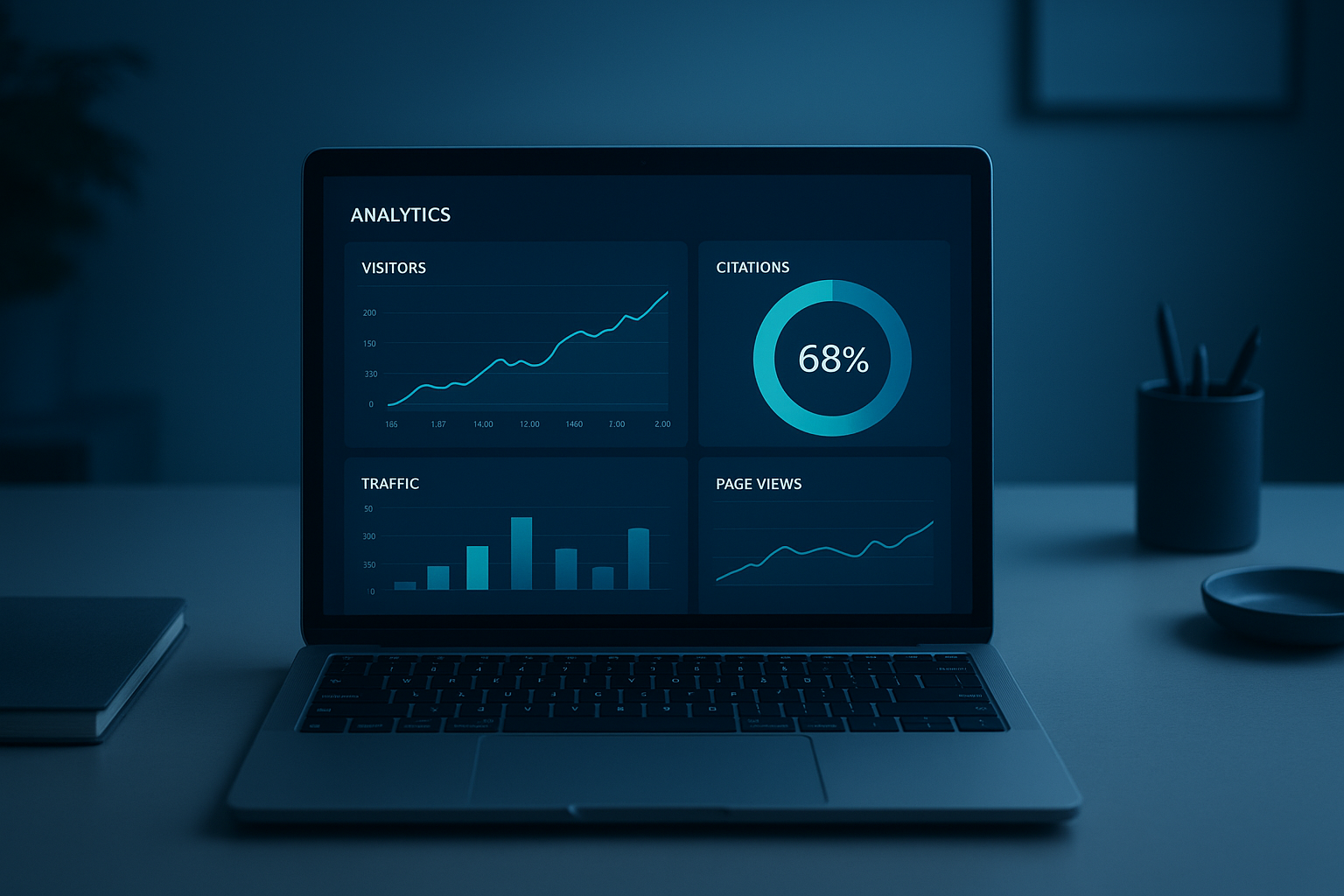
AI citation tracking dashboards reveal how often AI platforms reference your content.
What Is AI Citation Tracking?
AI citation tracking is the practice of monitoring how often, and in what context, AI search tools reference a specific website, brand, or page in their generated answers. In short, it measures whether AI engines know your business exists and whether they trust it enough to mention it.
Traditional SEO focused on rankings within a list of blue links. However, generative AI tools like ChatGPT and Perplexity synthesize answers from multiple sources and often cite only a handful of them directly. Consequently, AI citation tracking fills a visibility gap that standard rank trackers were never designed to measure.
Large language models, a category of AI that powers many of these answer engines, learn patterns from enormous amounts of text data. You can read more about how these systems function on Wikipedia’s overview of large language models, which explains the underlying technology in plain terms.
Why AI Visibility Tracking Matters for Your Business
AI visibility tracking matters because consumer behavior has already changed. Many people now ask an AI assistant a question instead of typing it into a search box, and they often stop reading once they get a confident-sounding answer. As a result, if your business is not part of that answer, you may lose the click entirely.
Industry analysts have taken notice of this shift. For example, Gartner predicted in 2024 that traditional search engine volume could fall by around 25% by 2026 as users increasingly turn to AI chatbots and virtual agents for answers. Therefore, businesses that ignore AI citation tracking risk measuring the wrong thing while their real audience moves elsewhere.
In addition, AI citation tracking gives you a competitive lens. By comparing which competitors get cited for the same queries, you can identify content gaps and structural weaknesses on your own site. You can explore this kind of comparison in more depth through Rank Authority’s AI visibility resources.
How AI Citation Tracking Works
At a basic level, AI citation tracking tools send sample questions to AI platforms and then scan the responses for mentions of your domain, brand name, or linked sources. Specifically, the process usually follows a repeatable structure, which makes it easier to monitor consistently over time.
Here is a simplified version of that process:
- Run a baseline AI visibility audit. Start by scanning your site with a diagnostic tool to see whether AI platforms currently recognize and cite your pages at all before making any changes.
- Identify the queries worth tracking. List the questions and topics your customers actually ask AI assistants, then build a tracking set around those phrases rather than generic keywords alone.
- Audit and deploy schema markup. Review your existing structured data and add or correct schema so AI crawlers can accurately parse your content, authorship, and topical relevance.
- Monitor citations across AI platforms. Track mentions across ChatGPT, Gemini, Perplexity, and Google AI Overviews on a recurring schedule to spot patterns in which content gets cited and which does not.
- Refine content based on citation data. Use the tracking results to rewrite underperforming pages into clearer, more directly answerable formats that AI systems are more likely to reference again.
Structured data plays a particularly important role here. Schema markup, a standardized vocabulary maintained collaboratively by major search engines, helps machines understand what a page is actually about. You can learn more about this vocabulary directly from Wikipedia’s entry on Schema.org, or review implementation guidance from Google’s structured data documentation.
Mapping citation patterns helps reveal which pages AI engines trust most.
Key Metrics in AI Citation Tracking
Not every metric matters equally when you are monitoring AI citation tracking results. Instead, a handful of indicators tend to provide the clearest picture of progress.
Citation frequency measures how often your domain appears across a defined set of tracked queries. Source diversity shows whether multiple pages on your site get cited, or just one. Platform coverage tracks which AI engines mention you and which ignore you entirely. Finally, competitive share of citation compares your mention rate against direct competitors for the same topics.
Together, these metrics form what many platforms, including Rank Authority, summarize into a single composite score. A Rank Authority Score, or RA Score, condenses technical health, content quality, and citation signals into one number so you can track progress without digging through raw data every time.
Common Mistakes in AI Citation Monitoring
Many businesses make the same few mistakes when they first attempt AI citation monitoring. For instance, some track only branded search terms, which misses the much larger pool of informational questions where new customers actually discover a brand for the first time.
Similarly, businesses often neglect technical fixes like schema markup and site speed, assuming content alone drives citations. In contrast, AI systems rely heavily on clean technical signals to parse and trust a page before they ever cite it. You can run a free diagnostic through resources like the AI visibility audit guide to catch these issues early.
How to Improve Your AI Citation Tracking Results
Improving your results starts with content clarity. Above all, AI systems favor content that answers a question directly within the first sentence or two, rather than burying the answer under several paragraphs of introduction.
In particular, pages built specifically for citation, sometimes called AI-optimized artifact pages, tend to perform well because they combine a direct answer, supporting data, and clear formatting. Rank Authority’s AI Blog Builder automates much of this structure, while RankFast analyzes competitor pages to identify where your content falls short. You can also review a deeper breakdown of citation scoring in the AI citation score checker guide.
Internal linking also plays a quiet but meaningful role. When your site’s topical clusters connect logically, AI crawlers can better understand which pages are authoritative on a given subject. Tools like RankLink automate this siloing process, and you can explore broader discoverability tactics in this guide to enhancing content discoverability.

Consistent AI citation tracking helps business owners see where visibility is growing.
Where Rank Authority Fits Into AI Citation Tracking
Rank Authority brings AI citation tracking together with traditional SEO automation in one dashboard, rather than requiring separate tools for each task. Specifically, the platform’s 1-Click AI AutoPilot scans your site for technical and content gaps, then streamlines approved fixes without requiring an in-house SEO team.
Meanwhile, AI visibility monitoring tracks citations across major AI answer platforms, so you can see exactly where your business is mentioned and where it is not. For deeper strategic context on how these pieces fit together, Rank Authority’s own AI-powered search insights guide walks through the full strategy. You can also start with a free scan directly at rankauthority.com to see where your site currently stands.
Note: Rank Authority can submit pages for indexing, but Google alone determines whether and when a page is actually indexed. Individual results vary, and reviews reflect individual user experiences rather than guaranteed outcomes for all users.
Frequently Asked Questions About AI Citation Tracking
What is AI citation tracking?
AI citation tracking is the process of monitoring how often and where AI platforms like ChatGPT, Gemini, and AI Overviews mention or cite a specific website, brand, or piece of content. It helps businesses understand their visibility within AI-generated answers rather than only traditional search results.
How does AI citation tracking work?
AI citation tracking tools send sample queries to AI platforms, then scan the responses for brand mentions, links, or source citations. Results are logged over time to reveal trends in visibility and citation frequency.
Why is AI citation tracking important for businesses?
Because more consumers are getting answers directly from AI chatbots instead of clicking search results, being cited by those tools influences discoverability. Without tracking, businesses have no visibility into whether AI engines even know they exist.
How is AI citation tracking different from traditional rank tracking?
Traditional rank tracking measures position on a search engine results page, while AI citation tracking measures whether and how often an AI model references a source in its generated answer. The metrics, data sources, and optimization tactics differ significantly between the two.
How much does AI citation tracking cost?
Costs vary widely, from free diagnostic tools that offer a basic snapshot to paid platforms with ongoing monitoring across multiple AI engines. Rank Authority offers a free AI Visibility Checker along with a seven-day trial of its full monitoring suite.
How long does it take to see results from AI citation tracking?
Initial visibility data can appear within days, but meaningful citation growth typically takes several weeks to a few months as content and schema updates get crawled and reprocessed. Individual results vary depending on site history and competition.
What AI platforms should businesses monitor for citations?
At minimum, businesses should track Google AI Overviews, ChatGPT, Perplexity, and Gemini, since these represent major sources of AI-driven answer traffic. Expanding coverage to additional platforms provides a more complete visibility picture.
What common mistakes do businesses make with AI citation tracking?
A common mistake is tracking only a handful of keywords instead of broader topic clusters, which misses many real citation opportunities. Another mistake is ignoring structured data, since poorly marked-up content is harder for AI systems to understand and cite.
What is the best practice for improving AI citation rates?
Publishing clear, well-structured content with accurate schema markup and direct answers to common questions tends to improve citation rates. Consistent monitoring also helps identify which topics and formats AI engines favor.
Can small businesses benefit from AI citation tracking?
Yes, small businesses often compete more effectively in AI search results than in crowded traditional rankings, since AI engines reward clarity and relevance over sheer domain size. Tracking citations helps smaller brands find and expand those opportunities.
Does schema markup improve AI citation tracking results?
Structured data such as schema markup helps AI systems parse content accurately, which can increase the likelihood of correct citations. It does not guarantee citations, but it removes a common technical barrier to being understood by machines.
How often should I review my AI citation tracking data?
Reviewing data weekly or biweekly is generally sufficient to catch trends without overreacting to normal fluctuations. Monthly deep-dive reviews help assess whether content and schema changes are producing measurable gains.
Final Thoughts on AI Citation Tracking
AI citation tracking is no longer a niche concern for large enterprises; it is quickly becoming a core part of how any business measures its online visibility. As AI assistants continue to answer more consumer questions directly, knowing whether and how often you get cited is just as important as knowing where you rank on a traditional results page.
To summarize, start with a baseline audit, track the right queries, fix technical gaps like schema markup, and monitor your citation results consistently across major AI platforms. Over time, that data will show you exactly where to focus your content efforts. Ultimately, businesses that treat AI citation tracking as an ongoing practice, rather than a one-time check, position themselves to stay visible as search continues to evolve.

