

Domain ranking Moz — formally known as Domain Authority (DA) — is a logarithmic score from 1 to 100 developed by Moz that predicts how likely a website is to rank in search engine results pages. Understanding this metric is essential for any SEO strategy because it provides a fast, comparative snapshot of your site’s link-based authority.
However, DA is not a Google ranking factor. Instead, it correlates strongly with the same signals — quality backlinks, trustworthy referring domains — that search engines actually reward. Therefore, improving your DA score generally means you are also building the foundation that Google values.
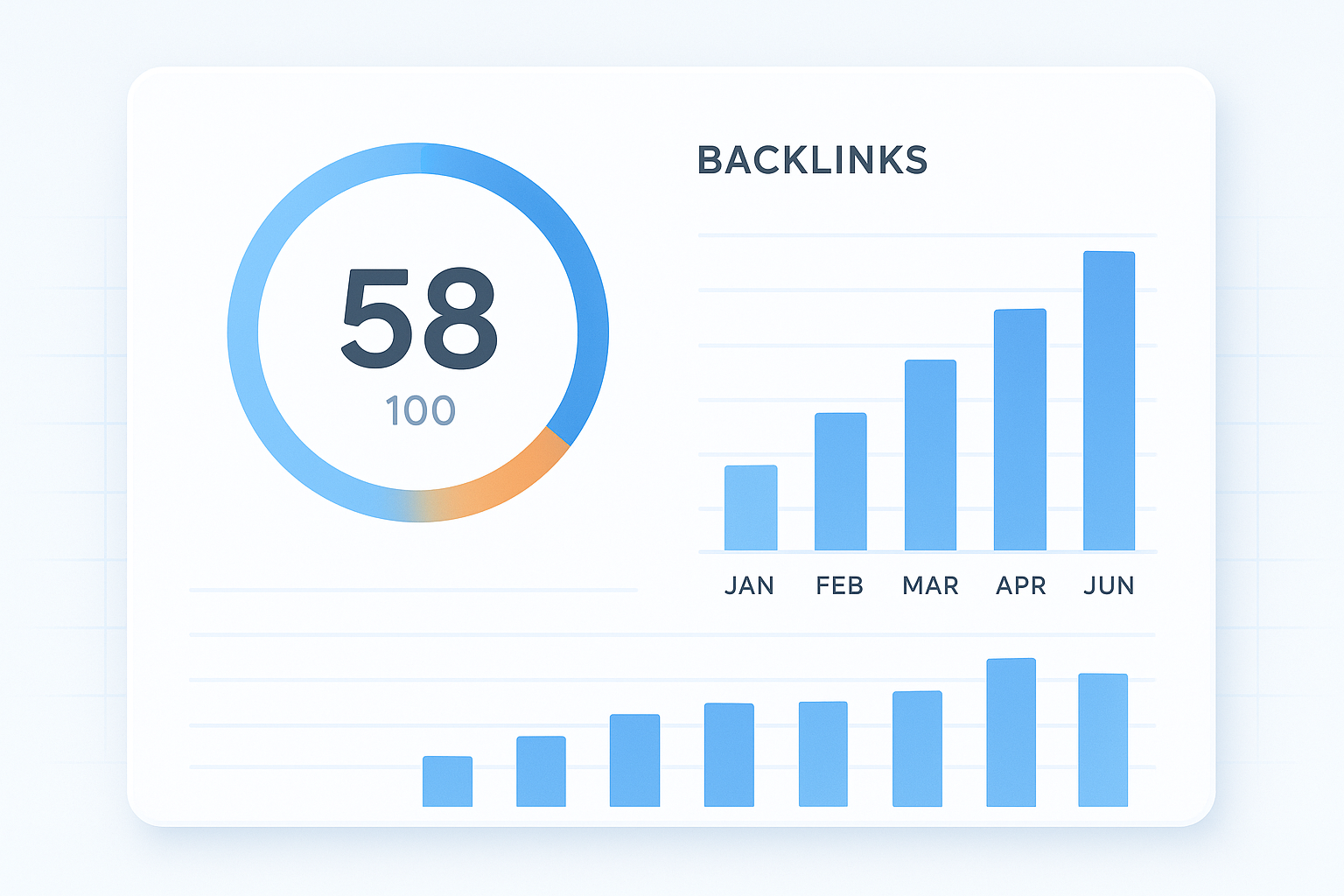
A domain ranking Moz dashboard illustrates how DA scores and backlink trends are tracked over time.
What Is Domain Ranking Moz and How Does It Work?
Domain Authority was created by Moz as a comparative benchmark. The score is calculated using a machine-learning model that analyzes hundreds of link-based signals, with the most influential being the number of unique linking root domains and the quality of those links. Because the scale is logarithmic, moving from a DA of 20 to 30 is far easier than moving from 60 to 70.
Additionally, DA is always recalculated relative to all other sites in Moz’s index. As a result, your score can fluctuate even when your own backlink profile has not changed — simply because competitors have grown faster. This is why context and competitor comparison matter more than focusing on a raw number.
How to Read Your DA Score
New websites typically start with a DA between 1 and 10. As they earn more backlinks, scores climb. The following ranges offer a general benchmark for interpreting your position:
DA 1–20
New or low-authority sites. Focus on building foundational links first.
DA 21–40
Developing authority. Consistent link-building is showing results.
DA 41–60
Good authority. Competitive in many niches.
DA 61–100
High authority. Reserved for major brands and established publishers.
In practice, the most useful comparison is always between your site and your direct competitors. For example, if you are targeting a niche keyword and your competitors average a DA of 35, reaching DA 40 puts you in a strong competitive position — even though 40 is objectively a mid-range score.
Five Steps to Improve Your Moz Domain Authority
Raising your DA requires a disciplined, long-term approach. Because the metric is driven almost entirely by your backlink profile, the following steps focus on earning and maintaining high-quality external links.
Step 1: Audit Your Current Backlink Profile
First, use Moz Link Explorer to review every backlink pointing to your domain. Identify spammy or irrelevant links and disavow them through Google Search Console. Toxic links drag down your link equity and can suppress your DA score over time.
Step 2: Analyze Competitor Link Profiles
Next, identify which high-DA domains link to your competitors but not to your site. These represent your most valuable outreach opportunities because the sites are already proven to link out in your niche. Building a prioritized list from this gap analysis makes your outreach far more efficient.
Step 3: Create Link-Worthy Content
Additionally, no outreach strategy succeeds without strong content to promote. Original research, comprehensive how-to guides, and data-driven studies naturally attract editorial backlinks. When other sites reference your work, those links carry the highest possible authority signal because they are earned rather than requested.

Strategic link building is the most reliable way to raise your Moz domain authority over time. For a deeper walkthrough, see our Domain Authority Ahrefs: Complete Guide (2024).
Step 4: Execute Targeted Outreach
With your content assets in place, reach out to relevant websites, journalists, and bloggers with personalized pitches. Generic mass outreach rarely works. Instead, tailor each message to explain specifically why your resource adds value to their audience. Resources like RankAuthority provide structured link-building services that can accelerate this process for sites that lack an in-house SEO team.
Step 5: Monitor and Iterate Monthly
Finally, track your DA and linking root domain count monthly. Because DA updates regularly as Moz recrawls the web, monthly monitoring helps you catch sudden drops early. Adjust your link-building focus based on which content types and outreach channels are producing the most new referring domains.
Common Mistakes That Hurt Your Score
Many site owners inadvertently suppress their DA by chasing link quantity over quality. Buying links from link farms, participating in private blog networks, or accepting guest post placements on irrelevant, low-DA sites can all introduce toxic signals into your backlink profile. Over time, these shortcuts do more damage than no link-building at all.
Another common mistake is ignoring Moz’s Spam Score metric. According to SEO best practices, sites with high Spam Scores on linking domains carry little positive link equity. Therefore, regularly auditing and disavowing these links protects your DA from unnecessary decay.
Moz DA vs. Competing Metrics
Moz DA is not the only domain-level authority metric available. Ahrefs offers Domain Rating (DR), and Semrush provides its own Authority Score. While all three measure link-based authority on a 100-point scale, they use different crawlers and algorithms — so scores will differ for the same domain across tools.
In practice, the best approach is to track one metric consistently rather than switching between tools. Consistency matters more than which tool you choose, because the goal is to measure relative progress over time. For many SEO professionals, Moz DA remains the industry standard for quick competitive comparisons, particularly because of how widely it is referenced in client reporting. Resources like RankAuthority also use DA as a core benchmark when evaluating link-building campaign performance.
Quick Answer
Domain ranking Moz (Domain Authority) is a 1–100 score that predicts a site’s search ranking potential based on its backlink profile. It is most useful as a relative benchmark for comparing your site against competitors, not as an absolute performance target.
Frequently Asked Questions About Domain Ranking Moz
What is domain ranking Moz and how is it calculated?
Domain ranking Moz, formally called Domain Authority, is a score from 1 to 100 developed by Moz to predict how well a website will rank in search results. It is calculated using a machine-learning model that factors in the number of linking root domains, link quality, and overall link profile strength.
What is considered a good Moz Domain Authority score?
A DA between 40 and 50 is average, 50 to 60 is good, and above 60 is excellent. However, DA is most useful as a relative metric — comparing your score to direct competitors matters more than chasing any specific number.
How long does it take to improve your Moz DA score?
Improving your DA typically takes three to six months of consistent link-building. Because DA is logarithmic, gains become progressively harder as your score increases.
Does Moz Domain Authority directly affect Google rankings?
No, DA is not a Google ranking factor — it is a third-party metric. However, the underlying factors that raise DA, such as quality backlinks and strong content, do influence Google rankings directly.
Why did my Moz DA score drop suddenly?
DA scores can drop when Moz updates its algorithm, when competitors gain links faster than you, or when you lose backlinks. A drop does not necessarily mean your SEO health has declined — always compare against competitors before drawing conclusions.
What is the difference between Domain Authority and Page Authority in Moz?
Domain Authority measures the ranking potential of an entire domain, while Page Authority measures the ranking potential of a single URL. Both use a 1 to 100 logarithmic scale based on backlink data.
How can I check my website’s Moz Domain Authority for free?
You can check your DA score for free using Moz’s Link Explorer at moz.com/link-explorer. Moz also offers a free browser extension called MozBar that displays DA and PA scores as you browse.
What types of backlinks raise Moz DA the most?
Editorially placed backlinks from high-DA, topically relevant domains raise your score the most. Links from authoritative news sites, universities, and government domains carry especially strong weight because they are difficult to earn and highly trusted.
Can internal linking improve my Moz Domain Authority?
Internal linking does not directly raise Domain Authority, which is driven by external backlinks. However, strong internal linking improves crawlability and distributes link equity across your site, which can support Page Authority for individual URLs.
Is Moz Domain Authority the same as Ahrefs Domain Rating?
No, they are different metrics from different tools. Moz DA and Ahrefs Domain Rating both measure link-based authority on a 100-point scale, but they use different algorithms, crawlers, and link indexes, so scores often differ for the same domain.
What common mistakes hurt a site’s Moz DA score?
Common mistakes include acquiring spammy or irrelevant backlinks, buying links from link farms, and neglecting regular link audits. Toxic links can drag down your score, so disavowing harmful links regularly is essential.
How does Moz’s Spam Score relate to Domain Authority?
Moz’s Spam Score flags sites with link patterns resembling penalized or low-quality domains. A high Spam Score on linking domains can negatively influence your DA because those links carry little positive weight and may signal manipulative link practices.
Conclusion
Understanding domain ranking Moz is one of the most practical starting points for any serious SEO effort. Although DA is not a direct Google signal, it reliably mirrors the backlink quality and content authority that search engines actually reward. By auditing your existing links, earning high-quality backlinks through strategic outreach, and monitoring your score consistently, you can build a domain that competes confidently in any niche. Focus on relative progress against your competitors, and your DA score will follow.

