

Generative SEO practices are the strategies that determine whether AI-powered search tools such as Google AI Overviews, ChatGPT, and Perplexity actually find, understand, and quote your website instead of a competitor’s. Search behavior has changed fast: rather than scrolling through ten blue links, people now read a single AI-generated summary and move on. As a result, the businesses that master generative SEO practices are the ones capturing visibility while everyone else quietly loses ground. This guide covers everything the topic demands — what generative SEO practices actually are, how they differ from traditional ranking tactics, exactly how to implement them step by step, and how to measure whether they’re working. By the end, you’ll have a complete, practical framework rather than a surface-level overview. Learn how to Improve Online Search Rankings with linked cluster strategies.
Quick answer: Generative SEO practices are the technical and content strategies that make a website’s information easy for AI models to locate, interpret, and cite — including structured data markup, direct-answer formatting, entity clarity, and demonstrated topical authority. Unlike ranking for position one, the goal is being the source an AI model chooses to quote.
What Are Generative SEO Practices?
Generative SEO practices are the set of methods used to make a website’s content easy for generative AI models to interpret, trust, and cite inside a synthesized answer. Unlike the keyword-focused tactics of the past decade, these practices prioritize clarity, structure, and verifiable facts. As a result, content becomes easier for AI systems to lift directly into a generated response instead of being paraphrased incorrectly — or skipped entirely.
Specifically, this involves combining traditional ranking factors with newer signals such as schema markup (code added to a page’s HTML that explicitly labels what each piece of content means), concise definitions, and clear source attribution. In particular, AI crawlers reward pages that state a conclusion first and support it with evidence afterward, rather than burying the answer three paragraphs deep. For a deeper breakdown of the underlying discipline, the introduction to generative engine optimization explains how this fits within the broader GEO framework, and the plain-language explanation of GEO breaks the terminology down further for teams still getting oriented.
Generative SEO Practices vs. Traditional SEO: What Actually Changes
Traditional SEO optimizes for a ranking position on a results page — you want to be link number one, two, or three. In contrast, generative SEO practices optimize for something entirely different: being the source an AI model chooses to synthesize into its own answer, with or without a clickable link attached. This distinction matters enormously, because a page can rank poorly in classic search yet still be cited frequently by an AI Overview if it answers a question with unusual clarity.
That said, the two disciplines aren’t opposites. Site speed, backlinks, and keyword relevance still matter under generative SEO practices — they just aren’t sufficient on their own anymore. Furthermore, AI models weigh factors like entity clarity (whether a page unambiguously identifies what it’s talking about), extractability (whether a paragraph can be lifted cleanly without losing meaning), and consistent topical coverage across a domain. For a full side-by-side comparison of how these two approaches diverge and overlap, see this detailed breakdown of GEO versus traditional SEO and the real difference between them.
Why AI Search Visibility Depends on These Practices
Search behavior is shifting quickly, and the data backs it up. According to Gartner, search engine volume is projected to drop by 25% by 2026 as users increasingly rely on AI chatbots and virtual assistants instead of traditional results pages (Gartner, 2024). Therefore, brands that ignore AI search optimization risk losing visibility even if their traditional rankings stay perfectly stable — the traffic simply moves somewhere else.
In contrast, sites that adapt early tend to capture disproportionate visibility because there is still relatively little competition for AI citations in most niches. Above all, this is a narrow window: as more competitors catch on, the advantage of being an early, well-structured source will shrink. For a broader look at where this trend is heading, see this analysis of the future of AI in SEO.

Generative SEO practices help AI models connect your content to relevant search queries.
Core Components of Generative Engine Optimization
Generative engine optimization, often abbreviated GEO, rests on a handful of core components. These include structured data, entity clarity, and content that can be extracted without losing meaning. Additionally, consistent topical coverage across related pages signals authority to AI crawlers — a single great article rarely carries the same weight as a well-linked cluster of related, equally strong pages.
Furthermore, technical foundations like fast load times and clean HTML still matter, since AI crawlers must access and parse a page before they can cite it. Notably, structured data built on the schema.org vocabulary gives AI systems an unambiguous map of what your content contains — Article, FAQPage, HowTo, and Product types are among the most useful for generative SEO practices. For practical implementation tips, review these best practices for using generative engine optimization.
How AI Search Engines Decide What to Cite
Not every AI system evaluates content the same way, and understanding these differences is where many guides on generative SEO practices fall short. Google’s AI Overviews draw heavily from pages that already rank well organically, then layer in structured data and freshness signals to decide which snippet to surface. Google documents much of this evaluation logic in its own Search Central documentation on AI features, which is worth reviewing directly.
ChatGPT and similar large language models, meanwhile, tend to favor content that was well-represented during training and reinforced by strong topical authority signals across the web — meaning brand consistency and repeated citation elsewhere genuinely help. Perplexity sits somewhere in between: it performs live retrieval, so a page’s real-time structure, clarity, and direct-answer formatting matter just as much as its historical authority. Consequently, a truly effective generative SEO practices strategy accounts for all three retrieval styles rather than optimizing for just one engine.
How to Implement Generative SEO Practices Step by Step
Implementing generative SEO practices doesn’t require rebuilding your entire site. Instead, follow a focused process that layers new signals onto your existing content.
- Audit your content for AI readability. Identify pages where answers are buried in long paragraphs rather than stated clearly near the top, and flag them for a rewrite.
- Add structured data markup. Implement FAQPage, HowTo, and Article schema so AI crawlers can parse your content’s meaning accurately instead of guessing at context.
- Rewrite key sections as direct answers. Ensure the first sentences of important paragraphs answer the implied question before adding supporting detail or nuance.
- Strengthen topical authority. Publish supporting content, cite credible sources, and display author credentials clearly so AI systems can verify expertise.
- Build a connected content cluster. Link related pages together so AI crawlers can confirm your site covers a topic comprehensively, not just in isolated posts.
- Monitor AI citation and adjust. Track whether pages appear in AI Overviews or chatbot answers, then refine underperforming content based on what gets cited elsewhere.
Notably, testing new formats consistently tends to outperform a one-time overhaul. If you’re looking for fresh angles to test, this collection of fresh SEO ideas for testing strategies is a useful starting point.
Answer Engine Optimization and Its Role in Generative Search
Answer Engine Optimization (AEO) is the discipline of structuring content so it directly answers a specific question, often in a single concise block. Consequently, AEO overlaps heavily with generative SEO practices because both aim to make content easy for AI systems to lift verbatim rather than reinterpret from scratch. For a focused AEO playbook, see Answer Engine Optimization explained for 2025.
For example, a well-formatted FAQ section or a numbered process, similar to the ones used throughout this article, is far more likely to be quoted than a dense narrative paragraph. In particular, models like those powering Perplexity and Google’s AI Overviews tend to favor sources that answer questions in the first few sentences (Wikipedia: Generative artificial intelligence).
Common Mistakes to Avoid in AI Content Optimization
One frequent mistake is stuffing pages with keywords instead of clear explanations, which actually hurts extraction accuracy rather than helping it. Another is skipping structured data entirely, leaving AI crawlers to guess at context they could otherwise read directly from your markup. Finally, many sites neglect author expertise signals — sometimes called E-E-A-T (Experience, Expertise, Authoritativeness, and Trust) — which weakens the trust score AI models use when selecting sources.
Similarly, publishing outdated statistics or leaving broken schema in place quietly erodes citation frequency over time, even on pages that once performed well. To see how these signals translate into measurable visibility gains, this explanation of how generative engine optimization improves website visibility covers the mechanics in more depth.

Structured, direct-answer content is far easier for AI models to cite accurately.
How to Measure the Success of Your Generative SEO Practices
Measurement is where many teams stall out, largely because standard analytics tools weren’t built to track AI citations. Even so, several concrete signals reveal whether your generative SEO practices are working.
- AI citation frequency: how often your brand or page is quoted inside AI Overviews, ChatGPT responses, or Perplexity answers.
- Referral traffic from AI platforms: visits arriving from chatbot links, which most analytics tools now segment separately from organic search.
- Share of voice: how your citation rate compares to competitors targeting the same questions.
- Traditional organic metrics: rankings, click-through rate, and impressions, since generative SEO practices build on these rather than replacing them.
As a result, the most reliable approach combines manual spot-checks — actually asking ChatGPT or Perplexity your target questions — with any AI-visibility reporting your analytics or automation platform provides.
Generative SEO Practices in Action: Real-World Examples
Context helps make these ideas concrete. An e-commerce brand, for instance, can apply generative SEO practices by adding Product and FAQ schema to category pages, which makes it far more likely an AI assistant recommends a specific model when a shopper asks a comparison question. Meanwhile, a local service business benefits from clear, structured location and service pages, since AI assistants increasingly answer “best plumber near me” style questions using structured local data rather than generic web results.
A SaaS company, on the other hand, tends to see the biggest lift from publishing direct-answer documentation and comparison pages, since AI models frequently cite these when users ask “what’s the difference between X and Y.” In every case, the underlying principle stays the same: clarity and structure beat volume. For a practical walkthrough of applying these ideas to your own site, this guide on enhancing your website’s visibility with GEO is a useful next step.
Tools and Automation for Generative SEO Success
Manually auditing structured data, rewriting content, and tracking AI citations across dozens of pages is time-consuming. As a result, many businesses turn to automation platforms to handle this work continuously rather than in occasional bursts.
For instance, RankAuthority offers a 1-Click AI AutoPilot tool specifically built to automate the technical and strategic layers of GEO and AEO. This is particularly useful for small business owners, digital marketers, and agencies managing multiple sites who don’t have time to master every algorithm update manually. Above all, the platform’s seven-day trial period allows teams to test results before committing.
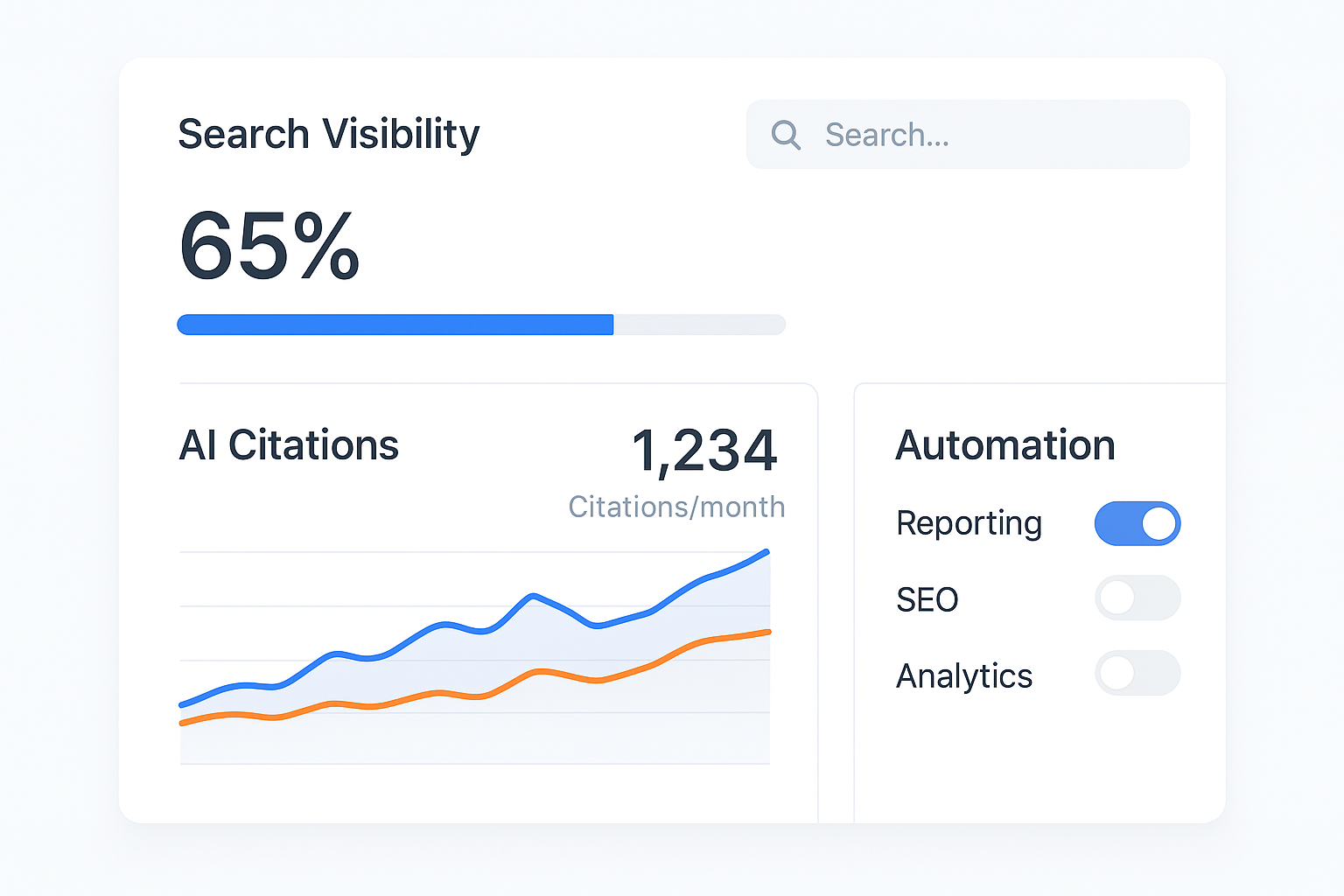
Automation platforms can track and adjust generative SEO practices without constant manual oversight.
The Expanding Role of GEO in Modern SEO Strategy
Ultimately, generative SEO practices shouldn’t be treated as a side project — they’re becoming a core part of any modern SEO strategy. In particular, teams that fold structured data, direct-answer writing, and AI-citation tracking into their normal content workflow tend to adapt faster than teams treating it as a one-off experiment. For a wider view of how this shift fits into an overall marketing strategy, see this overview of the role of GEO in modern SEO strategies.
Frequently Asked Questions About Generative SEO Practices
What are generative SEO practices?
Generative SEO practices are content and technical strategies designed to help AI systems like Google AI Overviews, ChatGPT, and Perplexity find, understand, and cite your website. They focus on clarity, structure, and factual accuracy rather than keyword volume alone.
How do generative SEO practices differ from traditional SEO?
Traditional SEO targets ranking positions on a results page, while generative SEO practices aim to get content quoted inside an AI-generated answer. Both rely on relevance and authority, but generative approaches prioritize structured, extractable answers.
Why are generative SEO practices important right now?
AI-generated answers are replacing a growing share of traditional search clicks, so unoptimized content risks losing visibility. Adopting generative SEO practices early helps brands stay discoverable as this shift accelerates.
How much does it cost to implement generative SEO practices?
Costs vary widely, from free manual adjustments like adding structured data to paid automation platforms that handle optimization continuously. Many tools, including RankAuthority, offer a risk-free trial period before any commitment.
How long does it take to see results from generative SEO practices?
Most sites see initial improvements in AI citation and visibility within four to eight weeks of consistent optimization. Full authority building typically takes three to six months, similar to traditional SEO timelines.
What tools help automate generative SEO practices?
Platforms that combine structured data automation, content scoring, and AI-readiness audits are the most effective. RankAuthority’s 1-Click AI AutoPilot is one example built to automate GEO and AEO tasks for businesses and agencies.
What is the difference between GEO and AEO?
GEO focuses on getting content referenced inside AI-generated summaries, while AEO focuses on structuring content to directly answer specific questions. Both fall under the broader umbrella of generative SEO practices.
What common mistakes should I avoid with generative SEO practices?
Common mistakes include vague answers, missing structured data, and ignoring E-E-A-T signals like author expertise. Overloading pages with keywords instead of clear explanations also hurts AI extraction.
Can small businesses use generative SEO practices effectively?
Yes, small businesses often benefit the most because generative SEO practices reward clarity and specificity over sheer content volume. A single well-structured FAQ page can outperform a competitor’s unstructured content.
How do AI search engines decide which content to cite?
AI systems tend to favor content with clear definitions, structured headings, verifiable facts, and schema markup that makes information machine-readable. Sites with consistent topical authority are cited more frequently.
What content formats work best for generative engine optimization?
Direct-answer paragraphs, numbered steps, comparison tables, and FAQ sections tend to perform best because AI models can extract them cleanly. Long, unstructured prose is harder to summarize accurately.
Do generative SEO practices replace traditional SEO entirely?
No, generative SEO practices build on traditional SEO fundamentals like site speed, backlinks, and keyword relevance rather than replacing them. The two approaches work together to maximize visibility.
How do I measure the success of generative SEO practices?
Track AI citation frequency, referral traffic from chatbots, and appearances in AI Overviews alongside standard metrics like organic traffic and rankings. Several optimization platforms now report these AI-specific metrics directly.
Does E-E-A-T matter for generative SEO practices?
Yes, Experience, Expertise, Authoritativeness, and Trust signals directly influence whether AI models treat a source as reliable enough to cite. Displaying author credentials and citing credible sources both strengthen these signals.
How often should I update content for generative SEO practices?
Review and refresh key pages every 60 to 90 days since AI models favor current, accurate information. Outdated statistics or broken structured data can quickly reduce citation frequency.
Final Thoughts on Generative SEO Practices
In summary, generative SEO practices combine structured data, direct-answer formatting, and demonstrated authority to help content earn visibility inside AI-generated search results. As search behavior continues shifting toward AI Overviews and chatbot answers, sites that adapt now will hold a meaningful advantage over those that wait. Whether you handle optimization manually or rely on automation like RankAuthority’s 1-Click AI AutoPilot, the underlying goal remains the same: make your content easy for AI systems to find, trust, and quote. Ultimately, consistent application of generative SEO practices today builds the search authority that will matter most tomorrow. Author: RankAuthority Editorial Team. Last updated: 2026-08-14.

