

How to Optimize for Google AI Overviews in 2025: The Complete Strategy Guide
To optimize for Google AI overviews means deliberately engineering your content so that Google’s generative AI engine selects it as a cited, trusted source inside the synthesized answer blocks appearing at the very top of search results — before any traditional organic result is ever seen. In 2025, this is the single most consequential shift in SEO since Google’s Panda update. This guide gives you every actionable strategy to compete and win. Include a visible author byline and short bio with verifiable credentials plus a clear "Last updated" date to strengthen E‑E‑A‑T.
Google AI Overviews — formerly the Search Generative Experience (SGE) — have permanently altered how users consume search results. Learn how to Optimize for Google AI Overviews. Rather than scrolling through ten blue links, users receive an AI-generated, sourced summary positioned above all organic listings. That summary can make or break your site’s traffic in 2025. Being cited inside it is the new #1 position.
This guide covers every layer of the optimization process: what AI overviews are, how Google selects sources, the precise strategies that earn citations, the technical signals that matter, the content mistakes that disqualify pages, and how to measure your progress over time — all in one Complete 2025 guide.
Quick Answer
To optimize for Google AI overviews, produce content that directly answers specific questions in the first 100 words, demonstrates strong E-E-A-T signals, uses structured formatting (numbered lists, definition blocks, comparison tables, FAQs), builds topical authority through content clustering, implements relevant schema markup, targets long-tail and question-based queries, and maintains consistent technical SEO health. Google’s AI selects sources that are clear, factually accurate, comprehensively helpful, and structurally easy to parse — not simply highly ranked. For hands-on content creation workflows, see AI SEO content.
What Are Google AI Overviews — and Why Do They Dominate 2025?
Google AI Overviews is the generative AI layer embedded directly into Google Search results, powered by Google’s Gemini model. When a user searches an informational query, Google’s AI reads and synthesizes multiple web sources in real time, then generates a structured, cited answer block that appears above every traditional organic result on the page. For guidance on writing AI-friendly content, see how to optimize content for AI search.
AI overviews were rolled out broadly in the US in May 2024 under Google’s “AI Overviews” branding, replacing the experimental SGE (Search Generative Experience) label. By 2025, they appear for hundreds of millions of queries globally, spanning informational, how-to, definitional, comparison, and research-oriented searches.
According to Wikipedia’s overview of Google Search, the platform processes billions of queries every day. AI overviews now intercept a substantial and growing portion of those — particularly the high-intent, research-driven searches that historically delivered the most valuable organic traffic.
The Traffic Impact: Why Being Cited Matters More Than Ranking #1 — and how to get cited in conversational search.
Early data from 2024 consistently showed AI overview presence reducing click-through rates to uncited organic results, sometimes significantly — while simultaneously driving concentrated, high-intent traffic to cited sources. The dynamic has created a two-tier SERP: those cited inside the AI overview, and everyone else competing for attention below it.
This is not simply about ranking higher. Pages ranked #5, #8, or even outside the top 10 have been observed receiving AI overview citations when their content quality and structure outperform pages ranked above them. The implication is decisive: to optimize for Google AI overviews is a separate discipline from traditional rank optimization, and it requires its own strategy.
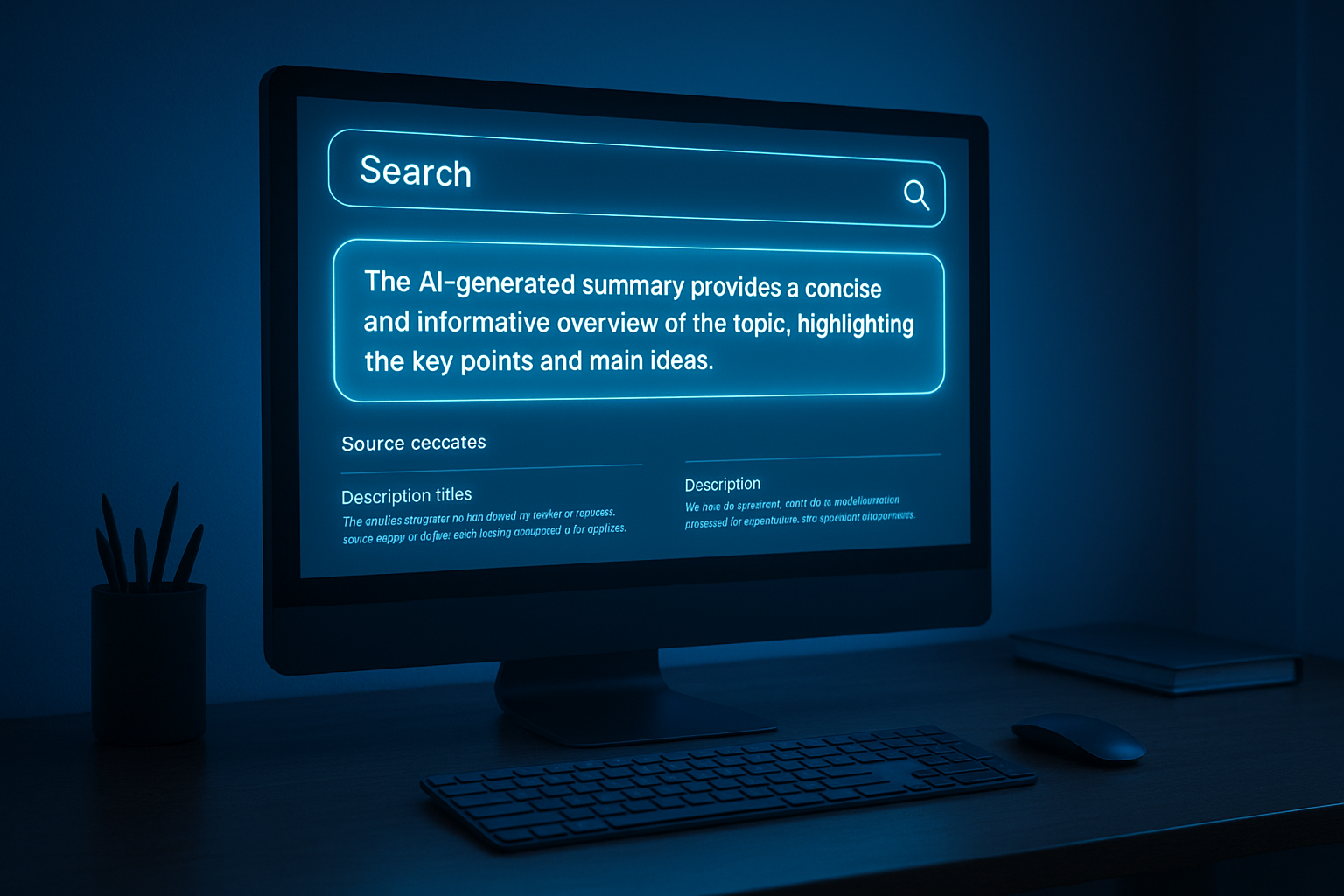
Understanding how AI overviews appear in search is the essential foundation for learning how to optimize for Google AI overviews effectively.
How Google Selects Sources for AI Overviews
Google has not published a definitive, step-by-step source selection algorithm for AI overviews. However, through analysis of which pages consistently earn citations and which do not, a clear pattern of evaluation criteria has emerged. Understanding these signals is the prerequisite to any effective optimization effort.
Google’s AI actively evaluates each candidate source across multiple dimensions:
- Query relevance precision: Does the page directly and explicitly address the exact query — not a generalized version of it?
- Answer directness: Is the core answer stated clearly, early, and without excessive qualification or hedging?
- Topical comprehensiveness: Does the content cover the full scope of the subject, not just one narrow angle?
- Structural parsability: Is the content organized into clearly segmented sections, lists, tables, or definitions that the AI can cleanly extract?
- E-E-A-T strength: Does the page demonstrate real Experience, genuine Expertise, recognized Authority, and documented Trustworthiness? For a deeper walkthrough, see our guide to getting cited in conversational search.
- Source credibility signals: Does the page cite authoritative references, link out to reputable sources, and avoid unverified claims?
- Content freshness: Is the information current, accurate, and recently verified?
- Technical accessibility: Can Google’s crawler fully access, render, and index the page without encountering errors, blocks, or slow load times?
Critically, Google’s AI does not simply mirror the organic ranking order. A page ranked 7th can be cited in an AI overview while the #1 ranked page is ignored — if the 7th-place page more effectively meets the criteria above. This is what makes AI overview optimization both an opportunity and a strategic imperative.
What It Actually Means to Optimize for Google AI Overviews
To optimize for Google AI overviews is to align every dimension of your content strategy — structure, depth, credibility, technical health, and query mapping — with the signals Google’s AI uses to evaluate, trust, and cite sources. It is not keyword stuffing. It is not simply writing longer content. It is a holistic discipline that treats AI citation as the primary performance metric rather than traditional rank position.
The distinction from traditional SEO is important. Classic SEO focused on matching keywords, earning backlinks, and accumulating domain authority. AI overview optimization requires all of that — plus explicit answer engineering, precision formatting, semantic content clustering, and consistent factual accuracy. The bar is higher, the evaluation is more nuanced, and the reward for getting it right is disproportionately large.
Key Distinction
Traditional SEO asks: “How do I rank higher for this keyword?” AI overview optimization asks: “How do I make my content the most credible, direct, and well-structured answer Google’s AI can find for this query?” These goals overlap significantly — but not completely. Both are required for dominance in 2025. See our Artificial Intelligence SEO coverage for broader AI-driven ranking strategies.
9 Proven Strategies to Optimize for Google AI Overviews
1. Lead With a Direct, Declarative Answer — Immediately
Google’s AI is built to extract the clearest, most direct answer from each candidate source. If your answer is buried beneath a lengthy preamble, the AI will either skip your page or extract a weaker passage from deeper in the content. Place your primary answer in the first 100 words. Use declarative, confident language — not hedged qualifications.
Think of it like writing a dictionary entry before the essay: give the definition first, then the elaboration. Pages that open with “In today’s fast-paced digital landscape…” signal to the AI that useful content may not begin for several paragraphs — a signal that costs you citations.
2. Build Deep, Interconnected Topical Authority
A single excellent article rarely earns sustained AI overview citations in isolation. Google’s AI rewards sites that demonstrate consistent, expert-level coverage across a topic cluster. If your site has one strong article on AI overviews but nothing surrounding it, the AI treats it as less authoritative than a site with a full ecosystem of related, interlinked content.
Build your topical authority systematically: create beginner guides, advanced breakdowns, comparison pieces, case studies, FAQ hubs, and tool reviews — all internally linked through a coherent architecture. See Optimize for Google AI Overviews.
3. Use Structured Formatting as a Core Content Strategy
Google’s AI parses structured content far more effectively than unbroken prose. Structure is not a stylistic preference — it is a functional signal to the AI about where extractable, citable content lives. Use the following formats intentionally throughout every article: see Google AI Overviews guide for formatting examples.
4. Strengthen Every E-E-A-T Signal on Your Page and Domain
Experience, Expertise, Authoritativeness, and Trustworthiness are not abstract ideals — they are evaluated through concrete, identifiable signals that Google’s AI actively weighs when selecting AI overview sources. Weak E-E-A-T is one of the most common reasons otherwise well-written pages fail to earn citations.
Strengthen E-E-A-T through these specific, actionable measures:
- Author bios with verifiable credentials: Name, title, professional background, and links to professional profiles (LinkedIn, institutional pages) on every article.
- Primary source citations: Link out to original research, official Google documentation, peer-reviewed studies, and authoritative industry publications — not just to other blog posts.
- Factual accuracy and currency: Review and update your most important pages at least quarterly. Stale data is one of the fastest ways to lose AI overview citations.
- Transparent editorial standards: Publish visible content policies, fact-checking procedures, and correction notices when errors are found.
- Earned backlinks from respected publications: Third-party endorsements remain a powerful trust signal even in the AI overview era.
- Demonstrate real-world experience: Where relevant, include original insights, first-person experimentation, or proprietary data — content that could only exist if the author had genuine experience with the subject.
5. Implement Schema Markup Precisely and Completely
Schema markup provides Google’s AI with explicit, machine-readable context about your content’s type, structure, and intent. It eliminates ambiguity — telling the AI exactly what kind of content it’s reading, what questions it answers, and what steps it describes. This directness significantly increases the probability of extraction and citation. For concrete schema examples and templates, see Optimize for Google AI Overviews (schema examples).
Deploy these schema types based on your content structure:
FAQPage— for any article containing explicit Q&A sectionsHowTo— for numbered instructional processesArticleorBlogPosting— for standard editorial contentDefinedTerm— for glossary-style definition contentBreadcrumbList— to provide clear site hierarchy signalsWebPage— to provide page-level metadata including speakable selectors
Always validate your schema using Google’s Rich Results Test before publishing. Invalid or malformed schema is ignored entirely by the AI — and can potentially confuse crawlers about your content’s purpose.
6. Map Content to Long-Tail and Question-Based Query Patterns
AI overviews appear most frequently for long-tail, conversational, and question-based queries — searches beginning with “how,” “what,” “why,” “which,” “when,” and “can.” These queries signal that users want a synthesized explanation, not just a list of links — making them the primary triggers for AI overview generation.
Research these queries systematically using Google’s “People Also Ask” boxes, Google Search Console query data, keyword research platforms, and your own site search analytics. For each significant question your audience asks, create a dedicated content section that answers it directly and completely within 150–250 words — the length range AI tends to extract most reliably. For audit checklists and templates, see our AI visibility audit guide.
Do not simply answer the surface question. Anticipate and address the follow-up questions that naturally arise from it. If a user asks “how do AI overviews work,” they likely want to know who triggers them, what sources get cited, and how rankings relate to citation frequency — address all of it in sequence.
7. Engineer Content for Both AI Extraction and Human Engagement
One of the most important nuances in AI overview optimization is that content must simultaneously serve two audiences: Google’s AI (which needs structure, directness, and factual precision) and human readers (who need engagement, narrative flow, and useful depth). Pages that optimize only for AI extraction tend to read as sterile and robotic, reducing dwell time and increasing bounce rates — signals that ultimately hurt overall trustworthiness.
The solution is layered content architecture: lead each section with a directly extractable answer (for the AI), then follow it with context, examples, data, and nuance (for the human reader). This way, the AI gets its clean extraction point and the reader gets a genuinely useful experience — both goals achieved simultaneously.
8. Develop Consistent Content Freshness and Update Cadence
Google’s AI strongly favors content that is demonstrably current and factually maintained. This is especially true in fast-moving categories like SEO, AI, technology, and finance — where outdated information can actively mislead users. Pages that were cited last quarter can lose their citations when newer, more accurate content emerges. See Artificial Intelligence SEO for complementary insights on freshness and update cadence.
Establish a formal content update schedule. Audit your most important pages quarterly. When you update content, add a visible “Last Updated” date so both Google’s AI and human readers can confirm the information is current. Make meaningful updates — add new data points, revise outdated statistics, expand sections where the landscape has shifted — not just cosmetic tweaks.
Pay particular attention to: statistics with specific years attached, references to specific platform features (which change frequently), pricing data, regulatory or policy information, and any claim that begins with “currently” or “as of.”
9. Monitor AI Overview Signals and Iterate Continuously
Optimization for AI overviews is not a publish-and-forget exercise. Google’s AI continuously refines which sources it trusts based on quality signals, user engagement data, and evolving content landscapes. What earns a citation today may lose it within weeks if a better-structured competitor page emerges.
Use Google Search Console to monitor impressions, clicks, and query data for pages you are trying to get cited. Look for queries where your page appears in traditional results but not in the AI overview — these are your highest-priority optimization targets. Track changes in impression volume after you update content structure, add schema, or improve E-E-A-T signals. Learn practical content workflows in AI SEO Content Creator.
For more granular, real-time monitoring, Rank Authority’s real-time SEO issue alerts can flag technical problems and content gaps the moment they emerge — before they cost you AI overview citations. Their AI SEO features are specifically designed to keep your optimization strategy current as generative search continues to evolve rapidly through 2025 and beyond.

Structured content planning and continuous monitoring are both essential when you optimize for Google AI overviews — one without the other is insufficient.
Technical SEO Factors That Directly Affect AI Overview Inclusion
Content quality alone cannot earn AI overview citations if the technical foundation of your page prevents Google’s AI from accessing, rendering, or trusting your content. Technical SEO and AI overview optimization are not separate disciplines — they are deeply interconnected, and failures in technical infrastructure will override even excellent content quality.
Page Speed and Core Web Vitals
Slow-loading pages impair Google’s ability to crawl and render your content efficiently. Aim for a Largest Contentful Paint (LCP) under 2.5 seconds, a Cumulative Layout Shift (CLS) score under 0.1, and an Interaction to Next Paint (INP) under 200ms. Use Google’s PageSpeed Insights and Core Web Vitals report in Search Console to identify and resolve performance bottlenecks.
Crawlability and Indexability
Verify that your robots.txt file does not block Googlebot from crawling your content pages. Confirm your most important pages are indexed using the URL Inspection tool in Search Console. Resolve any “Crawled — currently not indexed” or “Discovered — currently not indexed” status issues, as these pages will never be considered for AI overview citation regardless of content quality.
Mobile Friendliness and Rendering
Google uses mobile-first indexing, meaning the mobile version of your page is what Google’s AI primarily evaluates. Ensure your content is fully accessible, readable, and structurally intact on mobile devices. Content that is hidden behind tabs, accordions, or lazy-load mechanisms on mobile may not be fully accessible to Google’s rendering engine — and therefore may not be available for AI overview extraction.
HTTPS and Site Security
HTTPS is a baseline trust signal. Pages served over HTTP are treated as less trustworthy by both Google’s algorithms and users. Ensure your site uses a valid SSL certificate with no mixed-content warnings. Redirect all HTTP URLs to their HTTPS equivalents with proper 301 redirects.
Internal Linking Architecture
Isolated pages lack the topical authority signals that come from a well-connected content ecosystem. Every important page on your site should receive internal links from related, contextually relevant articles. Use descriptive, keyword-rich anchor text in internal links — not generic “click here” or “read more” phrasing. A well-built internal link structure distributes authority across your content cluster and reinforces the topical depth signals that AI overviews reward. See our guide to Get cited in conversational search for internal-link examples that earned citations.
Which Content Types Trigger Google AI Overviews Most Often
Not all queries trigger AI overviews equally. Understanding which search intents and content types are most likely to generate an AI overview — and then structuring your content to match those patterns — is a fundamental optimization lever that most content creators underutilize.
- Informational queries (highest trigger rate): Searches seeking explanations, definitions, or educational content — “what is,” “how does,” “why does,” “explain.” These are the dominant AI overview trigger category.
- How-to and instructional queries: Step-by-step process searches — “how to optimize for Google AI overviews,” “how to set up,” “how to fix.” Google’s AI frequently generates structured step-list overviews for these.
- Comparison queries: Searches evaluating alternatives — “X vs Y,” “best tools for,” “which is better.” AI overviews for these often pull from comparison tables and structured pros/cons lists.
- Research and background queries: Multi-faceted questions requiring synthesized answers — “what factors affect,” “what are the benefits of,” “what causes.” These trigger overview blocks that cite multiple sources.
- Transactional queries (lower trigger rate): Commercial queries with clear purchase intent generate AI overviews less frequently, though this is evolving. Shopping-related overviews are expanding in some verticals.
- YMYL (Your Money, Your Life) queries (selective): Medical, legal, financial, and safety queries do trigger AI overviews but are subject to extremely high E-E-A-T requirements — Google is more conservative about which sources it cites in these categories.
Common Mistakes That Block AI Overview Citations
Many pages with genuine quality fail to earn AI overview citations because of avoidable, correctable mistakes. Understanding these failure patterns is as important as understanding the optimization strategies — because fixing one critical error can unlock citations that no amount of additional content creation will achieve.
- Vague or hedged answers: Google’s AI strongly prefers confident, declarative statements. Phrases like “it depends,” “some experts believe,” or “results may vary” without concrete follow-up reduce extractability significantly.
- Thin content: Pages under 600–800 words rarely provide sufficient depth for AI citation consideration, regardless of how well they rank traditionally. The AI needs enough substance to synthesize from.
- Burying the answer: If your direct answer appears in paragraph 6 after five paragraphs of scene-setting, Google’s AI is likely to miss it or deprioritize your page in favor of sources that answer immediately.
- Technical access barriers: Slow load times, crawl errors, blocked JavaScript, or noindex tags prevent Google’s AI from reading your content at all — making every other optimization effort irrelevant.
- Outdated or inaccurate information: Google’s AI has mechanisms to detect factual inaccuracy and content staleness. Pages with demonstrably outdated claims lose citations rapidly when fresher sources are available.
- No internal linking ecosystem: Pages that exist as isolated islands signal low topical authority. The AI treats connected, interlinked content clusters as more authoritative than standalone articles.
- Ignoring schema markup entirely: Absent schema markup leaves the AI to infer your content’s type, structure, and purpose on its own — a process that introduces uncertainty and reduces citation probability.
- Over-optimizing for keywords at the expense of usefulness: Keyword-stuffed content that sacrifices clarity and usefulness for density is detected and penalized. The AI rewards helpfulness, not repetition.
- No clear authorship or organizational identity: Anonymous content with no author attribution and no organizational context is inherently less trustworthy to Google’s E-E-A-T evaluation. Every article should be attributable to a named, credentialed author or a recognized organization.
How to Measure and Track Your AI Overview Performance
Measuring AI overview performance is still an evolving discipline — Google has not provided a dedicated, direct AI overview report in Search Console. However, there are concrete methods to approximate your citation status and track progress over time.
Google Search Console: The Primary Monitoring Tool
Use Search Console’s Performance report to identify queries generating impressions but low clicks — these often indicate your page appears in a SERP dominated by an AI overview that captures user attention before clicks occur. Filter by “Search type: Web” and sort by impression volume. Pages with high impressions and unusually low CTR for their ranking position are frequently suppressed by an AI overview — meaning optimizing for AI overview citation on those queries should be a top priority.
Manual SERP Spot Checks
For your most important target queries, conduct regular manual Google searches using an incognito window. Check whether an AI overview appears, which sources are cited, and where your content appears in relation to cited sources. Document these checks systematically over time to track citation gains or losses after content updates.
Third-Party AI Overview Monitoring Tools
Several SEO platforms have begun building AI overview tracking capabilities. Use these to monitor citation frequency across large keyword sets at scale — manual spot checks are insufficient for sites targeting dozens or hundreds of queries simultaneously. Real-time alerting, like that offered by Rank Authority’s issue alert system, ensures you are notified the moment a technical problem emerges that could cost you an AI overview citation — rather than discovering the issue weeks later during a routine audit. See tool comparisons in AI SEO Optimization Tools.
Engagement Metrics as Indirect Citation Signals
Pages receiving traffic from AI overview citations tend to attract high-intent visitors who already have context from the AI-generated summary. Watch for changes in time-on-page, scroll depth, and conversion rates when you update content for AI overview optimization. Unexpectedly high-quality traffic patterns on previously low-traffic pages can indicate newly earned AI overview citations that aren’t yet fully visible in other reporting tools.
Frequently Asked Questions About Optimizing for Google AI Overviews

Google’s AI evaluates content through sophisticated neural networks — building a sustainable strategy to optimize for Google AI overviews requires understanding and working with these systems, not around them.
Conclusion
To optimize for Google AI overviews in 2025 is to master the most consequential frontier in modern SEO. The pages that earn AI overview citations capture user attention before any organic result is seen, command disproportionate high-intent traffic, and establish topical authority that compounds over time. The pages that don’t are increasingly invisible to a significant share of search users. Last updated: 2026-07-02. Author: Rank Authority SEO Team (see About page for credentials). Add a visible author byline and a clear "Last updated" date on this page, and link to a short author bio with verifiable credentials to strengthen E-E-A-T.
The strategy is clear: answer directly and early, build genuine topical authority through interconnected content, format everything for AI parsability, strengthen E-E-A-T signals at every level, implement schema markup precisely, target the question-based query patterns that trigger AI overviews most often, maintain technical SEO health rigorously, and monitor your performance continuously with the tools and processes to iterate quickly.
Start today: audit your highest-value pages against each of the nine strategies in this guide, identify your weakest signals, fix the technical barriers first, then systematically improve your content depth and structure. The AI overview landscape will keep evolving — but the fundamentals of being the clearest, most credible, most structurally accessible answer to a user’s question will not.

