A broken link repair service for websites is a professional or automated process that identifies, audits, and fixes every hyperlink on a site that leads to a missing, deleted, or relocated page — most commonly generating a 404 Not Found, 410 Gone, or 500 Server Error response. Whether you manage a personal blog, a SaaS platform, or a large e-commerce store, unresolved broken links quietly erode your search engine rankings, frustrate real visitors, and waste your precious crawl budget. This guide covers every dimension of the topic: what broken links are, why they matter for SEO and user experience, how to find them using the right tools, how a professional repair service works step by step, how much it costs, how to choose the right service, and how to prevent broken links from coming back.
Quick Answer
A broken link repair service for websites crawls every internal and external link across your entire site, classifies each broken URL by error type and severity, and either automatically fixes the issue or delivers a prioritised repair report — protecting your SEO link equity, improving crawl efficiency, and ensuring every visitor reaches a live, relevant page.
What Is a Broken Link Repair Service for Websites?
A broken link repair service for websites is a structured workflow — executed by a specialist agency, a dedicated software platform, or a combination of both — that systematically crawls every URL on your site, tests each hyperlink for a valid HTTP response, and flags those returning error codes such as 404 Not Found, 410 Gone, 500 Internal Server Error, or 503 Service Unavailable. The service then either automatically redirects or removes the broken links, or delivers an actionable report so your team can resolve each one efficiently.
According to Wikipedia’s entry on HTTP 404, a 404 error is returned when a server cannot find the requested resource — the most common outcome when a broken link is followed. Left unaddressed, these errors accumulate and compound your site’s technical debt, forming a silent drag on every metric that matters: rankings, traffic, and conversions.
A high-quality broken link repair service is distinguished from a basic link checker by what it does after discovery: it contextualises each broken link by page authority, traffic level, and link type; it recommends the correct fix for each scenario; and it verifies that every fix resolves the underlying error without introducing new problems such as redirect loops or chains.

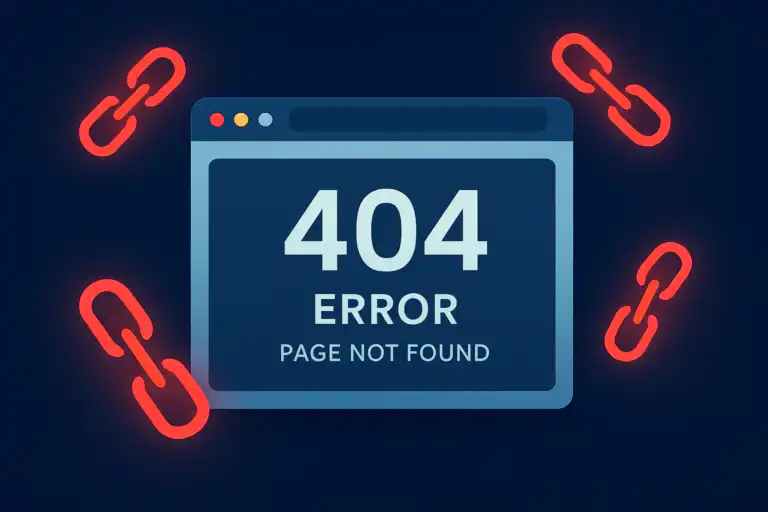
A 404 error is the most visible symptom a broken link repair service for websites is designed to resolve.
What Causes Broken Links on a Website?
Understanding the root causes of broken links is critical before selecting a repair strategy. The most common triggers include:
- Page deletions without redirects: The single most common cause. A page is removed during a site redesign or content audit, but no 301 redirect is set up to forward visitors and crawlers to a relevant replacement.
- URL structure changes: Changing a permalink format — for example, from
/blog/post-nameto/articles/post-name— instantly breaks every internal link pointing to the old structure. - CMS or platform migrations: Moving from one CMS to another (e.g. WordPress to Shopify, or vice versa) frequently produces mass broken links if URL mapping is not planned carefully.
- External pages going offline: Third-party sites you link to may delete pages, restructure their domains, or cease operating entirely — turning your outbound links into dead ends.
- Typos in manually entered URLs: A single mistyped character in an href attribute creates an instant broken link that a crawl tool will catch but human proofreading easily misses.
- Protocol changes: Sites migrating from HTTP to HTTPS without proper redirects across all URLs will generate broken links for any page still referenced under the old protocol.
- Content moved behind authentication: Pages that were public but are now gated or login-protected return a different error code and effectively become broken for external visitors.
- Domain changes or rebranding: If a business changes its domain name and does not redirect the old domain comprehensively, every inbound link pointing to the old domain becomes broken.
Important Note
Most broken links are not the result of negligence — they are a natural byproduct of websites evolving over time. The problem is not their existence; the problem is leaving them unmonitored. A continuous broken link repair service for websites transforms a reactive problem into a proactive, managed process.
Types of Broken Links: Internal, External, and Redirect Chains
Internal Broken Links
Internal broken links point to pages within your own domain that no longer exist or have changed URLs. These are fully within your control and should be your first priority. They directly interrupt the flow of link equity between your pages, disrupt site architecture, and signal to Googlebot that your site is poorly maintained. Common causes include page deletions during a redesign, permalink structure changes, and CMS migration errors.
External Broken Links (Outbound)
External broken links point outward to third-party pages that have been removed, moved, or taken offline. While you cannot control external sites, you are entirely responsible for the quality of links you publish. Regularly auditing and replacing dead outbound links with updated or equivalent sources demonstrates editorial quality — a trust signal search engines increasingly value. An external dead link also harms user experience: a reader who clicks expecting a citation or resource and reaches a 404 page loses confidence in your content.
Redirect Chains and Redirect Loops
Beyond simple broken links, two related issues cause comparable SEO damage: redirect chains (where URL A redirects to URL B, which redirects to URL C, and so on) and redirect loops (where the chain circles back to an earlier URL, creating an infinite loop). Both dilute link equity, slow page load times, and frustrate crawlers. A comprehensive broken link repair service for websites should identify and flatten redirect chains as part of its standard workflow.
Internal Broken Links
- Within your own domain
- Fully in your control
- Fix with 301 redirects
- Highest SEO priority
External Broken Links
- Point to third-party pages
- Cannot control destination
- Fix by replacing the link
- Harms trust & UX
Redirect Chains & Loops
- Multi-hop redirect paths
- Dilutes link equity
- Slows page speed
- Flatten to direct 301s

Understanding the difference between internal and external broken links is essential when planning a repair strategy.
Why Broken Links Are a Silent SEO Killer
Search engine crawlers — including Googlebot — follow every accessible link on your site to discover, evaluate, and index content. When a crawler encounters a broken link, it hits a dead end. The consequences are not theoretical — they are measurable and compounding.
Crawl Budget Waste
Every website receives a finite crawl budget — the number of URLs Googlebot will crawl in a given period. When crawlers spend that budget following links to 404 pages and dead-end URLs, important live pages may go unindexed entirely. For large sites with thousands of pages, this is not a theoretical risk — it is a concrete, measurable consequence.
Lost Link Equity
When a high-authority page on your site links to a deleted internal page, the link equity (PageRank) that would have flowed through that link simply evaporates. It is not redistributed — it is lost. Over a large site with hundreds of broken internal links, this represents a significant and entirely preventable erosion of ranking power.
User Experience Degradation
A visitor who clicks a link and reaches a 404 page has had their journey interrupted. The likely result: they return to the search results and choose a competitor. This increases your bounce rate, reduces time-on-site, and — if it happens often enough — sends negative engagement signals that depress your rankings further.
E-E-A-T and Site Quality Signals
Google’s E-E-A-T (Experience, Expertise, Authoritativeness, Trustworthiness) framework evaluates site quality holistically. A site riddled with broken links signals poor maintenance, outdated content, and editorial negligence — all of which undermine the trust signals Google uses to evaluate whether your content deserves to rank.
Full Impact Summary
SEO Damage
- Wasted crawl budget
- Lost link equity flow
- Lower page authority scores
- Reduced indexation rate
- Negative E-E-A-T signals
- Diluted internal linking architecture
User Experience Damage
- Higher bounce rates
- Reduced trust and credibility
- Abandoned conversion paths
- Negative brand perception
- Increased pogo-sticking to SERPs
- Lost sales and leads
How to Find Broken Links on Your Website
Identifying broken links is the essential first step before any repair work can begin. The right tool depends on your site’s size, your technical resources, and how frequently you need to audit.
Free Broken Link Checker Tools
For a fast, zero-setup audit, Rank Authority’s free broken links checker scans your site and returns a clear, actionable list of every dead URL — no installation or technical knowledge required. It is ideal for a first audit or for site owners who need a quick health check. For a deeper walkthrough, see our Backlink Authority Checker: The Complete 2024 Guide.
Google Search Console
Inside Google Search Console, navigate to Pages > Not Indexed > Not Found (404). This report shows every URL Googlebot has attempted to crawl and received a 404 response for — an authoritative source of broken internal links affecting your indexation. The Core Web Vitals and Coverage reports also surface crawl errors that indicate underlying link problems.
Dedicated Crawl Software
Tools like Screaming Frog SEO Spider and Sitebulb crawl your entire site and export broken link reports with full context — including the source page of each broken link, its anchor text, its HTTP response code, and its depth within the site architecture. These tools are the gold standard for technical SEO audits on medium-to-large sites.
Ahrefs, Semrush, and All-in-One SEO Platforms
Enterprise SEO platforms such as Ahrefs Site Audit and Semrush Site Audit not only identify broken links but contextualise them by page authority, organic traffic, and backlink profile — allowing you to prioritise fixes by SEO impact rather than just volume.
Real-Time SEO Monitoring
Platforms that offer continuous monitoring — such as the real-time SEO issue alerts from Rank Authority — notify you the moment a new broken link is detected anywhere on your site. This transforms broken link management from a periodic audit task into a continuous, automated quality control process.
Tool Comparison at a Glance
| Tool | Best For | Cost | Real-Time? |
|---|---|---|---|
| Rank Authority Free Checker | Quick audits, any site size | Free | No |
| Google Search Console | Google-sourced crawl errors | Free | Delayed |
| Screaming Frog | Deep technical audits | Free / £259/yr | No |
| Ahrefs / Semrush | Priority-ranked audits | From ~$99/mo | Partial |
| Rank Authority Monitoring | Continuous detection | Subscription | Yes |
How a Broken Link Repair Service Works: Step by Step
A professional broken link repair service for websites follows a structured, repeatable process that ensures every issue is found, classified, fixed, and verified. Here is what the full workflow looks like:
Step 1 — Full Site Crawl & Link Inventory
Every internal and external link across all pages, posts, images, PDFs, and assets is catalogued alongside its HTTP response code, source page, anchor text, and crawl depth. This creates a complete picture of your link ecosystem before any fixes are applied.
Step 2 — Error Classification & Prioritisation
Broken links are classified by error type (404, 410, 500, redirect chain, redirect loop) and prioritised by impact — high-traffic pages, pages with significant backlink equity, and pages in key conversion paths are addressed first. This ensures limited resources produce the maximum SEO return.
Step 3 — Redirect Mapping or Link Replacement
Internal broken links are resolved with 301 permanent redirects pointing to the most semantically relevant live page, or the anchor href is updated directly in the CMS. External dead links are researched and replaced with live, authoritative, topically relevant alternatives. Redirect chains are flattened to single-hop 301s.
Step 4 — Verification & Re-Crawl
After all fixes are applied, the site is re-crawled to confirm that every previously broken link now returns a valid 200 OK response, that no redirect loops have been introduced, and that redirect chains have been successfully flattened. A post-fix report documents the before and after state for each URL.
Step 5 — Google Search Console Request for Reindexing
For pages that were previously returning 404 errors and are now live or redirected, a URL inspection and reindex request is submitted in Google Search Console. This accelerates the recovery of any lost rankings and ensures Googlebot updates its cached understanding of the affected pages promptly.
Step 6 — Ongoing Monitoring Setup
Continuous monitoring is configured so that any future broken links are detected in real time — before they have a chance to accumulate into a large-scale problem. Alerts are set up for 404 spikes, new redirect chains, and external link deaths, giving your team the ability to respond within hours rather than months.
Methods for Fixing Broken Links: A Technical Reference
Not all broken links are fixed the same way. The correct repair method depends on the error type, the type of link (internal vs. external), and what happened to the destination page.
301 Permanent Redirect
The 301 redirect is the primary tool for fixing internal broken links where a page has moved permanently to a new URL. A correctly implemented 301 passes approximately 90–99% of link equity to the destination page and ensures both users and crawlers are forwarded seamlessly. In WordPress, redirects can be managed via plugins like Redirection. In other platforms, they are typically configured in the .htaccess file (Apache) or the Nginx configuration.
Updating the Anchor href Directly
When the correct destination page exists and the issue is simply that an old URL was linked instead of the current one, the cleanest fix is to update the hyperlink’s href attribute directly in the CMS editor. This avoids adding an unnecessary redirect hop and is the preferred method for internal link errors where the correct target page is clear.
Replacing the Linked Resource
For external broken links pointing to a third-party page that no longer exists, the correct fix is to research and replace the link with a live, authoritative, topically equivalent source. Do not simply remove the link if it was supporting a factual claim or providing context — find a better replacement and update the anchor text if necessary.
Removing the Link Entirely
In cases where a broken external link cannot be replaced with an equivalent source — and where the surrounding content remains valid without it — removing the link is the appropriate action. Do not leave a broken link in place simply because finding a replacement feels like extra work.
Restoring the Deleted Page
If a page was deleted by accident — or if analysis reveals that the deleted page had significant backlink equity or organic traffic — the correct fix may be to restore it with updated content. This preserves all inbound link equity that was pointing to that URL and recovers any rankings the page previously held.
Flattening Redirect Chains
For redirect chains, the fix is to update every link in the chain so it points directly to the final live destination via a single 301. This preserves full link equity transfer and eliminates the additional latency introduced by each redirect hop in the chain.
DIY vs. Professional Broken Link Repair Service: Which Do You Need?
The right approach depends on the scale of your site, your internal technical capacity, and how business-critical your SEO performance is.
DIY Is Appropriate When:
- Your site has fewer than 100 pages
- You publish content infrequently
- You have basic CMS access and confidence
- Your SEO performance is not business-critical
- You are comfortable running free audit tools
Professional Service Is Needed When:
- Your site has hundreds or thousands of pages
- You’ve recently completed a migration or redesign
- Organic search is a primary acquisition channel
- You lack internal technical SEO resources
- You need redirect mapping at scale
- You require ongoing monitoring and alerting
For large or growing sites, a professional broken link repair service for websites pays for itself through the recovery of lost link equity, the prevention of crawl budget waste, and the protection of rankings that would otherwise erode silently. The question is not whether broken links cost you — they always do. The question is whether the cost of leaving them unresolved exceeds the cost of fixing them.
How Much Does a Broken Link Repair Service Cost?
Cost varies significantly based on site size, the volume of broken links discovered, whether the service is a one-time fix or an ongoing arrangement, and whether manual redirect mapping or automated tooling is used.
- Free tools (self-managed): $0 — using Google Search Console plus a free broken link checker handles basic discovery. Remediation time is your own.
- Software platforms (self-managed): $50–$500/month depending on platform and site size. Includes audit, monitoring, and partial automation.
- Freelance SEO specialist: $300–$1,500 for a one-time audit and fix project on a site with hundreds of pages. Larger sites may cost more.
- Agency-managed broken link repair service: $500–$5,000+ for a comprehensive audit, full redirect mapping, implementation, and post-fix verification. Ongoing monitoring retainers typically run $200–$1,000/month.
- Enterprise-level services: Custom pricing for very large sites (10,000+ pages), typically bundled into broader technical SEO retainers.
ROI Perspective
For sites earning revenue from organic traffic, even a 5–10% recovery in crawl efficiency or link equity can translate directly into measurable ranking improvements and additional monthly revenue. A professional broken link repair service for websites is rarely a cost — it is a compounding investment in your site’s long-term SEO health.
How to Choose the Right Broken Link Repair Service for Your Website
Not all broken link repair services deliver the same depth of analysis or the same quality of remediation. When evaluating options, look for the following criteria:
- Scope of crawl: Does the service crawl all page types — posts, pages, product listings, category pages, PDFs, and images — or only top-level URLs?
- Error type coverage: Does it detect all relevant error codes (404, 410, 500, 301 chains, 302 misuse) or only 404s?
- Prioritisation methodology: Does it rank broken links by traffic impact and link equity, or simply by volume?
- Fix implementation: Does it implement fixes directly, or does it only provide a report? If it implements, how are redirects deployed — server-side or via plugin?
- Verification process: Does it re-crawl after fixing to confirm resolution and check for new errors introduced by the fixes?
- Ongoing monitoring: Does it include continuous monitoring and alerting, or is it purely a one-time audit?
- Reporting transparency: Does it provide a before-and-after comparison with documented outcomes for each URL?
- Integration with GSC: Does it cross-reference its findings with Google Search Console data for completeness?
How Often Should You Audit for Broken Links?
Audit frequency should scale with your site’s activity level and the frequency of structural changes. A static brochure site might require only a quarterly check. A blog publishing several articles per week, or an e-commerce store with regularly changing product pages, should run automated audits at least monthly — ideally with real-time alerting configured for immediate notification of new issues.
Recommended Audit Frequency by Site Type
| Site Type | Recommended Frequency | Monitoring Recommended? |
|---|---|---|
| Static brochure site (under 20 pages) | Quarterly | Optional |
| Small blog (under 100 posts) | Monthly | Recommended |
| Active content site (100–1,000 pages) | Bi-weekly | Strongly recommended |
| E-commerce store (changing inventory) | Weekly | Essential |
| Large enterprise site (10,000+ pages) | Continuous / real-time | Essential |
Pro Tip
Schedule a broken link audit immediately after any site migration, CMS update, URL restructure, bulk content deletion, or domain change. These events are the most common triggers for large-scale broken link outbreaks. Catching them within 48–72 hours prevents compounding SEO damage that can take months to recover from.
How to Prevent Broken Links From Recurring
The most efficient broken link repair service for websites is one that prevents the problem from arising in the first place. These preventive practices, when embedded into your site management workflow, dramatically reduce the frequency of broken link occurrences:
- Always set 301 redirects before deleting or moving pages. Never delete a URL that has inbound links, crawl history, or significant organic traffic without first configuring a redirect to its most relevant replacement.
- Use a pre-migration redirect map for any site restructure. Before changing URL patterns or migrating platforms, build a complete map of old URLs to new URLs and implement all redirects before launch day.
- Audit external links on a scheduled basis. Third-party pages go offline without warning. Quarterly outbound link audits ensure you are not sending visitors or crawlers to dead ends on other domains.
- Enable real-time SEO monitoring. Continuous monitoring tools alert you within hours of a new broken link appearing — turning a potential weeks-long problem into a same-day fix.
- Standardise your internal linking workflow. When publishing new content, reference a current sitemap or internal link database to ensure every internal link points to a live, valid URL at the time of publication.
- Review redirect configurations after CMS plugin updates. Redirect plugins and server configurations can be overwritten or corrupted by CMS updates — verify your redirects are intact after every major update.
- Archive rather than delete content when possible. If a page has significant link equity but its content is no longer relevant, consider archiving it (keeping the URL live with a note) rather than deleting it and creating a broken link chain.

Modern broken link repair service dashboards make it easy to track, fix, and monitor every link across your website in real time.
Frequently Asked Questions About Broken Link Repair Services
How do broken links affect SEO rankings?
Broken links interrupt the flow of link equity through your site, waste crawl budget on dead-end URLs, increase bounce rates when visitors hit 404 pages, and send negative quality signals to search engine crawlers. Over time, these factors compound and can cause measurable ranking declines across multiple pages. A broken link repair service for websites addresses all of these issues simultaneously, restoring link equity flow, improving crawl efficiency, and signalling quality to Google.
Can I fix broken links myself, or do I need a professional service?
Small websites with fewer than 50 pages can often manage broken link repairs manually using free tools such as Google Search Console and Rank Authority’s free broken link checker. Larger sites with hundreds or thousands of pages — or sites that have recently undergone migrations or restructures — benefit significantly from a professional broken link repair service that automates detection, prioritises fixes by impact, implements redirects at scale, and provides ongoing monitoring.
What is the difference between an internal and external broken link?
An internal broken link points to a missing page within your own website — fully within your control and the highest SEO priority. An external broken link points to a page on another domain that no longer exists or has moved. Both harm SEO and user experience but require different remediation strategies: 301 redirects or href updates for internal links, and link replacement or removal for external links.
How often should I audit my website for broken links?
Frequency depends on your site’s size and content velocity. Static sites need only a quarterly audit. Active blogs should audit monthly. E-commerce sites with regularly changing inventory should audit weekly. Large enterprise sites benefit from continuous real-time monitoring. Any site should run an immediate audit after a migration, redesign, or URL restructure.
What HTTP error codes indicate a broken link?
The most common broken link indicators are: 404 Not Found (page does not exist at that URL), 410 Gone (page has been permanently removed), 500 Internal Server Error (server-side failure), and 503 Service Unavailable (server temporarily down). Additionally, redirect chains (3xx responses chained across multiple hops) and redirect loops are treated as functional broken links by most broken link repair services.
Do broken links affect my Google Search Console coverage report?
Yes. Google Search Console’s Pages report flags URLs that Googlebot has attempted to crawl and received a 404 or other error response. These appear under the “Not Found” or “Crawled — currently not indexed” categories. A high volume of 404 errors in GSC is a strong signal that a broken link repair service for websites is overdue.
What is a redirect chain, and should it be treated as a broken link?
A redirect chain occurs when a URL redirects to a second URL, which redirects to a third, and so on before reaching the final destination. While the end result is a live page, redirect chains dilute link equity with each hop, slow page load times, and increase crawl complexity. A quality broken link repair service treats redirect chains as a priority issue and flattens them to single, direct 301 redirects.
How long does it take to see SEO improvements after fixing broken links?
Timeline depends on how quickly Googlebot recrawls the affected pages. For high-authority pages, improvements can appear within days of fixes being implemented and a reindex request being submitted in Google Search Console. For larger sites or lower-authority pages, it may take 4–8 weeks for ranking improvements to become clearly visible in performance data. Ongoing monitoring ensures no new broken links erode the gains made.
Conclusion: Make Broken Link Repair a Core SEO Habit
Implementing a reliable broken link repair service for websites is not a one-time task — it is an ongoing commitment to site quality, user trust, and long-term search engine performance. Every dead link you leave unresolved is a small but compounding drag on your rankings, your crawl efficiency, and your visitors’ confidence in your brand.
The opportunity is clear: broken links are among the most straightforward technical SEO issues to resolve, yet they are consistently neglected because their damage is invisible until it is significant. Start with a free scan, prioritise your highest-traffic and highest-equity pages, implement proper 301 redirects for all internal dead links, replace or remove external dead links, flatten any redirect chains, and set up continuous monitoring so problems are caught before they escalate.
The sites that dominate search results are not those that simply publish good content — they are the ones that maintain rigorous technical health beneath that content. A comprehensive broken link repair service for websites is one of the highest-leverage investments in that technical foundation you can make.
Take Action Today
Run a free broken link scan on your website right now and get a complete report of every dead link, redirect chain, and crawl error holding back your SEO performance.

