
LLM Visibility Optimization: The Complete Guide to Winning AI Answers, Citations, and Traffic
Your brand can appear first in AI-generated answers — here is exactly how to make that happen.
LLM visibility optimization is the practice of structuring your content, entities, and evidence so large language models select, quote, and trust your pages over every competitor. When a user asks a question inside ChatGPT, Google AI Overviews, Perplexity, or any other AI-powered answer engine, the brands that win citations are the ones that have deliberately optimized for this new layer of search. This guide is the most thorough resource available on LLM visibility optimization — covering strategy, tools, metrics, step-by-step implementation, and governance in one place.
In short, follow this system and your content becomes the safest, clearest answer for AI to quote — consistently, across every major platform.

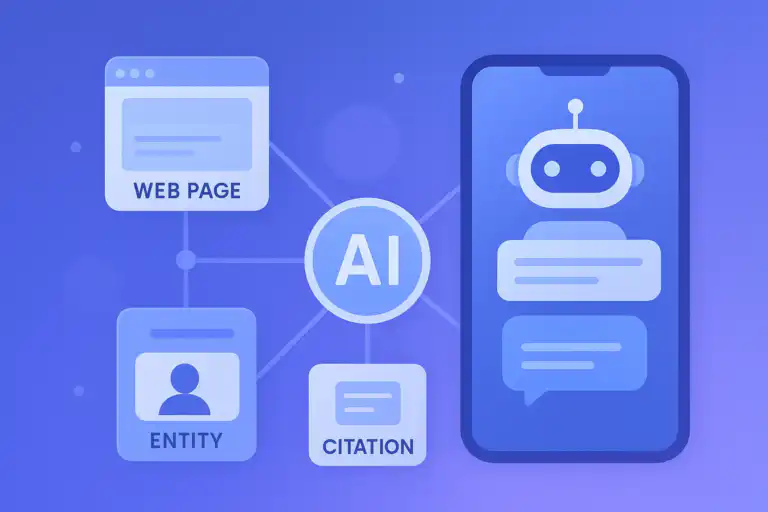
Visualizing how structured entities, evidence, and pages power LLM visibility optimization.
What Is LLM Visibility Optimization?
LLM visibility optimization is the process of making your brand the simplest, safest answer for an AI system to quote. Specifically, it means aligning your content structure, entity definitions, schema markup, and source credibility so that large language models — the AI engines powering tools like ChatGPT, Claude, Gemini, and Perplexity — can understand, verify, and confidently surface your answers to users.
Large language models, or LLMs, generate answers by blending internal training data with real-time retrieval from trusted web sources. Therefore, your content must be unambiguous, well-structured, credibly sourced, and easy to parse. For foundational context, see the Wikipedia overview of large language models to understand how these systems form text and depend on retrieval for current facts.
Direct Answer
LLM visibility optimization is structuring your content, data, and reputation so AI systems choose, quote, and trust your pages. Consequently, you win citations, traffic, and brand authority across answer engines — not just traditional search. For a deeper walkthrough, see our Local Search AI Visibility: The Complete 2025 Guide.
In contrast to SEO content optimization, which focuses primarily on keyword rankings and backlinks, LLM visibility optimization focuses on entity clarity, answer extractability, and evidence quality. Additionally, it operates across far more surfaces — including chat, voice, copilots, and AI-generated summaries — than conventional search ever did.
In summary, define clear entities, provide structured data, and back every claim with credible sources so LLMs can select you with full confidence.
Why LLM Visibility Optimization Matters Right Now
The search landscape has fundamentally shifted. As a result, AI-generated answers now intercept millions of queries before users ever click a traditional link. Specifically, Google’s AI Overviews appear in over 47% of searches in some categories, while tools like Perplexity and ChatGPT handle hundreds of millions of queries monthly.
Furthermore, studies show that AI-cited sources receive significantly higher click-through rates and brand trust signals than uncited competitors. Therefore, brands that appear in AI answers are building a compounding authority advantage — while those that ignore LLM optimization are being systematically excluded from the new front page of the internet.
The Shift from Keywords to Entities
Traditional SEO optimized for keywords. LLM visibility optimization, however, optimizes for entities — the named things, concepts, products, and organizations that AI systems use to reason about the world. Consequently, your content must define these entities unambiguously, reinforce them consistently, and connect them to trusted knowledge graphs.
In addition, LLMs favor pages that answer questions in a predictable, extractable format. Above all, clarity and credibility determine whether a model quotes you or your competitor.
LLM Visibility Optimization Strategy: The 5-Part Framework
To win consistently across AI surfaces, you need a SEO content optimization method that balances quick wins with durable authority. Therefore, use this five-part framework to operationalize your LLM visibility optimization work — from intent mapping to ongoing governance.
- Intent Mapping: First, list the exact questions your target users ask — in search engines, chat tools, sales calls, and support tickets. Then group them by intent type, commercial value, and difficulty. Prioritize questions where a concise, sourced answer can fully satisfy the need.
- Entity Definition: Secondly, define each core entity — your product, service, topic, or brand — with one canonical page, a short formal definition, and common synonyms. Consequently, LLMs have a single authoritative source to pull from for each concept you own.
- Evidence Layering: Third, support every key claim with citations, data points, and first-party proof such as original research, pricing data, or published policies. As a result, your content becomes inherently safer for AI to quote than an unsourced competitor page.
- Structured Clarity: Fourth, add schema markup, consistent heading hierarchies, and direct answer blocks so LLMs can extract facts instantly without ambiguity. Furthermore, validate your schema regularly to catch errors before they degrade trust.
- Visibility Measurement: Finally, monitor AI answer share, citation counts, coverage ratios, and downstream conversions to determine precisely where to improve next. Above all, tie every effort to a measurable outcome.
In short, this framework turns a vague goal into measurable weekly sprints that compound authority steadily over time.

A dashboard tracking answer share, citations, and coverage helps you steer optimization sprints effectively.
“Design each section so an LLM can quote one sentence and be completely correct.” Because of this discipline, your page becomes the safest citation when models need a reliable, concise answer.
The Best Tools for LLM Visibility Optimization
Choosing the right tools accelerates every phase of LLM visibility optimization. Specifically, the best tools help you audit content gaps, track AI citations, validate schema, and monitor answer share across multiple engines simultaneously. Below is a detailed breakdown of the Answer Engine Optimization categories and specific tools worth evaluating.
AI Answer Monitoring and Citation Tracking Tools
These tools track how often your brand appears in AI-generated answers and which competitors are being cited instead. Consequently, they are the SEO Content Optimization core measurement layer for any LLM optimization program.
- Peec.ai: Tracks brand mentions across ChatGPT, Gemini, Perplexity, and Claude. Specifically, it shows your AI answer share, citation frequency, and the exact prompts where competitors outrank you. Furthermore, Peec.ai provides competitive benchmarking so you can identify the precise gaps to close.
- Profound: An enterprise-grade AI visibility platform that maps your brand’s presence across AI engines, tracks share of voice, and surfaces content recommendations. In addition, Profound integrates with analytics stacks to connect AI citation data to revenue impact.
- Brandwatch (AI Mentions): Monitors brand references across AI tools, social, and editorial sources. Additionally, it provides sentiment analysis alongside citation data — useful for understanding not just whether AI mentions you, but how.
- SE Ranking AI Overview Tracker: Specifically built for tracking Google AI Overviews, it shows which pages earn featured positions and how visibility shifts over time. As a result, it bridges traditional SEO monitoring and AI-era tracking in a single platform.
Schema Markup and Structured Data Tools
Schema markup is the machine-readable layer that tells AI systems exactly what your content means. Therefore, generating and validating schema correctly is non-negotiable for effective structured data optimization.
- Google Rich Results Test: The authoritative validator for structured data. Specifically, it confirms whether your JSON-LD schema is correctly parsed and eligible for rich result display. Use it after every schema deployment.
- Schema.org Validator: The foundational reference and testing tool for all schema types. In addition, it supports a wider range of schema types than Google’s tool, making it ideal for validating complex entity relationships.
- Merkle’s Technical SEO Schema Markup Generator: A free, user-friendly tool for generating correctly formatted JSON-LD blocks for FAQ, HowTo, Organization, Product, and more. Consequently, non-technical teams can produce valid schema without writing code.
- Rank Authority Schema Auditing: For teams that need systematic schema auditing across large sites, Rank Authority’s real-time SEO issue alerts flag schema errors, broken markup, and validation failures as they occur.
Content Optimization and Entity Analysis Tools
These tools help you identify entity gaps, semantic coverage weaknesses, and content structure issues that reduce AI extractability. Furthermore, they ensure your pages cover topics with the depth and breadth that LLMs expect.
- Surfer SEO: Analyzes top-ranking pages for semantic coverage and entity mentions. Specifically, its Content Score feature identifies missing topics and terms that would strengthen your AI extractability. In addition, Surfer integrates directly into Google Docs for streamlined editing workflows.
- Clearscope: A content optimization platform that grades your content against a target keyword’s semantic landscape. Moreover, it highlights the concepts and entities that top-cited pages include but yours may be missing.
- MarketMuse: Uses AI to audit entire site topical authority, identify content gaps, and prioritize which pages to build or improve. Consequently, it is particularly powerful for enterprise content teams managing hundreds of entity pages simultaneously.
- InLinks: Specifically focused on entity-based SEO, InLinks maps the entities in your content, links them to Knowledge Graph entries, and strengthens topical authority signals. As a result, it directly improves one of the most critical signals for LLM citation selection.
Keyword and Prompt Research Tools
Understanding the exact questions users ask AI systems is the foundation of intent mapping. Therefore, these tools help you discover the prompt patterns, question formats, and conversational queries driving AI engine traffic.
- AlsoAsked: Maps the “People Also Asked” question clusters around any topic. Specifically, it reveals the conversational question trees that AI systems draw on when generating multi-turn answers. Furthermore, these question clusters directly inform your answer block structure.
- AnswerThePublic: Generates hundreds of question, preposition, and comparison queries for any topic. In addition, its visual map format makes it easy to spot content gaps and intent clusters quickly.
- Semrush Keyword Magic Tool: Provides question-format keyword data alongside search volume and intent signals. Moreover, filtering by question-type queries specifically surfaces the prompts most likely to trigger AI Overviews.
- SparkToro Audience Research: Reveals the sources, publications, and phrases your target audience uses when searching. Consequently, it helps you match the exact language your users bring to AI tools — a key factor in entity resolution.
Technical Audit and Crawling Tools
Technical health directly affects AI crawlability and content freshness signals. Specifically, crawl errors, slow load times, and broken internal links can all prevent LLMs from accessing and trusting your content.
- Screaming Frog SEO Spider: The industry-standard technical crawler. Specifically, it identifies broken links, missing schema, duplicate content, and crawl depth issues that could reduce AI indexing effectiveness.
- Ahrefs Site Audit: Provides a comprehensive technical health score with actionable fixes. Furthermore, its JavaScript rendering capability ensures AI-critical content embedded in scripts is audited correctly.
- Google Search Console: The essential free tool for monitoring indexing status, Core Web Vitals, and manual actions. Additionally, its URL Inspection tool verifies whether Google’s crawler — which feeds its AI systems — can access and render your pages correctly.
Semantic Signals for AI Answers: Entities, Intent, and Evidence
LLMs reward pages that resolve ambiguity decisively. Therefore, your core job is to name entities consistently, anchor them with authoritative definitions, and provide identifiers that connect to established knowledge sources. Additionally, use internal links to your canonical entity page to reinforce the signal across your whole site.
- Definitions: In practice, start each entity page with one precise sentence that a model can lift verbatim and remain 100% accurate. This is the single most high-leverage action in LLM optimization.
- Synonyms and Variants: Moreover, list common name variants, abbreviations, and alternate phrasings so retrieval systems do not miss your coverage when users phrase queries differently.
- Schema Markup: Furthermore, mark up products, FAQs, organizations, and how-to processes to expose attributes and entity relationships in machine-readable form.
- Evidence and Citations: Finally, cite credible external sources and show first-party data — original research, case studies, policies — so your claims are inherently safe for a model to quote.
- Knowledge Graph Connections: Specifically, include Wikidata identifiers, Wikipedia links, and sameAs attributes in your Organization and Person schema to connect your entities to established graph nodes.
In addition, strengthen topical coverage using semantic methods like latent semantic indexing to map related terms and subtopics across your content. Consequently, your pages read naturally while covering the semantic breadth that LLMs use to assess topical authority.
In short, clear entities combined with sourced, verifiable facts create the strongest possible path to consistent AI citations.
Prompt Surfaces and Answer Engines: Where LLM Visibility Happens
Users now ask questions across a rapidly expanding set of AI surfaces. Therefore, your LLM visibility optimization plan must target answer engines broadly — not just the traditional ten blue links of classic web search.
General Chat Assistants
Tools like ChatGPT, Claude, and Gemini synthesize answers from multiple retrieved sources and frequently cite them inline. Specifically, these systems favor pages with crisp definitions, clear structure, and high authority backlink profiles. For practical tactics to optimize for conversational models, see our guide on Optimize for ChatGPT answers.
AI-Powered Search Summaries
Google AI Overviews and Bing Copilot generate search-results-page summaries that pull claims and links directly from indexed pages. Additionally, these summaries appear above organic results — making citation in them more valuable than a first-page ranking in some query categories. As a result, optimizing for AI Overviews requires the same entity and evidence work as broader LLM optimization, with extra emphasis on freshness signals.
Vertical and Shopping Copilots
In contrast to general chat tools, shopping copilots like Microsoft Copilot in Bing Shopping and AI-powered product discovery tools favor structured specs, clear pricing data, availability signals, and return policies. Specifically, for e-commerce and SaaS brands, this means Product schema and Offer schema are not optional — they are the primary signals these surfaces read.
On-Site AI Assistants and Help Bots
Meanwhile, the same optimized answer blocks you create for external AI engines power your own on-site chat assistants, support bots, and help centers. Consequently, LLM visibility optimization delivers a dual benefit — external authority and internal CX quality — from the same content investment.
In summary, meet users wherever they ask by packaging answers that travel well across every AI surface and context.
Metrics for LLM Visibility Optimization: Share, Citations, and Coverage
Measuring LLM visibility requires a portfolio approach. Therefore, track both leading indicators — which show whether your optimization work is landing — and business outcomes, which prove its value to stakeholders.
Core LLM Visibility Metrics
- AI Answer Share: Your percentage presence across a defined set of target questions and AI engines. Specifically, track this weekly against your top three to five competitors to spot trend shifts early.
- Citations and Mentions: Count direct links, footnote citations, and brand callouts in AI-generated answers. Additionally, distinguish between cited sources (with links) and unnamed paraphrases (without attribution).
- Coverage Ratio: The percentage of your priority questions that have a strong, extractable answer block currently live on your site. Furthermore, this is your clearest signal for where to focus next.
- Assisted Conversions: Connect AI traffic referrals to conversions, signups, demos, or purchases. Consequently, this proves the revenue impact of your LLM optimization investment to decision-makers.
- Sentiment in Citations: Specifically, track whether AI systems describe your brand positively, neutrally, or negatively when citing you. In contrast to pure citation counts, sentiment reveals reputation signals that affect long-term trust.
How to Build Your Measurement Stack
Start by combining a dedicated AI visibility tool (such as Peec.ai or Profound) with Google Search Console and your analytics platform. Additionally, create a weekly snapshot report covering answer share change, new citation monitoring, schema validation status, and coverage growth.
In short, these metrics reveal exactly where LLM visibility optimization is working and precisely where to iterate for maximum impact.
How LLM Visibility Optimization Works in Practice
Large language models look for the path of least risk when selecting a source to cite. Consequently, they prefer pages with precise definitions, clean heading structure, and verifiable sourcing. Additionally, when multiple sites cover a topic similarly, consistent entity signals and stronger evidence consistently tip the selection toward the brand that did the optimization work. Learn how to structure extractable answer content in our structured data optimization guide.
- Clarity: Your headings and direct answer blocks reduce the ambiguity an LLM faces at parse time. Specifically, answering in the first sentence of a section is more powerful than burying the answer in the third paragraph.
- Structure: Schema markup exposes facts in machine-friendly form that AI retrieval systems can read without interpreting prose. Furthermore, consistent heading hierarchies (H1 → H2 → H3) help models understand the informational architecture of your page.
- Proof: Citations and first-party data raise the trust score of your content at model generation time. Moreover, pages that link to primary sources — government data, academic studies, official policies — are treated as more reliable than pages that assert claims without support.
- Coverage Breadth: Finally, covering a broad range of related questions improves your probability of selection across diverse prompt variations. In addition, it signals topical authority to both LLMs and traditional search ranking systems.
- Freshness: Specifically, AI systems that use retrieval-augmented generation (RAG) — a method that pulls live web data to supplement training knowledge — weigh content recency as a trust signal. Therefore, updating your key answer pages regularly maintains your citation eligibility.
In short, you win AI citations by being the clearest, cleanest, most credible, and most current source to quote on every question you target.

Hands-on schema and citation work transforms good pages into trusted AI answers.
Step-by-Step: Implement LLM Visibility Optimization in 90 Days
Here is a practical 90-day plan your team can execute immediately. See our SEO Content Guide for content-level tactics. Therefore, schedule weekly checkpoints and protect two to four hours of focused time per sprint to maintain momentum without disrupting other priorities.
- Weeks 1–2 — Intent Inventory: Collect every question your audience asks — from search console data, chat logs, sales call recordings, and support tickets. Then cluster them by intent type, commercial value, and current answer quality. Specifically, flag the top 20 questions with the highest value and lowest current coverage for immediate action.
- Weeks 3–4 — Entity and Answer Architecture: Draft crisp one-to-three sentence direct answers for each priority question. Additionally, designate or create a single canonical page for each core entity, and ensure that page opens with a formal definition sentence.
- Weeks 5–6 — Schema Deployment: Add FAQ, Product, HowTo, and Organization schema to all priority pages. Furthermore, validate every block using Google Rich Results Test and the Schema.org Validator before pushing live. Fix every error — even minor warnings reduce parsing confidence.
- Weeks 7–8 — Evidence Layering: Strengthen each priority page with at least two credible external citations, one piece of first-party proof (original data, a policy page, a pricing table), and where possible a named author or organizational source. Consequently, models have multiple corroborating signals supporting your claims.
- Weeks 9–10 — Publication and Interlinking: Publish your answer blocks prominently — ideally within the first 200 words of each page. Moreover, interlink all related entity pages using consistent anchor text that matches your canonical entity names.
- Weeks 11–12 — Measure and Iterate: Run your first full measurement cycle using your AI visibility tool, Search Console, and analytics. Specifically, identify the three to five questions with the lowest AI answer share and highest commercial value — then iterate those pages first before expanding to new topics.
In short, this plan builds a durable LLM visibility foundation and shows measurable momentum within the first 30 days.
Workflow and Governance for Durable LLM Visibility
Treat LLM visibility optimization as an ongoing editorial and data project — not a one-time setup task. Therefore, create a weekly cadence with clear owners, documented statuses, and a shared backlog of priority questions to address each sprint.
- Source of Truth Document: First, maintain a central document containing every entity definition, canonical page URL, preferred answer text, and supporting citations. Consequently, any team member can quickly verify what the official position is on any question.
- Editorial Sprints: Next, commit to writing or revising two to five answer blocks per week. Each block must include a direct answer sentence, supporting evidence, and validated schema before it ships.
- Monitoring and Alerts: Additionally, configure automated alerts for broken links, schema validation errors, and content drift. For proactive monitoring, Rank Authority’s approach to real-time SEO issue alerts is particularly effective at catching problems before they degrade AI citation eligibility.
- Quarterly Review and Expansion: Finally, every quarter, evaluate overall answer share trends, identify new intent clusters emerging from search and chat data, and expand your coverage into adjacent topics. As a result, your LLM visibility compounds rather than plateaus.
In short, rigorous governance keeps your answers fresh, factually accurate, and perpetually citation-worthy.
LLM Visibility Optimization vs. Traditional SEO: Key Differences
Understanding the differences between LLM optimization and traditional SEO helps you allocate effort correctly. Specifically, they are complementary — not competing — disciplines, but they require different tactics and success metrics.
| Dimension | Traditional SEO | LLM Visibility Optimization |
|---|---|---|
| Primary Signal | Keywords and backlinks | Entities, evidence, and extractability |
| Success Metric | Rankings and organic traffic | AI answer share and citations |
| Content Format | Long-form, keyword-dense pages | Extractable answer blocks + schema |
| Trust Signals | Domain authority, PageRank | Citations, schema, entity clarity |
| Update Cadence | Periodic refreshes | Continuous freshness maintenance |
| Surfaces | Search engine results pages | Chat, summaries, copilots, bots |
In short, the strongest digital visibility programs combine both disciplines — using traditional SEO to build domain authority while applying LLM optimization techniques to win the AI answer layer that sits on top of it.
Pros and Cons of Optimizing for AI Answer Engines
Every strategy involves trade-offs. Therefore, weigh the following benefits and risks before committing resources at scale — and build mitigation steps for the downsides into your governance plan from the start.
| Pros | Cons |
|---|---|
| Higher answer share and authority visibility across AI surfaces | Requires ongoing maintenance to keep answers fresh and schema valid |
| Strong differentiation through clear entities and verifiable evidence | Attribution methods vary across engines and change with algorithm updates |
| Content reusable across chat, documentation, and support channels | Short answer formats can reduce time-on-page for long-form content |
| Faster trust acquisition through cited, verifiable claims | Requires consistent editorial discipline and cross-team governance |
| Dual benefit: improves both external AI citations and on-site CX | ROI timeline is longer than traditional PPC — typically 3–6 months to full impact |
In short, the upside of LLM visibility optimization is substantial and compounding — but consistency and governance discipline are non-negotiable for sustained results.
Governance Checklist and Quick Wins
Use this checklist during your weekly review sessions. Specifically, run through each item to ensure your LLM visibility optimization program never stalls between major sprints.
- Definitions Present: Every entity page opens with one precise sentence that an AI model can quote verbatim and remain fully accurate.
- Schema Valid: All structured data passes Google Rich Results Test and Schema.org Validator, and accurately reflects the on-page content.
- Evidence Layered: At least two credible external citations or pieces of first-party proof support every key claim on each priority page.
- Answer Blocks Live: Each priority question has a direct one-to-three sentence answer positioned within the first 200 words of the page.
- Coverage Growing: Two to five new or meaningfully improved answer blocks ship every sprint without exception.
- Monitoring Active: AI answer share tracking, schema error alerts, and broken link monitoring are all configured and reviewed weekly.
- Competitor Gap Review: Additionally, once per month, run a structured comparison of your citation rate versus your top two competitors on your highest-value questions. Consequently, you spot emerging threats before they erode your position.
In short, steady shipping combined with rigorous validation drives compounding, durable LLM visibility.
FAQ: Common Questions About LLM Visibility Optimization
Here are precise answers to the most common questions — structured specifically so answer engines can extract and quote them cleanly.
Key Takeaways
- LLM visibility optimization makes your content the safest, most credible answer for AI systems to quote — across every major platform.
- Entities, schema markup, direct answer blocks, and verifiable evidence form the core technical signal stack.
- Success shows up as measurable AI answer share, citation counts, coverage ratios, and ultimately assisted conversions.
- The right tools — including Peec.ai, Profound, Surfer SEO, InLinks, and Google Rich Results Test — accelerate every phase of the work.
- Weekly governance and editorial sprints compound authority steadily across all AI engines and answer surfaces.
- LLM optimization and traditional SEO are complementary — combining both disciplines delivers the strongest overall digital visibility.
Conclusion: Make LLM Visibility Optimization Your Unfair Advantage
The brands that will dominate AI-powered search are those that start building their LLM visibility optimization systems today. Therefore, commit to a structured editorial rhythm — mapping intent, defining entities, deploying schema, layering evidence, and measuring answer share every week. Specifically, the teams that simplify answers and prove claims with credible sourcing will own citation share in every major AI engine over the next 12 to 24 months.
Furthermore, as you scale, consider leveraging expert resources like rankauthority.com to guide your audits, automate monitoring, and sharpen your measurement framework. In addition, the tools covered in this guide — from Peec.ai for citation tracking to InLinks for entity optimization — remove the manual effort from each phase, allowing your team to focus on strategic content decisions rather than tactical execution. Add an author byline (name + 1–2 sentence bio) and a visible "Last updated" date near the top of the article to strengthen credibility.
Ultimately, when you operationalize LLM visibility optimization as a core discipline — not a side project — you win citations today, build authority that compounds over time, and secure a presence in the AI answer layer that competitors cannot easily displace. Add a byline and short author bio (name, role, credentials) plus a visible "Last updated" date on the page to boost credibility.

