

Machine learning in SEO is the application of AI algorithms that learn from data to improve how websites rank, how content is evaluated, and how search engines understand user intent. In short, it means search engines no longer rely solely on fixed rules — they adapt, learn, and get smarter with every query they process. Author: Rank Authority editorial team. Last updated: 2026-07-02.
This shift has profound implications for anyone who depends on organic search traffic. Furthermore, the pace of change is accelerating. Understanding how machine learning reshapes SEO is no longer optional — it is the foundation of any competitive digital strategy. Read the AI algorithm SEO guide for deeper tactics.
What Is Machine Learning in SEO?
Machine learning in SEO is the process by which search engine algorithms — and the content optimization tools marketers use — automatically improve through experience rather than explicit programming. Instead of following a rigid checklist, these systems analyze vast datasets, detect patterns, and refine their behavior continuously.
For example, Google processes over 8.5 billion searches per day (Internet Live Stats). Machine learning helps Google make sense of that enormous volume — identifying which results satisfy users and which fall short. Consequently, every click, scroll, and bounce feeds back into the algorithm, making it progressively more accurate.
This is why traditional SEO tactics — keyword stuffing, exact-match anchor text, and thin content — have steadily lost effectiveness. The algorithm has learned to recognize and penalize them.

Machine learning neural networks analyze billions of search signals to continuously refine how rankings are determined.
How Google’s AI Algorithms Changed the SEO Landscape
Google has deployed advanced algorithms that directly affect how pages rank. Each represents a leap forward in the search engine’s ability to understand language and intent.
RankBrain: The First ML Ranking Factor
RankBrain, launched in 2015, was Google’s first machine learning ranking signal. It was designed specifically to handle novel queries — searches Google had never seen before. By mapping unfamiliar terms to related concepts, RankBrain could deliver relevant results even without an exact keyword match.
As a result, Google confirmed RankBrain as one of its top three ranking factors. This was a turning point — it signaled that keyword matching alone would no longer determine rankings.
BERT and MUM: Understanding Language at a Deeper Level
BERT (Bidirectional Encoder Representations from Transformers), introduced in 2019, brought natural language processing (NLP) — the branch of AI that helps machines read and interpret human language — directly into search ranking. BERT reads the full context of a sentence rather than individual words in isolation.
Subsequently, Google’s MUM (Multitask Unified Model) pushed further still, processing text, images, and video simultaneously. Together, these systems mean that content quality, clarity, and genuine helpfulness now matter far more than keyword frequency.
For a deeper dive into how AI is reshaping optimization, the complete guide to AI-driven SEO optimization on rankauthority.com provides a comprehensive breakdown of these developments.
How to Optimize Your Site for Machine Learning Algorithms
Adapting your strategy requires a systematic approach. Follow these five steps to align with how ML-powered search engines evaluate content: See our Artificial intelligence SEO guide for strategy examples.
- Audit your content for topic depth. Review existing pages and identify thin or shallow coverage. Use tools to find gaps where competitors answer user questions more thoroughly than you do.
- Restructure keyword research around search intent. Group keywords by intent — informational, navigational, or transactional — rather than chasing isolated phrases. Build content clusters that address the full range of related questions.
- Optimize content for natural language and semantic relevance. Write clearly and conversationally. Include semantically related terms, answer questions directly, and use descriptive headings that help NLP algorithms parse meaning accurately. See the AI and SEO guide for broader examples and case studies.
- Strengthen technical SEO signals. Ensure fast load speeds, mobile responsiveness, structured data markup, and a clean site architecture. Machine learning algorithms factor Core Web Vitals and user experience into ranking decisions.
- Monitor performance and iterate with AI tools. Use AI-powered analytics to track ranking shifts, user behavior, and content performance. Continuously refine your approach based on data-driven insights.
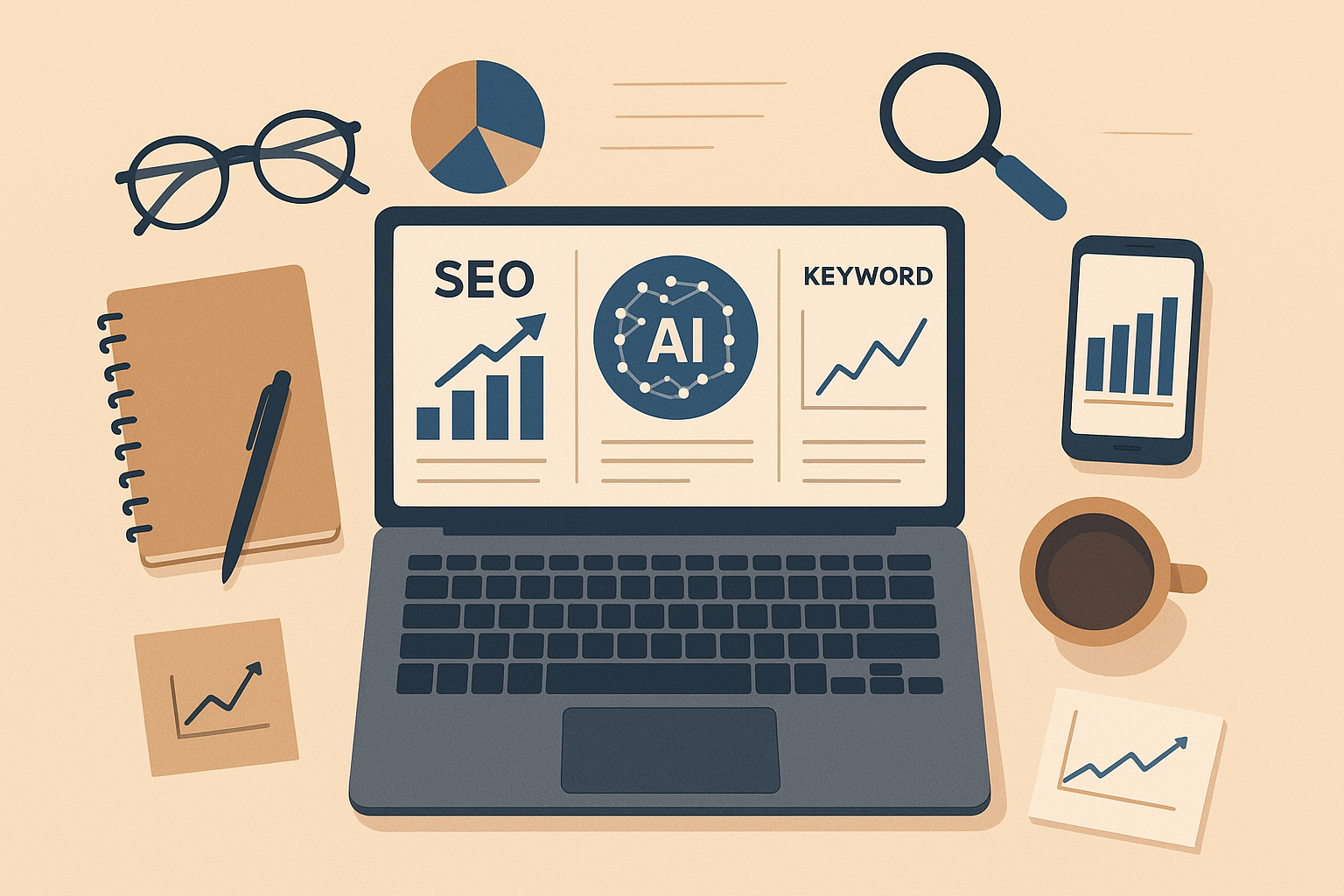
AI-powered analytics platforms surface the highest-impact optimization opportunities automatically, saving hours of manual analysis through AI analytics for SEO.
Practical Benefits of AI-Driven Search Optimization
The practical benefits of integrating machine learning into your SEO workflow are significant. First, predictive keyword research tools can identify rising search trends before they peak — giving early movers a ranking advantage. Second, automated content scoring helps writers understand whether a draft is likely to satisfy user intent before it is even published, especially when paired with intelligent SEO tools.
In addition, machine learning enables more precise audience segmentation. By analyzing behavioral patterns, AI tools can identify which content resonates with specific user groups, allowing marketers to personalize strategies at scale.
For businesses exploring how AI enhances these outcomes, the article on what benefits AI offers in SEO strategies outlines the specific advantages in measurable terms.
Automating the Technical Work
One of the most compelling applications of machine learning in SEO is automation. Tasks that once required hours of manual effort — crawl error analysis, internal link auditing, metadata optimization — can now be handled automatically by intelligent platforms like AI-driven SEO tools.
Platforms like rankauthority.com exemplify this shift. Their 1-Click AI AutoPilot technology automates the complex technical and strategic work of search optimization, making advanced GEO capabilities and AEO accessible to small business owners, marketers, and agencies alike — without requiring deep technical expertise.
The Role of Generative AI in Next-Generation Search
Beyond traditional search, machine learning now powers generative AI search experiences — such as Google’s AI Overviews and Bing’s Copilot integration. These systems synthesize answers from multiple sources rather than simply listing links. As a result, the criteria for appearing in these results differ from classic blue-link rankings.
According to Search Engine Journal, content that is structured, authoritative, and directly answers specific questions is significantly more likely to be cited in AI-generated answers. Therefore, optimizing for answer engines (AEO) is becoming as important as traditional SEO.
To understand how this changes day-to-day practice, the guide on how AI can change the way you do SEO offers practical, actionable guidance for this new environment.
Structured Data and Schema Markup
Structured data — code added to web pages that explicitly labels content for search engines — has become even more valuable in a machine learning context. It gives AI systems unambiguous signals about what a page contains, increasing the likelihood of appearing in rich results and AI-generated answers.
Furthermore, implementing schema markup for FAQs, how-to guides, products, and reviews directly feeds the machine learning models that power featured snippets and knowledge panels. This is one of the highest-leverage technical investments available to SEOs today.
Common Mistakes When Adapting to ML-Powered SEO
Many marketers make predictable errors when first confronting machine learning-driven algorithms. Specifically, the most common mistake is continuing to optimize for keyword density rather than topical authority. ML algorithms evaluate the depth and breadth of coverage across a subject, not the number of times a phrase appears.
Similarly, ignoring user experience signals is a costly oversight. Bounce rate, dwell time, and interaction data all feed back into machine learning models. In other words, a page that ranks well but fails to engage visitors will gradually lose ground to pages that do both.
Additionally, underestimating the importance of E-E-A-T (Experience, Expertise, Authoritativeness, and Trustworthiness) — a framework Google explicitly documents — is a significant risk. Machine learning systems are increasingly capable of assessing content credibility, so demonstrating genuine expertise matters more than ever.
For a broader strategic view, the resource on AI search engine optimization strategies, tools, and ROI covers how to measure and maximize returns from these evolving approaches.
Key Insight — By Rank Authority. Last updated: 2026-06-07.
A 2023 BrightEdge study found that 68% of online experiences begin with a search engine, and AI-driven algorithms now influence virtually every result. Brands that adapt their SEO strategies to machine learning principles are significantly better positioned to capture and retain that traffic. Last updated: 2026-08-14. Author: Rank Authority Editorial Team.
Frequently Asked Questions About Machine Learning in SEO

AI-driven optimization platforms make machine learning SEO strategies accessible to businesses of every size, not just enterprise teams.
Conclusion: Embracing Machine Learning in SEO for Long-Term Growth
Machine learning in SEO has fundamentally changed what it means to rank well online. Search engines no longer reward keyword repetition or link volume alone — they reward relevance, depth, credibility, and genuine user satisfaction. Therefore, adapting your strategy to align with how these AI systems evaluate content is the most important investment you can make in your digital presence today. Learn expected AI-driven SEO results and timelines.
In summary, the key takeaways are clear: optimize for intent over keywords, build topical authority, use structured data, prioritize user experience, and leverage AI-powered tools to automate what would otherwise take significant time and expertise. For businesses ready to act on these principles, exploring the ways AI enhances search engine optimization is an excellent next step. Platforms like rankauthority.com are purpose-built to make this transition seamless — turning the complexity of machine learning-driven search into a competitive advantage that works continuously on your behalf. Author: Rank Authority SEO Team — add a visible byline and short author bio with credentials and a link to an author page.

