

AEO vs GEO is the most important strategic debate in search marketing right now — and understanding both disciplines is no longer optional for brands that want to stay visible as AI reshapes how people find information. Answer Engine Optimization (AEO) and Generative Engine Optimization (GEO) are two distinct but deeply complementary approaches. Knowing when and how to apply each one can dramatically change your organic reach.
Search behavior has changed at a remarkable pace. According to a 2024 SparkToro study, roughly 59% of Google searches in the US now end without a click — users receive their answer directly on the results page. Furthermore, generative AI tools like ChatGPT and Perplexity AI are diverting millions of additional searches away from traditional results pages entirely. Both trends make AEO and GEO critically important — together.
What Is AEO vs GEO? Definitions That Actually Clarify the Difference
Answer Engine Optimization (AEO) is the practice of structuring content so that answer engines — platforms that deliver direct, immediate responses rather than ranked lists of links — surface your content as the definitive reply. Think Google’s featured snippets, voice search results from Siri or Alexa, and quick-answer boxes. AEO is primarily about winning a single, specific answer position for a specific question.
Generative Engine Optimization (GEO), in contrast, is the practice of optimizing content so that AI-powered generative tools — such as ChatGPT, Perplexity AI, and Google AI Overviews — cite, reference, or synthesize your content when generating responses for users. GEO is about becoming a trusted source that AI models draw from repeatedly, across many different queries.
In short: AEO targets the immediate answer box. GEO targets the AI-generated paragraph — learn the role of GEO. Both aim to place your content front and center — but through very different mechanisms. Importantly, they are not competitors — they reinforce each other when used together.
It is also worth noting what GEO is not. It is sometimes confused with geographic targeting — using “geo” to mean location-based SEO. In modern digital marketing, however, GEO has taken on this distinct meaning: optimizing for AI generative engines specifically.
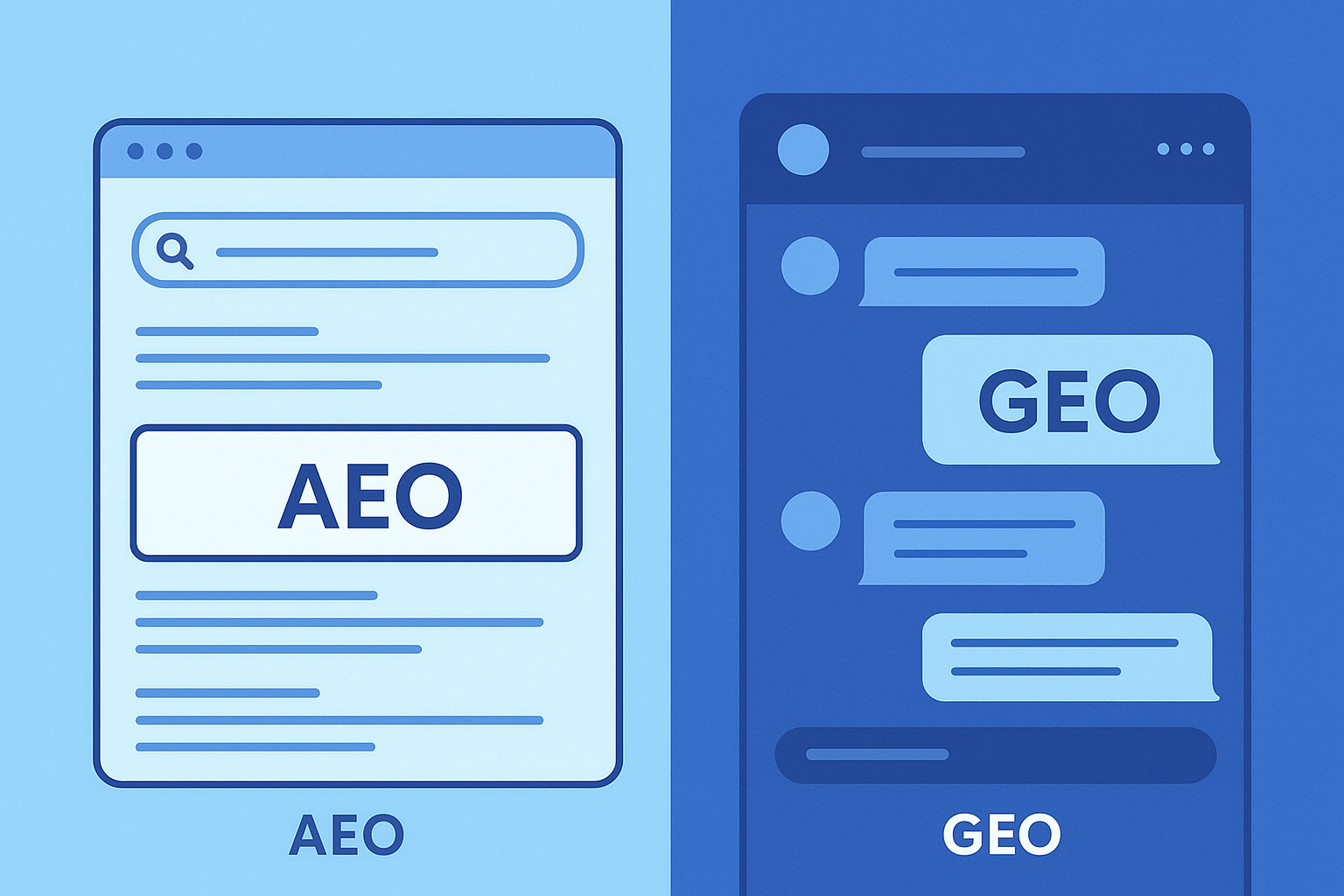
Understanding the two distinct pathways of AEO vs GEO is the first step toward a modern, AI-era search strategy.
How Answer Engine Optimization Actually Works
AEO is closely related to traditional SEO but goes further. Specifically, it focuses on making content scannable, structured, and directly responsive to user questions. Google’s featured snippets are the most visible outcome of strong AEO work — those highlighted answer boxes that appear above the standard organic results.
For example, when someone asks “what is the best time to post on Instagram,” a well-optimized AEO page delivers a crisp, one-paragraph answer at the very top — before elaborating with supporting detail. That structure is what earns the featured snippet position. The answer comes first; the explanation follows.
Furthermore, voice search is a major AEO channel. Smart speakers and phone assistants read single answers aloud. So if your content is not formatted to be that single answer, you are effectively invisible in voice results.
What Triggers a Featured Snippet?
Featured snippets are triggered when Google detects that a query has clear informational intent. The search engine pulls the most direct, well-structured answer it finds among indexed pages. Consequently, your page does not need to rank #1 — it needs to answer the question most clearly. Pages ranking anywhere in the top 10 have been awarded snippets.
There are three main featured snippet formats to optimize for: paragraph snippets (for definitions and explanations), list snippets (for steps and ranked items), and table snippets (for comparisons and data). Each requires a slightly different formatting approach.
AEO and Voice Search: The Overlooked Channel
Voice search queries are typically longer and more conversational than typed searches. Phrases like “Hey Google, how do I fix a 404 error?” require content written in natural spoken language. As a result, AEO-optimized content often uses full questions as headings and answers them immediately below in plain, spoken-sounding prose. This dual benefit — snippet + voice — makes AEO formatting highly efficient.
Core Tactics for AEO Success
- Write concise answers of 40 to 60 words directly under question-format headings
- Use FAQPage, HowTo, and Speakable schema markup
- Structure content with clear H2 and H3 question headings that mirror real search queries
- Target conversational, long-tail query formats that match how people speak
- Format lists and tables for snippet eligibility — use consistent bullet or numbered formats
- Optimize for voice search with natural-language phrasing throughout body copy
- Place the direct answer in the first sentence below a heading — never bury it in the third paragraph
How Generative Engine Optimization Differs in Practice
GEO operates on a fundamentally different logic. Rather than targeting a specific search result position, GEO aims to make your content the kind of source that AI language models trust, cite, and synthesize — see our GEO vs Traditional SEO comparison for tactical differences. Therefore, the emphasis shifts from keyword placement to topical authority and factual credibility.
AI tools like Google AI Overviews and Perplexity AI pull from a wide range of sources. However, they consistently favor content that is well-structured, factually accurate, frequently cited by other credible sources, and clearly attributed — learn how Generative Engine Optimization works in practice. In other words, GEO rewards the same behaviors that build genuine expertise — just applied with AI citation mechanics in mind.
Consequently, link-building and brand mentions from authoritative publications become GEO signals — not just traditional SEO signals. When reputable sites reference your content, AI models are more likely to treat your material as a trustworthy source worth citing.
How AI Models Decide What to Cite
Large language models (LLMs) — the technology behind ChatGPT, Claude, and Gemini — are trained on vast amounts of web content and then fine-tuned to prefer high-quality, authoritative sources. When these models generate a response and cite a source, they are reflecting patterns learned during training and retrieval processes. Specifically, content that is precise, well-organized, written by an apparent expert, and corroborated by other credible sources scores better in this selection process.
Perplexity AI, for instance, uses a retrieval-augmented generation (RAG) approach — meaning it actively searches the web at query time and pulls sources dynamically. Similarly, Google AI Overviews blend trained knowledge with live search signals. Understanding these mechanisms helps you produce content that fits what AI retrieval systems look for.
Core Tactics for GEO Success
- Build deep topical authority through GEO guide and pillar cluster content
- Cite credible statistics and data with clear, verifiable source attribution
- Earn backlinks and brand mentions from high-authority domains and publications
- Write factual, precise content that AI models can synthesize accurately without distortion
- Use structured data markup so AI parsers understand your content’s context and entity relationships
- Demonstrate clear authorship and expertise signals — author bios, credentials, and publication dates
- Cover topics comprehensively enough that AI tools prefer your source over thinner alternatives
- Use consistent brand entity signals so AI models recognize and reliably identify your organization

Modern marketers must monitor both featured snippet placements and AI-generated citations to measure full search visibility.
AEO vs GEO: A Comprehensive Side-by-Side Comparison
The table below maps the most important differences between AEO and GEO across every dimension a marketer needs to consider — from platform focus and content format to measurement and timeline.
The Role of E-E-A-T in AEO and GEO
Google’s E-E-A-T framework — which stands for Experience, Expertise, Authoritativeness, and Trustworthiness — is directly relevant to both AEO and GEO, though in different ways. Understanding this connection sharpens your strategy considerably.
For AEO, E-E-A-T matters primarily at the content quality level. Google’s human quality raters use the E-E-A-T guidelines to evaluate whether a page deserves to feature prominently in results. Therefore, content that demonstrates clear expertise through precise, accurate answers performs better in snippet selection.
For GEO, E-E-A-T is even more central. AI models trained on web data absorb quality signals embedded in how the broader web links to and references content. See our GEO vs Traditional SEO piece for nuance about authority signals versus classic ranking signals. Consequently, a page cited by authoritative sources, authored by a named expert, and backed by verifiable data is far more likely to be pulled into an AI-generated response. In this sense, building genuine expertise is the highest-ROI GEO tactic available.
Practical E-E-A-T Signals to Implement
- Add detailed author bios with credentials and relevant experience
- Display publication and last-updated dates prominently on every article
- Cite primary research, government data, or peer-reviewed studies as sources
- Include first-hand experience claims (“In our testing…” or “Based on our analysis…”)
- Earn editorial mentions in recognized industry publications
- Use Organization schema with consistent NAP (name, address, phone) data
How to Build a Combined AEO and GEO Strategy: Step-by-Step
The most effective approach is to treat AEO and GEO as complementary layers of the same content strategy. Each step below addresses both disciplines simultaneously, saving time and compounding results.
- Audit your existing content for answer-readiness. Review your top pages and check whether each one answers a clear question directly in the first paragraph or under a dedicated heading. If not, restructure those pages first. See AEO vs SEO differences.
- Add FAQ schema and structured data markup. Implement FAQPage, HowTo, and Article schema across relevant pages. This helps both search engines and AI models parse your content structure accurately and confidently. Validate your markup using Google’s Rich Results Test tool before deploying.
- Build topical authority with depth content. Create comprehensive pillar pages and supporting cluster articles that cover your niche from multiple angles. Cite credible statistics, link to authoritative external sources, and ensure every article covers a topic completely — not just superficially. AI tools consistently prefer comprehensive sources over thin ones.
- Strengthen your E-E-A-T signals across your site. Add author credentials, update publication dates, and ensure every article clearly attributes its claims to verifiable sources. Add a visible author byline (name and 1–2 credentials) and a "Last updated" date on the article page so readers and AI systems can verify expertise. For GEO, this is especially critical — AI models favor content with clear expertise signals.
- Earn authoritative backlinks and brand mentions. Pursue link-building and digital PR campaigns that result in your brand being cited on high-authority websites. These signals increase the likelihood that AI models reference your material and that Google awards your pages featured snippet positions.
- Monitor AI visibility and iterate continuously. Use platforms like RankAuthority to track how often your content appears in AI-generated responses and featured snippets. Identify which topics AI tools are sourcing from competitors instead of you, then produce better-targeted content to close those gaps.
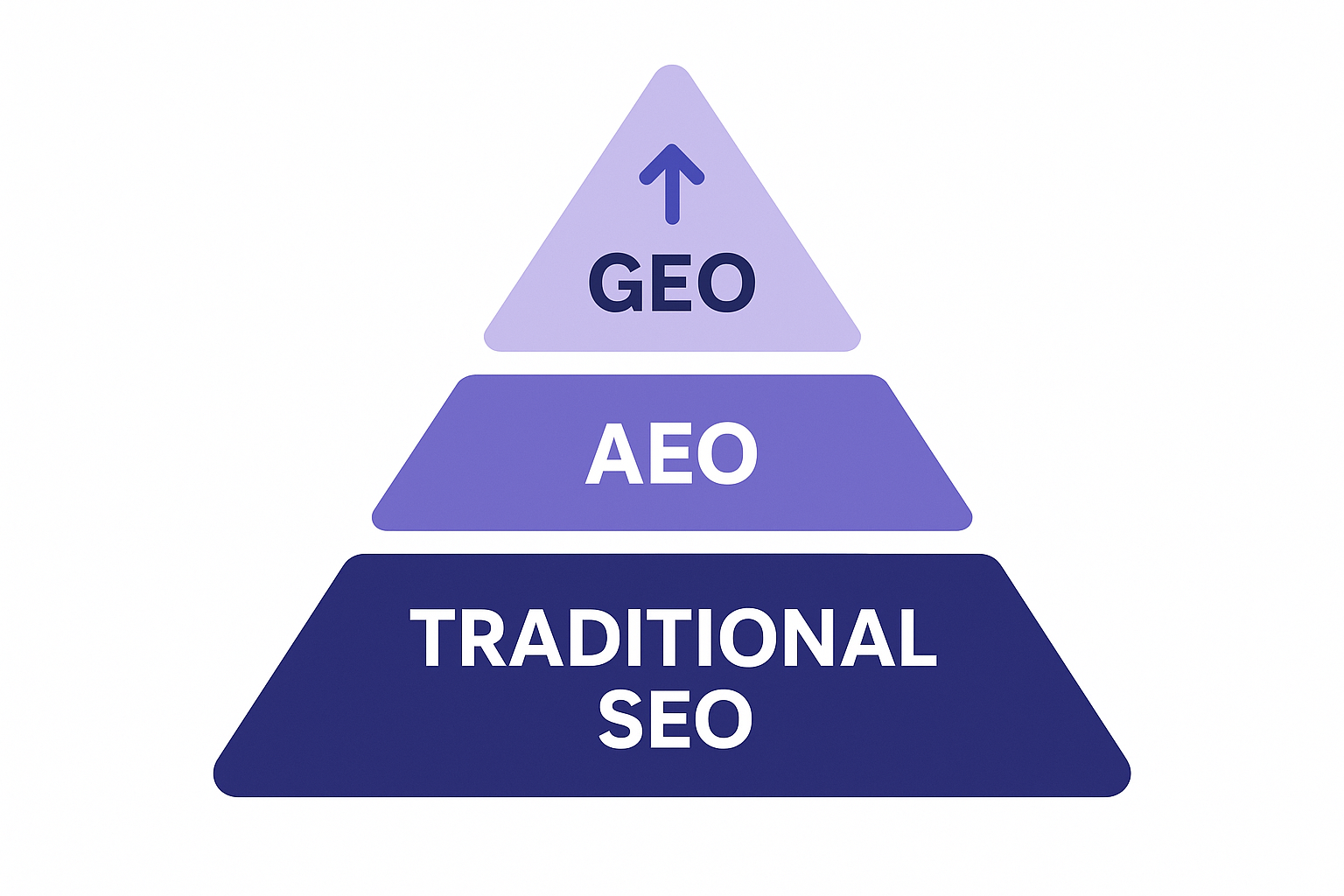
Traditional SEO forms the foundation on which AEO and GEO strategies are built for maximum search visibility. For a deeper walkthrough, see our AEO Services for Local Businesses: The Complete Guide.
Why Traditional SEO Still Underpins Both AEO and GEO
Neither AEO nor GEO replaces traditional SEO. Instead, they build on top of it. Technical site health, crawlability, Core Web Vitals, page speed, and strong backlink profiles remain foundational requirements. Without these basics, your content is unlikely to be indexed well enough to appear in either answer boxes or AI responses.
Think of it as a three-tier pyramid. Traditional SEO sits at the base — it ensures your content can be found and trusted at a technical level. AEO sits in the middle tier — it positions your best answers for direct visibility in search results. GEO sits at the top — it earns you a place in the AI-generated conversations that are increasingly becoming the first stop in many users’ research journeys.
Additionally, resources like RankAuthority provide marketers with the tools to track AI-era visibility alongside traditional rankings — making it easier to see how all three strategies interact and where gaps exist. Add a visible author bio and a clear "Last updated" date on each article to strengthen E-E-A-T and improve GEO citation likelihood.
Technical SEO Priorities That Directly Support AEO and GEO
- Core Web Vitals — Fast-loading, stable pages get crawled and indexed more reliably
- Clean site architecture — Clear URL structures and internal linking help AI crawlers map your topical authority
- Mobile optimization — Voice searches overwhelmingly originate from mobile devices
- HTTPS security — A baseline trust signal for both Google and AI citation tools
- Canonical tags — Prevent duplicate content issues that dilute authority signals across your domain
How to Measure AEO and GEO Performance
One of the most underexplored areas of both disciplines is measurement. AEO is relatively straightforward to track — Google Search Console shows which queries trigger your pages, and third-party tools like Semrush and Ahrefs can identify whether you hold featured snippet positions for target terms.
GEO measurement is newer and more complex. However, several emerging approaches are proving effective:
Measuring AEO Results
- Google Search Console — Monitor impressions and click-through rates for featured snippet queries
- Semrush / Ahrefs — Track featured snippet ownership across your target keyword set
- Manual SERP checks — Test voice query responses on Google Assistant and Alexa periodically
- Rich result reports — Use Google’s Search Console Enhancement reports to verify schema implementation
Measuring GEO Results
- Manual AI prompt testing — Query ChatGPT, Perplexity, and Google AI Overviews for your target topics and check whether your brand or content is cited
- Brand mention monitoring — Use tools like Mention or Google Alerts to track how often your content is referenced online
- Referral traffic from AI platforms — Check your analytics for referral visits from Perplexity, ChatGPT, and similar AI tools
- RankAuthority — Dedicated AI visibility tracking that surfaces how your brand appears across generative AI responses
Common Mistakes to Avoid With AEO and GEO
Many marketers treat AEO and GEO as isolated tactics rather than integrated strategies. For example, a brand might add FAQ schema to a page but fail to write concise, direct answers — rendering the schema ineffective for AEO purposes entirely.
On the GEO side, a common error is producing high-volume content without depth or credibility. AI models are trained to recognize thin, low-authority content and are less likely to cite it. Consequently, publishing fewer but more authoritative pieces consistently outperforms a high-volume, low-quality approach.
Furthermore, neglecting to monitor AI-generated results is a significant missed opportunity. Tracking which sources AI tools cite for your target topics reveals exactly what kind of content you need to produce or improve to compete effectively in the GEO landscape.
The Top 7 AEO and GEO Mistakes — and How to Fix Them
- Writing answers that are too long for AEO. Keep direct answers to 40–60 words. Elaborate in subsequent paragraphs.
- Adding schema without matching content. Schema markup amplifies the content beneath it — if the answer text is vague, the schema will not compensate.
- Chasing volume over depth for GEO. Twenty highly authoritative posts outperform two hundred thin articles for AI citation purposes.
- Ignoring authorship and credentials. Anonymous content struggles to earn AI citations. Named experts with verifiable credentials perform better.
- Failing to update content. AI tools and Google both favor recently updated, accurate information. Stale data reduces citation likelihood over time.
- Not monitoring AI outputs. If you never check whether AI tools cite you, you cannot improve. Build this into your monthly reporting process.
- Treating AEO and GEO as separate projects. The best-performing content serves both disciplines simultaneously — optimizing for concise answers while also building comprehensive topical depth.
Real-World Examples: AEO vs GEO in Action
Abstract definitions are useful — but concrete examples make strategies actionable. Here is how AEO and GEO play out in practice for different business types.
Example 1: A SaaS Company Using AEO
A project management software company publishes a page titled “What Is a Gantt Chart?” They place a clear 55-word definition directly under the H1 heading, followed by supporting detail. Within six weeks of indexing, they win the featured snippet for that query — and the page begins receiving voice assistant traffic as well. The concise, direct answer structure is the primary driver of both wins. This is AEO at work.
Example 2: A Financial Publisher Using GEO
A personal finance publisher builds a comprehensive guide to compound interest — 3,500 words, with data sourced from the Federal Reserve and academic studies, an author bio showing a certified financial planner credential, and backlinks from three major financial news sites. When users ask Perplexity AI “how does compound interest work over 30 years,” the publisher’s article is cited in the AI’s response. Their authoritative, well-sourced content has become a trusted GEO asset.
Example 3: A Small Business Winning with Both
A local HVAC company publishes a detailed FAQ about air conditioning maintenance. Each question has a concise, direct answer (AEO) followed by a thorough explanation supported by energy efficiency data from the U.S. Department of Energy (GEO). The page earns a featured snippet for “how often should I change my AC filter” and is cited by Google AI Overviews for regional HVAC queries. This is AEO and GEO working in tandem — something the competitor page does not illustrate with real examples.
AEO vs GEO vs SEO: Understanding How All Three Relate
A question that arises frequently is: how do AEO, GEO, and traditional SEO actually relate to one another? Are they competing frameworks — or layers of the same discipline?
The most accurate framing is that they are evolutionary stages of the same discipline. Traditional SEO — focused on crawlability, keyword targeting, and link authority — was the dominant framework from the late 1990s through the 2010s. AEO emerged as a response to zero-click searches and voice assistants. GEO is now emerging in direct response to the rise of large language model tools.
Importantly, each layer does not replace the one below it. Instead, each new layer depends on the prior one being implemented correctly. You cannot win AEO without solid on-page SEO. You cannot win GEO without the credibility and backlink profile that SEO builds. Treating them as sequential rather than competing priorities is the strategic mindset that wins.
Frequently Asked Questions About AEO vs GEO
What is the difference between AEO vs GEO?
AEO (Answer Engine Optimization) focuses on getting content featured as direct answers in tools like featured snippets and voice search. GEO (Generative Engine Optimization) focuses on getting content cited by AI-generated responses in tools like ChatGPT and Google AI Overviews. Both maximize visibility — but through fundamentally different channels and mechanisms.
What does AEO stand for in digital marketing?
AEO stands for Answer Engine Optimization. It is the practice of structuring content so that answer engines surface it as the definitive response to a user’s query — particularly in Google’s featured snippets and voice search results from assistants like Siri and Alexa.
What does GEO stand for in digital marketing?
GEO stands for Generative Engine Optimization. It refers to optimizing content so that AI generative tools — such as ChatGPT, Perplexity AI, Google AI Overviews, and Claude — reference or synthesize your content when generating responses for users. Note: in this context, GEO does not refer to geographic or location-based targeting.
Which is more important: AEO or GEO?
Neither is universally more important — they target different visibility channels. AEO is more effective for capturing immediate, factual queries via featured snippets and voice search. GEO is critical for appearing in AI-generated long-form responses as AI tools become a primary research channel. Most modern strategies benefit from implementing both simultaneously.
How do I optimize my content for AEO?
Structure content with question-format headings and place concise 40–60 word answers directly beneath them. Use FAQPage and HowTo schema markup, target conversational long-tail query formats, and format lists and tables for snippet eligibility. Voice search readiness — natural spoken-language phrasing — is also a key AEO outcome.
How do I optimize my content for GEO?
GEO optimization involves building topical authority through comprehensive pillar content, citing credible and verifiable data sources, earning mentions from authoritative websites, and demonstrating clear authorship and expertise. Structured data, consistent entity signals, and up-to-date content also help AI tools identify and cite your material reliably.
Does traditional SEO still matter alongside AEO and GEO?
Yes — traditional SEO remains the essential foundation. Technical site health, crawlability, Core Web Vitals, and strong backlink profiles support both AEO and GEO strategies. Without a solid SEO base, content is unlikely to be indexed reliably enough for either answer engines or generative AI tools to surface it consistently.
What tools help track AEO and GEO performance?
For AEO, use Google Search Console to monitor featured snippet queries, and Semrush or Ahrefs to track snippet ownership. For GEO, manual prompt testing in ChatGPT and Perplexity remains essential. RankAuthority offers dedicated AI visibility tracking for both disciplines in one platform.
Can a small business benefit from GEO?
Absolutely. Small businesses with niche expertise can earn citations in AI-generated responses by publishing highly specific, accurate, and well-structured content. GEO levels the playing field because AI tools prioritize relevance, accuracy, and expertise over domain size alone. A focused small business can outperform a large brand for niche queries.
How does schema markup relate to AEO and GEO?
Schema markup is critical for AEO because it signals to search engines exactly what type of content you have and where the answer is located. For GEO, structured data helps AI models parse entity relationships, understand content context, and build trust in your material — all of which increase the likelihood of citation in generated responses.
What is a common mistake when implementing AEO?
A common mistake is writing answers that are too vague, too long, or buried deep in the page. AEO requires concise, direct answers of ideally 40 to 60 words placed immediately under the relevant heading. Burying the answer in a third paragraph or wrapping it in promotional language significantly reduces your chances of winning a featured snippet.
How long does it take to see results from GEO?
GEO results typically take weeks to months depending on how quickly AI models index and reference your content. Building topical authority, earning backlinks from credible sources, and keeping content current all accelerate the timeline. Perplexity AI, which uses live retrieval, tends to cite new content faster than models with longer training cycles.
How does AEO vs GEO differ in terms of content length?
AEO favors short, precise answers — 40 to 60 words per direct answer block — even within longer articles. GEO generally favors comprehensive, longer-form content because AI models prefer authoritative coverage over surface-level summaries. The good news: you can serve both in one piece by providing concise answer blocks followed by thorough supporting sections.
Conclusion: Mastering AEO vs GEO for Future-Proof Search Visibility
The debate around AEO vs GEO ultimately resolves into one clear takeaway: the most successful brands will pursue both strategies in parallel. AEO secures your position in the immediate answer layer of search — featured snippets, voice results, and answer boxes. GEO ensures you are present in the AI-generated conversations that increasingly shape how people discover, evaluate, and act on information. Together, they represent the full spectrum of modern search visibility.
Furthermore, neither discipline exists in isolation. Both depend on a solid traditional SEO foundation, both benefit from strong E-E-A-T signals, and both reward content that is genuinely useful, clearly structured, and authoritatively sourced. Start by auditing your current content for answer-readiness, add the right schema markup, and build the topical authority that AI tools reward.
As a result, your brand will be positioned to capture attention across every modern search surface — from Google’s featured snippets to ChatGPT’s cited sources to Perplexity’s real-time AI answers. Neglecting either AEO or GEO leaves meaningful visibility, traffic, and competitive advantage on the table. The time to act on both is now.

