

The Moz difficulty score is a numeric metric ranging from 0 to 100 that estimates how competitive it is to rank on the first page of Google for a specific keyword. Understanding this score is one of the most practical steps you can take to build a smarter, more efficient keyword strategy — whether you run a new blog or an established business site.
What Does the Moz Difficulty Score Actually Measure?
The score reflects the collective strength of the pages currently occupying the top 10 positions in Google search results for a given keyword. Specifically, Moz analyzes the Page Authority (PA) and Domain Authority (DA) of each ranking URL and aggregates that data into a single 0–100 difficulty number.
In practice, a score of 10 means the current top-ranking pages are relatively weak, so a new or mid-sized site could potentially compete. A score of 80, however, signals that the results page is dominated by well-established, heavily linked websites — making it far harder to break in without significant authority of your own.
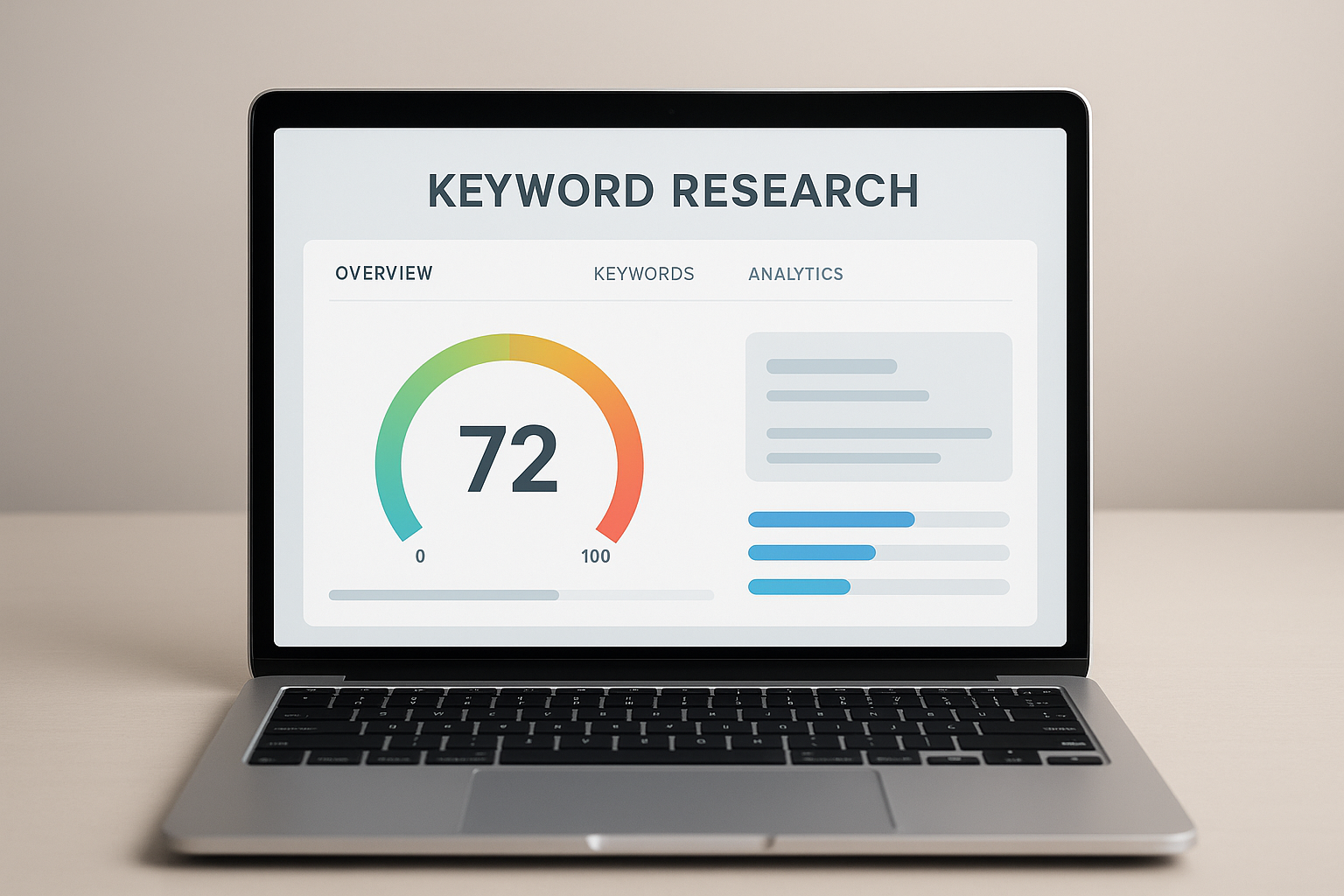
The Moz difficulty score uses a 0–100 scale to help you gauge how competitive a keyword is before investing in it.
How the Score Is Calculated Step by Step
Moz pulls the top 10 organic results for a keyword and evaluates two core signals for each result: the Page Authority of the specific ranking URL and the Domain Authority of the root domain it belongs to. Both metrics are themselves logarithmic scores built from hundreds of link-based signals in the Moz Keyword Explorer.
Because the scale is logarithmic, moving from a difficulty of 40 to 50 is considerably easier than moving from 70 to 80. Therefore, small numerical differences at the top of the scale represent enormous real-world gaps in competitive effort required.
Additionally, Moz factors in the presence of SERP features — such as featured snippets, knowledge panels, and ads — that can reduce the organic click-through rate even if you do rank on page one. This makes the score a more holistic view of ranking opportunity, not just raw competition.
Understanding the Difficulty Score Ranges
0–30 — Low Difficulty: Realistic targets for new or smaller sites. Competition is limited and quality content can earn rankings relatively quickly.
31–50 — Moderate Difficulty: Attainable for sites with growing authority. Consistent content and link-building will be necessary over several months.
51–70 — Hard: Requires an established domain with a meaningful backlink profile. Expect a long-term campaign to see first-page results.
71–100 — Very Hard: Dominated by major brands and high-authority publishers. Competing here demands significant SEO investment and patience.
Practical Ways to Use This Metric in Your Strategy
Knowing the score is only useful if you act on it strategically. First, use it as a filter during keyword research — not as an absolute barrier, but as a prioritization tool that helps you allocate your time and budget wisely.
For example, if you run a site with a Domain Authority of 25, targeting keywords with a difficulty score above 60 will likely produce little return in the short term. Instead, focus on keywords in the 20–40 range where you can realistically compete and build topical authority over time.
As your authority grows, you can gradually move into more competitive territory. This staged approach — sometimes called the keyword difficulty ladder — is one of the most reliable frameworks for sustainable organic growth. Resources like Rank Authority offer additional guidance on building this kind of tiered keyword strategy.

Organizing keywords by difficulty tier helps you build authority progressively rather than chasing unwinnable rankings early on.
Combining Difficulty Score With Search Volume
Difficulty alone does not tell the full story. A keyword with a score of 20 but only 10 monthly searches may not be worth pursuing, while a keyword with a score of 45 and 5,000 monthly searches could be a high-value target for a site with moderate authority.
Therefore, the most effective approach is to evaluate both metrics together. Look for keywords where the volume-to-difficulty ratio is favorable — meaning you get meaningful traffic potential without facing an unrealistic competitive barrier.
According to search engine optimization principles, targeting a mix of head terms and long-tail keywords is widely considered best practice. Long-tail keywords typically carry lower difficulty scores while still driving highly qualified traffic that converts well.
Common Mistakes When Interpreting This Metric
One of the most frequent errors is treating the difficulty score as a pass/fail threshold. In reality, it is a relative signal that should be weighed against your site’s current authority and your competitive context. A score of 55 might be achievable for one site and completely out of reach for another.
Another mistake is ignoring the quality of the content currently ranking. Sometimes a high-difficulty score reflects strong domains that have published weak, outdated content. In those cases, a well-researched, comprehensive article from a mid-authority site can still break through — because Google rewards relevance and freshness alongside authority.
Finally, many SEOs overlook search intent when filtering by difficulty. Even a low-difficulty keyword will underperform if your content does not match what the searcher actually wants to find. Always review the actual SERP before committing to a keyword target.

Reviewing difficulty alongside volume and intent gives you a far more complete picture than any single metric alone.
How Moz Compares to Other Difficulty Tools
Moz, Ahrefs, and Semrush all offer keyword difficulty scores, but they calculate them differently. Ahrefs focuses heavily on the number of referring domains pointing to top-ranking pages. Semrush blends on-page and off-page signals with its own proprietary weighting.
As a result, the same keyword may show a difficulty of 35 in Moz, 48 in Ahrefs, and 42 in Semrush. None of these tools is definitively “correct” — they each reflect different modeling choices. However, using two or more tools together gives you a more reliable consensus estimate of true ranking difficulty.
For teams working primarily within the Moz ecosystem, the Moz difficulty score remains a reliable and well-established benchmark. It is especially useful when combined with Moz’s own Domain Authority and Page Authority metrics, since those inputs feed directly into the difficulty calculation. You can explore deeper competitive analysis approaches at Rank Authority.
Conclusion: Making the Moz Difficulty Score Work for You
In summary, the Moz difficulty score is an indispensable compass for keyword research — not a rigid gate. Used alongside search volume, search intent, and your site’s current authority level, it gives you a realistic picture of where you can compete and where you should wait until your domain grows stronger.
The most successful SEO strategies treat difficulty scores as a prioritization framework rather than a barrier. Start with lower-difficulty keywords to build topical authority, then progressively target harder terms as your domain earns more trust. That disciplined, ladder-based approach consistently outperforms the alternative of chasing high-competition keywords before you are ready.
Frequently Asked Questions
What is the Moz difficulty score?
The Moz difficulty score is a 0–100 metric that estimates how hard it is to rank on the first page of Google for a given keyword. It is based on the Page Authority and Domain Authority of the pages currently ranking in the top 10.
What is a good score for a new website?
For new websites, targeting keywords with a difficulty score below 30 is generally the most realistic starting point. These lower-competition keywords allow newer sites to gain traction and build authority before tackling harder targets.
How is the difficulty score calculated?
Moz calculates the score by examining the Page Authority and Domain Authority of the top 10 ranking pages for a keyword. The stronger those pages collectively are, the higher the difficulty number will be.
Is a score of 50 hard to rank for?
A score of 50 is moderately challenging. Sites with a growing backlink profile and solid on-page SEO can compete at this level, but it typically requires sustained effort over several months.
How does it differ from Ahrefs Keyword Difficulty?
Moz uses Page Authority and Domain Authority as its primary inputs, while Ahrefs bases its difficulty score mainly on the number of referring domains pointing to ranking pages. Both are valid but use different methodologies, so scores often differ for the same keyword.
Can I rank for a high-difficulty keyword?
Yes, but it requires significant authority and a long-term investment in link-building and content quality. It is generally more efficient to build domain strength on lower-difficulty keywords before targeting highly competitive ones.
Does the score account for search intent?
No. The Moz difficulty score measures the competitive strength of ranking pages but does not evaluate search intent. You should always review the actual SERP to confirm that your content type aligns with what users are looking for.
How often does Moz update this metric?
Moz refreshes its index on a rolling basis, but changes are not real-time. Significant SERP shifts for a keyword may take days or weeks to be reflected in the updated difficulty score.
Where can I find the Moz difficulty score?
The score is available inside Moz Keyword Explorer and Moz Pro. Some third-party SEO platforms also display Moz metrics through API integration, allowing you to access the data within your preferred workflow.
Should I only target low-difficulty keywords?
Not exclusively. A healthy strategy balances quick-win low-difficulty keywords with medium-difficulty targets that align with your growth goals. Avoiding all competitive keywords entirely can cap your long-term traffic potential.
What is the relationship between Domain Authority and difficulty score?
Domain Authority is a direct input into the difficulty score calculation. When the pages ranking for a keyword come from high-DA domains, the difficulty score rises accordingly. Improving your own DA over time makes higher-difficulty keywords more attainable.
Is a score above 70 impossible to rank for?
Not impossible, but very difficult. Scores above 70 typically indicate SERPs dominated by major brands or high-authority publishers. Ranking at this level usually demands a sustained, high-investment SEO campaign over an extended period.

