

Moz domain rank is a proprietary SEO metric developed by Moz that scores a website’s overall link authority on a logarithmic scale from 1 to 100. Understanding this metric helps SEOs, content marketers, and business owners benchmark their site’s competitive standing and prioritize link-building efforts more effectively.
A domain rank score reflects the cumulative strength of a site’s backlink profile on a 0–100 scale.
What Is Moz Domain Rank and How Does It Work?
Moz domain rank — more formally known as Domain Authority (DA) — predicts how likely a website is to rank on search engine results pages. Because the scale is logarithmic, moving from a DA of 20 to 30 is far easier than moving from 70 to 80. That distinction is critical for setting realistic growth targets.
The score is computed using Moz’s Link Explorer index, which crawls billions of backlinks across the web. Specifically, it weighs the number of unique linking root domains, the authority of those domains, and the absence of spammy signals. Therefore, a handful of links from highly authoritative sources will outperform hundreds of links from low-quality sites.
Additionally, Moz recalibrates scores across all websites simultaneously during each monthly update. As a result, your score can fluctuate even when your own backlink profile has not changed — simply because competitors gained or lost links.
Domain Authority vs. Page Authority: Key Differences
Moz offers two closely related scores that are often confused. Domain Authority evaluates the entire domain’s link profile, while Page Authority (PA) evaluates the link strength of a single URL. Both use the same 1-to-100 scale, but they answer different questions.
For example, a brand-new blog post on a high-DA site may initially have a low PA because it has not yet earned individual links. However, it still benefits from the domain’s overall authority in search. In contrast, a standalone landing page that earns many targeted backlinks may achieve a high PA even if the domain’s DA is modest.
In practice, most SEOs use DA as a quick competitive benchmark and PA when evaluating specific pages for link-building outreach or content partnerships.
What Score Range Should You Aim For?
Score benchmarks vary by industry and competition level. Nevertheless, the following ranges serve as a general guide:
| DA Range | Interpretation | Typical Profile |
|---|---|---|
| 1 – 20 | Low | New or rarely linked sites |
| 21 – 40 | Below Average | Small local businesses |
| 41 – 60 | Average – Good | Established SMBs and niche blogs |
| 61 – 80 | Strong | Industry leaders and publishers |
| 81 – 100 | Elite | Wikipedia, major news outlets |
Because the scale is logarithmic, even reaching a DA of 50 from 30 requires significant and sustained link-building investment. For most small businesses, therefore, focusing on outranking direct competitors rather than chasing absolute score targets is the more practical approach.
Proven Strategies to Improve Your Score
Improving your domain rank is not an overnight process. However, these proven tactics consistently move the needle when applied with discipline.
- Audit your existing backlink profile. First, use Moz’s Link Explorer or a comparable tool to identify toxic links. Disavowing harmful backlinks prevents them from dragging down your overall score.
- Earn links from high-DA domains. Next, prioritize outreach to authoritative sites in your niche. A single link from a DA 75 domain carries far more weight than ten links from DA 15 sites.
- Publish genuinely link-worthy content. Additionally, original research, comprehensive guides, and data-driven articles naturally attract backlinks over time without requiring constant outreach.
- Build internal links strategically. Although internal links do not directly raise DA, they distribute page authority across your site, strengthening the overall domain signal.
- Monitor and reclaim lost backlinks. Finally, regularly check for broken or removed links pointing to your site and reach out to webmasters to restore them.

Building a deliberate backlink strategy is the most reliable path to a higher domain authority over time.
Common Mistakes That Hurt Your Score
Many site owners unknowingly make decisions that suppress their domain rank. Understanding these pitfalls helps you avoid them before they cause lasting damage.
Buying links in bulk is one of the most common errors. While it may temporarily inflate a score, Moz’s spam detection and Google’s own algorithms will eventually identify and devalue those links. In contrast, earned links from real editorial placements hold their value over time.
Ignoring Spam Score is another frequent mistake. According to SEO best practices, a high Spam Score can actively suppress your domain rank because it signals an unnatural or low-quality link profile. Therefore, routinely auditing and disavowing spammy referring domains is essential maintenance.
Neglecting link diversity also limits growth. A healthy backlink profile draws from multiple types of sites — news outlets, blogs, directories, and industry associations — rather than relying on a single source category.
How to Use Domain Rank in Competitive Research
Beyond measuring your own site, domain rank is a powerful competitive intelligence tool. Before targeting a keyword, compare your DA against the sites currently ranking on page one. If all top-ranking competitors have a DA of 60 or above and yours is 25, you will likely need significant link-building work before competing effectively.
Meanwhile, identifying low-DA competitors who still rank well reveals keyword opportunities where content quality and topical relevance can overcome an authority gap. Tools like Rank Authority can help you surface these competitive gaps and prioritize your SEO roadmap accordingly.
Additionally, when evaluating guest posting or link-building partnership opportunities, always check the prospective site’s DA first. Partnering with domains that have a higher DA than yours ensures the link passes meaningful authority to your site.
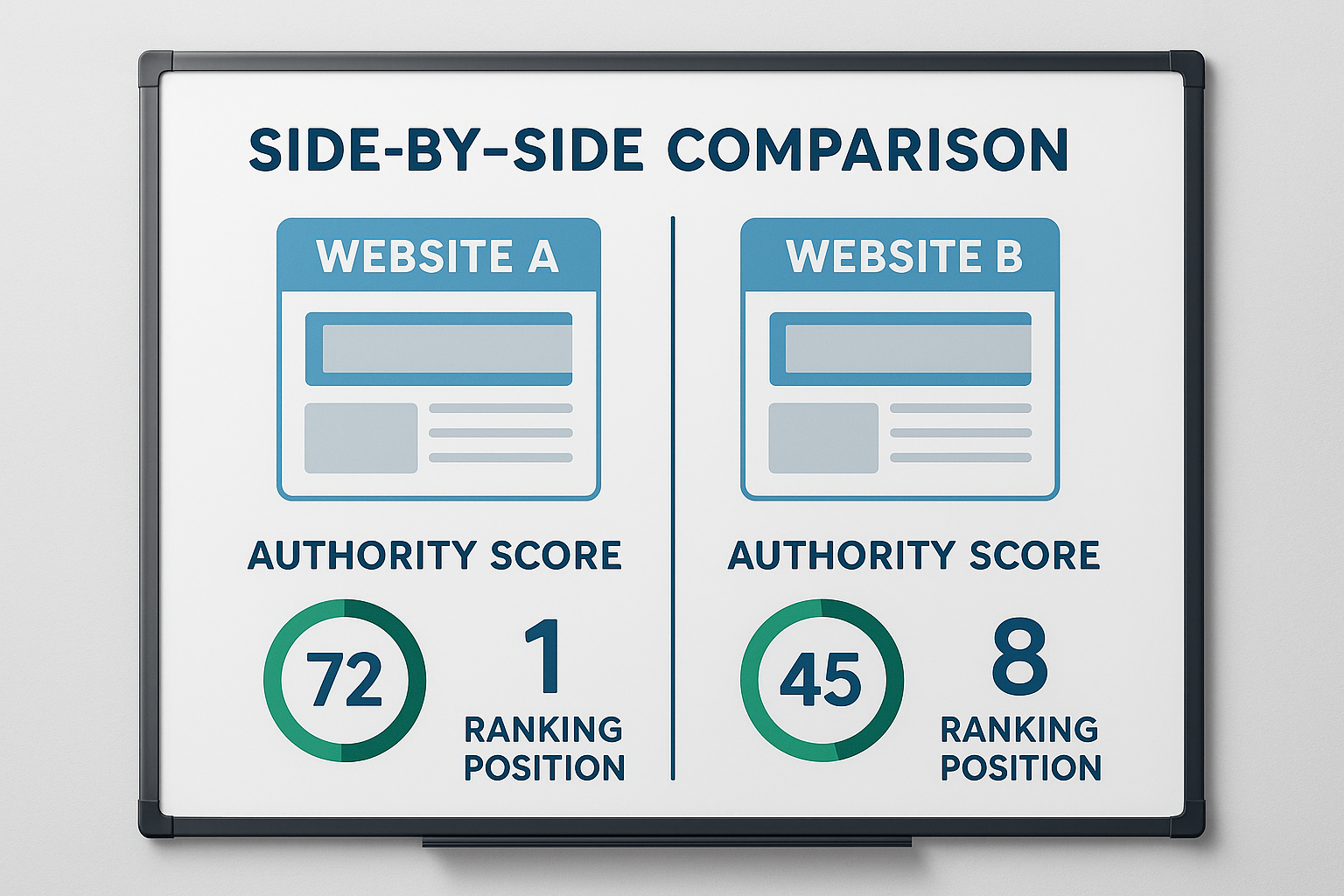
Comparing competitor domain authority scores before targeting a keyword reveals how much link-building investment is realistically needed.
Does Domain Rank Directly Affect Google Rankings?
Moz domain rank does not feed directly into Google’s ranking algorithm because it is a third-party metric. However, it is a strong proxy for the underlying link quality signals that Google’s own systems do evaluate. Sites with high DA tend to rank well because they have earned many authoritative, relevant backlinks — the same signals Google rewards.
Furthermore, research from Moz and independent SEO studies consistently shows a positive correlation between DA and average ranking position. Therefore, while you should never optimize for DA as a goal in itself, improving the factors that raise your DA — quality backlinks, clean link profiles, strong content — will naturally benefit your Google rankings as well.
For a deeper dive into building the authority signals that move both your domain rank and your organic rankings, explore the resources at Rank Authority, which offers actionable guidance on sustainable link-building and authority development.
Quick Answer
Moz domain rank is a 1-to-100 logarithmic score reflecting a website’s backlink authority. Higher scores correlate with stronger Google rankings because they reflect the same link quality signals Google’s algorithm evaluates. Improving your score requires earning quality backlinks, auditing toxic links, and publishing link-worthy content consistently.
Frequently Asked Questions
What is Moz domain rank?
Moz domain rank, formally called Domain Authority, is a score from 1 to 100 that predicts a website’s likelihood of ranking in search engines based on its backlink profile. Higher scores indicate stronger authority. It was developed by Moz as a benchmarking tool for SEO professionals.
How is Moz domain rank calculated?
Moz calculates it by analyzing the quantity and quality of backlinks in its Link Explorer index, factoring in linking root domains and spam signals. The score is then normalized logarithmically across all sites in the index.
What is a good Moz domain rank score?
A score between 40 and 60 is considered good for most small-to-medium businesses. Scores above 60 are strong, and scores above 80 are typically seen on major brands and high-traffic publishers.
How often does Moz update domain rank scores?
Moz updates scores approximately once per month after recrawling its link index. Because the recalibration is applied across all domains at once, your score may shift even without changes to your own link profile.
Is Moz domain rank the same as Google PageRank?
No. Moz domain rank is a third-party metric and is not used by Google. Google’s PageRank is an internal signal that has not been publicly visible since 2016. Both concepts measure link authority, but they are entirely separate systems.
Can I improve my Moz domain rank quickly?
Significant improvement takes consistent effort over months. Earning quality backlinks, removing toxic links, and publishing authoritative content are the most reliable strategies. Quick shortcuts like bulk link purchases tend to backfire.
Does domain rank directly affect Google rankings?
Not directly, since it is a third-party metric. However, it strongly correlates with Google performance because it reflects the same backlink quality signals Google evaluates internally. Improving your DA-driving factors will typically improve your organic rankings as well.
What is the difference between Domain Authority and Page Authority?
Domain Authority scores the entire domain’s link strength, while Page Authority scores a single URL. Both use the same 1-to-100 logarithmic scale. Use DA for competitive benchmarking and PA for evaluating individual pages in outreach decisions.
Why did my Moz domain rank drop suddenly?
Sudden drops most often result from Moz’s monthly recalibration, competitors gaining stronger backlinks, or the loss of previously earned links. It does not automatically indicate a Google penalty, but it warrants a backlink audit to confirm.
How do I check my Moz domain rank for free?
You can use Moz’s free Link Explorer for a limited number of monthly queries. Additionally, platforms like Rank Authority surface domain authority data within broader SEO reporting dashboards, making it easy to track alongside other key metrics.
What is Spam Score and how does it relate to domain rank?
Spam Score is a Moz metric that flags how many spam-like signals a domain exhibits. A high Spam Score can suppress your domain rank because toxic backlinks reduce overall link profile quality. Regularly auditing and disavowing spammy links helps keep your Spam Score low.
How many backlinks do I need to increase my domain rank?
There is no fixed number because quality matters far more than quantity. One link from a DA 80 domain can move your score more than dozens of links from DA 10 sites. Focus on relevance and authority rather than raw link counts.
In conclusion, understanding and improving your moz domain rank is one of the most actionable steps you can take toward long-term SEO success. By earning authoritative backlinks, maintaining a clean link profile, and consistently publishing high-quality content, you build the kind of domain authority that translates into real, sustained organic growth. Use it as a competitive benchmark, not an end goal — and let the underlying link quality do the real work.

