

An SEO content generator is a software tool that uses artificial intelligence to research keywords, structure outlines, and draft search-optimized web content automatically. Instead of spending hours on manual research, business owners and marketers can produce a publish-ready article in minutes, then focus their time on review and strategy rather than first drafts.
However, not every automated tool handles SEO, GEO, and AEO equally well. Some simply generate generic text, while others build in schema markup, internal linking, and answer-ready formatting designed to earn citations in AI search tools like Google’s AI Overviews. This guide explains how these tools work, when they make sense, and how to use one without sacrificing quality.
Quick answer: An SEO content generator combines keyword research, AI drafting, and on-page optimization into one automated process, producing articles structured to rank in traditional search and get cited by AI answer engines. Human review remains essential for accuracy and brand voice.

An SEO content generator combines keyword data with AI drafting to speed up publishing.
What Is an SEO Content Generator?
An SEO content generator is a tool that automates keyword research, outline creation, and drafting so content is built to perform in search results from the start. In short, it replaces several manual steps—research, structuring, and initial writing—with one streamlined workflow.
Most platforms pull data on target keywords, competitor pages, and search intent before generating anything. As a result, the draft that comes out already reflects what Google and AI answer engines tend to reward: clear structure, direct answers, and topic coverage that matches what searchers actually want.
According to Wikipedia’s overview of search engine optimization, ranking well depends heavily on relevance, structure, and authority signals. Consequently, a generator built around those principles has a better chance of producing usable, rank-ready drafts than a general-purpose AI writer.
How Does an SEO Content Generator Work?
Under the hood, most tools follow a similar sequence. First, the system analyzes the target keyword and related search queries. Then it studies top-ranking pages to identify common subtopics, headings, and content gaps.
After that research phase, the generator drafts content using large language models trained to follow on-page SEO conventions, such as placing the keyphrase early, using descriptive subheadings, and maintaining readable sentence lengths. Some platforms go further by adding structured data automatically, which helps search engines and AI systems understand the page’s content without manual coding. Schema.org maintains the vocabulary most tools rely on for this structured markup.
Finally, many tools include an internal linking step, suggesting related pages on the same site to strengthen topical relevance. This matters because AI-based SEO content tools that ignore internal linking often leave pages isolated, which weakens their overall authority signal within the site.
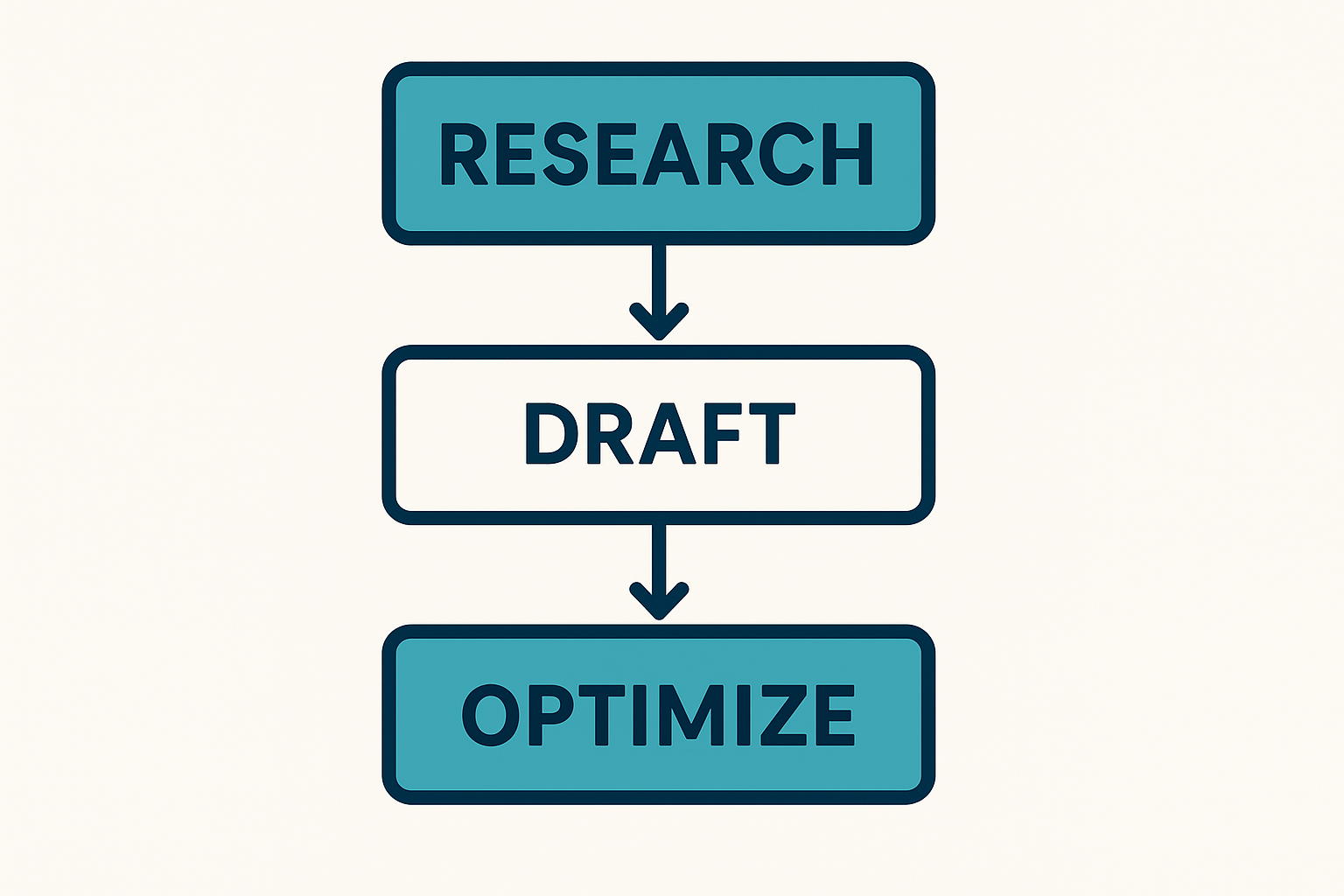
A typical SEO content generator workflow moves from research to draft to optimization.
Key Benefits of Using an AI Content Optimization Tool
Speed is the most obvious advantage. A draft that might take three or four hours to research and write manually can often be produced in a fraction of that time, freeing up resources for editing and strategy instead of blank-page writing.
In addition, consistency improves. Because the tool applies the same structural rules to every draft, teams avoid the quality swings that happen when different writers follow different habits. For agencies managing several client sites, this consistency is particularly valuable.
Furthermore, well-built generators now extend beyond classic SEO. Many are designed to format content for Generative Engine Optimization and Answer Engine Optimization, meaning the output is structured to be cited directly inside AI-generated answers rather than only ranked in a list of blue links. For teams exploring this shift, the guide on optimizing content for AI search engines covers the supporting concepts in more depth.
SEO Content Generator vs. Traditional Content Writing
Traditional content writing relies on a human researching keywords, outlining the piece, and drafting it from scratch. This approach often produces strong original insight, but it is slow and depends on the individual writer’s SEO knowledge.
By contrast, an SEO content generator applies data-driven structure consistently and quickly, though it still benefits from human editing to add original examples, verify facts, and refine tone. In practice, the strongest results tend to come from a hybrid approach: AI handles research and drafting, while a person adds judgment and brand voice.
Google’s own SEO Starter Guide emphasizes helpfulness and originality over production method, which supports this hybrid model rather than fully automated or fully manual extremes.
Step-by-Step: How to Use an SEO Content Generator Effectively
Getting good results from automation still requires a process. The following steps outline a practical approach that balances speed with quality.
- Audit existing content and keyword gaps. Review current pages first so the generator targets genuine opportunities instead of duplicating what already exists.
- Generate a search-intent-matched outline. Build a heading structure that mirrors what top-ranking pages and AI answer engines expect for that query.
- Draft the content with AI assistance. Let the tool produce a full draft that incorporates the target keyphrase and supporting data naturally.
- Edit for accuracy and brand voice. Have a reviewer fact-check claims and adjust tone so the article sounds authentic rather than generic.
- Deploy schema markup and monitor results. Publish with structured data applied, then track rankings and AI citations over several weeks.
Businesses that want a deeper breakdown of on-page mechanics can also review how to optimize website content for search engines for additional context on each step.
Choosing the Right SEO Content Generator
Not every tool is built the same way, so the selection process matters. Specifically, look for keyword research integration, automated schema markup, internal linking suggestions, and readability scoring within the same platform.
Equally important, check whether the tool tracks visibility in AI answer engines, not just traditional rankings. As AI search adoption grows, tools that only optimize for classic blue-link results risk missing an increasingly significant share of discovery traffic. For a broader comparison, the roundup of the best SEO software for content creators is a useful starting point.
Finally, consider CMS integration. A generator that deploys directly into WordPress, Shopify, or similar platforms removes an extra manual publishing step, which matters most for teams managing several sites at once.
Common Mistakes to Avoid With AI-Generated SEO Content
Publishing a draft without review is the most frequent mistake. Even strong AI output can contain outdated information or generic phrasing that needs a human pass before it goes live.
Another common error is ignoring internal links and schema markup, both of which help search engines and AI systems understand how a page fits into the wider site. Similarly, targeting a keyword without matching the content structure to actual search intent often produces articles that rank poorly despite being well-written.
Teams that want a focused checklist for one of these elements can review the automated meta description guide, since meta details are a small but frequently overlooked piece of the on-page puzzle.
How Rank Authority’s AI Blog Builder Approaches Content Generation
Rank Authority’s AI Blog Builder is built as part of a broader platform that combines traditional SEO automation with Generative Engine Optimization and Answer Engine Optimization. In practice, this means generated articles are formatted with direct-answer structure, schema markup, and internal linking applied automatically rather than left for manual setup.
The platform also includes AI visibility monitoring, which tracks whether content is being cited across major AI answer platforms, alongside the RA Score reporting used to benchmark overall site health. Rank Authority can submit published changes for indexing, though Google alone determines whether and when a page is actually indexed.
Businesses curious about the technology can start with a seven-day trial to evaluate the AI Blog Builder alongside tools like RankFast and RankLink. Individual results vary, and reviews reflect individual user experiences rather than guaranteed outcomes for every site.

Comparing manual content writing with an automated seo content generator workflow.
Frequently Asked Questions About SEO Content Generators
What is an SEO content generator?
An SEO content generator is a software tool that uses artificial intelligence to research keywords, build outlines, and draft web content optimized for search engines. It automates tasks that normally require a writer, strategist, and technical SEO specialist working together.
How does an SEO content generator work?
It analyzes search intent, competitor pages, and target keywords, then produces a structured draft with headings and meta details. Most tools also apply on-page SEO rules automatically, such as keyword placement and readability checks.
Why use an SEO content generator instead of writing manually?
Manual research and drafting can take hours per article, while automated tools compress that workflow into minutes. This lets small teams publish consistently without hiring additional writers or strategists.
What is the difference between an SEO content generator and a general AI writer?
A general AI writer produces text from a prompt, but an SEO content generator also incorporates keyword data, schema markup, and ranking-focused structure. The output is built specifically to perform in search and AI answer engines, not just read well.
How much does an SEO content generator cost?
Pricing varies widely, from free limited-use tools to subscription platforms costing roughly $30 to several hundred dollars per month. Platforms bundling GEO, AEO, and technical SEO automation typically sit in the mid-to-upper range of that spectrum.
How long does it take to generate SEO content?
A first draft can often be produced in under five minutes, though final publishing usually requires a review and editing pass. Total turnaround time, including human review, commonly ranges from 15 minutes to an hour per article.
What are common mistakes when using an SEO content generator?
Publishing AI drafts without fact-checking, skipping internal links, and ignoring schema markup are frequent errors. Another common mistake is targeting keywords without matching the content structure to actual search intent.
What are best practices for using an SEO content generator?
Always review AI output for accuracy, add original insight or data, and confirm schema markup and internal links are in place before publishing. Pairing automated drafts with a human editing step tends to produce the strongest results.
Can an SEO content generator help with AI search visibility?
Yes, many modern tools now format content for Generative Engine Optimization and Answer Engine Optimization in addition to traditional SEO. This structure helps content get cited by AI answer engines, not only ranked in classic search results.
Does Google penalize AI-generated content?
Google’s guidance focuses on content quality and helpfulness rather than how it was produced. Low-quality, unedited, or spammy content can underperform regardless of whether a human or an AI content generator created it.
What features should I look for in an SEO content generator?
Look for keyword research integration, automated schema markup, internal linking suggestions, readability scoring, and AI visibility tracking. CMS integration for platforms like WordPress or Shopify also reduces manual publishing work.
Is Rank Authority’s AI Blog Builder a good SEO content generator?
Rank Authority’s AI Blog Builder is designed to generate SEO- and AEO-optimized articles with schema markup and internal linking built in, as part of a broader automated visibility platform. Individual results vary, and a seven-day trial is available for businesses that want to evaluate it directly.
Can an SEO content generator handle schema markup automatically?
Many advanced platforms generate and deploy schema markup automatically alongside the written content. This removes a technical step that otherwise requires manual coding or a developer’s involvement.
Final Thoughts on Choosing an SEO Content Generator
In summary, an SEO content generator can significantly speed up publishing while keeping articles structured for both traditional search and AI answer engines. However, the strongest results still come from pairing automation with human review for accuracy, originality, and brand voice.
As AI search continues to reshape how people find information, choosing a generator that handles GEO, AEO, and technical SEO together—rather than treating them as separate tasks—offers a more durable path to visibility. Teams ready to test this approach can explore Rank Authority’s AI Blog Builder and related tools through a seven-day trial to see how the workflow fits their own publishing needs.

