
SEO defined simply, is the ongoing practice of improving a website so that search engines rank it higher in unpaid, organic results — the listings nobody pays for a click to see. Put another way, search engine optimization (SEO) is how you make your pages easier for Google, Bing, and other search engines to find, understand, and recommend to the people already searching for what you offer. Whether you run a personal blog, manage an e-commerce store, or oversee marketing for a growing company, understanding SEO is the first real step toward sustainable, free traffic.
Because most guides only skim the surface, this article goes further. Specifically, you will learn exactly how search engines crawl and rank pages, the pillars that make up a complete SEO strategy, the metrics Google actually measures today, and a clear step-by-step plan you can start using immediately. By the end, you will understand SEO defined in full — not as a buzzword, but as a practical system you can apply this week.
What Is SEO Defined? The Core Definition Explained
At its simplest, SEO defined is the process of shaping a website’s content, structure, and reputation so that search engines display it prominently for relevant queries. Search engines such as Google rely on complex algorithms — layered sets of rules and machine-learning models that decide what to show first — to rank billions of pages. As a result, optimizing for those algorithms means more organic, unpaid visitors land on your site every single day.
According to Wikipedia’s entry on search engine optimization, the discipline dates back to the mid-1990s, when the earliest search engines first began cataloguing the web. Since then, SEO has evolved from simple keyword matching into a sophisticated practice that weighs hundreds of ranking signals at once. In fact, Google reportedly updates its ranking systems thousands of times per year, which is exactly why SEO defined today looks very different from SEO defined a decade ago.
In practice, SEO is not a single task you complete and forget. Instead, it is an ongoing strategy built on three core pillars — plus a specialized fourth pillar that matters enormously for local businesses. Understanding each one individually makes the entire concept far easier to apply.
SEO defined visually: search engines rank pages based on relevance, authority, and user experience signals.
The Three Core Pillars of SEO — Plus a Fourth for Local Businesses
Every complete SEO strategy rests on three interconnected pillars. Together, they cover what your pages say, how your site is built, and how authoritative it appears to search engines. Additionally, businesses with a physical presence benefit from a fourth, specialized layer: local SEO.
On-Page SEO: What Your Content Communicates
On-page SEO refers to everything you control directly on each web page. This includes your title tag (the clickable blue headline shown in search results), meta description, headings, body copy, image alt text, and internal links. Because search engines read these elements to understand what a page covers, getting them right is foundational.
Keyword research — the process of identifying the exact phrases your audience types into Google — is the starting point for on-page SEO. For a deeper look at effective tools and workflows, Moz’s Beginner’s Guide to SEO is a widely respected industry resource. However, keyword usage must feel natural; stuffing a page with repetitive terms actually harms rankings today rather than helping them.
Off-Page SEO: Building Authority Beyond Your Site
Off-page SEO focuses on signals that exist outside your website but still influence how search engines perceive your authority. The most powerful of these signals is the backlink — a link from another website pointing to yours. Think of each backlink as a vote of confidence: the more reputable the source, the more weight that vote carries.
Additionally, brand mentions, social media signals, and digital PR (earning press coverage that links back to your site) all contribute to off-page authority. Building this kind of trust takes time, but it creates a competitive advantage that rivals find very difficult to replicate quickly.
Technical SEO: The Foundation Search Engines Rely On
Technical SEO ensures that search engine crawlers can access, read, and index your pages without obstacles. Key elements include site speed, mobile responsiveness, HTTPS (the secure, encrypted connection protocol browsers look for), XML sitemaps, and structured data markup. Even outstanding content can fail to rank if technical barriers prevent Google from properly indexing the page.
For example, a page that loads in five seconds on mobile will lose rankings to a competitor that loads in one second, all else being equal. Therefore, technical SEO is not optional — it is the infrastructure everything else depends on. For a deeper walkthrough, see our SEO Competitor Intelligence Dashboard: Complete Guide.
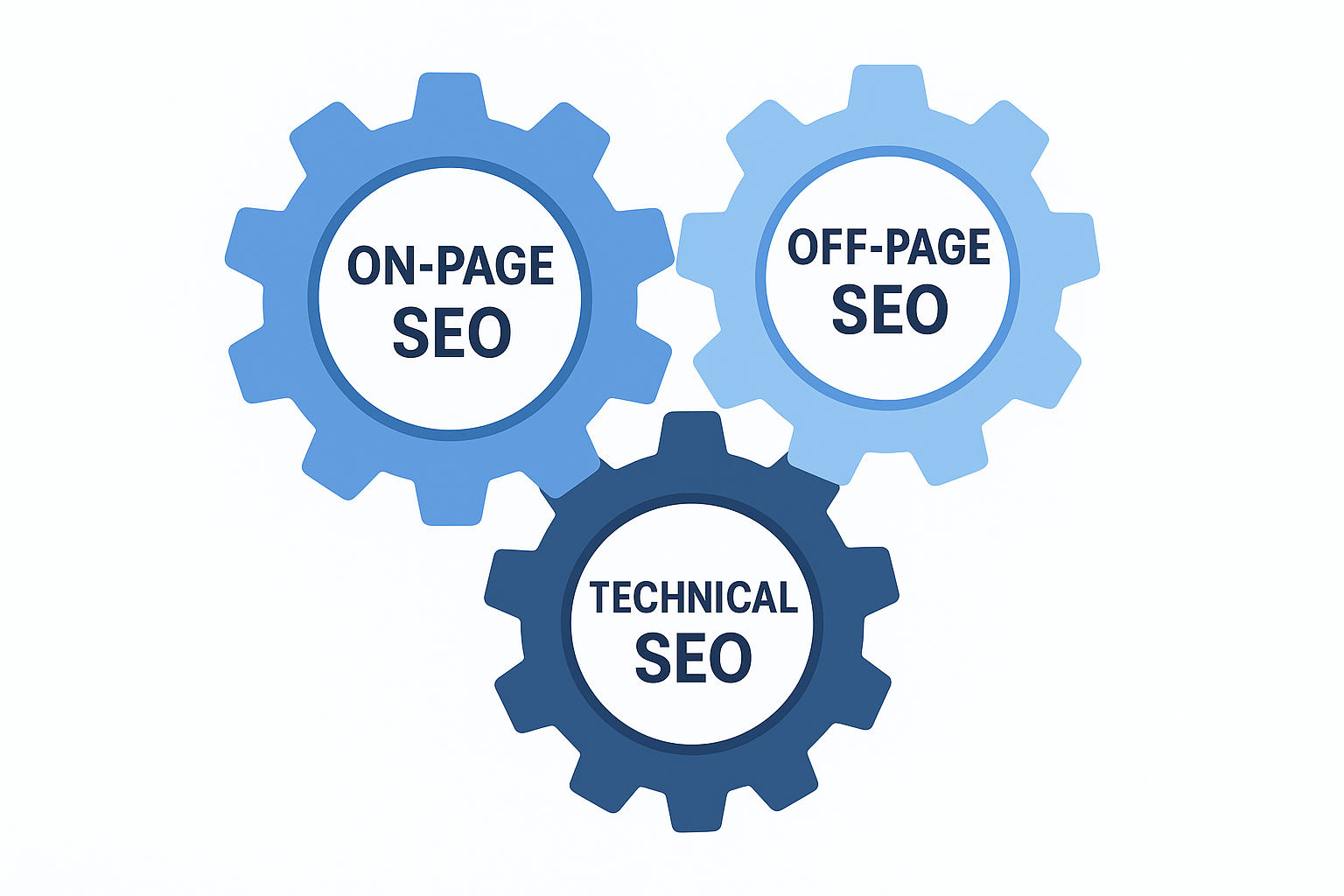
The three foundational pillars of SEO work together — neglecting any one of them limits the effectiveness of the others. Local SEO builds directly on top of all three.
Local SEO: The Specialized Fourth Pillar
If your business serves a specific city or region, local SEO deserves just as much attention as the three core pillars. This means claiming and optimizing your Google Business Profile, keeping your name, address, and phone number (often shortened to “NAP”) consistent across directories, and earning reviews from real customers. In particular, “near me” searches have exploded in volume, and businesses that ignore local SEO leave this traffic entirely to competitors.
How Search Engines Crawl, Index, and Rank Web Pages
Before you can optimize for search engines, it helps to understand what they actually do behind the scenes. Google, for instance, uses automated programs called crawlers, or “spiders,” to discover web pages by following links across the internet.
Crawling and Indexing: How Google Finds Your Pages
Once a crawler discovers a page, it is stored in a massive index — essentially a giant digital library of web content. Without indexing, a page simply cannot appear in search results, no matter how well written it is. Consequently, checking your indexing status is one of the very first technical SEO tasks any website owner should perform.
Ranking Algorithms: Turning Index Data Into Results
When someone types a query, Google’s algorithm searches the index and ranks the most relevant, authoritative, and user-friendly pages. Importantly, this ranking process happens in milliseconds and considers hundreds of signals simultaneously. That is precisely why SEO is a long-term discipline rather than a one-time fix.
Understanding User Intent
One of the most critical concepts in modern SEO is user intent — the underlying reason behind a search query. For instance, someone searching “best running shoes” is likely in shopping mode, whereas someone searching “how to tie running shoes” wants instructional content. Matching your content to the correct intent dramatically improves your chances of ranking.
Search engines have become remarkably good at detecting intent mismatches. As a result, creating content purely to target keywords — without genuinely serving the searcher’s need — is a strategy that consistently underperforms.
E-E-A-T and Core Web Vitals: What Modern SEO Really Rewards
E-E-A-T Explained: Experience, Expertise, Authoritativeness, Trust
Google’s quality guidelines rely heavily on a concept called E-E-A-T: Experience, Expertise, Authoritativeness, and Trustworthiness. In plain terms, this means Google favors content written by people who have genuinely used a product, lived through a situation, or hold demonstrable expertise in a topic. Above all, trust signals — such as transparent authorship, accurate information, and secure browsing — matter more today than ever before.
Core Web Vitals: The Technical Metrics Google Measures
Core Web Vitals are a specific set of page-experience metrics, including loading speed, interactivity, and visual stability, that Google uses as ranking signals. For official benchmarks and testing tools, Google’s own Search Central documentation is the most authoritative source available. In short, a technically fast, stable page gives every other SEO effort a far better chance of succeeding.
SEO vs. SEM: Organic Search Versus Paid Search Explained
People often confuse SEO with SEM (search engine marketing), yet the two work quite differently. SEO earns free, organic rankings over time, whereas SEM involves bidding on keywords to display paid ads instantly. Understanding the difference helps you allocate budget and expectations correctly.
- Cost: SEO traffic is free once a page ranks; paid search costs money for every single click.
- Speed: SEM delivers visibility instantly; SEO typically needs months to build momentum.
- Longevity: SEO rankings can persist for years; paid ads disappear the moment the budget stops.
- Trust: Many users trust organic results more than labeled advertisements, which boosts SEO’s long-term click-through rate.
In many cases, the smartest strategy combines both: SEM for immediate visibility and SEO for compounding, long-term growth.
Why SEO Delivers Long-Term Value
Unlike paid advertising, where traffic stops the moment your budget runs out, SEO builds compounding value over time. A well-optimized page can continue attracting visitors for months or even years after it was first published. Furthermore, organic search traffic tends to convert at higher rates because users arrive with specific intent already formed.
For businesses of all sizes, this makes SEO one of the highest-return digital marketing channels available. Resources like RankAuthority provide structured guidance for building and executing an effective SEO strategy, whether you are just starting out or scaling an established site.

Tracking SEO performance over time reveals which optimizations are driving organic growth. Last updated: 2026-07-30. Author: RankAuthority editorial team.
Common Mistakes That Undermine SEO Progress
Even with the right intentions, many websites make avoidable errors that slow their SEO progress. Keyword stuffing — repeating a phrase unnaturally throughout a page — is one of the oldest and most persistent mistakes. Meanwhile, neglecting mobile optimization means losing a massive share of potential visitors, since most searches now happen on smartphones.
Other frequent pitfalls include ignoring page speed, building backlinks from low-quality or irrelevant sites, and publishing thin content that does not genuinely answer a searcher’s question. In contrast, sites that invest in comprehensive, well-structured content consistently dominating search outperform those chasing shortcuts.
SEO in the Age of AI-Powered Search
Search itself is changing quickly. AI-generated summaries and conversational search experiences now sit above traditional results for many queries, which means SEO defined for 2025 must account for how these systems choose and cite sources. Specifically, structured, well-sourced, and clearly authored content tends to get selected more often by AI summarization layers.
If you want a deeper dive into what SEO means on AI-powered platforms, that guide breaks down exactly how ranking signals shift once AI becomes the interface. Similarly, our breakdown of AI-enhanced SEO strategies for 2025 rankings walks through practical tactics for staying visible as search engines integrate generative features.
How to Start Applying SEO Today: A 6-Step Action Plan
Getting started with SEO does not require a massive budget or a team of specialists. Instead, focus on these foundational steps, in order.
Conduct Keyword Research. Use free tools like Google Search Console or paid platforms to identify the terms your audience is searching for. Focus on relevance and search volume, then prioritize keywords where you have a realistic chance of ranking.
Optimize Your Pages. Update your title tags, meta descriptions, and headings to include your target keywords naturally. Additionally, ensure every page has a clear structure with one main topic per URL.
Fix Technical Issues and Improve Core Web Vitals. Run a technical audit to identify crawl errors, slow-loading pages, and missing sitemaps. Tools like Google Search Console are free and reveal the most critical issues first.
Build Quality Backlinks. Create content worth linking to — original research, comprehensive guides, or unique data. Then promote it through outreach, guest posting, and digital PR to earn authoritative links.
Adapt Your Strategy for AI-Powered Search. Review how your content performs in AI-generated summaries, then tighten authorship clarity and sourcing. Our guide to what SEO means on AI-powered platforms explains this shift in full detail.
Measure, Refine, and Scale. Track your rankings, organic traffic, and conversion rates monthly. For a complete roadmap, see the best ways to improve your site’s search rankings, then use the data to decide where to improve next.
Essential SEO Tools and Resources to Accelerate Your Strategy
As your strategy matures, dedicated platforms can automate much of the repetitive work involved in keyword tracking, auditing, and reporting. For instance, our 2026 buyer’s guide to smart SEO automation platforms compares the leading tools side by side. Likewise, if you want to future-proof your stack, the complete 2026 guide to AI-driven search platforms explains what to look for in next-generation software.
Conclusion: Putting SEO Defined Into Practice
With SEO defined clearly across its four pillars — on-page, off-page, technical, and local — you now have the framework to approach optimization strategically rather than reactively. SEO is not a magic switch; however, it is one of the most reliable ways to build sustainable, compounding online visibility over time. Start with the fundamentals, stay consistent, and use trusted resources like RankAuthority to deepen your expertise as your strategy matures.
Frequently Asked Questions About Search Engine Optimization
What does SEO defined actually mean?
Meaning of SEO means Search Engine Optimization — the practice of improving a website’s visibility in unpaid search engine results. It involves technical, content, and authority-building strategies that help search engines understand and rank your pages.
How does SEO work?
SEO works by aligning your website’s content, structure, and authority signals with what search engines look for when ranking pages. Search engines crawl, index, and then rank pages based on hundreds of factors, including relevance, speed, and backlinks.
What are the four main types of SEO?
The four main types of SEO are on-page SEO (content and keyword optimization), off-page SEO (backlinks and authority), technical SEO (site speed, crawlability, and structure), and local SEO (optimizing for location-based searches). Together, they form a complete optimization strategy.
Why is SEO important for a business?
SEO is important because it drives free, organic traffic to your website from people actively searching for your products or services. Unlike paid ads, SEO results compound over time and deliver long-term return on investment.
How long does SEO take to show results?
SEO typically takes three to six months to show meaningful results, though competitive niches may take longer. Factors like domain age, content quality, and link profile all influence how quickly rankings improve.
What is on-page SEO?
On-page SEO refers to optimizations made directly on your web pages, including title tags, meta descriptions, headers, keyword usage, and internal linking. It ensures search engines can understand what each page is about.
What is off-page SEO?
Off-page SEO involves actions taken outside your website to improve its authority and trustworthiness, primarily through earning backlinks from other reputable sites. Social signals and brand mentions also contribute to off-page SEO.
What is technical SEO?
Technical SEO covers the backend elements of a website that affect how search engines crawl and index it, including site speed, mobile-friendliness, XML sitemaps, and structured data. Without a solid technical foundation, even great content may not rank well.
What is local SEO?
Local SEO is the practice of optimizing a website and online listings so a business appears in location-based searches, such as “near me” queries. It relies on Google Business Profile optimization, consistent business information, and customer reviews.
What is E-E-A-T and why does it matter for SEO?
E-E-A-T stands for Experience, Expertise, Authoritativeness, and Trustworthiness — a framework Google uses to evaluate content quality. Pages written by credible, experienced sources with transparent authorship tend to rank better.
What are Core Web Vitals?
Core Web Vitals are a set of Google metrics measuring page loading speed, interactivity, and visual stability. They directly influence rankings because they reflect real-world user experience.
What is the difference between SEO and paid search (SEM)?
SEO focuses on earning organic, unpaid rankings in search results, while paid search (SEM) involves bidding on keywords to display ads. SEO takes longer but provides sustainable traffic, whereas paid search delivers immediate visibility at ongoing cost.
What are the most important SEO ranking factors?
The most important SEO ranking factors include content relevance and quality, backlink authority, page experience signals like Core Web Vitals, and proper keyword usage. Google uses hundreds of signals, but these consistently carry the most weight.
What is keyword research in SEO?
Keyword research is the process of identifying the words and phrases your target audience types into search engines. It informs your content strategy by revealing search volume, competition level, and user intent.
What is a backlink and why does it matter for SEO?
A backlink is a link from another website pointing to yours, and it acts as a vote of confidence in your content’s authority. High-quality backlinks from reputable sites are one of the strongest signals search engines use to rank pages.
What common SEO mistakes should beginners avoid?
Common SEO mistakes include keyword stuffing, ignoring mobile optimization, neglecting page speed, and building low-quality backlinks. Additionally, failing to create content that matches user intent is one of the most damaging errors beginners make.
How is SEO changing with AI-powered search?
AI-powered search experiences now summarize answers directly in results, pulling from well-structured, clearly authored, and authoritative pages. As a result, SEO increasingly rewards content that demonstrates real expertise and is easy for AI systems to parse and cite.

