
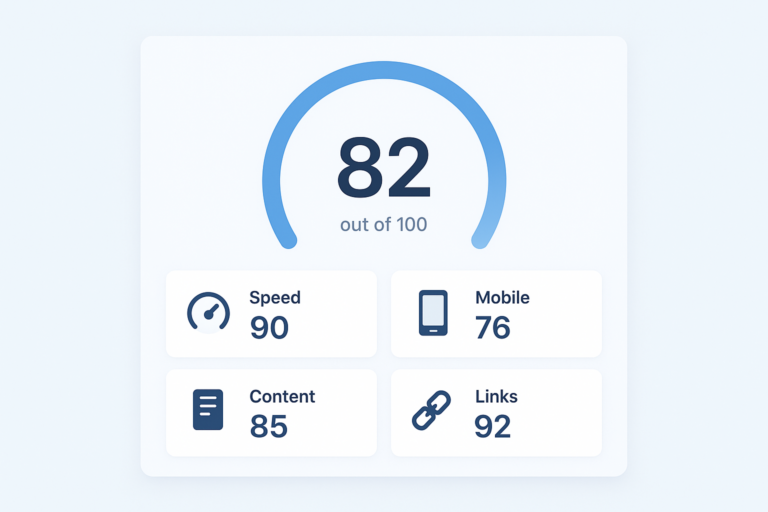
The SEO score meaning is straightforward: it is a numerical rating, typically on a scale of 0 to 100, that measures how well a website or individual page is optimized for search engine visibility. Understanding this number helps website owners identify weaknesses, prioritize improvements, and track progress over time. However, the score is only as valuable as your ability to interpret what it actually measures.
In practice, an SEO score aggregates dozens of individual signals — from page speed and mobile usability to content depth and backlink quality — into a single benchmark. Because it condenses so much data, it is one of the fastest ways to get a high-level view of your site’s health.
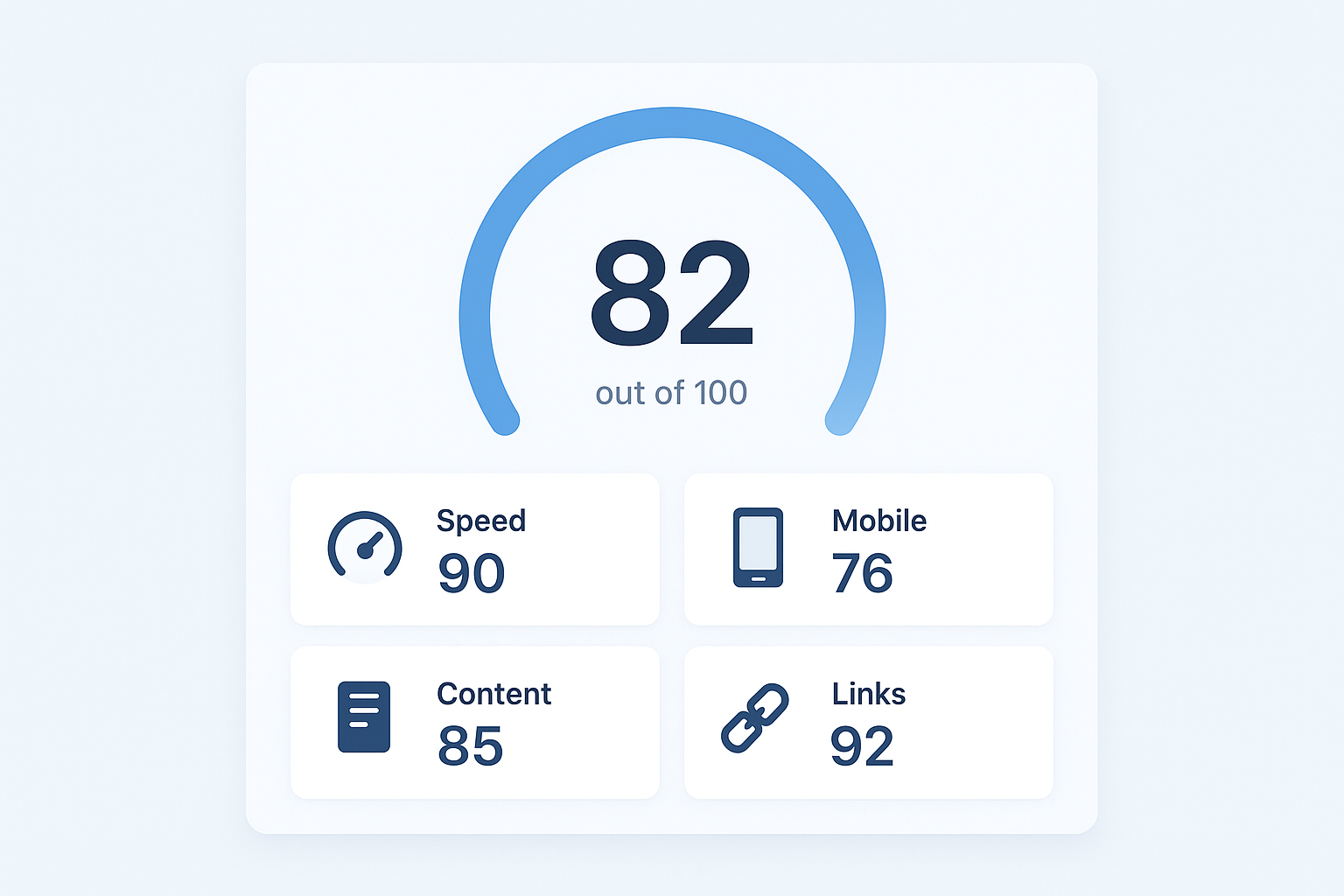
An SEO score dashboard brings together multiple optimization signals into one readable number.
What Does an SEO Score Actually Measure?
An SEO score is not a single data point — it is a composite. Most audit tools divide the score into three broad categories: technical SEO, on-page SEO, and off-page SEO. Each category contributes a weighted portion to the overall number.
Technical SEO covers the infrastructure of your site. This includes crawlability, site speed, HTTPS security, mobile responsiveness, and structured data. Because search engines must be able to access and index your pages, technical issues often carry the heaviest penalty to your score.
On-page SEO evaluates the content and HTML elements on each page. Title tags, meta descriptions, header structure, keyword placement, internal linking, and content length all fall into this category. Therefore, even a technically flawless site can score poorly if its content is thin or poorly structured.
Off-page SEO reflects your site’s authority as seen from the outside. Backlink quantity, backlink quality, and domain authority contribute here. As a result, newer sites with few inbound links will typically score lower in this dimension regardless of how well the page itself is built.
How Is the Score Calculated?
Different tools use different formulas, so scores are not interchangeable across platforms. For example, a score of 72 on one tool does not equal 72 on another. Despite this variation, most platforms follow a similar audit logic:
- Crawl the site — The tool spiders your pages, following links and indexing what it finds.
- Flag issues — Each problem is categorized as critical, warning, or notice, and assigned a severity weight.
- Calculate sub-scores — Technical, on-page, and off-page metrics each receive a partial score.
- Aggregate the total — Sub-scores are combined using the tool’s proprietary weighting to produce a final number.
According to Wikipedia’s overview of search engine optimization, the discipline encompasses both technical and creative elements, which is precisely why a good scoring system must weigh both dimensions.
What Is a Good Score Range?
While thresholds vary by tool, a widely accepted benchmark framework looks like this:
0 – 49: Poor — significant technical and content issues need urgent attention.
50 – 69: Needs Improvement — core foundations exist but several gaps remain.
70 – 89: Good — well-optimized site with minor areas for refinement.
90 – 100: Excellent — highly optimized and competitive.
In practice, most established websites land between 60 and 80. Reaching 90+ requires consistent attention to all three pillars: technical health, content quality, and authority building.
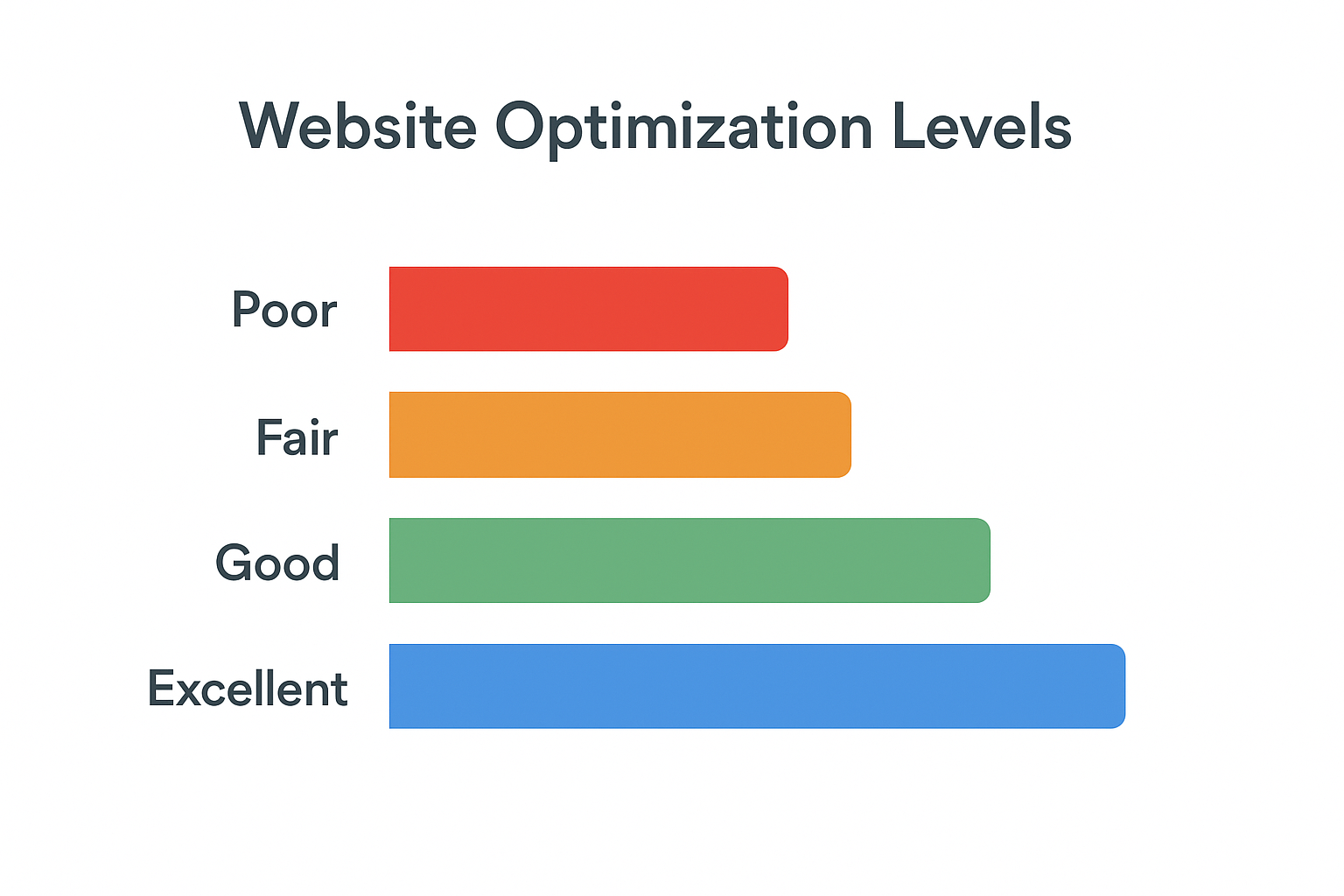
Score ranges help you benchmark your site against recognized performance tiers.
Common Mistakes That Drag Scores Down
Many site owners are surprised to discover that simple, fixable issues are responsible for the bulk of their score loss. The following problems are among the most common culprits:
- Missing or duplicate meta descriptions — These reduce click-through rates and signal poor on-page hygiene.
- Slow page load times — Google explicitly uses page speed as a ranking signal, so slow pages hurt both score and rankings.
- Broken internal links — They block crawlers and frustrate users, both of which lower your score.
- No HTTPS — Unencrypted sites are flagged by browsers and penalized by most audit tools.
- Thin content — Pages with fewer than 300 words rarely satisfy search intent and drag down content sub-scores.
Additionally, ignoring mobile optimization is increasingly costly. Because Google now uses mobile-first indexing, a poor mobile experience directly impacts how your pages are evaluated.
How to Improve Your Score Step by Step
Improving your score is most effective when you work from highest-impact fixes down to refinements. Here is a practical sequence to follow:
Step 1 — Run a full audit. Use a reliable tool to generate a baseline score and export the full list of issues. This gives you a prioritized starting point rather than guessing where to begin.
Step 2 — Fix critical technical errors first. Address broken links, redirect chains, missing sitemaps, and crawl blocks. These issues often produce the fastest score gains because they affect every page simultaneously.
Step 3 — Optimize on-page elements. Write unique title tags and meta descriptions for every page. Then, review your heading structure and ensure keywords appear naturally in your content without stuffing.
Step 4 — Improve page speed. Compress images, enable browser caching, and minimize JavaScript. Tools like Google Search Console can highlight Core Web Vitals issues that directly affect performance scoring.
Step 5 — Build quality backlinks. Off-page authority takes the longest to develop. However, earning links from reputable, relevant sources is one of the most durable ways to raise your score over time.
For a deeper audit and ongoing monitoring, resources like Rank Authority provide structured tools to track your progress and identify new opportunities as your site grows. For a deeper walkthrough, see our SEO Services for Small Businesses: 2026 Buyer’s Guide to Sustainable Growth.
Score vs. Rankings: Understanding the Relationship
A common misconception is that a perfect SEO score will automatically translate into first-page rankings. In contrast, the score is a diagnostic tool, not a ranking lever. Google does not read your Moz or Ahrefs score — it reads your actual page signals.
Nevertheless, the correlation between a high score and strong rankings is real. This is because the factors that raise your score — faster pages, better content, stronger backlinks — are the same factors Google rewards in its algorithm. Therefore, treating your score as a proxy for site health is a sound strategy, as long as you remember it is a means to an end, not the end itself.
Putting It All Together
Understanding the SEO score meaning gives you a practical framework for diagnosing your website’s optimization health at a glance. It combines technical, on-page, and off-page signals into a single number that helps you prioritize your efforts. However, the true value lies not in the number itself but in the specific issues it reveals and the actions you take to resolve them. Consistent monitoring, methodical fixes, and a long-term commitment to content quality will move both your score and your rankings in the right direction.
Quick Answer
An SEO score is a 0–100 rating that measures how well your website is optimized across technical, on-page, and off-page factors. Scores above 80 are generally considered good. Improving your score means fixing real issues that also improve your actual search rankings.

Reviewing your audit report is the first step toward turning your SEO score into real ranking gains.
Frequently Asked Questions
What is the SEO score meaning in simple terms?
An SEO score is a numerical rating from 0 to 100 that reflects how well a web page is optimized for search engine visibility. It combines technical health, content quality, and backlink strength into a single benchmark. A higher score generally indicates better optimization and greater ranking potential.
What is considered a good SEO score?
Most tools consider a score of 80 or above to be good, while anything above 90 is excellent. Scores below 50 usually signal significant issues that need immediate attention before rankings can improve.
How is an SEO score calculated?
SEO scores are calculated by auditing factors like page speed, mobile-friendliness, meta tags, keyword usage, backlinks, and crawlability. Each tool weights these factors differently, so scores vary between platforms and are not directly comparable.
Does a high SEO score guarantee top rankings?
No, a high SEO score does not guarantee a top ranking. It is a diagnostic indicator, not a direct ranking signal used by Google. However, improving the underlying factors that raise your score typically leads to better search visibility over time.
Which tools measure SEO score?
Popular tools include Rank Authority, Ahrefs, Moz, SEMrush, and Screaming Frog. Each uses its own methodology, so the scores are not interchangeable. It is best to pick one tool and track your progress consistently within that platform.
How often should I check my SEO score?
You should check your SEO score at least once a month, or after any major site update. Regular monitoring helps you catch technical regressions and content issues before they negatively impact your rankings.
What factors hurt an SEO score the most?
Slow page load times, broken links, missing meta descriptions, duplicate content, and a poor mobile experience are the biggest score killers. Fixing these issues typically produces the fastest and most measurable improvements.
Is SEO score the same as Domain Authority?
No, they are different metrics. Domain Authority measures the strength of a domain’s backlink profile specifically, while an SEO score is a broader audit covering technical, on-page, and off-page factors. Both are useful but serve different diagnostic purposes.
Can a new website have a high SEO score?
Yes, a new website can achieve a high technical SEO score if it is properly configured from launch. However, off-page metrics that depend on backlinks and domain age will naturally be lower until the site builds authority over time.
How long does it take to improve an SEO score?
Technical fixes like correcting broken links or adding meta tags can improve your score within days. Content and authority improvements, in contrast, typically take several weeks to months before they reflect meaningful gains in the score.
Does SEO score affect Google rankings directly?
Google does not use third-party SEO scores as a ranking factor. However, the underlying issues these scores flag — such as slow speed or poor mobile experience — are genuine Google ranking signals. Addressing them improves both your score and your actual rankings.
What is the difference between on-page and off-page SEO score factors?
On-page factors include content quality, keyword optimization, title tags, and internal linking. Off-page factors primarily involve backlinks and domain authority. A comprehensive SEO score weighs both categories to give a complete picture of your site’s optimization health.

