
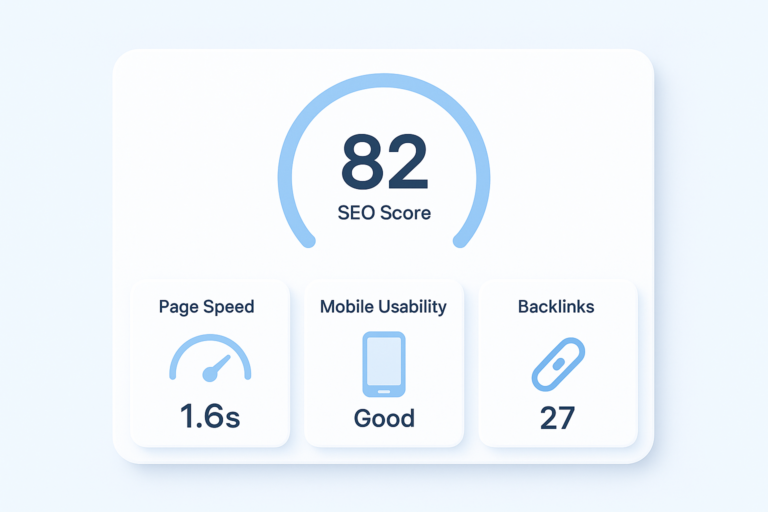
What is SEO score is one of the most common questions from website owners who want to understand their search performance at a glance. An SEO score is a numeric indicator — typically ranging from 0 to 100 — that reflects how well a website is optimized for search engines based on a combination of technical, content, and authority factors. Understanding your score is the first step toward improving your visibility in search results.
Why Your SEO Score Matters for Search Visibility
Your SEO score acts as a health report for your website. Just as a credit score summarizes your financial reliability, an SEO score summarizes how search-engine-ready your site is. Because Google evaluates hundreds of signals when ranking pages, the score helps you prioritize the most impactful improvements without getting overwhelmed by raw data.
Additionally, tracking your score over time reveals whether your optimization efforts are moving in the right direction. For example, if your score rises from 54 to 78 over three months, that trend strongly suggests your site is becoming more competitive in search results. In contrast, a declining score often signals new technical issues or content gaps that need immediate attention.
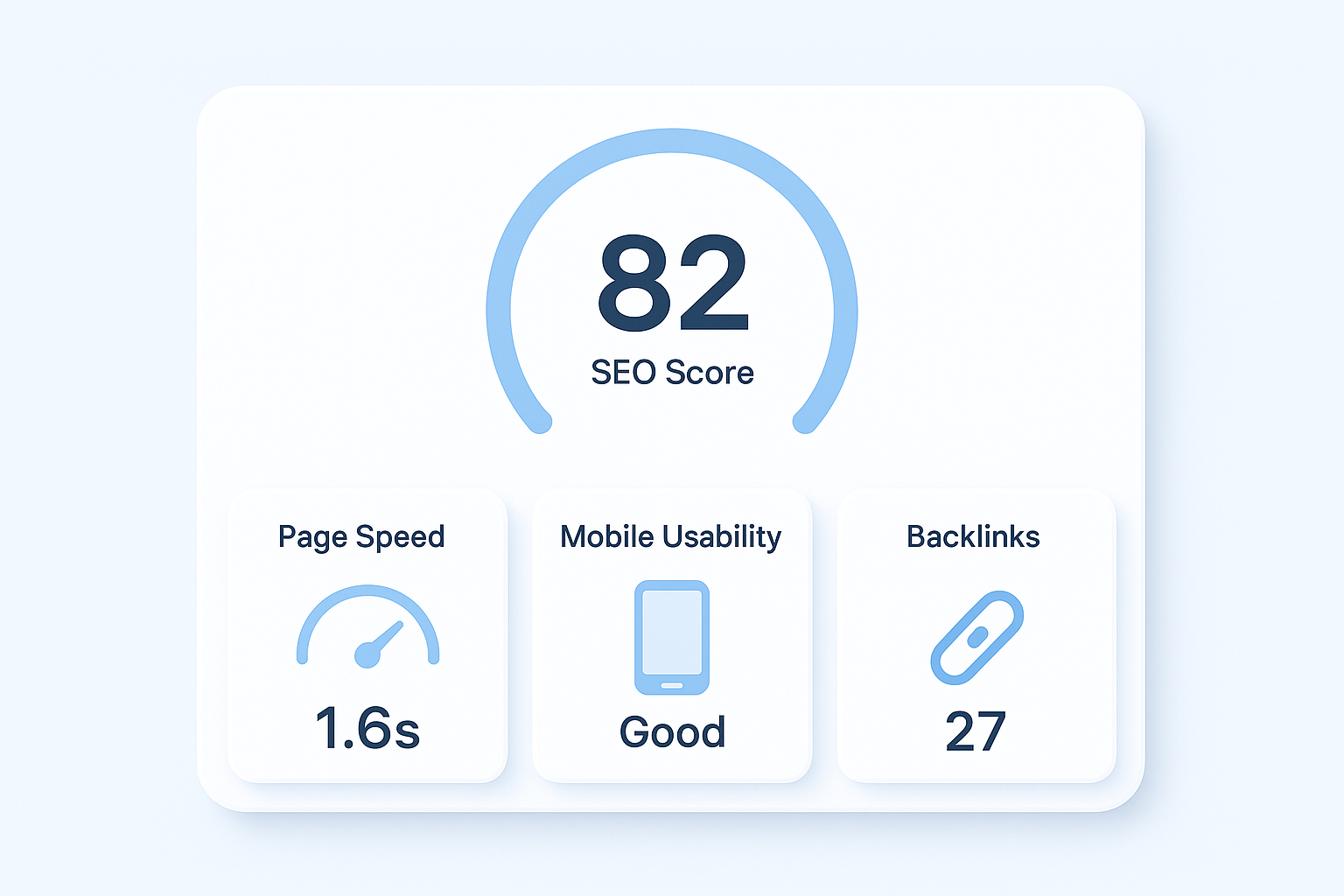
A typical SEO score dashboard breaks down your overall score into technical, content, and authority components.
The Three Pillars That Build Your Score
Most SEO auditing tools calculate a score by evaluating three broad categories. Understanding these pillars helps you see exactly where your points are being lost — and where the biggest gains are available.
1. Technical SEO Health
Technical SEO refers to the behind-the-scenes infrastructure of your site. This pillar includes factors such as page load speed, mobile responsiveness, HTTPS security, clean URL structure, proper use of canonical tags, and crawlability. Because search engine bots must be able to access and index your pages efficiently, technical issues can significantly drag down your score even when your content is excellent.
For instance, a site with broken internal links, duplicate content, or uncompressed images will lose meaningful points in this category. Therefore, resolving technical errors is usually the fastest path to a score improvement.
2. On-Page Content Quality
On-page factors examine the quality and structure of your actual content. Tools assess whether your title tags and meta descriptions are present, unique, and properly sized. They also evaluate keyword usage, heading hierarchy, image alt text, content length, and internal linking. Meanwhile, readability and topical depth increasingly influence how scoring algorithms weight individual pages.
A page that targets a topic thoroughly — answering related questions and using semantically relevant terms — will score higher than a thin page stuffed with repeated keywords. As a result, modern SEO scoring rewards genuine helpfulness over keyword density alone.
3. Authority and Backlink Profile
Authority signals measure how trustworthy and influential your site appears to search engines. The primary driver here is your backlink profile — the number and quality of external websites linking to yours. According to Wikipedia’s overview of search engine optimization, link authority has been a foundational ranking concept since the earliest days of modern search algorithms.
However, link quality matters far more than quantity. A single backlink from a respected industry publication can add more authority than dozens of links from low-quality directories. Therefore, building relationships and earning editorial mentions should be a central part of any long-term SEO strategy.
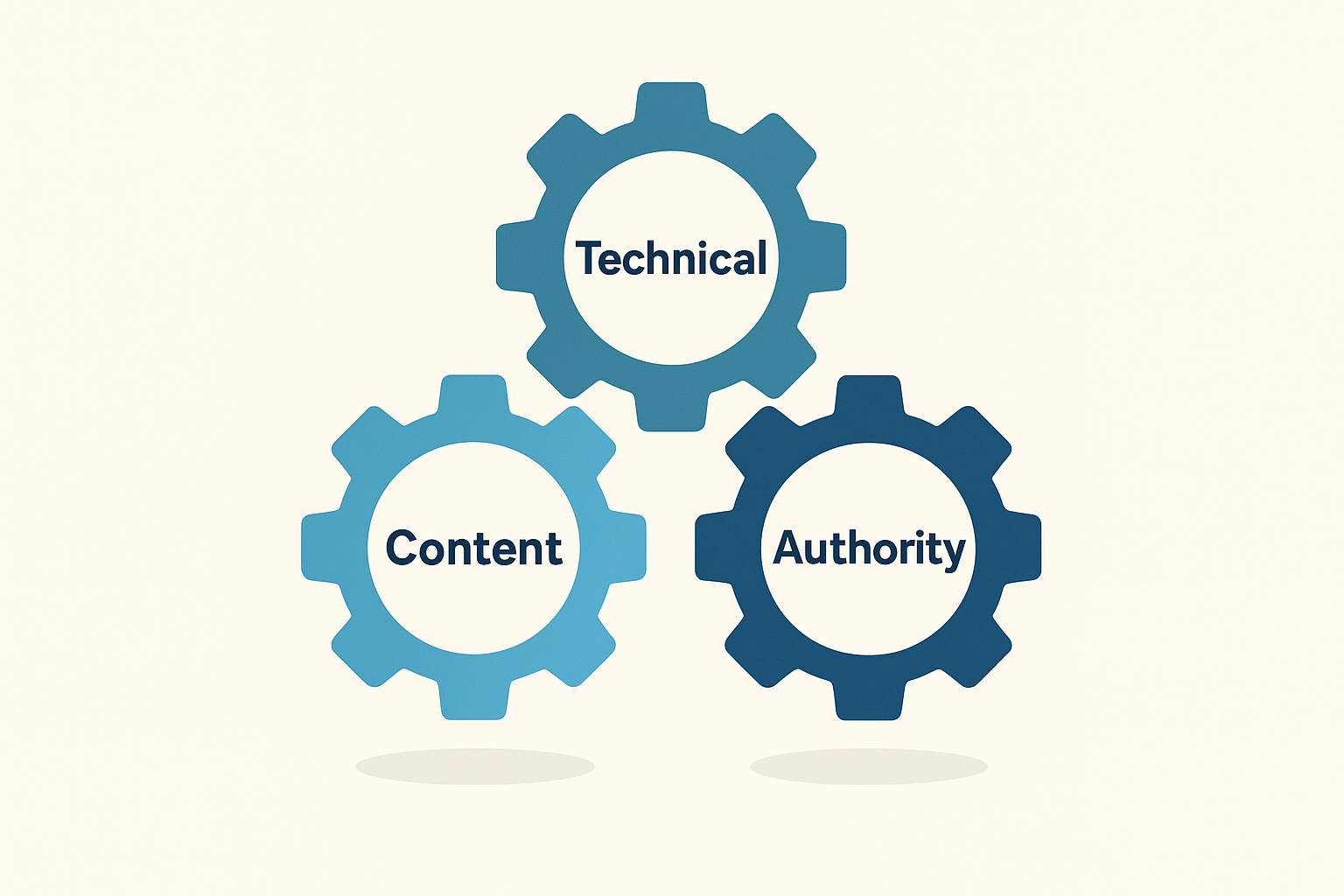
The three pillars of an SEO score work together — weakness in any one area limits your overall optimization potential.
What Score Range Should You Aim For?
While scoring scales vary slightly between tools, a practical benchmark framework applies broadly across most platforms:
| Score Range | Status | Action Needed |
|---|---|---|
| 0 – 49 | Poor | Urgent fixes required across multiple areas |
| 50 – 69 | Needs Work | Significant gaps limiting search performance |
| 70 – 89 | Good | Solid foundation; focus on refinements |
| 90 – 100 | Excellent | Maintain and monitor for regressions |
It is worth noting that different tools may produce different scores for the exact same website. Because each platform weights factors differently, your score from one tool is not directly comparable to another. As a result, the most effective practice is to choose one tool and track your progress consistently over time rather than jumping between platforms.
How to Improve Your Website’s Optimization Rating
Improving your score is a process of systematic auditing and prioritized fixes. Below are the most impactful actions you can take, organized from fastest wins to longer-term investments.
Step 1: Fix Critical Technical Errors First
Start by running a full site audit using a tool such as Rank Authority or Google Search Console. Look for broken links, missing meta tags, crawl errors, and redirect chains. These issues are often quick to fix and immediately boost your technical score.
Step 2: Optimize Page Speed and Core Web Vitals
Page speed is both a confirmed Google ranking factor and a major scoring component. Compress images, enable browser caching, minify CSS and JavaScript, and use a content delivery network where possible. Even shaving one second off your load time can meaningfully improve your score and reduce bounce rates.
Step 3: Strengthen Your On-Page Content
Review your most important pages and ensure each one has a unique, keyword-aligned title tag and meta description. Add descriptive alt text to all images, use a logical heading hierarchy, and expand thin content with genuinely useful information. Additionally, build a strong internal linking structure so both users and bots can navigate your site efficiently.
Step 4: Build High-Quality Backlinks Over Time
Authority growth is the slowest pillar to improve, but it has the greatest long-term impact. Focus on earning backlinks through original research, guest contributions, and creating genuinely shareable resources. Meanwhile, disavow any toxic or spammy links that may be dragging down your domain’s trust signals.
For a deeper look at ongoing optimization strategies, Rank Authority offers comprehensive auditing and guidance tailored to your site’s specific gaps.
Common Mistakes That Hurt Your Score
Many website owners unknowingly damage their own scores through avoidable missteps. First, publishing duplicate content — either across your own pages or copied from other sites — creates confusion for crawlers and dilutes your authority. Second, neglecting mobile optimization is increasingly costly because Google now uses mobile-first indexing for all sites.
Third, ignoring structured data markup means you are missing opportunities to help search engines understand your content’s context. Finally, letting your site accumulate 404 errors without redirecting or removing them wastes crawl budget and signals poor maintenance to both users and algorithms.

A structured SEO audit checklist helps you systematically address every factor dragging down your score.
Putting It All Together
Understanding what is SEO score means recognizing it as a dynamic, multi-dimensional snapshot of your site’s search readiness. It is not a single magic number that guarantees rankings, but rather a diagnostic tool that guides where to invest your optimization energy. Because the factors behind the score align closely with what Google actually rewards, improving your score and improving your rankings tend to go hand in hand.
Therefore, the most effective approach is to audit regularly, fix technical issues promptly, create genuinely helpful content, and build authority steadily over time. In practice, websites that treat their SEO score as a living benchmark — not a one-time project — consistently outperform those that optimize in bursts and then go dormant.
Frequently Asked Questions
What is SEO score exactly?
An SEO score is a numeric metric, typically between 0 and 100, that measures how well a website is optimized for search engines. It aggregates signals from technical health, on-page content quality, and link authority into a single benchmark figure. Tools use it to help website owners prioritize improvements without manually reviewing hundreds of individual signals.
What is a good SEO score?
A score above 80 is generally considered good, while 90 or higher is excellent. Scores below 50 indicate significant issues that are likely hurting your search visibility and should be addressed urgently.
How is an SEO score calculated?
SEO tools calculate the score by auditing dozens of factors including page speed, mobile-friendliness, metadata quality, keyword usage, backlink profile, and crawlability. Each factor is weighted and combined into a final percentage or number. The exact formula varies between tools.
Does Google use an SEO score to rank websites?
No, Google does not use a single SEO score number. The score is a third-party tool concept designed to help website owners understand their optimization level. However, the underlying factors that influence the score do directly affect Google rankings.
What factors affect an SEO score the most?
The most impactful factors include page load speed, mobile responsiveness, HTTPS security, quality of on-page content, proper use of title tags and meta descriptions, internal linking structure, and the quantity and quality of backlinks. Technical errors such as broken links and crawl blocks also carry significant weight.
How often should I check my SEO score?
Checking your SEO score monthly is a practical routine for most websites. However, after major site changes such as redesigns, new content launches, or technical updates, you should run an audit immediately to catch any regressions early.
Can I improve my SEO score quickly?
Some improvements are fast, such as fixing broken links, adding missing meta descriptions, or compressing images. However, lasting score improvements tied to rankings typically take weeks to months because they require content quality growth and backlink acquisition, which cannot be rushed.
What tools can I use to check my SEO score?
Popular tools include Google Search Console, Semrush, Ahrefs, Moz, and Rank Authority. Each tool uses slightly different methodologies, so scores may vary between platforms. Choose one and use it consistently for meaningful trend tracking.
Is a high SEO score a guarantee of top rankings?
No. A high SEO score shows your site is well-optimized, but rankings also depend on competition, search intent alignment, domain authority, and content freshness. Think of the score as a health indicator, not a ranking guarantee.
What is the difference between on-page SEO score and technical SEO score?
An on-page SEO score focuses on content quality, keyword usage, headings, and meta tags on individual pages. A technical SEO score, in contrast, evaluates site-wide infrastructure issues like crawlability, site speed, structured data, and security certificates.
Why do different tools show different SEO scores for the same site?
Each tool has its own proprietary algorithm and weights different factors differently. Therefore, a score from one tool is not directly comparable to a score from another. Use one tool consistently to track progress over time rather than comparing numbers across platforms.
How does page speed affect my SEO score?
Page speed is a confirmed Google ranking factor and a major component in most SEO scoring tools. Slow pages increase bounce rates and reduce crawl efficiency, both of which lower your overall score and search visibility. Improving Core Web Vitals is therefore one of the highest-return technical investments you can make.

