
Rank Authority · Expert SEO Guide · Updated 2025
2025 SEO Tips: The Complete, Actionable Guide to Dominating Search Rankings
The most thorough, up-to-date 2025 SEO tips resource available — covering AI-driven search, E-E-A-T, technical fundamentals, link building, local SEO, voice search, content strategy, measurement, and everything in between. Built for practitioners who need results, not theory.
Key Takeaways
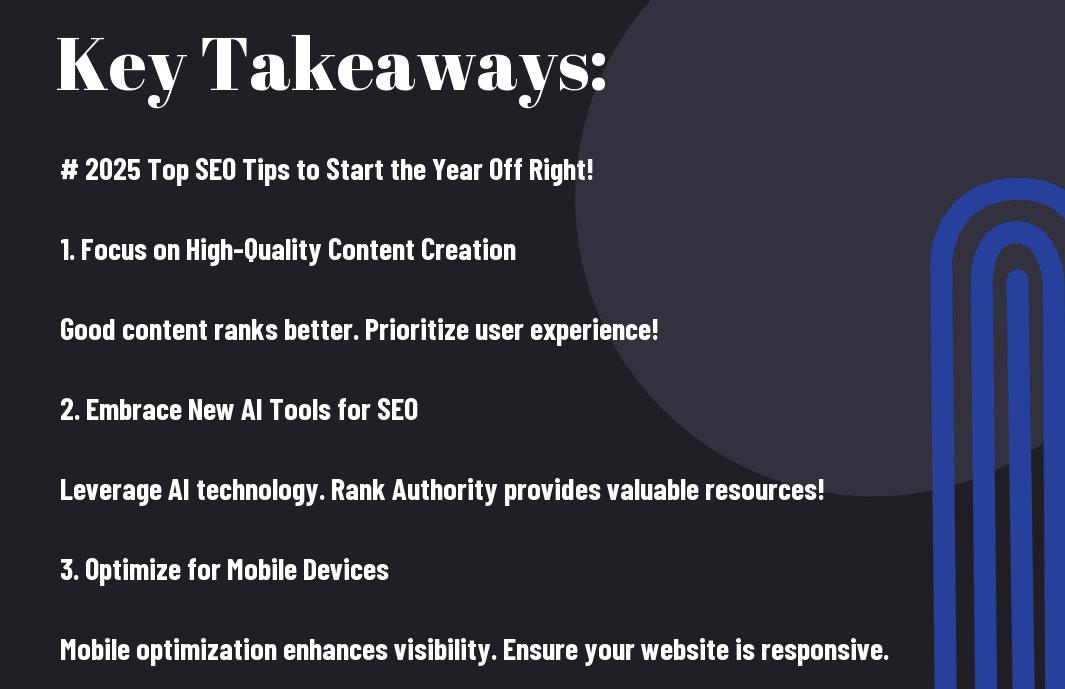
- →Google’s AI Overviews have permanently altered how traffic flows — being cited inside these summaries is now a top visibility priority.
- →E-E-A-T (Experience, Expertise, Authoritativeness, Trustworthiness) is the single most important editorial framework for 2025 SEO.
- →Topical authority — not isolated keyword pages — is how Google decides which sites to trust and rank across an entire subject area.
- →Core Web Vitals, mobile-first indexing, and crawl health form the technical baseline — without them, strong content still won’t rank.
- →Voice search, zero-click optimization, and local SEO represent three high-growth traffic channels most competitors are under-investing in.
- →AI-assisted SEO tools like Rank Authority can automate the most time-consuming optimization tasks — making enterprise-grade execution accessible at any scale.
Search engine optimization in 2025 demands more than a checklist — it demands a system built on current signals, real expertise, and continuous improvement. Whether you’re trying to break into page one for a competitive term or defend rankings you’ve already earned, the 2025 SEO tips in this guide give you a complete, prioritized roadmap. We cover everything: the algorithm changes reshaping search, the content strategies that are winning right now, the technical fixes most sites are still missing, and the link-building and local SEO tactics that move the needle fastest. Read this guide end to end and you’ll know exactly where to focus, in what order, and why.
How Google Has Changed: The 2025 SEO Landscape You Must Understand
You cannot implement effective 2025 SEO tips without first understanding what has fundamentally changed in how Google works. The algorithm operating today is architecturally different from what existed even eighteen months ago. Three developments define the new landscape — and they require real strategic adaptation, not cosmetic adjustments.
Google’s AI Overviews and the Zero-Click Search Reality
Google’s AI Overviews — the AI-generated summary blocks that now appear above organic results for a growing percentage of queries — represent the most disruptive shift in search behavior in years. For many informational queries, a significant share of users read the AI-generated answer and never click through to any website at all. This is the zero-click reality every SEO professional must account for in 2025.
But here’s the opportunity most practitioners miss: pages that are cited as sources within AI Overviews receive disproportionate visibility and authority signals. Google selects sources for AI Overviews based on structured, authoritative, trustworthy content — content that directly answers specific questions, uses structured data markup, and demonstrates genuine topical expertise. Optimizing to be cited inside AI Overviews is now a discrete, high-value SEO objective alongside traditional ranking.
Practical takeaway: Structure your most important content with clear, direct answers to specific questions. Use FAQ markup, concise definition-style introductions to sections, and strong structured data. These are the formatting choices that make Google’s AI more likely to pull your content as a cited source.
What Google’s Core Updates Are Actually Rewarding in 2025
Google’s Helpful Content System, multiple Spam Updates, and a series of broad Core Updates from 2023 through early 2025 have sent a unified, unambiguous signal: content that exists primarily to rank — rather than to genuinely help users — is being systematically devalued. The sites winning today share a consistent profile:
- ✓They demonstrate verifiable first-hand experience and deep subject matter expertise
- ✓They satisfy the full scope of user intent — answering not just the keyword but the complete underlying question
- ✓They load fast, render correctly on mobile, and pass all Core Web Vitals thresholds
- ✓They earn backlinks from contextually relevant, editorially trusted sources — not manufactured link schemes
- ✓They are regularly updated to keep information current, especially in fast-moving niches
- ✓They belong to sites with strong topical authority — comprehensive coverage of a subject area, not isolated optimized pages
E-E-A-T: The Core Framework Driving 2025 SEO Decisions
E-E-A-T stands for Experience, Expertise, Authoritativeness, and Trustworthiness — the four dimensions Google’s Quality Raters use to evaluate whether content deserves to rank. While not a direct algorithmic ranking factor, E-E-A-T shapes almost every signal Google does measure algorithmically. Understanding each dimension is essential for every serious 2025 SEO strategy:
- Experience: Include original insights, documented case studies, first-person observations, and real-world examples. Content that could have been written by someone with no hands-on experience is being systematically filtered down the rankings.
- Expertise: Demonstrate depth beyond what any generalist could produce. Surface-level overviews that skim topics without providing genuine insight are losing ground to content from demonstrated subject matter authorities.
- Authoritativeness: Build your brand’s reputation through citations, mentions, editorial backlinks, and consistent presence in authoritative industry conversations. Authoritativeness is earned over time — it cannot be faked or shortcut.
- Trustworthiness: Secure your site with HTTPS, include transparent authorship and credentials, cite your sources, maintain accurate and current information, and ensure your business information is consistent across the web. Trustworthiness is the foundation all other E-E-A-T signals rest on.
YMYL (Your Money or Your Life) content — any content touching health, finance, legal advice, or safety — faces the highest E-E-A-T scrutiny. If your site operates in these verticals, investing in verified author credentials, medical/legal/financial reviewer bylines, and source citations is not optional — it’s the cost of entry for ranking.
The Rise of Search Generative Experience and What It Means for Click-Through Rates
Independent research and early data from 2024–2025 suggest that AI Overviews are reducing organic click-through rates for informational queries by a measurable margin. This shifts the strategic priority for SEO in two important directions: first, towards transactional and commercial-intent keywords where AI Overviews are less prevalent and users still click through to make purchase decisions; and second, towards building the kind of comprehensive brand authority that earns citation within AI-generated summaries — converting zero-click appearances into brand awareness and trust signals that drive direct traffic and branded search over time.
Content Strategy: The 2025 SEO Tips That Actually Drive Rankings
Content is still the foundation of every sustainable SEO strategy — but the bar for what qualifies as “great content” has risen sharply. These content-focused 2025 SEO tips go beyond the basics to address exactly what separates pages that rank in position one from pages that stall on page three.
Step 1: Master Search Intent Before Writing a Single Word
Search intent is the single most important factor in content strategy for 2025. Google classifies user intent into four primary categories — informational, navigational, commercial investigation, and transactional — and ranks pages that match intent most precisely. Mismatching intent is the most common reason a well-written, well-optimized page fails to rank despite ticking every other box.
Before writing any content, answer these four diagnostic questions:
- What is the user actually trying to accomplish when they type this query — not just what words they used?
- What content format does the SERP favor for this keyword — listicle, step-by-step guide, comparison table, video, definition?
- What adjacent questions does the user likely have that competing content hasn’t fully addressed?
- What action does the user want to take after consuming this content — and does my page make that next step obvious?
The SERP itself is your best research tool. Analyze the top five results for your target keyword and note not just what they cover, but how they present it. Format, angle, and depth are as important as the content itself.
Step 2: Build Topical Authority With Content Clusters
One of the highest-leverage 2025 SEO tips is this: stop thinking in individual pages and start building topical clusters. Google evaluates the depth and breadth of coverage across your entire site — not just a single page’s optimization. A site that thoroughly covers every dimension of a topic is treated as an authority on that topic and rewarded with easier rankings for any new content it publishes in that space.
A topical cluster architecture has three components:
- Pillar Page: A comprehensive, authoritative overview of a broad topic (e.g., “The Complete 2025 SEO Guide”). This page targets your highest-volume, most competitive keyword and serves as the hub of your cluster.
- Cluster Content: Deeper dives into specific subtopics that link back to the pillar page (e.g., “Local SEO Tips 2025,” “Technical SEO Checklist,” “How to Do Keyword Research in 2025”). Each cluster page targets a more specific long-tail keyword.
- Internal Linking Architecture: Strategic, descriptive anchor-text links between the pillar and cluster pages, signaling to Google that your site owns this topic space and distributing page authority throughout the cluster.
Step 3: Conduct Advanced Keyword Research Beyond Search Volume
Keyword research in 2025 goes far beyond monthly search volume. The most effective keyword strategy layers multiple data points to identify not just what people search, but where you can realistically compete and win:
- Keyword Difficulty vs. Domain Authority: Target keywords where your current site strength gives you a genuine chance at page one. Overreaching on ultra-competitive terms burns content resources with no ROI.
- Long-Tail and Question-Based Keywords: These drive highly qualified, high-intent traffic and align naturally with voice search and conversational AI queries. They are also significantly easier to rank for while you build domain authority.
- Semantic Keyword Clusters: Related terms, synonyms, and co-occurring phrases that help Google understand the full context and depth of your content — not just the single target keyword.
- SERP Feature Opportunities: Keywords that trigger featured snippets, People Also Ask boxes, image packs, or video carousels let you gain visibility even without ranking #1. These represent asymmetric opportunities worth prioritizing.
- Trend Analysis: Use Google Trends to identify rising search queries before they saturate. Being first to comprehensively cover an emerging topic gives you a significant head start before competitors notice the opportunity.
- Competitor Content Gap Analysis: Use tools like Ahrefs’ Content Gap or SEMrush’s Keyword Gap to surface keywords your competitors rank for that you don’t — these are proven-demand targets with validated SEO potential.
Step 4: On-Page Optimization — The Details That Determine Rankings
On-page optimization in 2025 goes well beyond dropping a keyword into your title and a few headings. Every element of the page contributes to how Google understands, classifies, and ranks your content. Use this complete on-page checklist for every piece you publish:
- Title Tag: Include the primary keyword within the first 60 characters. Write for clicks, not just crawlers — click-through rate is a quality signal Google actively measures.
- Meta Description: Write a genuine, enticing 150–160 character summary that includes the keyword and gives users a specific reason to click your result over the others.
- H1 Tag: One per page, must contain the primary keyword, and must clearly and specifically describe the page’s content — no vague or clever titles that obscure the topic.
- Header Hierarchy (H2–H4): Use a logical, nested structure. Incorporate semantic keyword variants and related questions naturally in subheadings — don’t force exact-match keywords into every heading.
- URL Structure: Short, descriptive, keyword-inclusive slugs with hyphens. Avoid parameter-heavy or dynamically generated URLs for content pages.
- Image Alt Text: Every image should have descriptive, specific alt text. Include relevant keywords where they fit naturally — don’t keyword-stuff alt attributes.
- Internal Links: 3–5 internal links per long-form piece, using descriptive anchor text that accurately describes the destination page’s content. This distributes authority and helps Google understand your site architecture.
- Schema Markup: Implement relevant structured data (Article, FAQ, HowTo, BreadcrumbList) to help Google classify your content type and unlock rich result appearances in the SERP.
- Author and Credentials: Include a byline with credentials, a brief author bio, and links to the author’s other published work. This directly supports E-E-A-T signals and is increasingly important for ranking in competitive verticals.
- External Citations: Link outward to authoritative sources that support your claims. Pages that cite high-quality external sources consistently outperform pages that make unattributed assertions.
Step 5: Use Multimedia Strategically to Maximize Engagement and Rankings
In 2025, multimedia elements are strategic ranking assets — not decorative additions. Here’s exactly how each format contributes to SEO performance:
- Embedded Videos: Increase average session duration significantly — a behavioral signal Google tracks as a proxy for content quality and user satisfaction. Host on YouTube (for YouTube SEO benefits) and embed on your page.
- Original Infographics and Data Visualizations: Earn natural editorial backlinks when other creators in your niche reference your visual content. Proprietary data presented visually is one of the most efficient link-building tactics available.
- Optimized Images: Convert to WebP format, compress without quality loss, use lazy loading for below-the-fold images, and write descriptive alt text. This simultaneously improves page speed, Core Web Vitals scores, and image search visibility.
- Tables and Comparison Charts: Frequently pulled into featured snippets and People Also Ask boxes. Adding well-structured tables to your content creates a direct pathway to high-visibility SERP features without requiring a position-one ranking.
- Interactive Tools and Calculators: Generate massive engagement metrics, earn links organically, and create a reason for users to bookmark and return to your site — all of which send strong positive signals to Google.
Step 6: Refresh and Update Existing Content Systematically
One of the most underrated 2025 SEO tips is that publishing new content is not always the highest-ROI activity. Refreshing existing content that already has some ranking history — updating data points, expanding thin sections, improving internal links, and adding new schema markup — frequently produces faster ranking improvements than publishing from scratch. Build a quarterly content refresh calendar and prioritize pages sitting in positions 4–15, where a focused improvement effort can break them into the top three.
Technical SEO in 2025: The Non-Negotiable Foundation
No content strategy — no matter how brilliant — can overcome a broken technical foundation. The technical 2025 SEO tips in this section address what happens under the hood: site speed, crawlability, indexability, security, and mobile performance. These are the elements that determine whether Google can find, understand, and rank your content at all.
Core Web Vitals: The Performance Metrics That Directly Suppress or Boost Rankings
Google’s Core Web Vitals remain a confirmed ranking factor in 2025. Failing these metrics doesn’t just cost you points — it actively suppresses pages that would otherwise rank based on content quality alone. The three metrics you must optimize:
-
LCP
Largest Contentful Paint — measures loading performance. Target: under 2.5 seconds. Primary fixes: compress and properly size images, implement a CDN, eliminate render-blocking resources, and upgrade hosting infrastructure. -
INP
Interaction to Next Paint — measures responsiveness. Target: under 200 milliseconds. Primary fixes: minimize JavaScript execution time, reduce long tasks, and optimize event handlers. INP replaced FID as a Core Web Vital in 2024 — many sites are still not monitoring it. -
CLS
Cumulative Layout Shift — measures visual stability. Target: under 0.1. Primary fixes: always specify image and video dimensions, reserve space for ads and embeds, avoid dynamically injected content that pushes page elements around.
Measurement tip: Use field data from Google Search Console’s Core Web Vitals report — not just lab simulations from PageSpeed Insights. Lab data doesn’t capture real-user conditions. Field data is what Google actually uses to evaluate your pages.
Site Speed Optimization: A Step-by-Step Action Plan
Site speed is simultaneously a Core Web Vitals component and an independent ranking signal — and every additional second of load time measurably increases bounce rates while decreasing conversions. Follow this systematic approach:
- Upgrade your hosting infrastructure: Shared hosting is a performance ceiling. Managed WordPress hosting or a cloud VPS with SSD storage delivers dramatically faster server response times.
- Implement a Content Delivery Network (CDN): Cloudflare, Fastly, or Bunny.net serve your assets from servers geographically close to each user, reducing latency by 40–70% for geographically distributed audiences.
- Compress and convert all images to WebP: WebP images are 25–35% smaller than JPEG/PNG at equivalent quality. Implement lazy loading so below-the-fold images don’t slow initial page load.
- Minify CSS, JavaScript, and HTML: Remove whitespace, comments, and unnecessary characters from all code files. This typically reduces file sizes by 15–30%.
- Enable browser caching: Configure cache headers so returning visitors load your site from their local cache instead of re-downloading all assets on every visit.
- Eliminate render-blocking resources: Defer non-critical JavaScript and CSS so the browser can paint the main content before processing secondary scripts.
- Audit and remove unused plugins or scripts: Every third-party script added to your site (chat widgets, heatmaps, tracking pixels) adds load time. Audit quarterly and remove anything that doesn’t justify its performance cost.
Mobile-First Indexing: What True Mobile Optimization Looks Like in 2025
Google indexes and ranks the mobile version of your site first, period. Many businesses understand this conceptually but still fail the practical standard. True mobile optimization in 2025 means:
- Responsive design that adapts fluidly to every screen size — not a separate mobile subdomain with different or truncated content.
- Tap targets sized correctly — minimum 48×48 pixels — so navigation works reliably on touchscreens without accidental mis-taps.
- Body text no smaller than 16px — text that requires zooming to read is a usability failure that Google penalizes in mobile assessments.
- No intrusive interstitials or full-screen popups on mobile — Google explicitly penalizes these as they degrade the mobile experience.
- Identical content on mobile and desktop — never hide content on mobile that you want indexed. Google indexes only what the mobile crawler sees.
Crawlability, Indexability, and Site Architecture Fundamentals
Google can only rank pages it can find and properly understand. Technical crawl issues silently undermine even the strongest content. Conduct a comprehensive technical audit covering every item below:
- XML Sitemap: Keep it current, structured correctly, and submitted to Google Search Console. Include only canonical, indexable URLs — exclude noindex pages, parameter URLs, and redirect targets.
- Robots.txt: Audit to ensure you aren’t accidentally blocking important pages, CSS files, or JavaScript required for rendering.
- Canonical Tags: Use them to prevent duplicate content issues — especially critical for e-commerce sites with filtered or sorted URL variants.
- Broken Links (404 Errors): Fix or redirect every broken internal link. Broken links waste crawl budget and degrade user experience — both of which harm rankings.
- Redirect Chains: Eliminate chains of multiple consecutive 301 redirects. Each hop loses a portion of link equity — consolidate to direct redirects wherever possible.
- HTTPS: Your entire site must run on HTTPS with proper redirects from HTTP. Mixed-content warnings (HTTP assets on HTTPS pages) also suppress rankings and trigger browser security warnings.
- Log File Analysis: Review your server log files periodically to see exactly which pages Googlebot is crawling and at what frequency. Pages that aren’t being crawled or are being crawled infrequently despite their importance signal site architecture problems.
- Crawl Budget Management: For large sites (10,000+ pages), ensure Google is spending crawl budget on your most important pages — not on pagination, faceted navigation, or low-value parameter URLs.

Link Building in 2025: Quality, Relevance, and Earned Authority
Backlinks remain one of Google’s most powerful ranking signals in 2025 — and the rules around what constitutes a valuable backlink have tightened to the point where bad links are actively worse than no links. These 2025 SEO tips for link building focus entirely on earning genuine, high-quality authority signals that compound in value over time.
What Makes a Backlink Genuinely Valuable in 2025
Google’s algorithms are now sophisticated enough to distinguish between a natural editorial link from a topically relevant authority site and a manufactured link from a link scheme. A genuinely valuable backlink in 2025 has these characteristics:
- Topical relevance: The linking site covers subjects closely related to your content — a link from a topically adjacent site passes far more relevant authority than a link from an unrelated high-DA site.
- Domain authority and trust: The linking site has its own strong, organic backlink profile and established editorial reputation — not a freshly purchased domain or private blog network.
- Editorial context: The link appears naturally within relevant body content — not in footers, site-wide sidebars, author bios, or labeled advertising sections.
- Diverse, natural anchor text: A healthy backlink profile has varied anchor text — branded, naked URL, generic, and partial-match — not a suspiciously uniform pattern of exact-match keyword anchors.
- Referring page receives real traffic: Links from pages that actually get organic traffic pass more value than links from indexed-but-never-visited pages. Traffic indicates the linking page has genuine authority.
Proven Link Building Strategies That Work in 2025
- Original Research and Proprietary Data Studies: Publish surveys, industry reports, or data analyses that other creators in your niche need to cite. A single well-executed study can generate dozens of high-authority editorial backlinks organically over months and years.
- Digital PR: Create genuinely newsworthy content or findings and pitch them to journalists and industry publications. One placement in a major industry publication can outperform hundreds of low-quality directory links.
- Strategic Guest Posting on Legitimate Sites: Contribute genuinely valuable content to established sites in your niche that have real editorial standards and real traffic. Avoid sites that exist solely to host guest posts — Google has specifically identified these as manipulation vectors.
- Broken Link Building: Use tools like Ahrefs or Screaming Frog to find broken outbound links on relevant, high-authority pages, then pitch your content as a replacement. This provides value to the linking site while earning you a quality link.
- Resource Page Link Building: Identify curated resource pages in your niche that link to useful tools, guides, and content. Pitch your most comprehensive, genuinely useful content assets for inclusion.
- Podcast and Interview Appearances: Being featured on podcasts generates backlinks from show notes, brand mentions, referral traffic, and topical authority signals simultaneously — with compounding discoverability benefits as episodes age.
- Unlinked Brand Mention Outreach: Use tools like Ahrefs Alerts or Google Alerts to find places where your brand is mentioned without a link. Reach out and request that the mention be converted to a hyperlink — this is often the most straightforward link-building win available to established brands.
How to Use Social Media to Amplify Link Acquisition
Social media links are nofollow and don’t pass direct link equity — but social media plays an essential indirect role in link building by putting your content in front of the bloggers, journalists, and content creators who do link. Maximize this:
- Distribute your highest-value content consistently on LinkedIn, Twitter/X, and relevant industry communities immediately upon publishing.
- Engage authentically with industry voices whose audiences overlap your target market — relationship-building online translates into collaborative content and linking opportunities.
- Participate in niche-specific communities (Reddit, Slack groups, Discord servers, LinkedIn groups) where your content provides genuine value — not just promotion.
- Track social engagement as a content quality signal — content that earns strong social shares usually has the characteristics (utility, originality, strong take) that also attract natural backlinks.
Voice Search and Conversational SEO: Capturing the Audio Audience
Voice search now accounts for a significant and growing share of queries across smart speakers, mobile assistants, and in-car systems. Optimizing for voice is one of the most consistently underinvested 2025 SEO tips — meaning it also represents one of the clearest competitive advantages available to practitioners willing to do the work.
How Voice Search Queries Differ From Text Queries
Voice queries are longer, more conversational, and almost always phrased as complete questions. Instead of typing “2025 SEO tips,” a voice user says “What are the most important SEO tips I should be using in 2025?” This distinction has major implications for keyword strategy and content structure. Voice queries also skew heavily local (“near me” searches) and action-oriented (“how do I…”), making this a particularly high-value channel for local businesses and how-to content producers.
How to Optimize Your Content for Voice Search in 2025
- Create FAQ sections that mirror natural spoken questions. Write Q&As using the exact phrasing someone would use verbally — not keyword-stuffed or abbreviated versions.
- Write at a conversational reading level. Grade 8–9 reading level content translates better to voice responses than academic or highly technical writing. Short sentences, active voice, and plain language win.
- Target featured snippets aggressively. Google’s voice assistants typically read the featured snippet as the voice answer. Winning the snippet position is the single most direct path to voice search visibility.
- Prioritize local voice queries. “Near me” voice searches are extremely common and are directly tied to local SEO signals — Google Business Profile completeness, review quality, and citation consistency.
- Implement Speakable schema markup. This explicitly flags which sections of your content are most suitable for voice delivery, giving Google’s assistant a structured signal about where to pull audio-formatted answers.
- Optimize for position zero. Structure answer paragraphs to be 40–60 words — concise enough to be read aloud naturally but comprehensive enough to fully answer the question. This format is what featured snippet algorithms favor.
Local SEO in 2025: Dominating Your Geographic Market
For businesses serving a specific geographic area, local SEO is SEO — it’s the channel with the most direct connection between search visibility and in-store or in-market revenue. The 2025 SEO tips for local search focus on the signals Google uses to determine which businesses appear in local pack results, map results, and voice search responses.
Why Local Search Visibility Matters More Than Ever
The majority of consumers use search to find and evaluate local businesses before making a purchase decision. Searches with local intent — particularly “near me” queries — have grown dramatically and show no sign of decelerating. Ranking in the Google Local Pack (the map results appearing above organic listings for local queries) delivers click share that far exceeds most organic positions for commercially motivated queries. The Local Pack is often where the business decision is made.
How to Fully Optimize Your Google Business Profile
Your Google Business Profile (formerly Google My Business) is the most important single asset for local SEO. A fully optimized, actively maintained profile is the difference between appearing in the Local Pack and being invisible to local searchers. Here’s a complete optimization protocol:
- Claim and verify your listing. Unverified listings cannot rank in the Local Pack. Complete verification as the first step — without it, nothing else matters. Understanding the importance of local SEO and how AEO Services for Local Businesses: The Complete Guide.
- Complete every field: Business name, address, phone number (NAP), website, hours, categories, attributes, service areas, and products or services listed. Profiles with complete information outperform incomplete ones consistently.
- Select accurate primary and secondary categories. Categories directly determine which queries you appear for. Research competitors to understand which categories they’re using and which you may be missing.
- Upload high-quality photos and videos regularly. Businesses with active photo libraries receive significantly more clicks and direction requests than those with static or no imagery. New photos signal an active, legitimate business.
- Use Google Posts weekly. Post updates, promotions, events, and seasonal offers. Active posting signals to Google that your profile is maintained and your business is operating normally.
- Proactively populate the Q&A section. Add your own frequently asked questions and answers before customers (or competitors) do. This controls the narrative and surfaces useful information in your profile.
- Monitor and respond to every review — positive and negative. Engagement with reviews is a direct local ranking signal and builds trust with prospective customers reading your profile.
- Add your products and services with descriptions. This gives Google additional context about your business and creates additional surface area for keyword matching against local queries.
NAP Consistency and Citation Building
Your business Name, Address, and Phone number must be character-for-character identical across every online directory, citation source, and your own website. Even minor variations — abbreviating “Street” vs. spelling it out, different phone number formats — introduce inconsistencies that confuse Google’s local algorithm and suppress local rankings. Audit and correct your citations on every major platform: Yelp, Bing Places, Apple Maps, Yellow Pages, Facebook Business, and all industry-specific directories relevant to your vertical.
Building and Managing Customer Reviews at Scale
Reviews are both a direct local ranking factor and a primary conversion influence. Businesses with more frequent, higher-rated, actively responded-to reviews consistently outperform competitors in Local Pack results. Build a systematic review acquisition process:
- Build automated post-purchase email or SMS sequences requesting reviews from confirmed satisfied customers — timing matters, typically 24–48 hours post-service.
- Add a direct review link to your email signature, invoices, receipts, and post-purchase thank-you pages.
- Train customer-facing staff to mention reviews naturally at the point of service — a direct verbal ask at the moment of peak satisfaction has high conversion rates.
- Respond to every review promptly and professionally — showing active engagement builds trust with reviewers, prospects, and Google’s local ranking system simultaneously.
- Address negative reviews calmly and constructively — how you respond to criticism is as visible to prospective customers as the review itself, and often more trust-building than a string of perfect scores.
Local Content Strategy: Creating Location-Specific Pages That Rank
For multi-location businesses, creating genuine, unique, locally relevant content pages for each service area is one of the highest-leverage local 2025 SEO tips available. Thin, templated location pages (“We serve [City Name]!”) are actively devalued. Instead, each location page should include:
- Specific team members, address, hours, and local contact information
- Locally relevant case studies, projects, or customer success stories specific to that location
- Local schema markup (LocalBusiness) with precise geographic coordinates
- Embedded Google Maps for the specific location
- Location-specific FAQs addressing questions unique to that market or service area
AI Tools and Automation: Scaling Your 2025 SEO Strategy
Artificial intelligence is fundamentally reshaping how SEO is practiced at every level. The most successful 2025 SEO strategies integrate AI not to replace human judgment, but to accelerate and scale it — handling time-intensive research and optimization tasks so practitioners can focus on strategy, creativity, and the human expertise that AI cannot replicate.
How AI Transforms Keyword Research and Content Planning
AI-powered tools can analyze thousands of keyword combinations, SERP patterns, and competitor content gaps in minutes — a process that would previously take a skilled researcher days. Rank Authority’s AI platform goes further by directly analyzing your existing content, benchmarking it against top competitors for your target keywords, and surfacing specific on-page improvements ranked by estimated impact. This transforms keyword research from a periodic project into a continuous, automated competitive intelligence feed.
Using AI for Content Creation Without Sacrificing Quality
Pure AI-generated content published without expert human review consistently underperforms content that incorporates genuine expertise and original insight. Google’s quality evaluation systems are increasingly able to identify content that lacks first-hand experience and real depth. The winning formula for AI-assisted content in 2025:
- Use AI to generate outlines, identify subtopics, map semantic keyword clusters, and produce first drafts that establish structure.
- Layer in proprietary data, first-hand experience, case studies, and expert perspective that AI cannot replicate or fabricate convincingly.
- Use AI to check your content against your target keyword strategy, identify coverage gaps, and suggest improvements to structure and completeness.
- Have a subject matter expert review, edit, fact-check, and add original voice before publishing. The human layer is what creates E-E-A-T signals that AI alone cannot produce.
Technical SEO Automation with Rank Authority
Rank Authority’s one-click AI platform automates the most time-consuming elements of technical and on-page SEO — including meta optimization, schema implementation, internal link analysis, and competitive content benchmarking. This makes enterprise-level SEO execution accessible to businesses of any size, without requiring a dedicated in-house technical team. For businesses that want to implement the 2025 SEO tips in this guide without managing every element manually, it represents the most efficient path from strategy to execution.
Measuring SEO Success: KPIs, Tools, and Reporting Cadence
Implementing 2025 SEO tips without a measurement framework is like driving without a dashboard. You need to know which changes are working, which aren’t, and where to focus resources next. Here is a complete measurement system for tracking SEO success in 2025.
The Essential SEO KPIs to Track in 2025
-
Organic Traffic
Total sessions from unpaid search. Track by page, by keyword group, and site-wide. Watch for trend shifts following algorithm updates — sudden changes often indicate a content quality or technical issue needing attention. -
Keyword Rankings
Track target keyword positions weekly. Focus on movement for primary and secondary keywords, and flag any pages that have dropped from top positions after updates. -
Click-Through Rate (CTR)
A low CTR despite strong rankings signals that your title tag or meta description needs improvement. Google Search Console provides CTR at the page and query level. -
Core Web Vitals Scores
Monitor field data (real-user data) via Search Console’s Core Web Vitals report. Failing pages are actively suppressing rankings — treat CWV failures as high-priority technical fixes. -
Backlink Profile Growth
Track new referring domains, lost backlinks, and overall domain authority trend monthly using Ahrefs or SEMrush. Quality and relevance matter far more than raw quantity. -
Organic Conversions
The ultimate metric. Configure GA4 goal tracking to measure which organic landing pages and keywords produce leads, sales, sign-ups, or other meaningful business outcomes. Rankings and traffic are only valuable when they convert. -
Crawl Health and Index Coverage
Monitor for crawl errors, index coverage issues, and sitemap errors in Google Search Console. Critical errors that prevent indexing must be addressed immediately — they directly prevent pages from ranking. -
Branded Search Volume
Growing branded search volume is a strong signal of improving domain authority and content marketing effectiveness. Track month-over-month changes using Google Search Console or Ahrefs.
The Best SEO Tools for 2025 Analysis
- Google Search Console: Free direct data from Google — crawl status, impressions, clicks, CTR, Core Web Vitals, index coverage. The single most important tool in any SEO stack.
- Google Analytics 4 (GA4): User behavior, session sources, conversion events, engagement metrics, and attribution modeling for all traffic channels.
- Ahrefs: Comprehensive backlink analysis, keyword tracking, content gap identification, competitor research, and rank tracking. For a deeper walkthrough, see our Advanced Keyword Research Tool: The Complete Guide.
- SEMrush: Keyword rankings, full site audits, competitor traffic analysis, position tracking, and local SEO tools.
- Screaming Frog: Deep technical crawl analysis — broken links, redirect issues, duplicate content, missing metadata, and page structure analysis for sites of any size.
- Google PageSpeed Insights: Lab and field Core Web Vitals data with actionable, page-specific improvement recommendations.
- Rank Authority: AI-powered platform that consolidates keyword research, on-page optimization, schema implementation, and competitive benchmarking — with one-click implementation making enterprise-grade SEO execution accessible at any scale.
SEO Reporting Cadence: Weekly, Monthly, and Quarterly
- Weekly: Keyword ranking changes, crawl error alerts, traffic anomalies, and any algorithm update monitoring.
- Monthly: Organic traffic trends, backlink profile growth, Core Web Vitals status, content performance review, and conversion attribution.
- Quarterly: Full technical site audit, content refresh prioritization, topical cluster gap analysis, competitive positioning review, and strategic planning for the next quarter.
Your Prioritized 2025 SEO Action Plan: Where to Start Right Now
With this many 2025 SEO tips to work through, priority sequencing matters. Here is a prioritized action plan based on the highest-impact changes most websites can implement immediately:
- Run a Core Web Vitals audit today. Failing pages are being suppressed right now. Identify them in Search Console and prioritize fixes based on traffic volume.
- Audit your top 10 content pages for intent alignment and completeness. Are they fully satisfying user intent? Do they have complete on-page optimization? Update, expand, and improve anything thin or outdated.
- Fully optimize your Google Business Profile. If you serve local customers, this is the single fastest path to more visibility and it’s completely free.
- Map your topical cluster structure. Identify your pillar topics, inventory existing cluster content, and map the gaps you need to fill to build genuine topical authority.
- Initiate one high-quality link-building outreach this week. Identify a relevant target for a guest post, broken link replacement, or resource inclusion. Start building the relationship now — link building timelines are long.
- Add FAQ schema markup to your most important content pages. This increases SERP real estate, improves voice search eligibility, and supports AI Overview citation potential.
- Identify three content pieces in positions 4–15 to refresh. These are your highest-ROI content investment targets — close to ranking, needing a targeted improvement push.
- Set up Rank Authority’s one-click SEO platform. Automate the ongoing monitoring and optimization work so your strategy runs continuously — not just when you manually make time for it.
Frequently Asked Questions: 2025 SEO Tips
What are the most important 2025 SEO tips for a small business just getting started with SEO?
Start with the three fundamentals that deliver the fastest results for sites without established authority: fully optimize your Google Business Profile for local visibility, ensure your website passes Core Web Vitals thresholds on all key pages, and publish at least one comprehensive content piece per month that genuinely and completely answers a question your target customers are actively searching. These three actions will consistently outperform any advanced tactic applied to a site that hasn’t addressed these basics first.
How has AI changed SEO in 2025?
AI has changed SEO from two directions simultaneously. On the demand side, Google’s AI Overviews now summarize answers directly in search results for a growing range of queries — reducing click-through rates for informational content while creating a new priority: being cited as a source within those AI summaries. On the supply side, AI tools available to practitioners have dramatically accelerated keyword research, content gap analysis, technical auditing, and optimization workflows. Platforms like Rank Authority use AI to automate on-page optimization tasks that previously required hours of skilled manual work, making sophisticated SEO execution accessible at any scale.
How do I measure whether my 2025 SEO efforts are actually working?
Track both leading and lagging indicators. Leading indicators — which move first and show early signs of progress — include keyword ranking changes, Core Web Vitals scores, crawl health metrics, and CTR improvements. Lagging indicators — which reflect real business outcomes — include organic traffic volume, organic conversion rate, and revenue attributed to organic search. Use Google Search Console and GA4 for free baseline tracking across both indicator types, and add Ahrefs or SEMrush for competitive benchmarking and backlink monitoring. Review leading indicators weekly and conduct a full lagging-indicator analysis monthly.
Is link building still worth the time and investment in 2025?
Absolutely — backlinks remain among Google’s most powerful and durable ranking signals. What has changed is the quality threshold. Manipulative tactics including private blog networks, paid link placements, and mass low-quality directory submissions now carry significant algorithmic and manual penalty risk. The highest-ROI link building in 2025 comes through original research that earns natural citations, digital PR placements in legitimate publications, strategic guest posting on sites with real editorial standards and real traffic, and creating genuinely link-worthy resources that compound in value over time. One high-quality editorial link from a relevant authority site is worth more than hundreds of manufactured low-quality links.
How do I keep my SEO strategy current as Google continues updating its algorithm?
Build your strategy on durable fundamentals — E-E-A-T, complete user intent satisfaction, technical health, and genuine link authority — rather than tactics that exploit short-term loopholes. Google’s algorithm updates are iterative attempts to better reward what it has always claimed to value: helpful, expert, authoritative, trustworthy content on fast, accessible websites. Sites built on these fundamentals tend to benefit from updates rather than suffer from them. Supplement this foundation by following the Google Search Central Blog, Google Search Liaison communications, and respected industry publications like Search Engine Journal. Conduct quarterly content audits to keep your pages current and competitive as search patterns evolve.
What is topical authority and why does it matter so much for 2025 SEO?
Topical authority is the degree to which Google recognizes your site as a comprehensive, expert source on a specific subject. Sites with strong topical authority rank more easily for new content in their niche because Google has built an accumulated evidence base that the site consistently produces high-quality, expert coverage of that topic — and therefore new content from that site is more likely to be trustworthy by default. You build topical authority by publishing content clusters that comprehensively cover a subject — including pillar pages, detailed subtopic articles, FAQ content, and well-structured internal linking — rather than publishing isolated keyword-optimized pages with no topical connection to each other.
What’s the difference between on-page SEO and technical SEO — and which should I prioritize?
On-page SEO refers to the content and optimization signals on a specific page — title tags, headings, content quality, keyword usage, internal links, and schema markup. Technical SEO refers to the underlying infrastructure — site speed, crawlability, indexability, mobile performance, and security. Both are essential and interdependent. If your technical foundation is broken, even perfect on-page SEO won’t rank. If your technical foundation is strong but your content is thin or misaligned with user intent, rankings still won’t follow. For most sites, fix critical technical issues first (especially Core Web Vitals failures and indexing problems), then invest heavily in on-page content quality. Both must be maintained continuously — not treated as one-time projects.
How long does it take to see results from implementing 2025 SEO tips?
SEO timelines vary significantly based on your site’s existing authority, the competitiveness of your target keywords, and the scope of changes you implement. Technical fixes (Core Web Vitals, crawl errors, indexing issues) can show ranking improvements within 2–6 weeks of being fully crawled and reassessed by Google. On-page content optimizations on existing pages with some ranking history typically show movement in 4–12 weeks. Building topical authority through new content clusters typically takes 3–6 months to produce significant ranking improvements. Link building campaigns take the longest — 6–12 months before high-quality editorial links accumulate enough to meaningfully shift domain authority. Consistent, patient execution of fundamentals produces compounding returns over time.
Ready to Put These 2025 SEO Tips Into Action?
Rank Authority’s AI-powered platform handles the complex, time-consuming parts of SEO automatically — so you can focus on growing your business, not managing technical details.
Sign Up for Free!
One-Click Fully Automated SEO.
Boost Rankings and Increase Traffic.
Instantly Optimize Your Site.
No Coding · No Credit Card Required · One Click Setup

